AP COMP GOV
 Call Kai
 Learn
Learn Practice Test
 Spaced Repetition
 Match
Match Flashcards
 Knowt Play
1/77

There's no tags or description
Looks like no tags are added yet.
Name | Mastery | Learn | Test | Matching | Spaced | Call with Kai |
|---|
No analytics yet
Send a link to your students to track their progress
78 Terms
HDI
Human Development index; attempt to measure overall level of living on a 0-1 measure. The Higher the better.
Gini Index
level of income inequality in a country
Freedom House
measures corruption. Higher score = less corrupt
Transparency International CPI
0-100 measure of the degree of corruption that people percieve, higher values, less corruption.
Fragile States Index
0 to 120 index measuring degree to which state is vulnerable to collapse. The Higher the more fragile.
Sovereignty
the power a national government has over its constituency and its nation
Democracy (and some methods to become more democratic)
avoid concentration of unaccountable power by allowing participation by people (civil society).
Free/fair elections, more transparency
Increased suffrage/civil society
Government transparency, independent media
rule of law
all citizens and government officials are equally bound by established, transparent laws
Rule by Law
Gov uses law to control citizens (Chinese CCP)
Authoritarian + types of author.
lack of methods to prevent concentration of powers.
Illiberal/Hybrid - formal instit are democractic, but democrat. elected leaders erode limits, restrict liberties, and prevent true democracy.
One party - decisions are made by the leadership of a single political party.
Democratic consolidation
process by which a regime matures in terms of election rules, separation of powers, making it unlikely to revert to authoritarianism
Political stability and sources
capacity of a government to maintain order, authority, and effective gov.
Sources include:
Unitary (and the countries)
central government has ultimate policy making power. Can pursue devolution, which grants powers to some regions.
China, iran, uk
Federal
regional governments are protected against central, local authority.
however, can be assymetric
Nigeria, Mexico, Russia
legitimacy and its sources
refers to gov citizens believing their gov has the right to use power.
sources include
elections, constitutions, religion, natonalism
maintaining
policy effectiveness, efficacy (citizens believe they have influence over decisions)
Parliamentary
combine law making and execution functions, with legislative selecting head of government and cabinet.
Benefits: more efficient.
semi presidental
seperate popular elections for president and national legislature
Independent judiciary
degree to which judiciary can make legal rulings without influence.
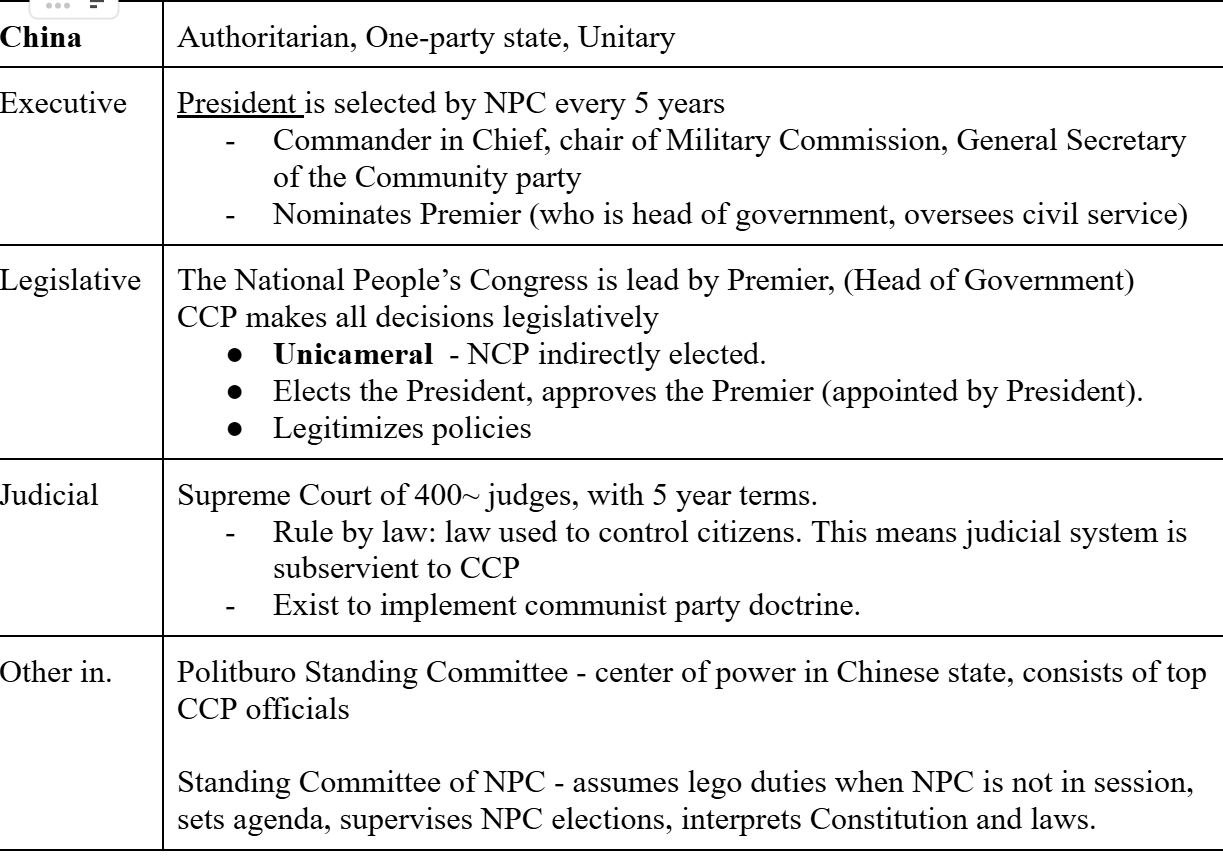
China categories and branches
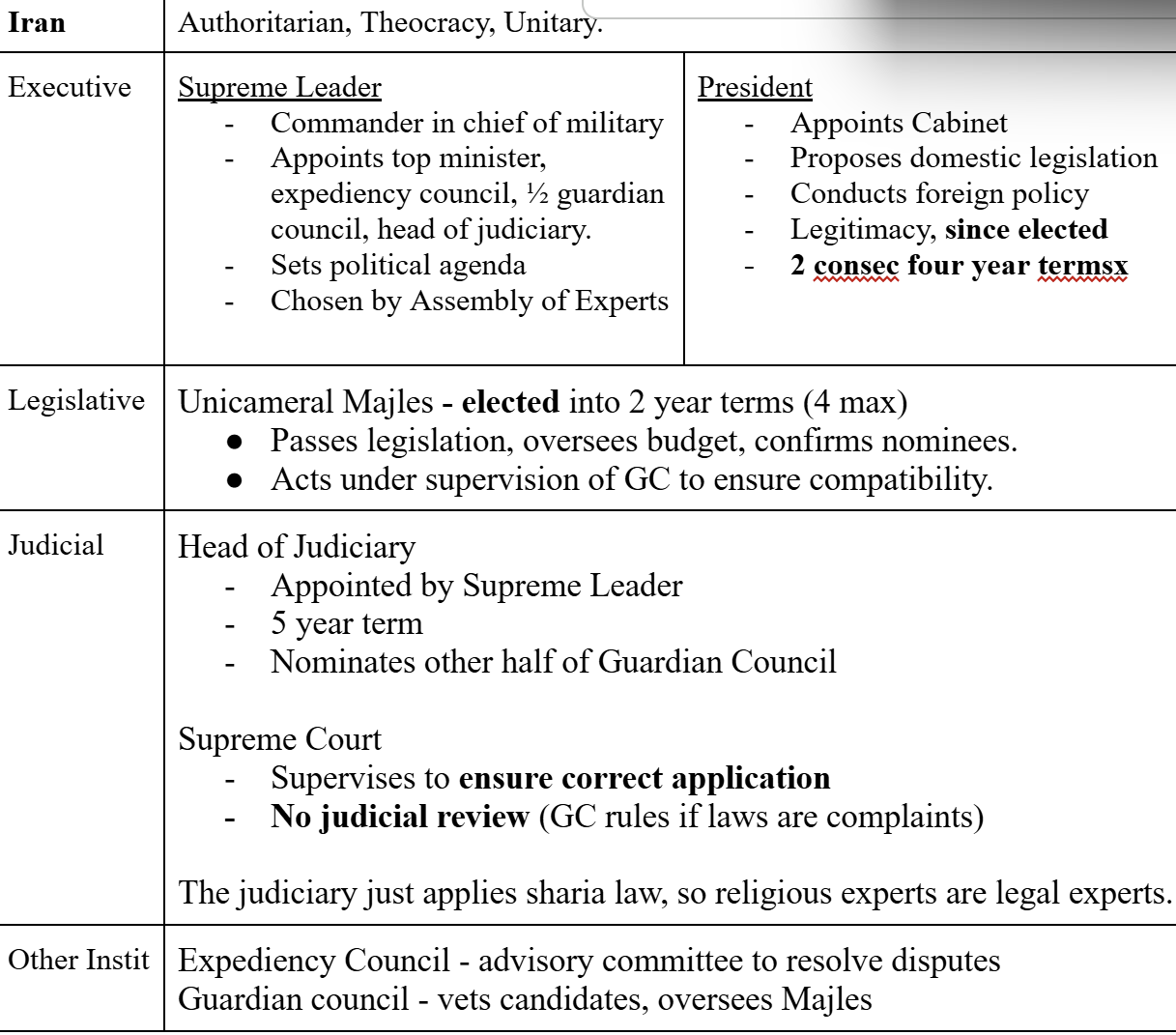
Iran
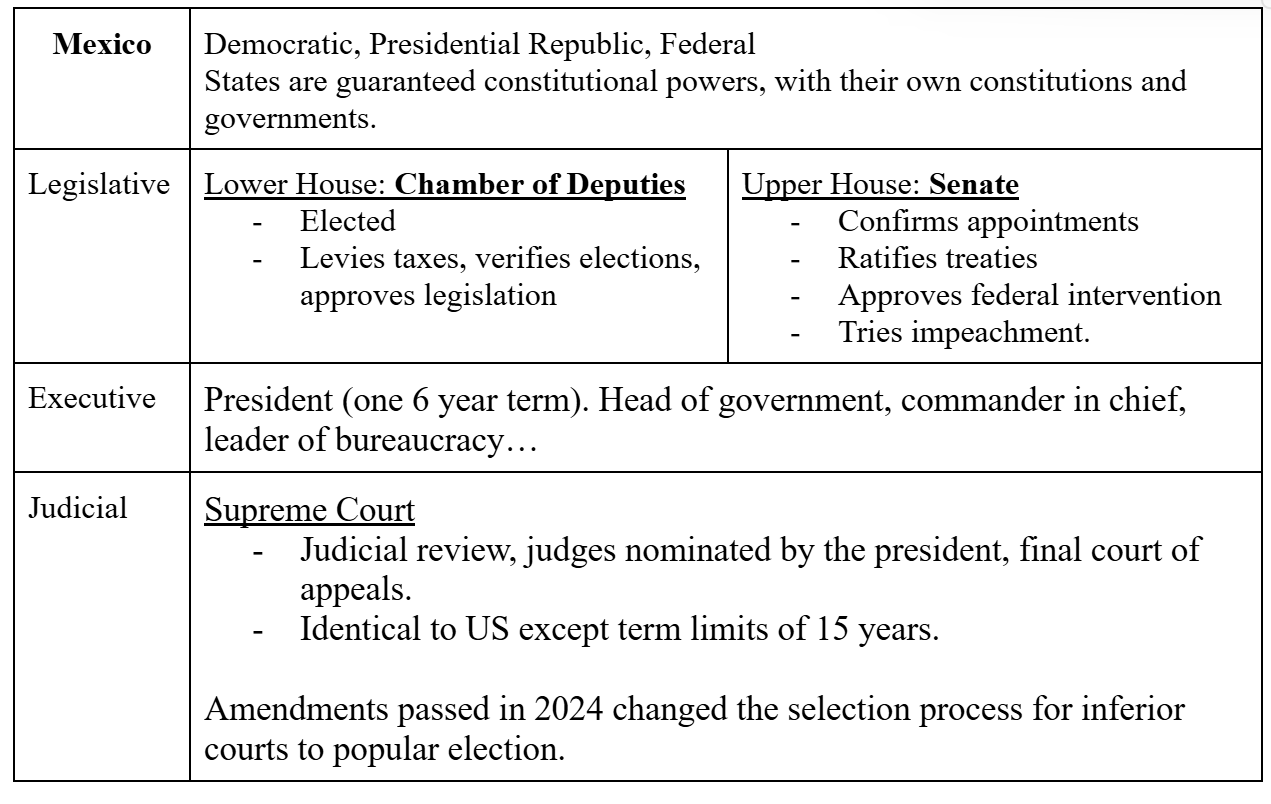
Mexico general structure
Nigera general structure

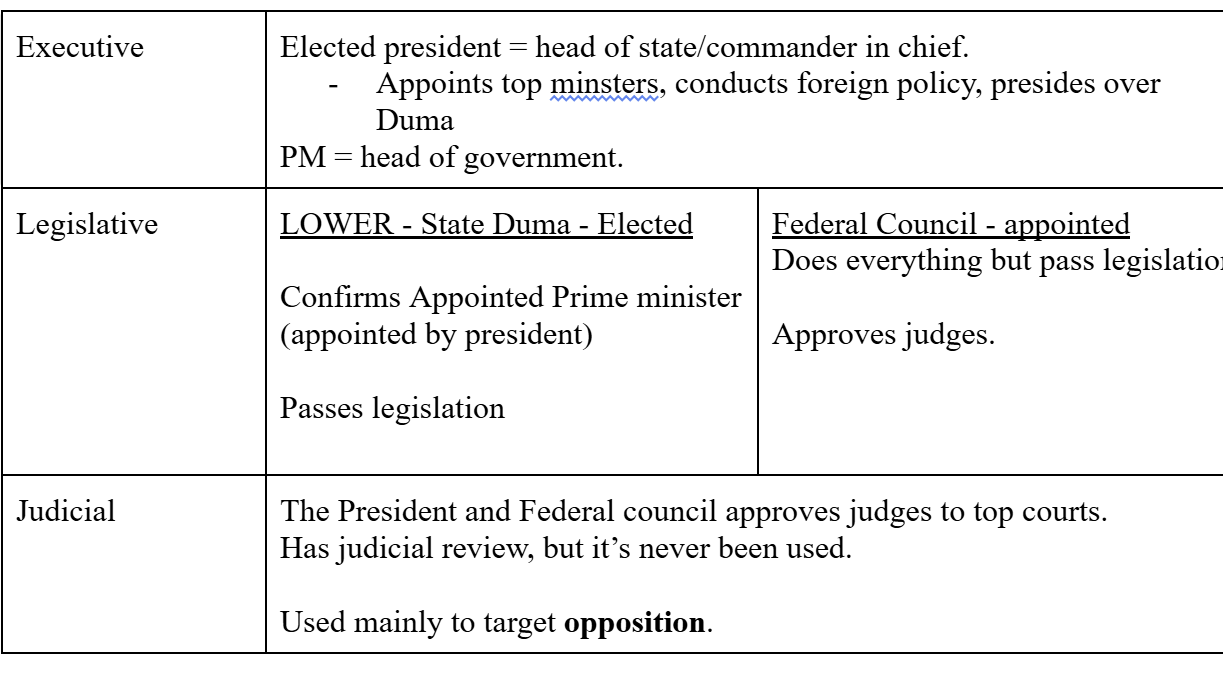
Russia general structure
Civil society and examples
comprises a range of voluntary associations that are INDEPENDENT from the state.
Local religious organizations, news media, NGOS (non governmental organizations.
NGOS are..
restricted by authori. rule because they are seem as agents of influence from foreign countries
political culture
are collective attiditudes and norms of behavior about the political system.
transmitted by political socializations
Political ideology
set of beliefs one already has about the goal of government (what is believed to be true in theory)
Individualism
belief in individual civil liberties and freedom over restrictions
Neoliberalism
believe in as little as possible civil liberties and freedoms over restrictions; supports privatization free trade, deregulation
Communism
belief in the removal of private property
Socialism
belief in the reduction of income disparties and nationalization of private indust.
fascism
extreme nationalist idealogy that favors rules and rights of ethnic majority over minorites
populism
political philosophy that supports the interest of common people over elites
Formal participation
formal process of selecting leaders, with voting, running for office, working for polling stations.
Informal participation
forms of political participation like discussion
Types of election/representation
Direct Democracy - people vote directly on law and policy.
First past the post - elections is where majority vote getter becomes political official (electoral college)
Proportional representation - one vote for party and party chooses legislators/officials
Limiting opposition political activity
Excluding opposition candidates using one party control:
Candidates in CHINA chosen by CCP
Russ: opposition candidates jailed on legal charges.
Iran GC: formal power to vet and exclude candidates.
Why do regimes tolerate media freedom? + media freedom good and bad examples
Encourage citizen control of agenda and check power/corruption
CCP use of Great firewall to limit political criticism
Iranian court suspens media licenses when jury finds owners guilty
Russia nationalization of broadcast media and has opposition on new segmnets (1990)
Cleavage
division in population that creates recognizably different groups examples include regional, ethnic, religious and more.
Cleavage examples
CHina cleave between urban/props and majority minorites.
Iran - Shia, a majority of clergy who dominate the regime, and religious minorities cleavages exist. Regional ethnic groups like Azeris, Kurds, and Arabs also pose a problem.
Mexico - division between the Amerindians, mestizos, and whites. This caused conflicts such as the Chiapas (Zapatistas) uprising. Also division between rich north and poor south.
an indigenous peasant rebellion that launched on the same day NAFTA took effect, protesting economic inequality and lack of indigenous rights.
Nigeria - Ethnic groups. The mainly christian south and muslim north disagree.
Russia - cleavage between ethnic Russians and minority
UK - cleavage between ethnic majority amd minority as well as cleavages between nations that make it up
Nigeria ethnic cleavage
Ethnic groups. The mainly christian south and muslim north disagree.
Zapatistas/Chiapas uprising
an indigenous peasant rebellion that launched on the same day NAFTA took effect, protesting economic inequality and lack of indigenous rights.
China Executive Selection
Selected by NPC every 5 years. Head of government is appointed by president.
Iran executive selection
Appointed for life by Assembly of experts (88-member deliberative body of Islamic jurists elected by public vote for eight-year terms)
President is elected. 2 round system: if no majority winnter in first round, top 2 have second run off. elected president
Mexico and Nigera
both elected, both plurality of national vote, with requirement to win 25 percent of 2/3 states in Nigera.
Russia executive
2 round system: if no majority winnter in first round, top 2 have second run off. elected president
prime minister appointed by president and confirmed by Duma
UK exe
Monarch - in herited. PM appointed by monarch based on HoC winning party.
2 round system
Iran and Russia. 2 round system: if no majority winnter in first round, top 2 have second run off. elected president
China Legi # and selection
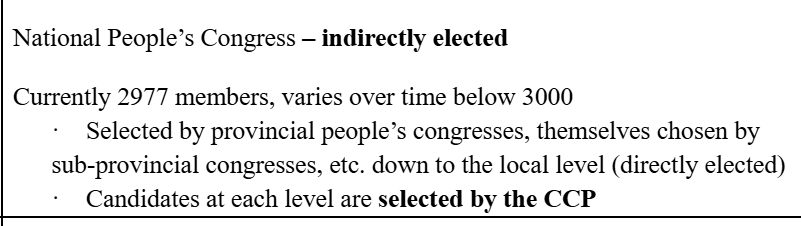
Iran legi selection
Majles; 285 elected in single member districts, 5 minorites
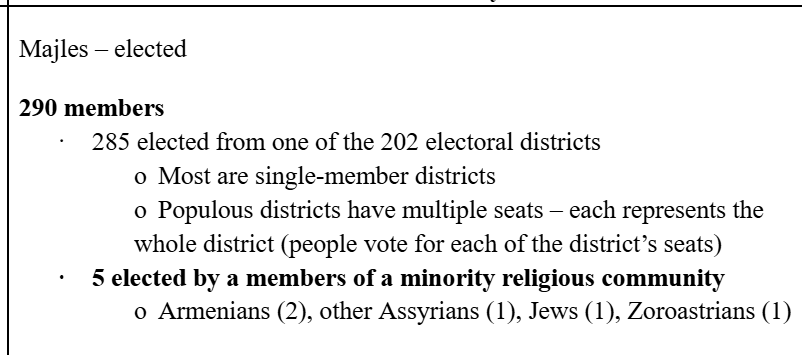
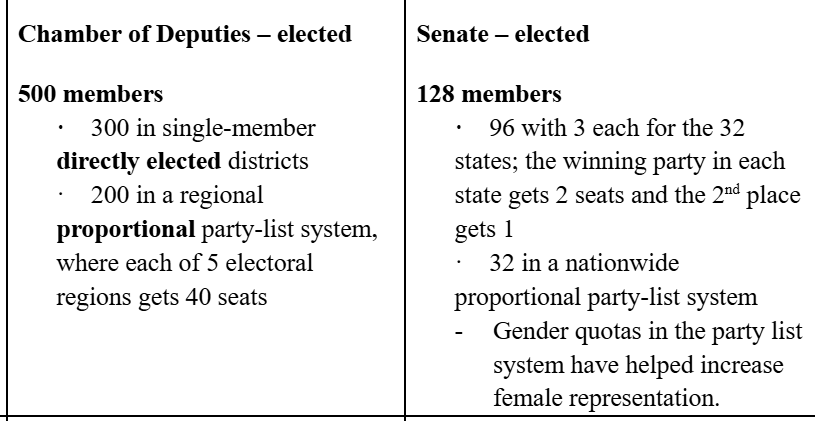
Mexico
Nigeria
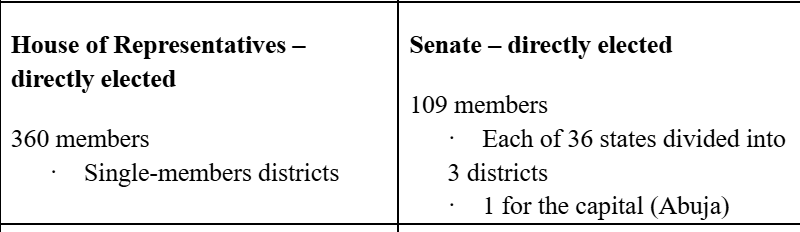
Russia
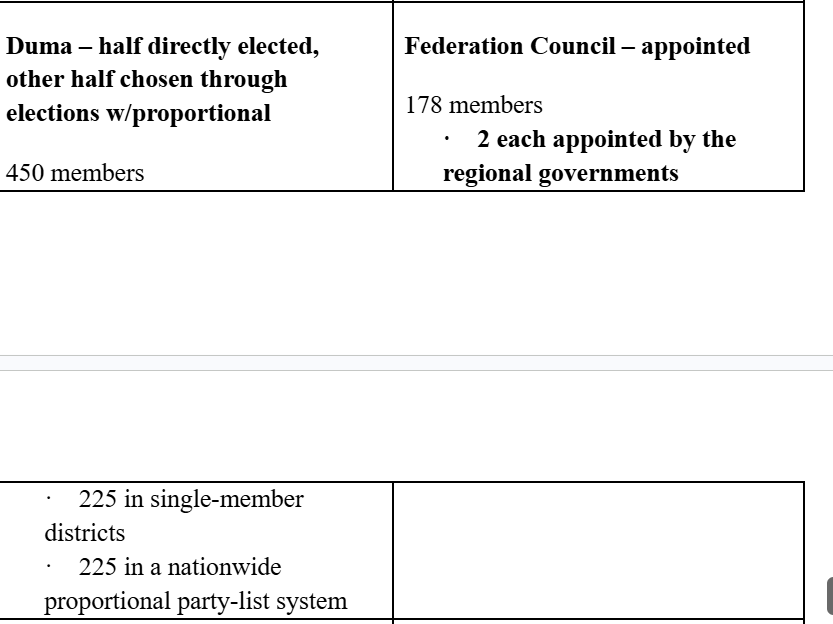
UK
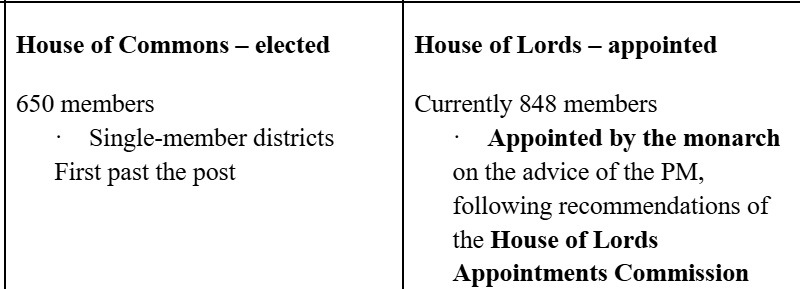
Party List/Proportional representation and countries that use it
where voters choose a party on ballot, then seats in legislative are allocated by the party
Used by Russia and Mexico
Increases minority representation but leads to coalitions
Single member districts (plurality)
divide the country into districts where each district sends a representative to the legislature.
Leads to 2 party systems
review the special election for executives again!
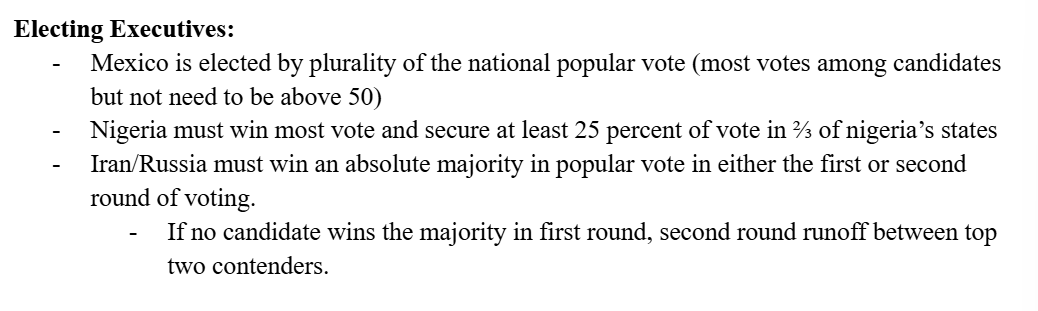
electino commitees/commissions
Mexico/Nigera commits have created election commissions to reduce voter fraud.
Iran Guardian council excludes reformers from ballots
party systems
china has rules allowing only one party
"Great Firewall" blocks foreign platforms (Google, Twitter, YouTube) and suppresses domestic content critical of the CCP
Russia has rules ensuring one party dominance, such as
Increasing party registration requirements, allowing only legally registered parties to run, using court decisions to disqualify candidates.
Mexico transitioning away, removing el dedazo (picking successor)
Interest Gropu Systems
Pluralist Interest Systems
Multiple groups may represent a single society interest.
Group membership is voluntary and limited
Loose and decentralized, clear separation between interest group and government
Democratic corporatist Interest Group Systems
Centrally organized and direct actions of other members
Membership is compulsory and nearly universal
Systematically involved in making/implementing policy
Corporatism system where the state organizes/controls interest groups.
Mexico dom party (PRI) organized society into three sectors, where PRI exchanged policy positions/patronage as long as interest groups were loyal.
define Social movements and name its difference from Interest groups
Social movements advocate for broad social change, interest groups try to influence gov policy. More broad, more loosely organized
Large groups of people pushing collectively for social change.
Social movement examples
Iranian Green Movement protesting election corruption in 2009
Zapatistas movement was a response to socioeconomic inequality and the negative impact of NAFTA (north american free trade agreement)
Nigeria MEND and MOSOP, emerged to advocate for the rights of an ethnic minority and protest against oil extraction.
Boko Haram trying to establish islamic state in North Nigeria
Domestic protests over Duma homophobic passage in Russia
pro-natalism
Government policy encouraging more births
austerity
government economic policies aimed at reducing public debt by cutting public spending, lowering welfare benefits, or raising taxes
Economic Globalization
the growing integration and interdependence of national economies through increased trade, foreign investment, and capital flows
Multinational Corporations (MNC)
are large companies based in one country that operate and have subsidiaries in multiple countries (Shell, Nestle)
pose chalenges to economic policies regarding labor, independence, corrptuion.
Economic Liberalization
policies that reduce state control over the economy, promoting free-market principles, privatization, deregulation, and reduced trade barriers
International Organizations
lend money to states and their businesses, operating between them
voluntary associations of sovereign states that cooperate on shared interests.
join treaties and agreements by choice, comply with decisions they consent to, and can withdraw without ceding any authority.
Ex: IMF (help countries iwth debt), World Bank, World Trade, Nafta.
Supranational organizations
bodies in which states ceded some soverieng authority to a higher authority. binded to rules even if they disagree. operate in between nations
ex: EU, (common currency)
ECOWAS - agreement for integration of states in West Africa. Promoted by Nigera to increase regional influence.
CIS - maintains Russia influence in region
rentier state
state that possess/extract large amounts of natural resources and greats revenue from them
Nigeria controls oil resources through NNPC which partners with foreign oil companies to gain revenue.
Iran and Russia have large reserves for oil, having state controlled companies that extract and sell. Russia explores and builds pipelines to sell.
ad and dis of economic globalization/reniter state
Ad: gov can pay for government programs due to rich revenue and lower taxes.
Disadvantage: Resourse Curse: Undiversiifed economy, major corruption, pollution, lack of accountability.
Nationalization of resources
means state owns the resources. reduces power of foreign governments, reducing wealth inequality
Economy Nationalization Examples
Russia in 1990 privated hydrocarbon industry. People who bought these shares became absurdly wealthy (oligarchs) sold assets for profits and entered the political sphere.
Putin curbed the power by re-nationalizing companies. in the 2000s.
Nigeria/Mexico have a mix of private and state control of oil. Deal with inequality from private ownership and corruption.
UK migration/democracy change
Positive net migration of immigration.
China migration patterns
Migration from rural to urban areas (west to east)
Special economic zones increase coastal migration
hukuo
Chinese system restricts where citizens can live.
Registered as rural and urban, which determines access to social services.
Mexico migration patterns
migration from rural to urban areas (south to north) due to Maquiladora zones: manufacturing plants with parent company in US. Hihg source of FDI
Nigeria North vs South Divide
North:
primarily Muslim. Rural, less urbanized, lower GDP, more poverty
South
Adopted Sharia/Islamic law as legal system
Boko haram: islamist insurgency in Nigeria where western education is forbidden, no women’s rights, etc.
South
primarily Christian. Divided between two major ethnic groups. Allows more rights for women