physics final
0.0(0)
Studied by 6 people Call Kai
 Learn
Learn Practice Test
 Spaced Repetition
 Match
Match Flashcards
 Knowt Play
Card Sorting
1/61

Last updated 12:06 AM on 12/15/22
Name | Mastery | Learn | Test | Matching | Spaced | Call with Kai | Chat |
|---|
No analytics yet
Send a link to your students to track their progress
62 Terms
1
New cards
physics
\
is a branch of science that involves the study of the physical world: energy, matter, and how they are related.
is a branch of science that involves the study of the physical world: energy, matter, and how they are related.
2
New cards
dimensional analysis
treating the units as algebraic quantities
3
New cards
**significant digits**
The valid digits in a measurement
4
New cards
hypothesis
is an educated guess about how variables are related.
5
New cards
scientific method
make observations, do experiments, and create models or theories to try to explain your results or predict new answers.
6
New cards
**scientific law**
a rule of nature that sums up related observations to describe a pattern in nature.
7
New cards
s**cientific theory**
is an explanation based on many observations sup- ported by experimental results.
8
New cards
**measurement**
is a comparison between an unknown quantity and a standard.
9
New cards
**precision**
degree of exactness of a measurement
10
New cards
**Accuracy**
describes how well the results of a measurement agree with the “real” value
11
New cards
**independent variable**
is the factor that is changed or manipu- lated during the experiment.
12
New cards
**dependent variable**
is the factor that depends on the independent variable.
13
New cards
**line of best fit**
The line in blue, drawn as close to all the data points as possible,
14
New cards
**linear relationship**
between the two variables.
15
New cards
**Linear Relationship Between Two Variables**
*y* = *mx* +*b*
16
New cards
**Slope**
*slope*

17
New cards
**Quadratic Relationship Between Two Variables**
when one variable depends on the square of another.

18
New cards
**Inverse Relationship**
A hyperbola results when one variable depends on the inverse of the other.

19
New cards
**motion diagram**
A series of images showing the positions of a moving object at equal time intervals
20
New cards
**particle model**
is a simplified version of a motion diagram in which the object in motion is replaced by a series of single points
21
New cards
**origin**
is the point at which both variables have the value zero.
22
New cards
coordinate system
location of the zero point of the variable you are studying and the direc- tion in which the values of the variable increase.
23
New cards
**position**
he separation between an object and the origin.
24
New cards
**distance**
The length of the arrow indicates how far the object is from the origin
25
New cards
**magnitude**
Quantities that have both size,
26
New cards
vectors
direction
27
New cards
**scalars**
Quantities that are just numbers without any direction, such as distance, time, or temperature
28
New cards
**Time Interval** \n
The difference between two times

29
New cards
**displacement**
is equal to the final position minus the initial position.

30
New cards
**position-time graph**
a horizontal axis and the position data on a vertical axis
31
New cards
**instantaneous position**
the position at a particular instant.
32
New cards
**average velocity**
defined as the change in position, divided by the time during which the change occurred.

33
New cards
**average speed**
how fast the object is moving
34
New cards
**instantaneous**
The speed and direction of an object at a particular instant
35
New cards
**acceleration**
the rate at which an object’s velocity changes
36
New cards
Average Acceleration
is the change of an object in velocity during some measurable time interval divided by that time interval.

37
New cards
**instantaneous acceleration.**
The change in velocity at an instant of time is called The instantaneous acceleration of an
38
New cards
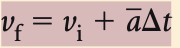
**FinalVelocitywithAverage**
**Acceleration**
**Acceleration**
The final velocity is equal to the initial velocity plus the product of the average acceleration and time interval.
39
New cards
**Position with Average Acceleration**
An object’s position at a time after the initial time is equal to the sum of its initial position, the product of the initial velocity and the time, and half the product of the acceleration and the square of the time.

40
New cards
**Velocity with Constant Acceleration**
The square of the final velocity equals the sum of the square of the initial velocity and twice the product of the acceleration and the displacement since the initial time.

41
New cards
**free fall**
which is the motion of a body when air resistance is negligible and the action can be considered due to gravity alone.
42
New cards
**acceleration due to gravity**
is the acceleration of an object in free fall that results from the influence of Earth’s gravity.
43
New cards
**force**
is a push or pull exerted on an object.
44
New cards
**free-body diagram.**
physical model, which represents the forces acting on a system
45
New cards
**net force**
the vector sum of all the forces on an object
46
New cards
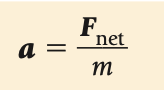
**Newton’s second law**
the observation that the acceleration of an object is proportional to the net force and inversely proportional to the mass of the object being accelerated
47
New cards
**Newton’s first law.**
his statement, “an object that is at rest will remain at rest, and an object that is moving will continue to move in a straight line with constant speed, if and only if the net force acting on that object is zero,”
48
New cards
**Inertia**
the tendency of an object to resist change.
49
New cards
**equilibrium**
the net force on an object is zero, then the object
50
New cards
**apparent weight**
is the force an object experiences as a result of all the forces acting on it, giving the object an acceleration.
51
New cards
**weightlessness**
means that there are no contact forces pushing up on the object, and the object’s apparent weight is zero.
52
New cards
**drag force**
is the force exerted by a fluid on the object moving through the fluid.
53
New cards
**terminal velocity**
The constant velocity that is reached when the drag force equals the force of gravity
54
New cards
**interaction pair**
is two forces that are in opposite directions and have equal magnitude.
55
New cards
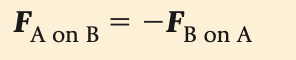
**Newton’s third law**
which states that all forces come in pairs.
56
New cards
tension
name for the force exerted by a string or rope
57
New cards
**normal force**
is the perpendicular contact force exerted by a surface on another object.
58
New cards
**components**
which are a vector parallel to the *x*-axis and another parallel to the *y*-axis.
59
New cards
**vector resolution**
breaking a vector into its components is sometimes
60
New cards
**kinetic friction**
it is exerted on one surface by another when the two surfaces rub against each other because one or both of them are moving.
61
New cards
**static friction**
which is the force exerted on one surface by another when there is no motion between the two surfaces.
62
New cards
**coefficient of static friction**
is the maximum static friction force that must be overcome before motion can begin.