4. Saccades - Eye Movements & Binocular Vision Summer 2026
 Call Kai
 Learn
Learn Practice Test
 Spaced Repetition
 Match
Match Flashcards
 Knowt Play
1/108

There's no tags or description
Looks like no tags are added yet.
Name | Mastery | Learn | Test | Matching | Spaced | Call with Kai |
|---|
No analytics yet
Send a link to your students to track their progress
109 Terms
What are the types of direction that specify saccadic movement?
1) ocular or eye direction (α)
2) oculocentric or relative direction (β)
3) egocentric or absolute direction (χ)
Sign Convention for Saccades
Right is (+/-)
+
Sign Convention for Saccades
Left is (+/-)
-
Sign Convention for Saccades
Up is (+/-)
+
Sign Convention for Saccades
Down is (+/-)
-
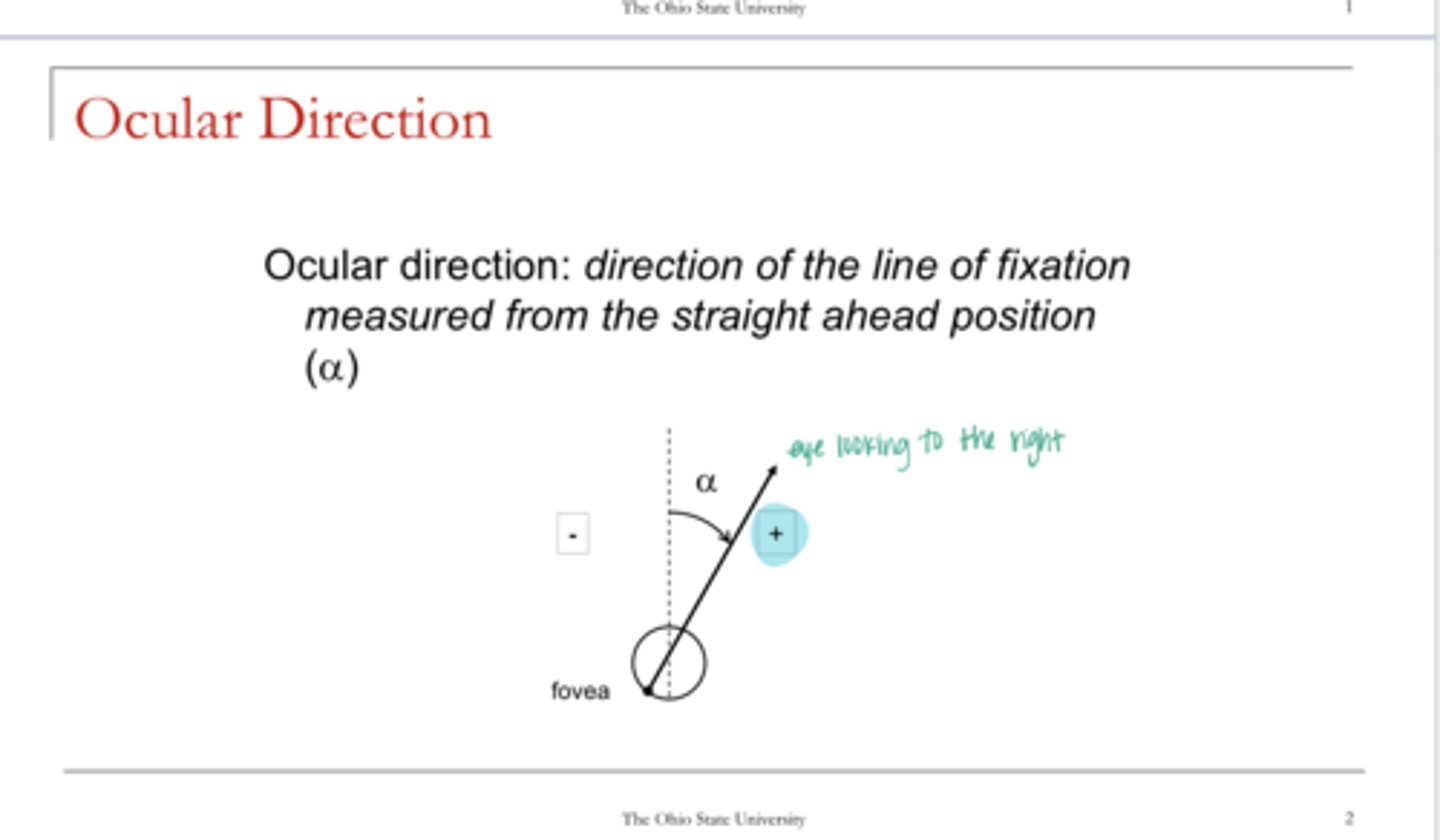
What is the ocular direction?
direction of the line of fixation measured from the straight ahead position (α)
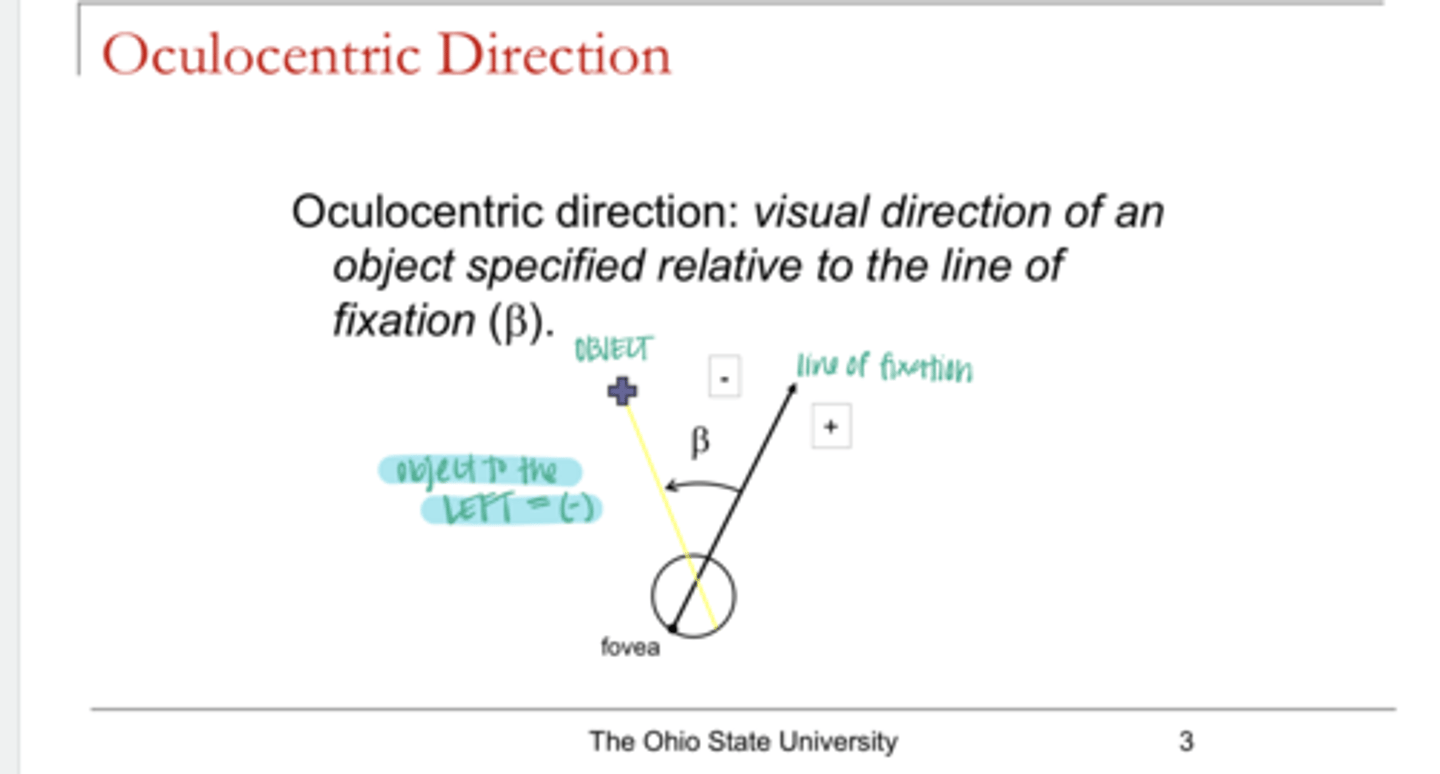
What is the oculocentric direction?
visual direction of an object specified relative to the line of fixation (β)
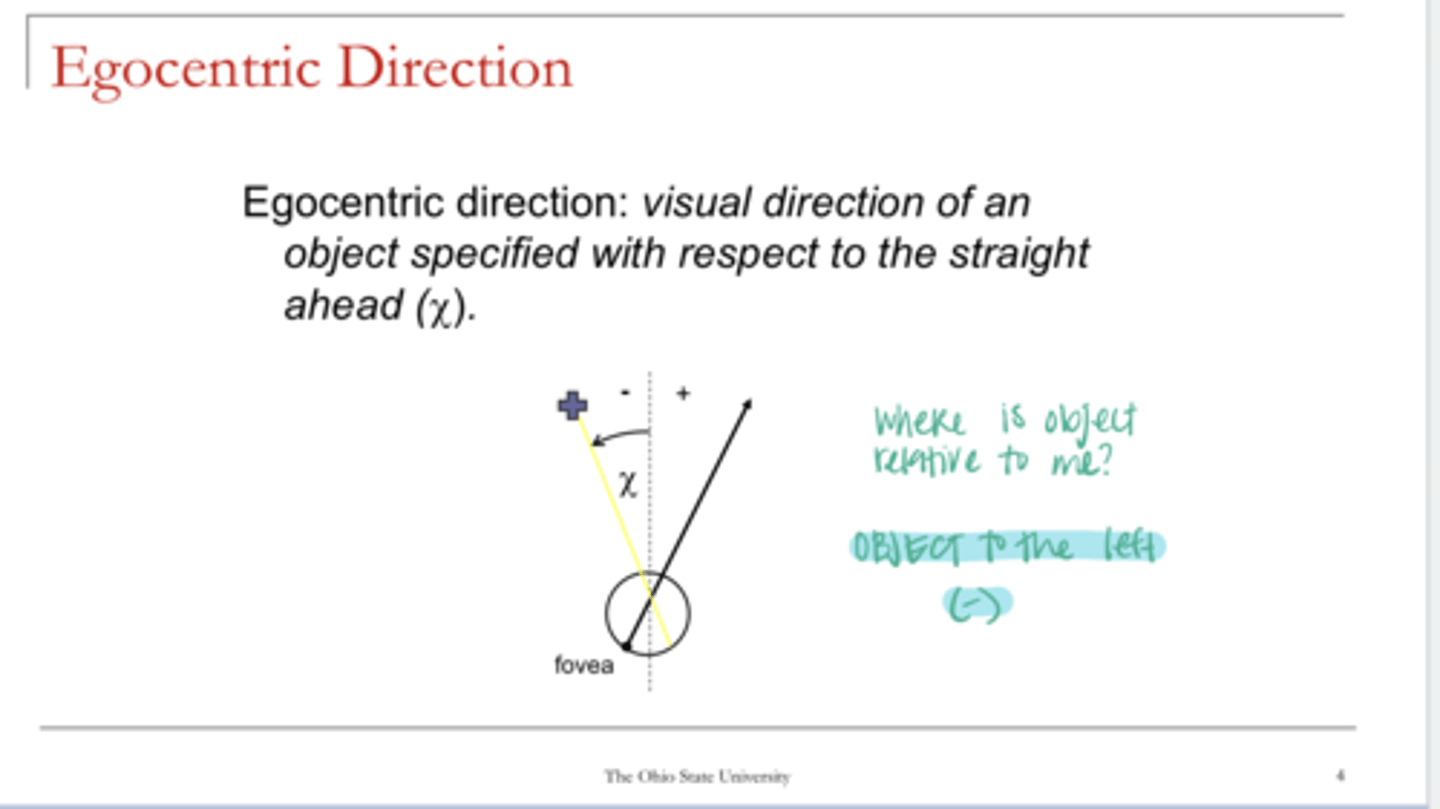
What is the egocentric direction?
visual direction of an object specified with respect to the straight ahead (χ)
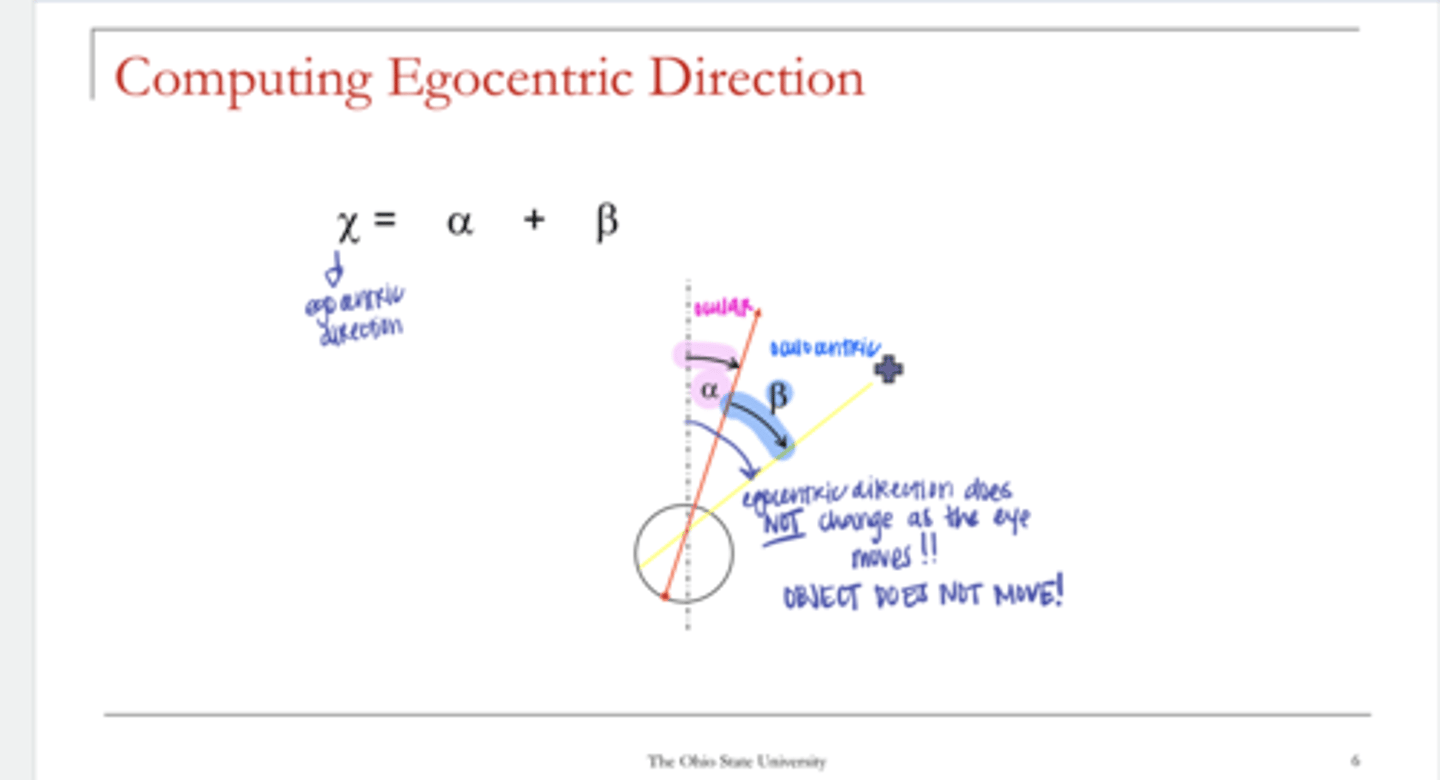
You can compute the Egocentric Direction with what equation?
χ = α + β
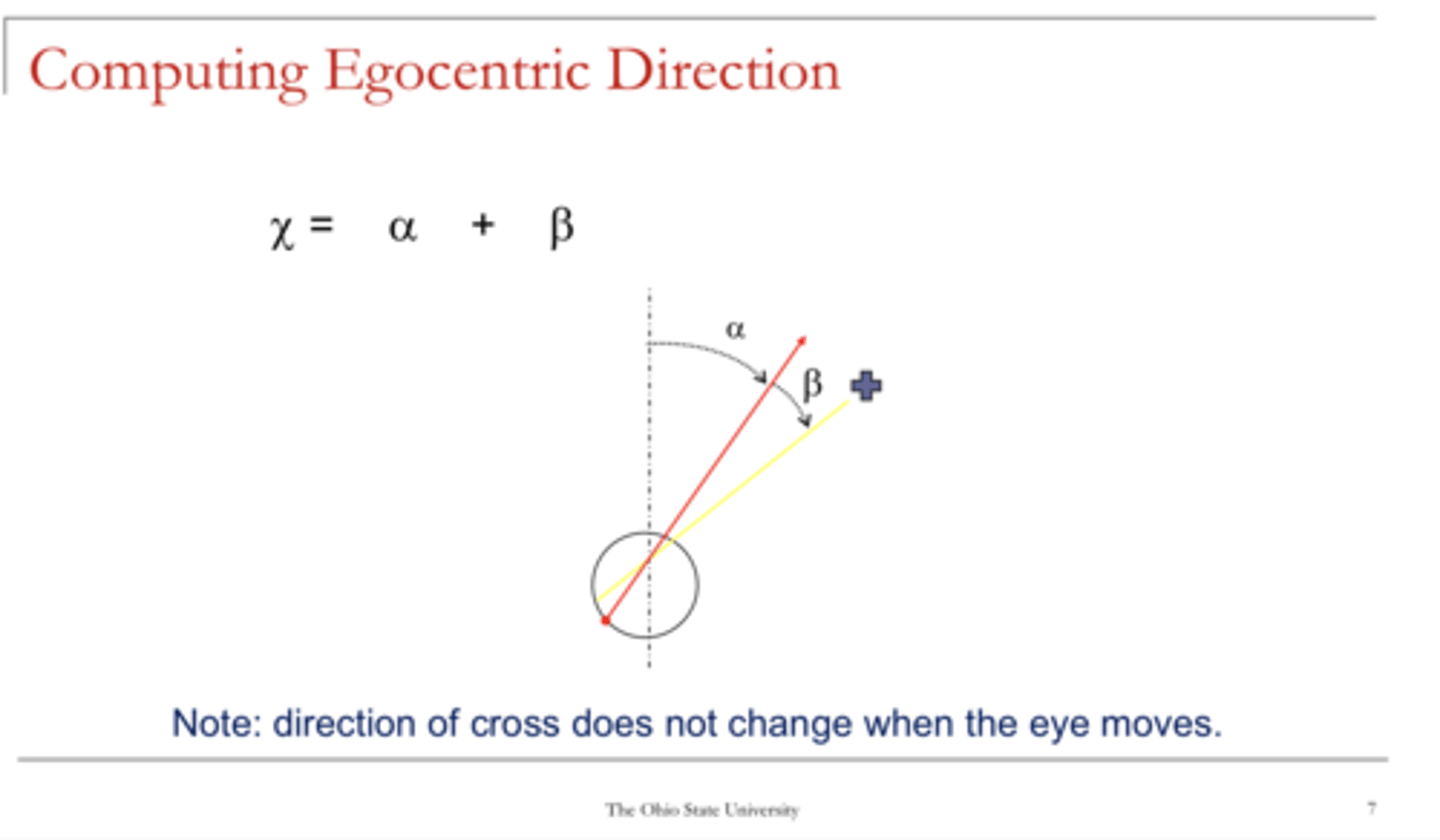
Does the egocentric location change as the eye moves?
No -- the object DOES NOT move with eye movement
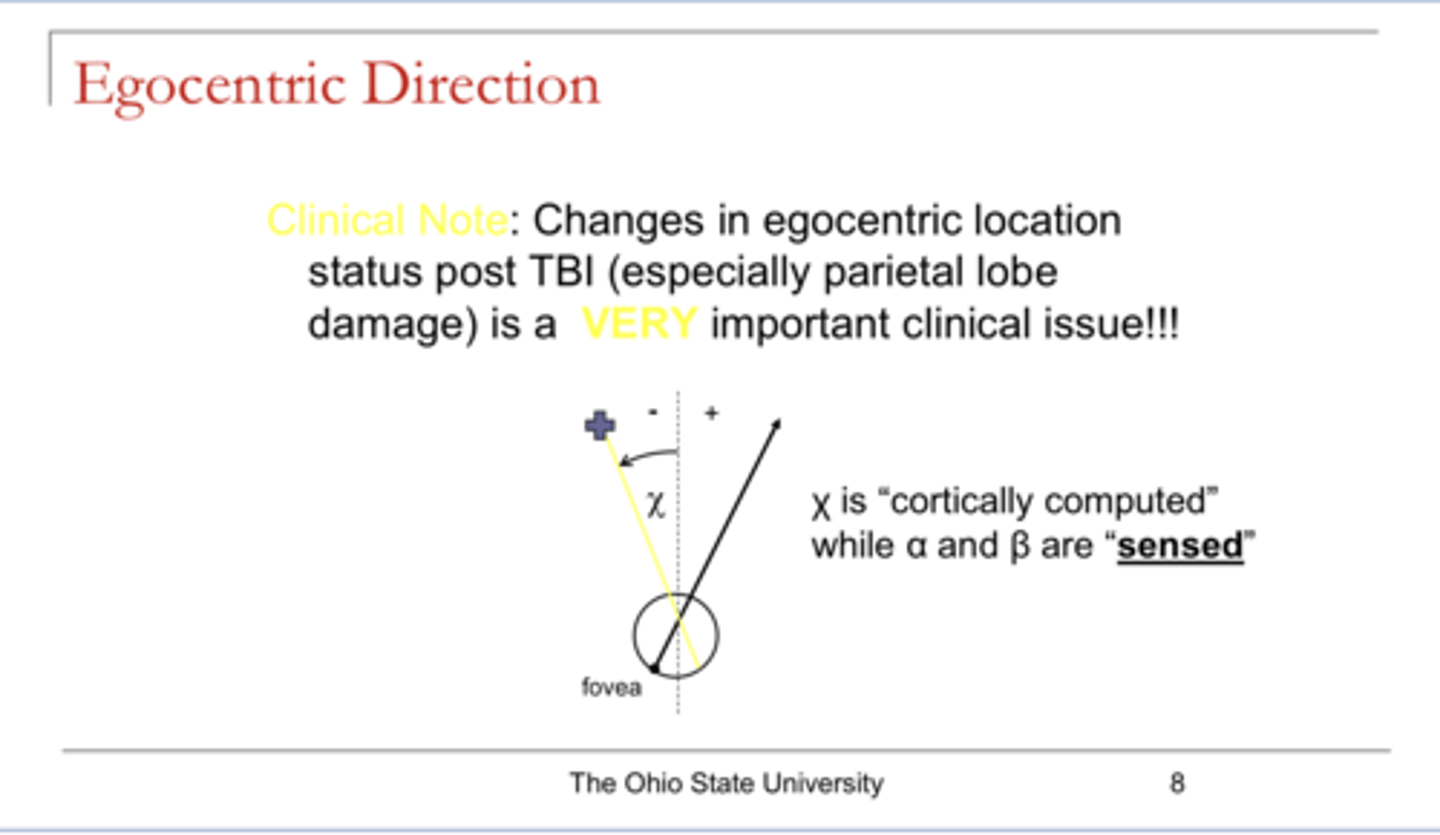
Changes in egocentric location status post ______ is a very important clinical issue
TBI (esp with parietal lobe damage)
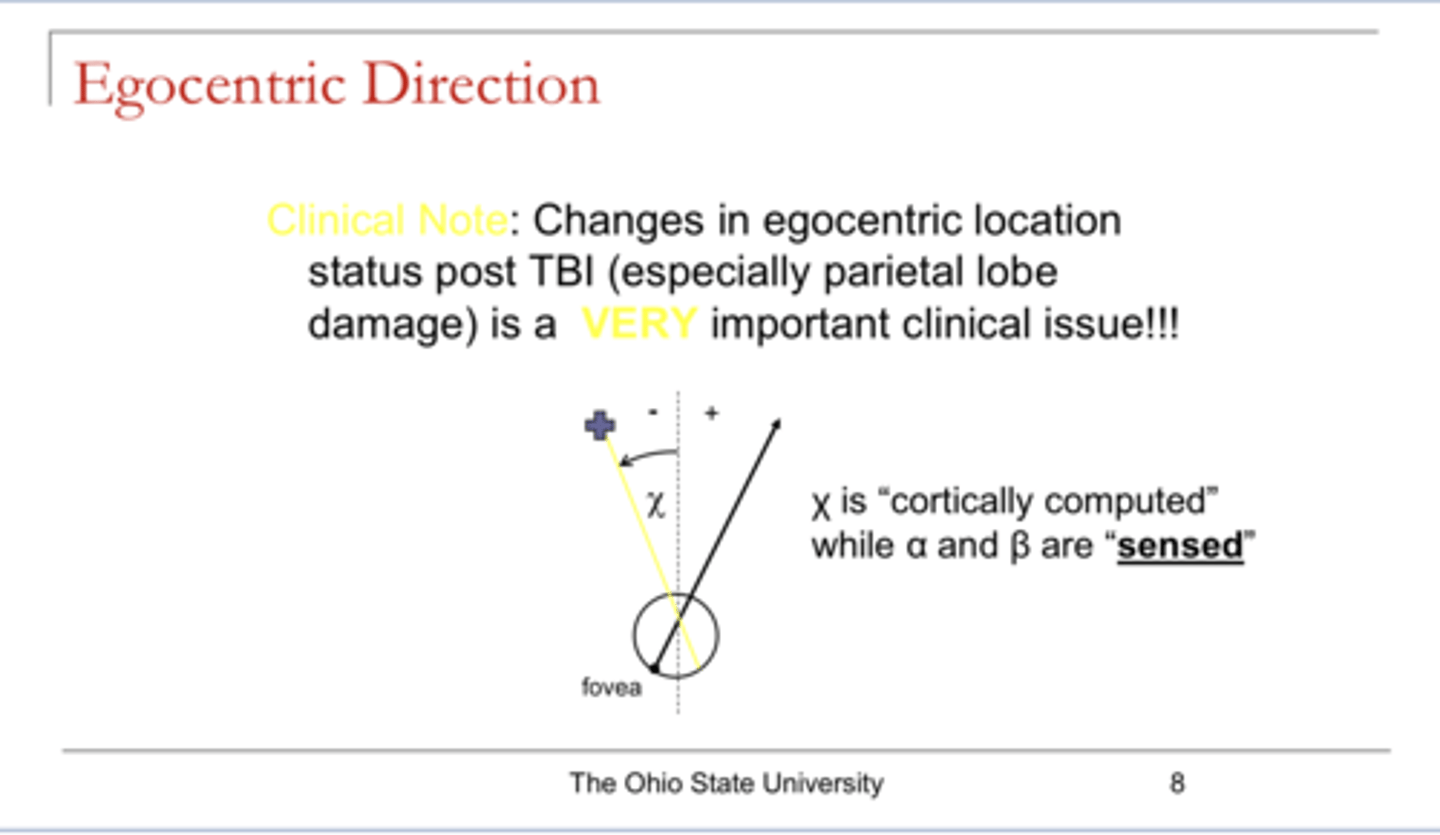
Egocentric location is _______ computed
cortically
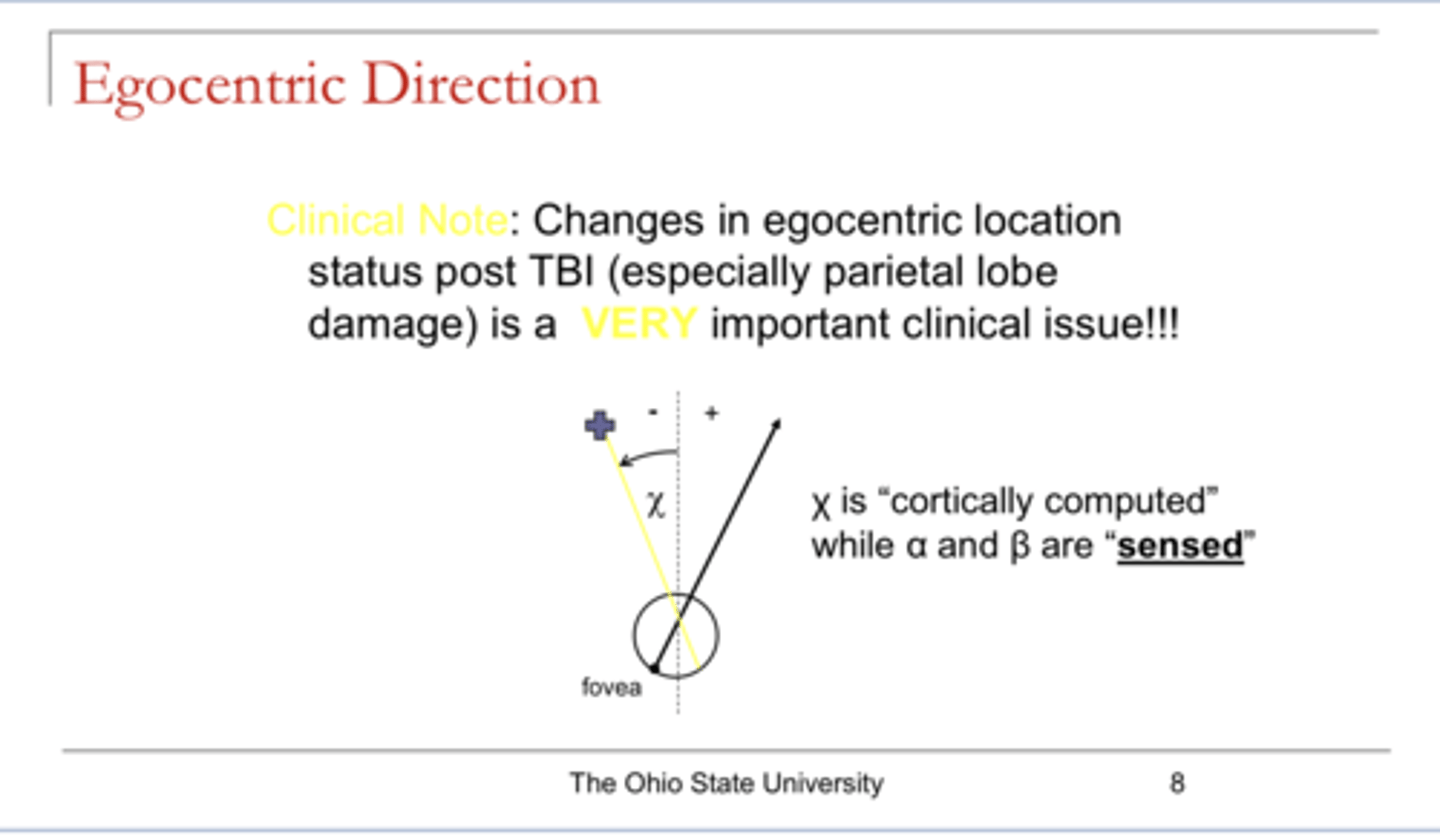
Ocular direction and Oculocentric location are ______
sensed
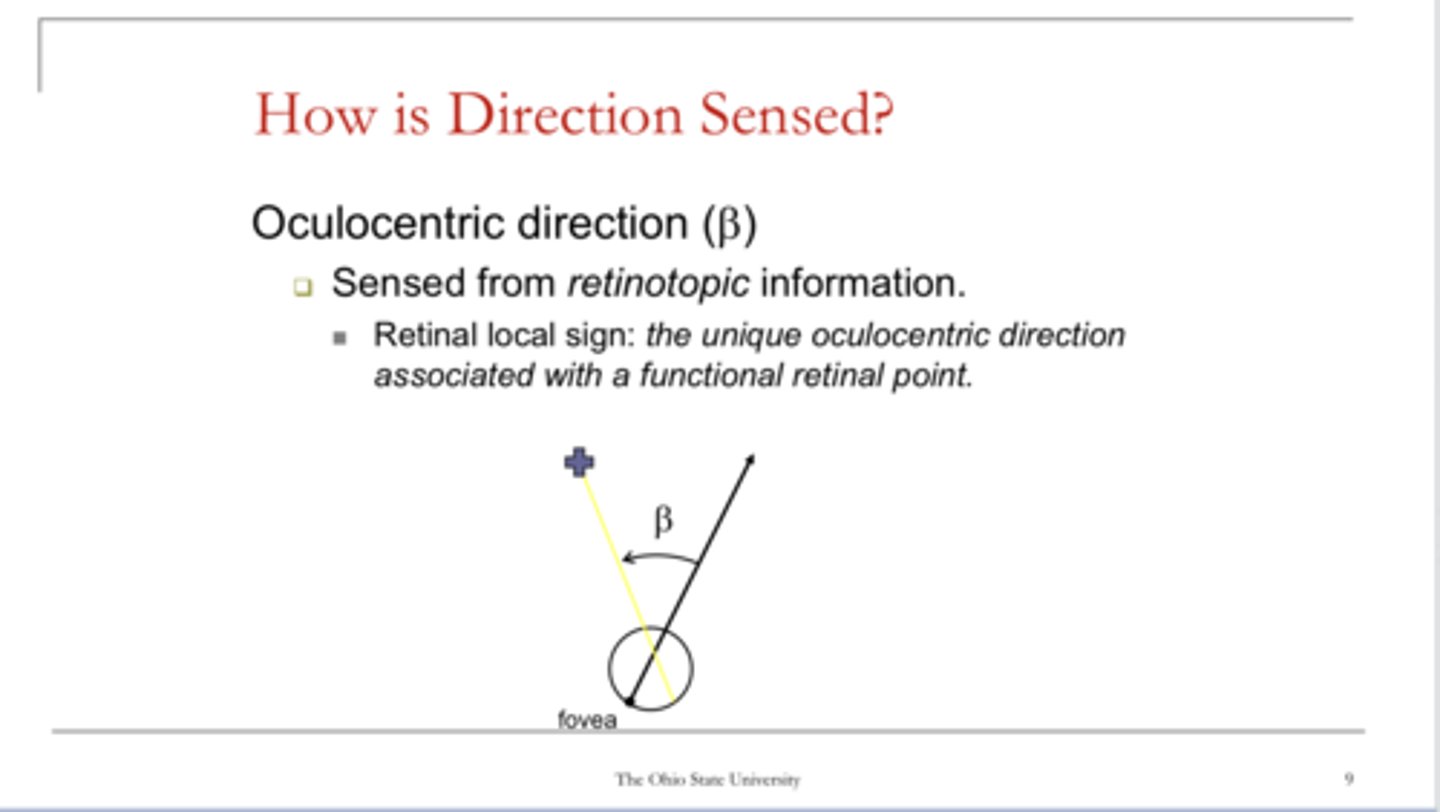
Oculocentric direction is sensed from ______ information
retinotopic
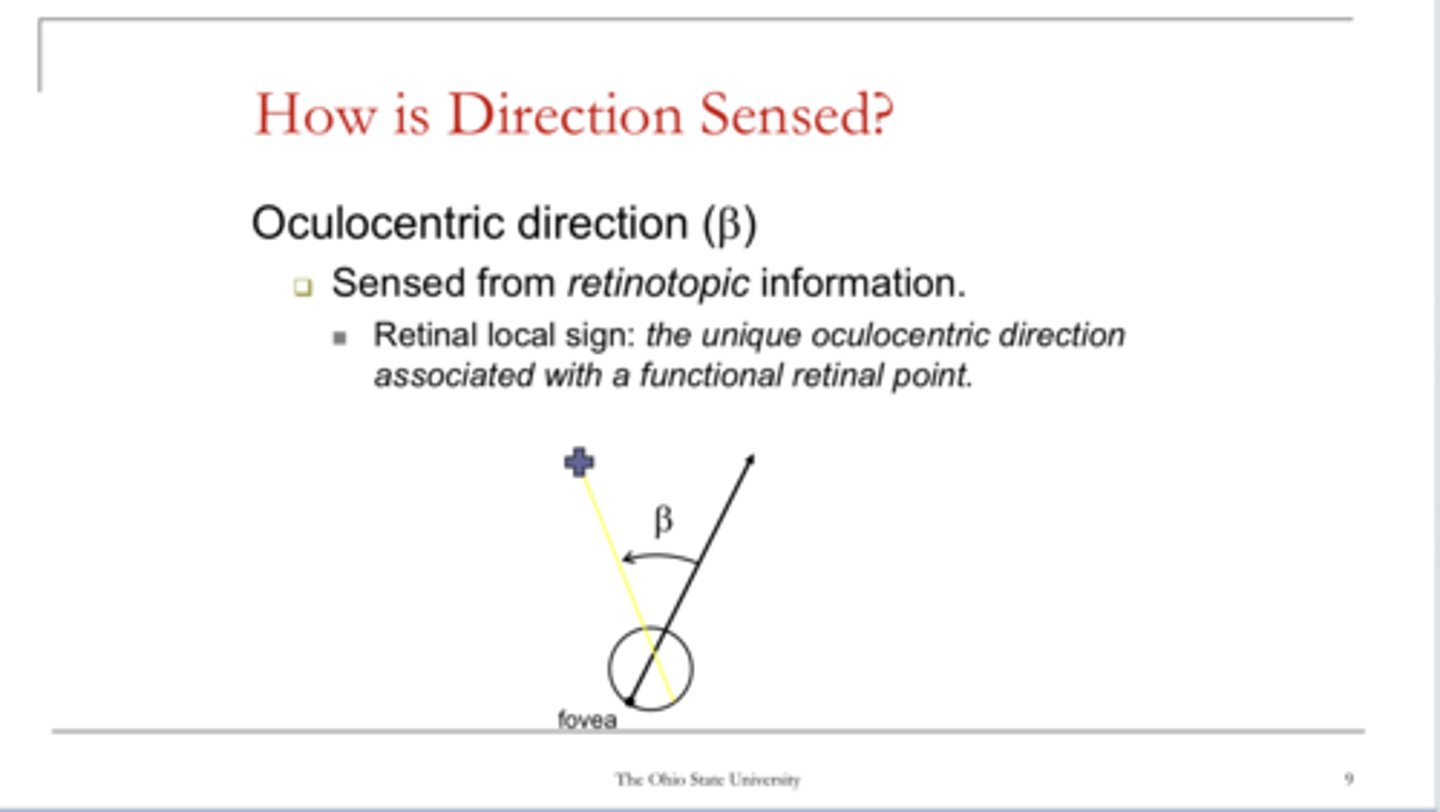
What is a retinal local sign?
the unique oculocentric direction associated with a functional retinal point
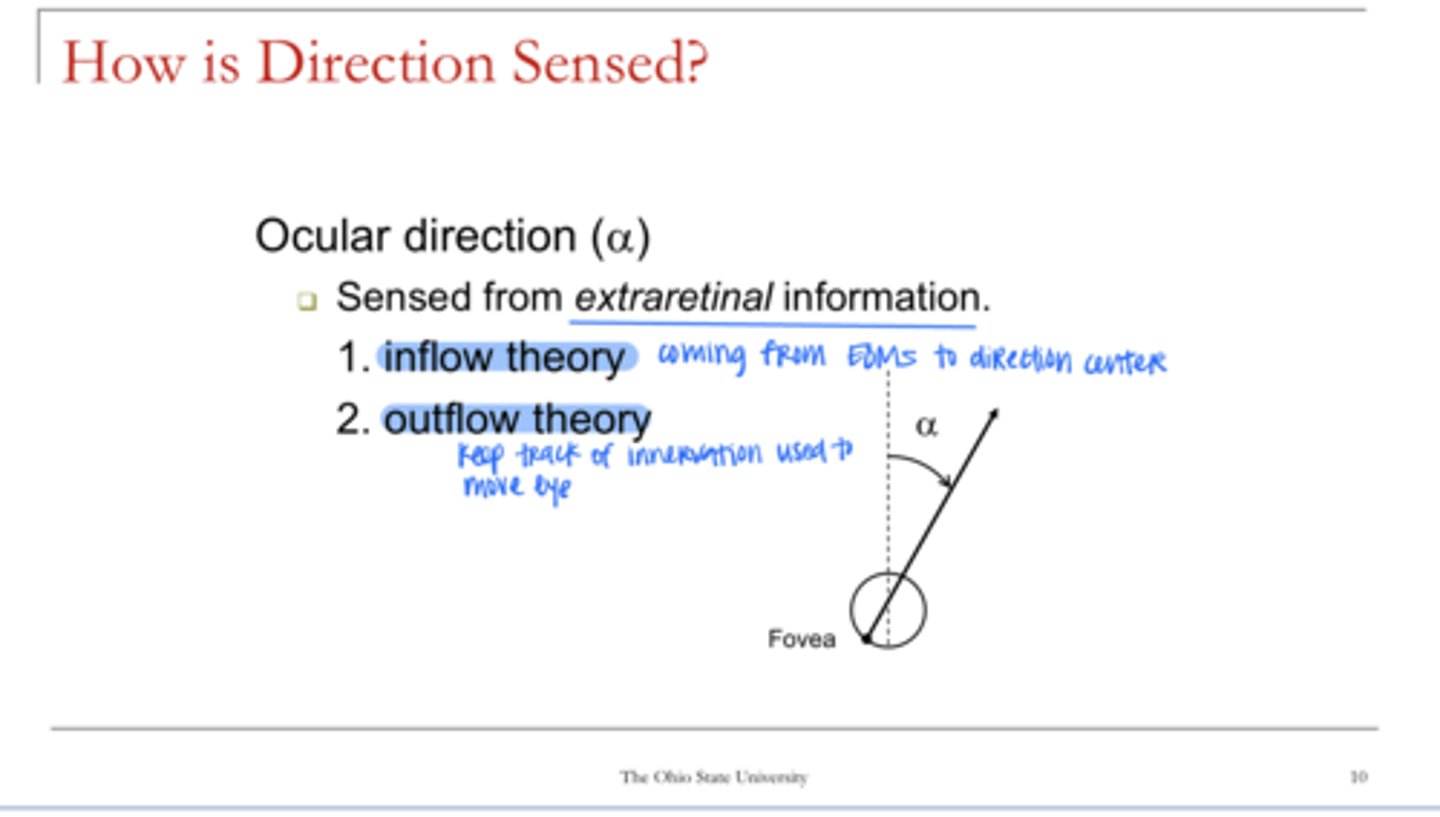
Ocular direction is sensed from ______ information
extraretinal
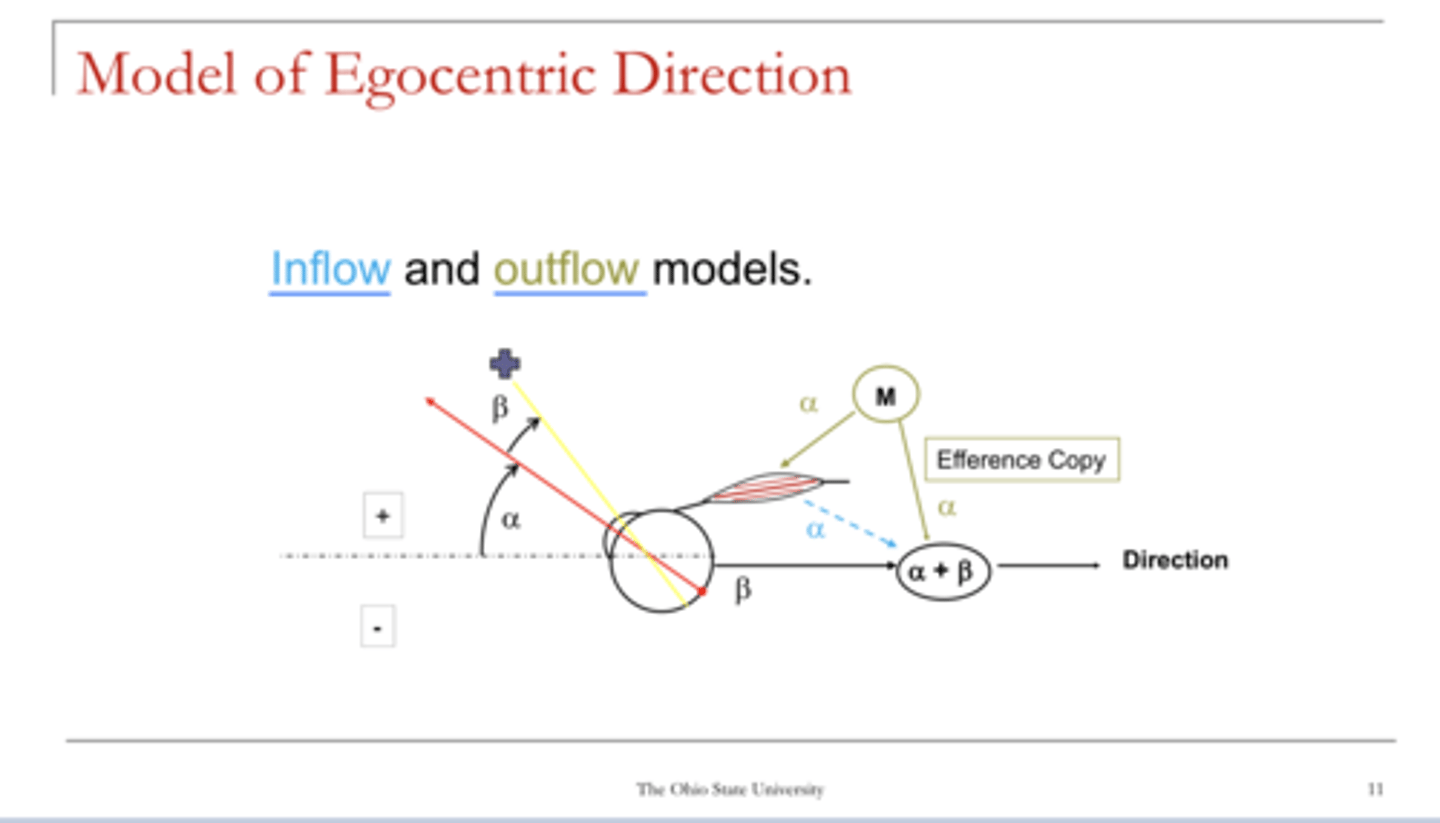
What are the 2 theories of how ocular direction is sensed?
1) inflow theory
2) outflow theory
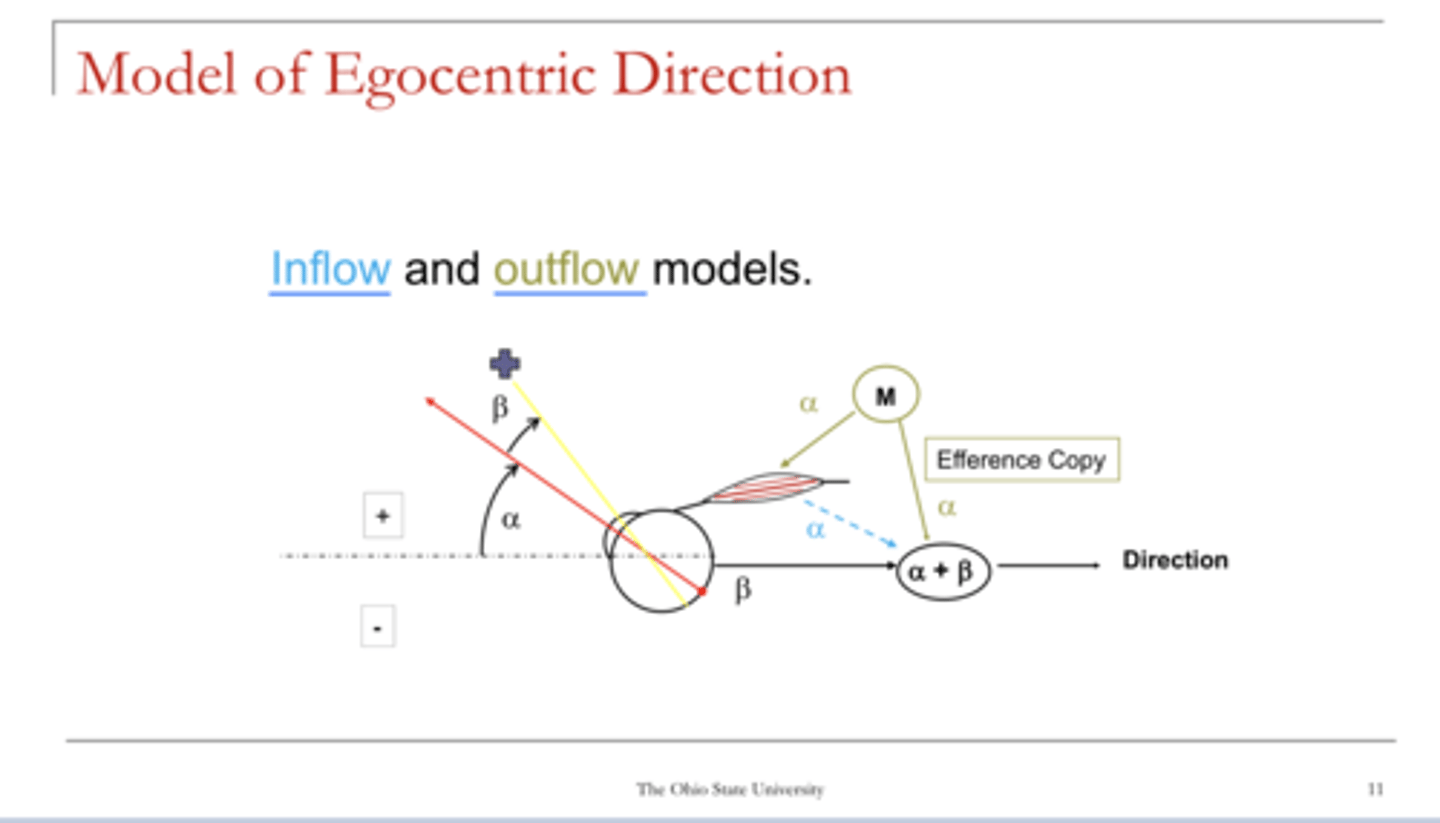
Inflow and Outflow Models of Egocentric Direction (Pic)
Inflow and Outflow Models of Egocentric Direction (Pic)
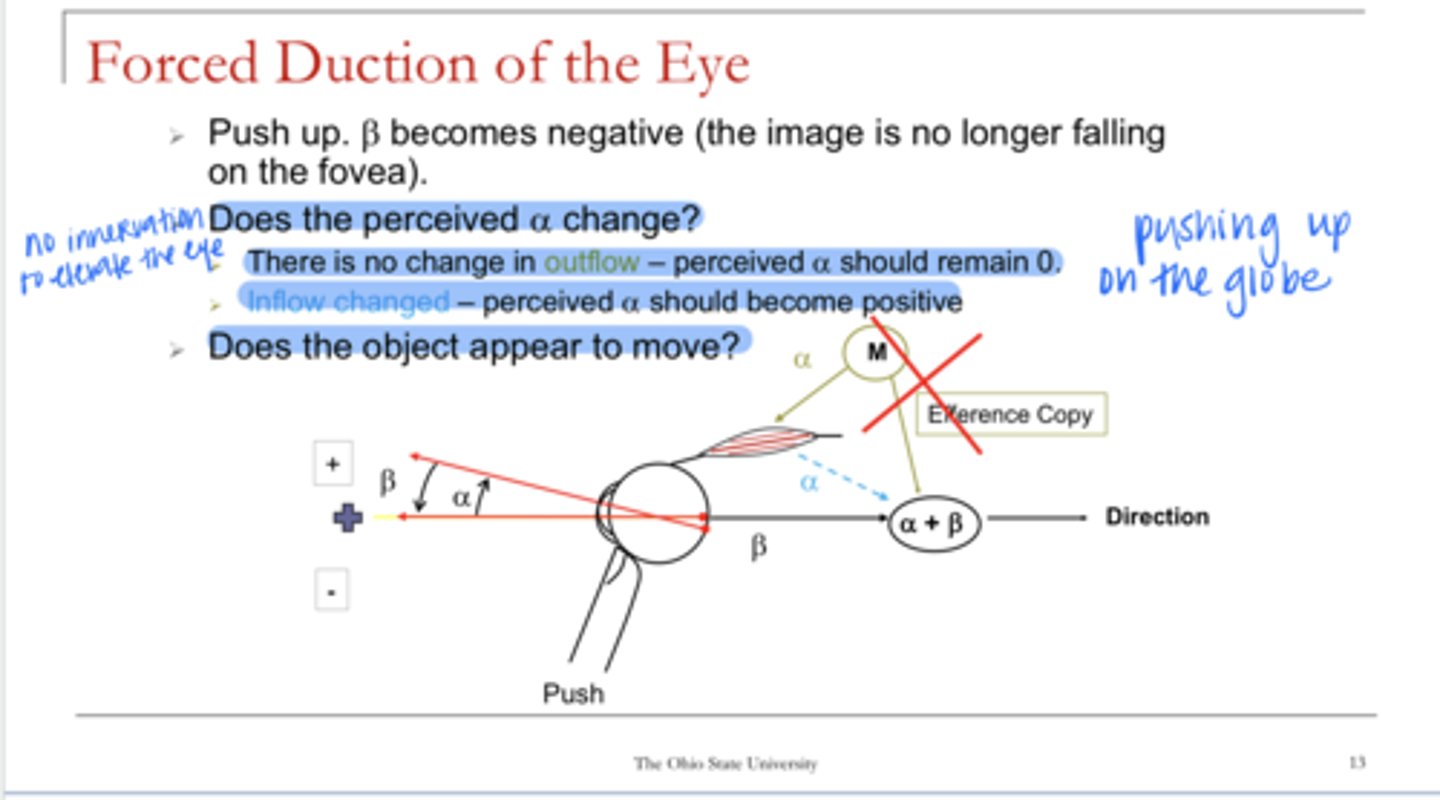
What happens during forced duction of the eye?
-Eye looking straight ahead
-Push up on the globe
- β becomes negative (image no longer falls on the fovea)
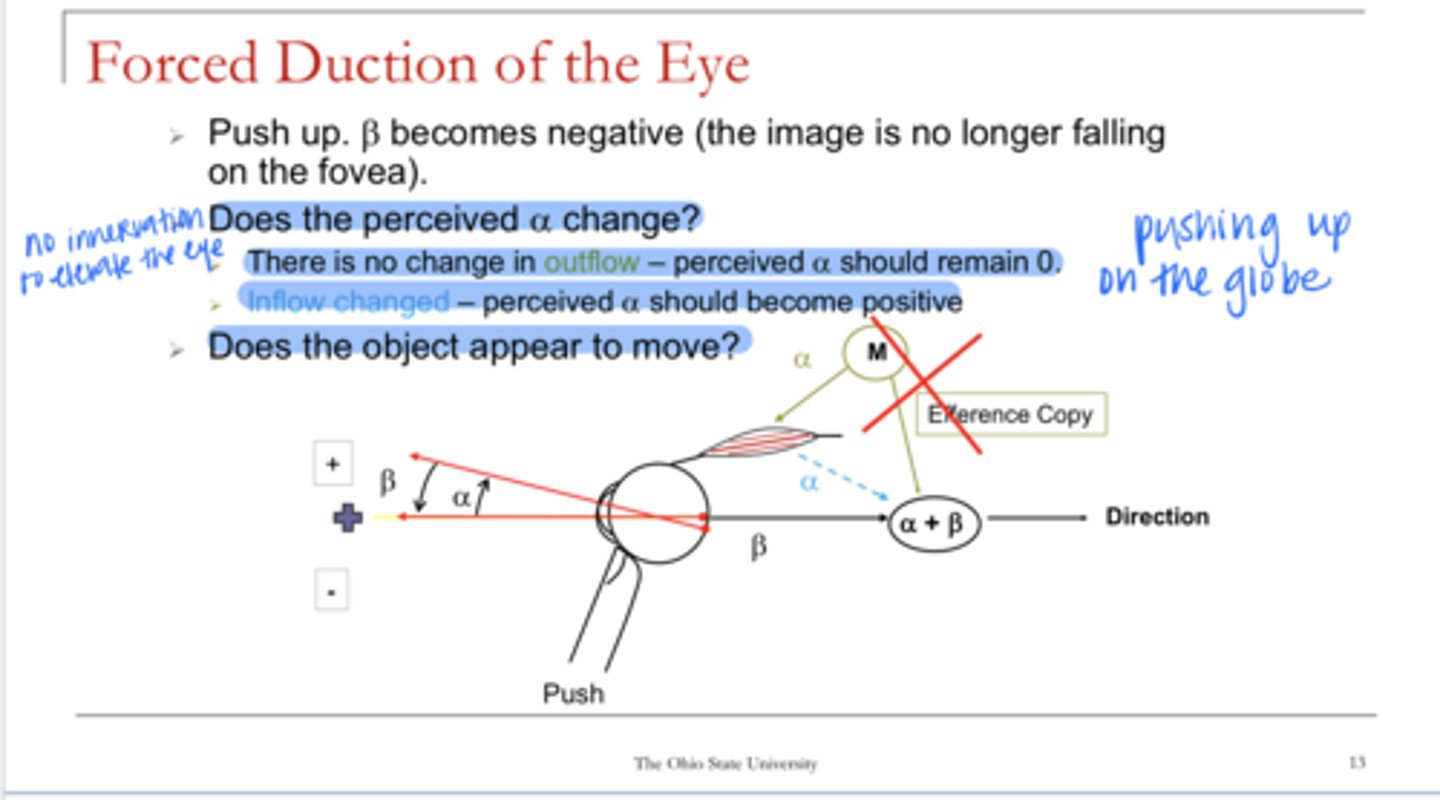
Does α change during the forced duction test based on both the inflow and outflow theory?
-Outflow theory: no change; α = 0
-Inflow theory: perceived α should be positive
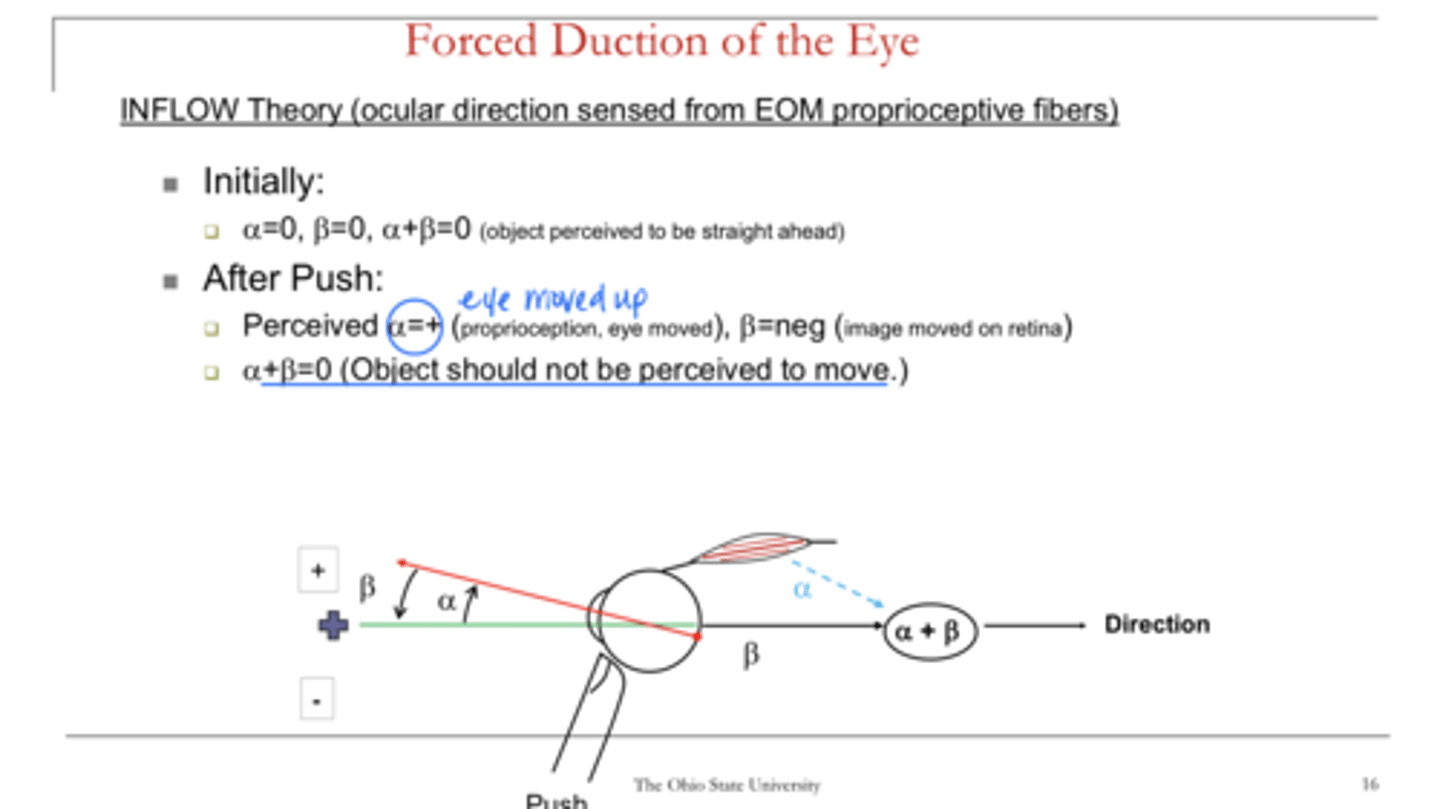
According to the inflow theory, is the object perceived to move after the forced duction test?
-α = +
-β = -
-χ = (+) + (-)
-χ = 0
-The object will not appear to move
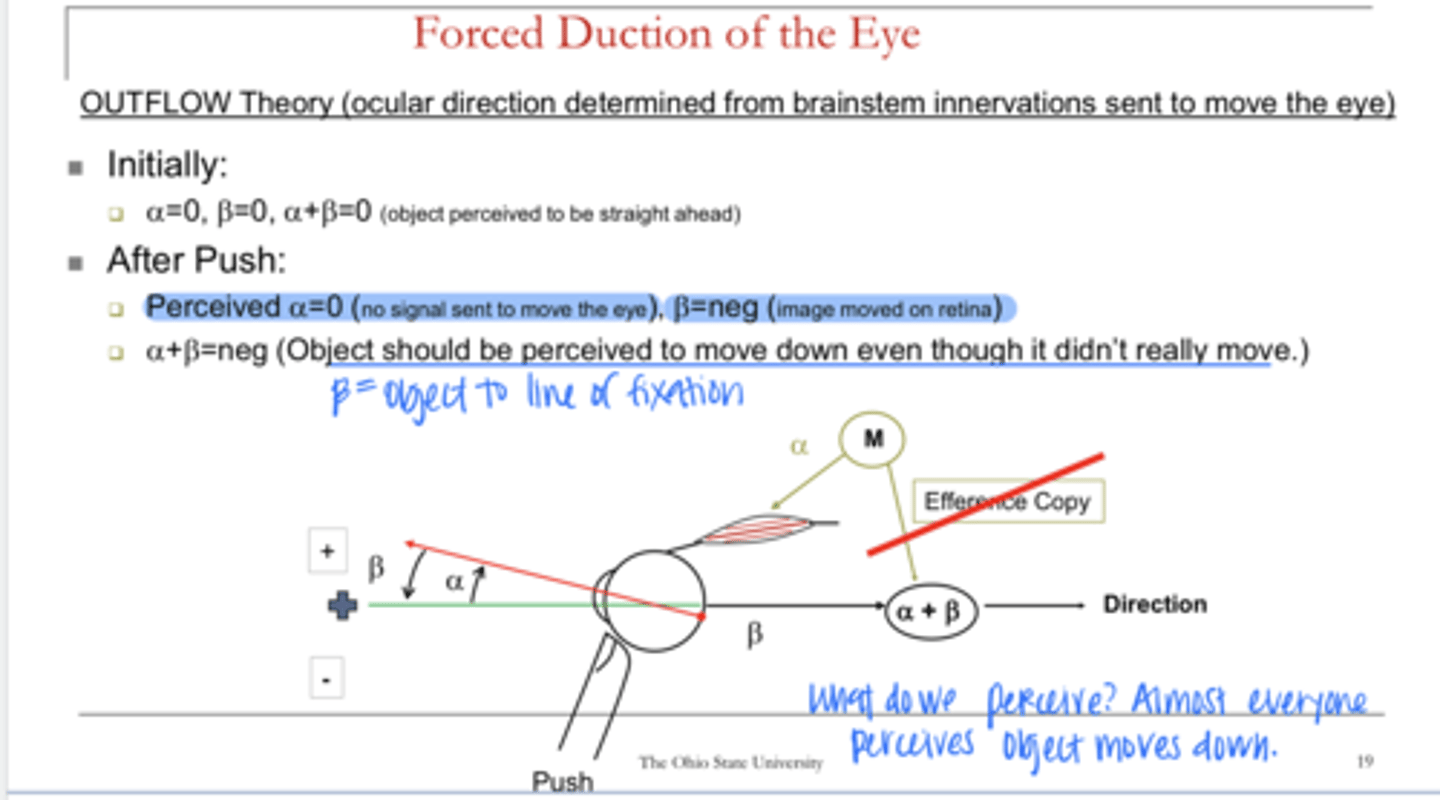
According to the outflow theory, is the object perceived to move after the forced duction test?
-α = 0
-β = -
-χ = (0) + (-)
-χ = -
-The object will appear to move downward
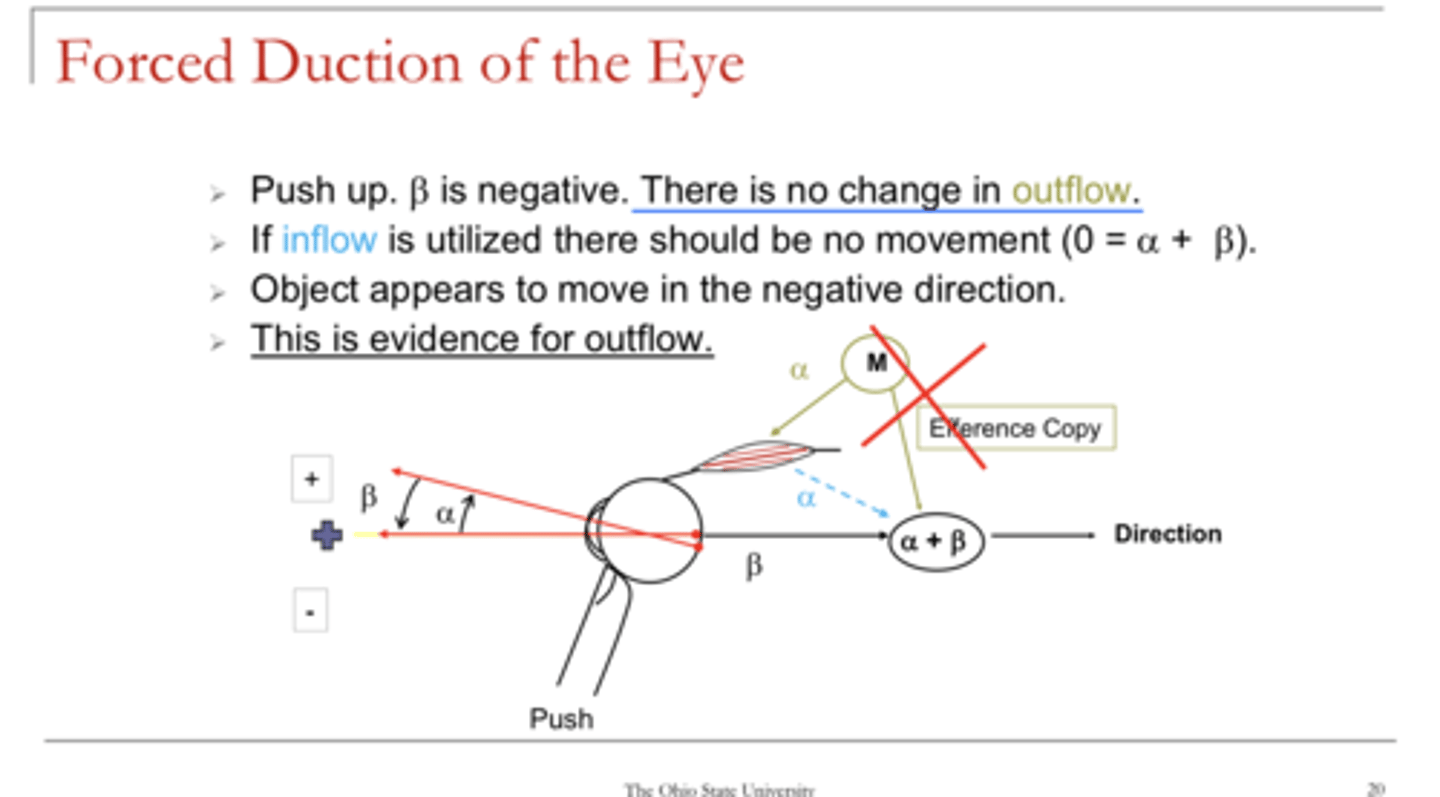
The forced duction test is evidence for (outflow/inflow) theory
outflow
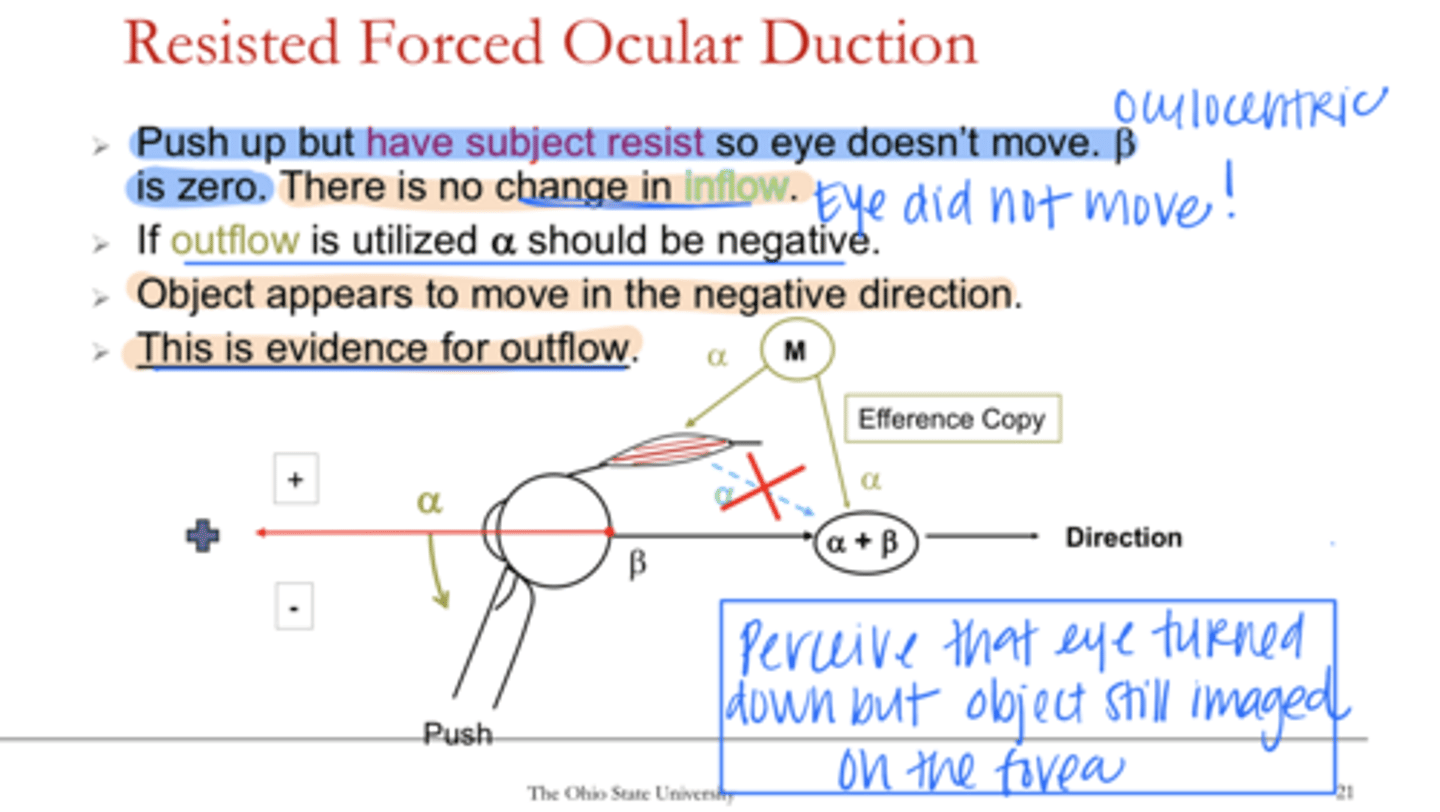
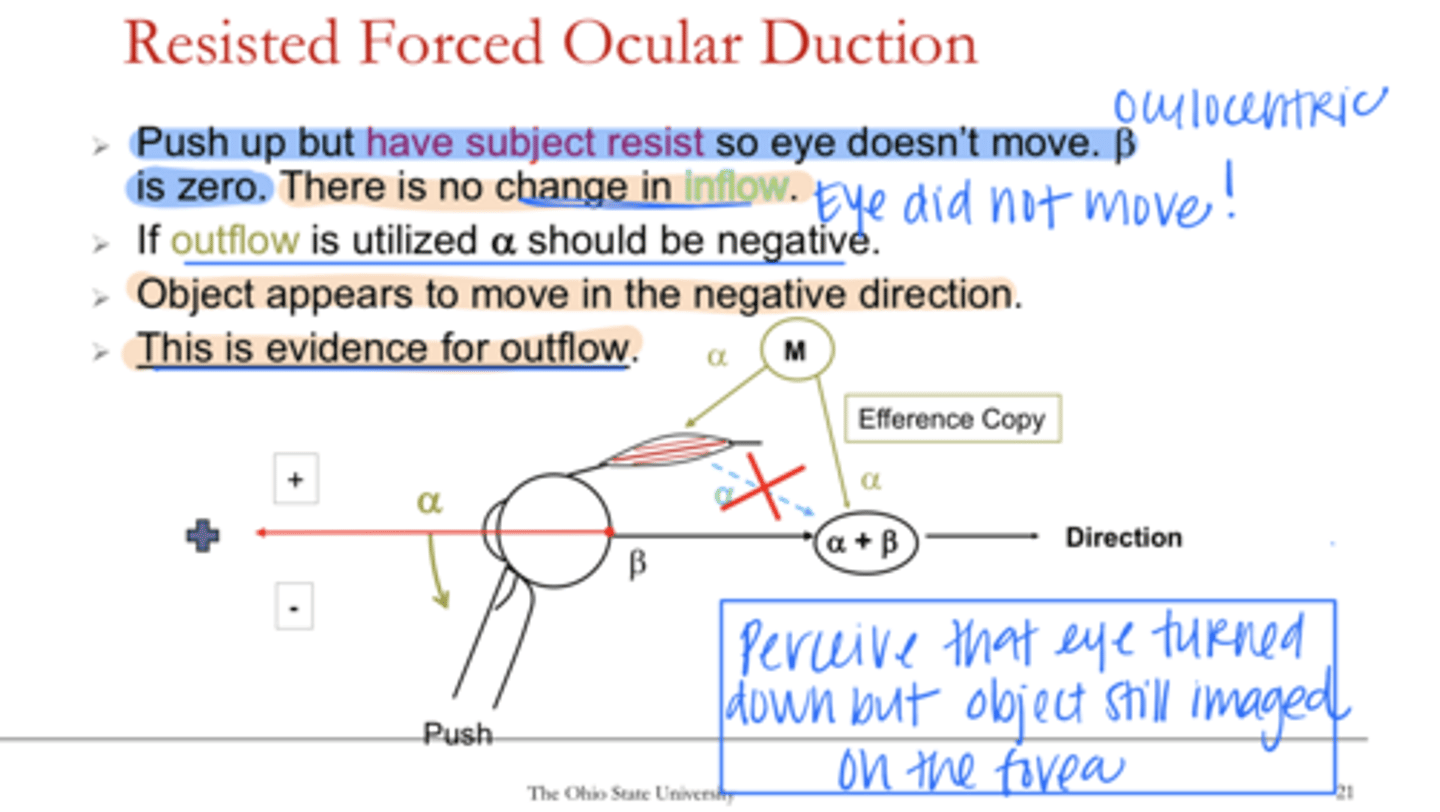
What is the resisted forced duction test?
Push up on the globe but have the subject resist so that the eye does not move.
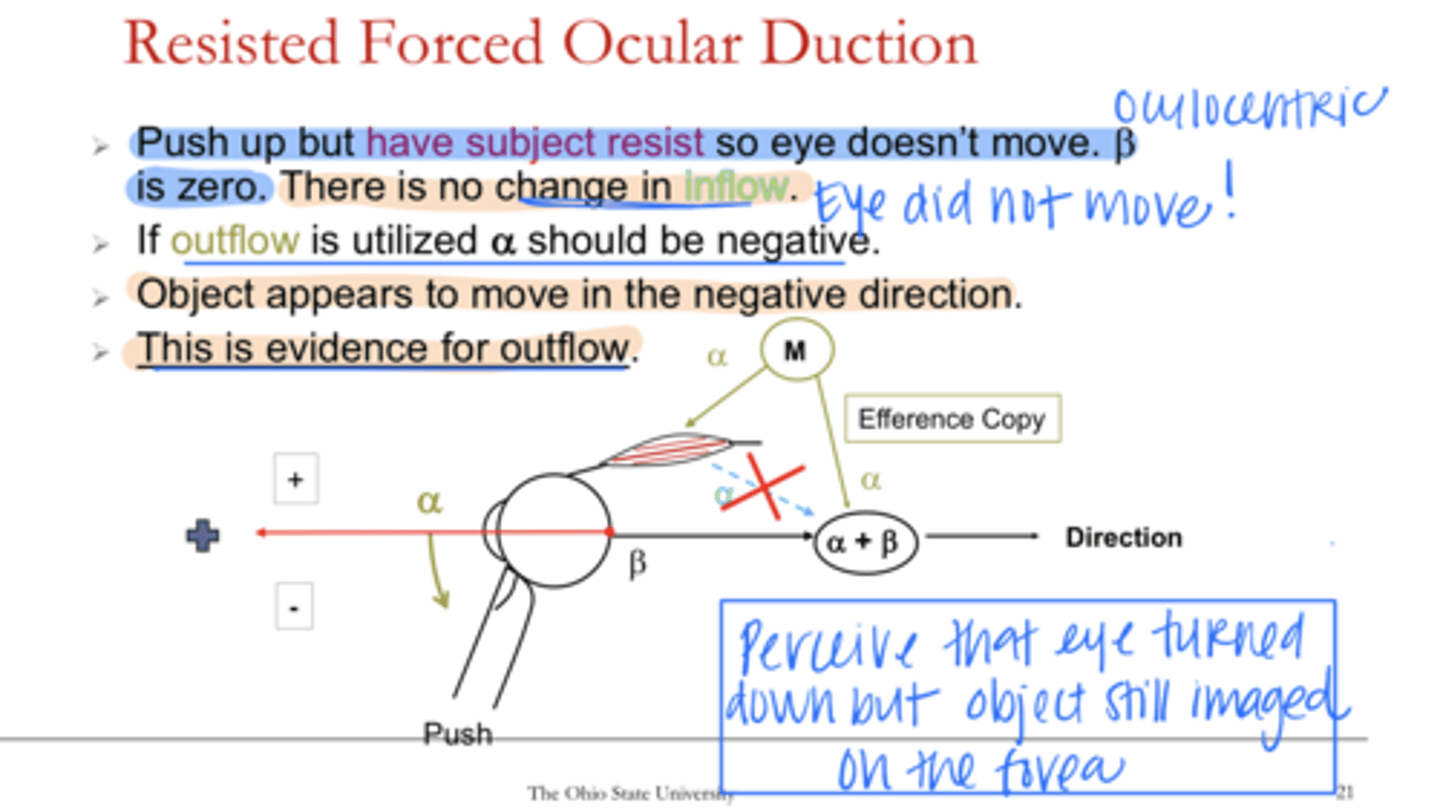
What is the value of β in the resisted forced duction test?
0
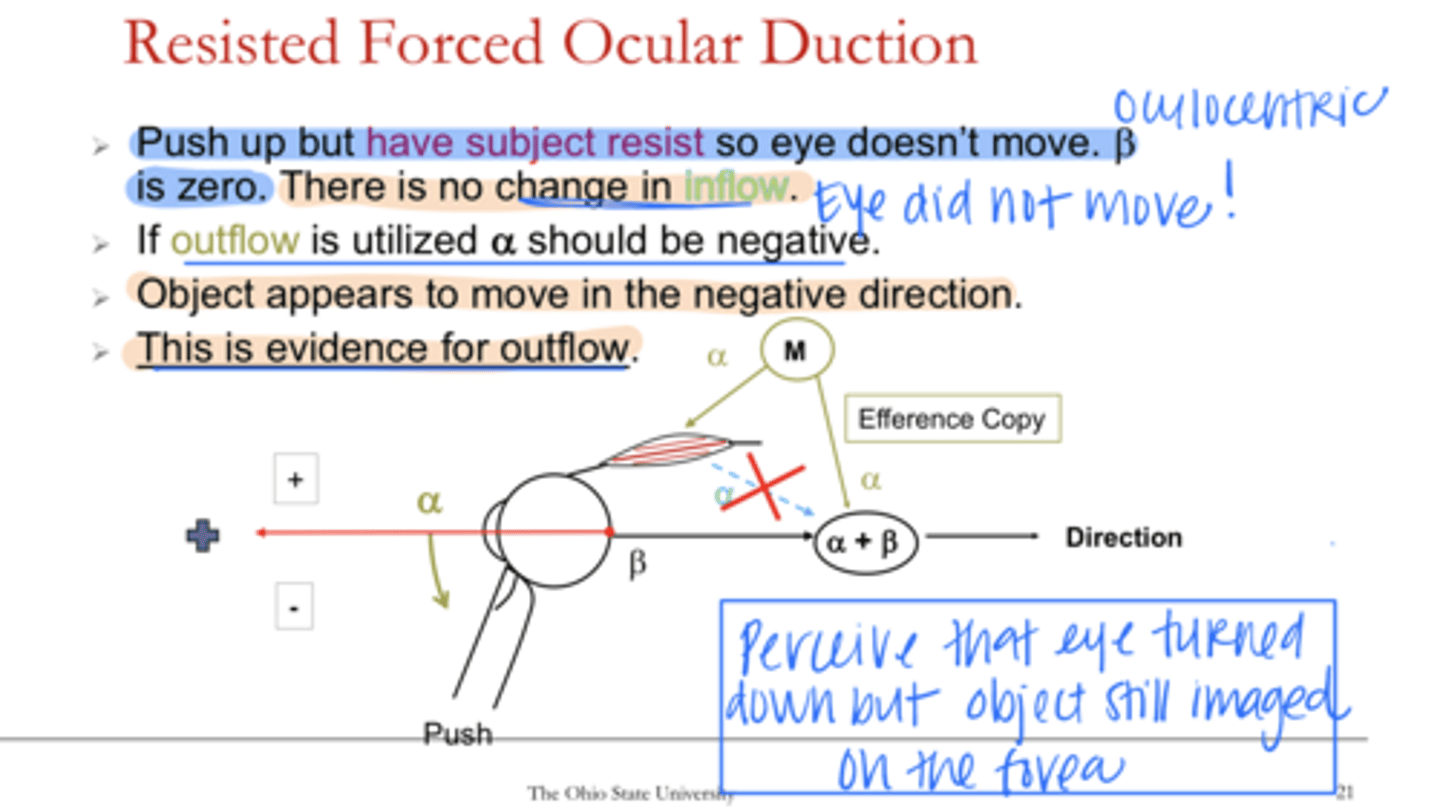
Is there any change to inflow in the resisted forced duction test?
No
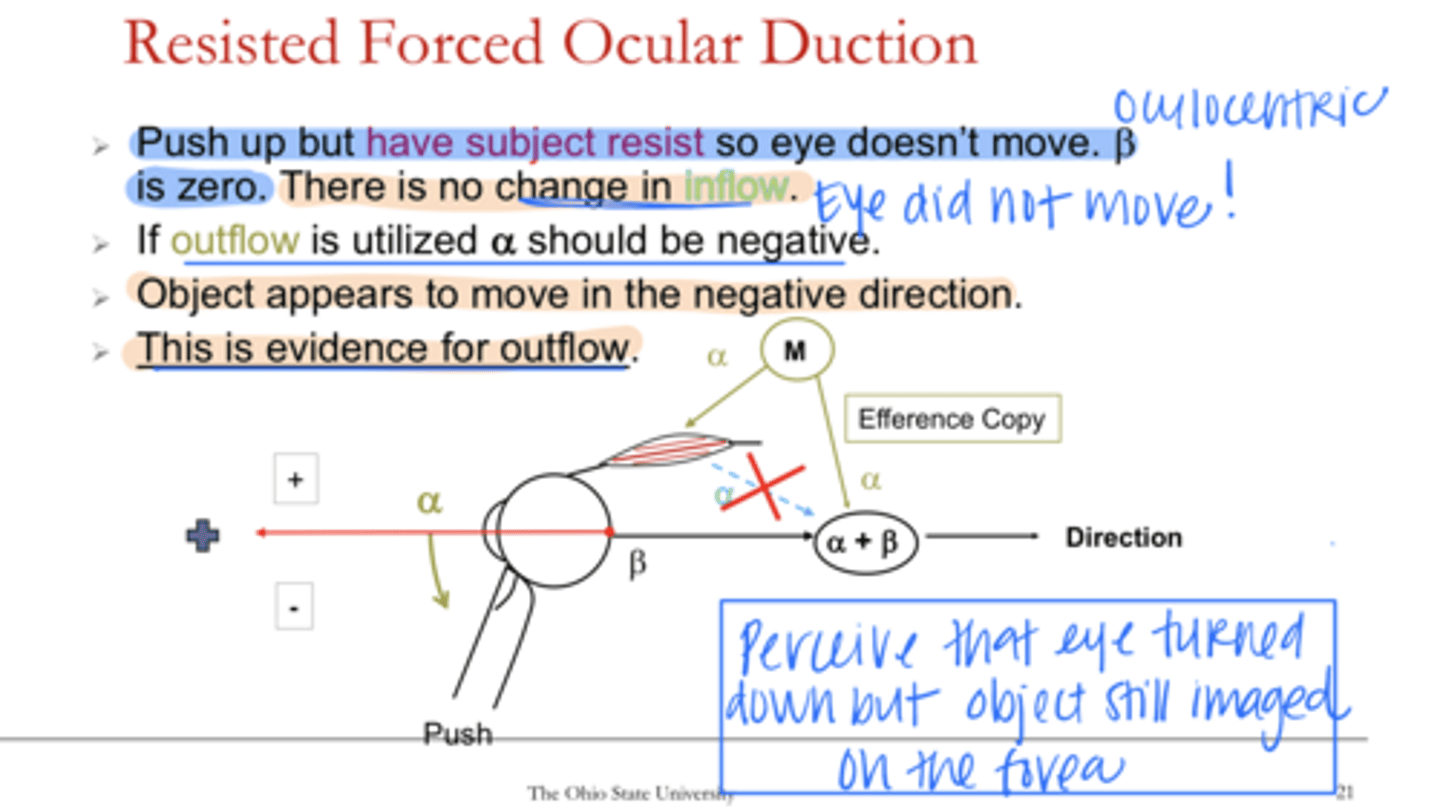
If outflow is utilized by the resisted forced duction test, then β should be (+/-)
-
During the resisted forced duction test, the object appears to move in the negative direction. This is evidence for (outflow/inflow) theory
outflow
EOM Paresis can be a form of evidence for the (inflow/outflow) theory
outflow
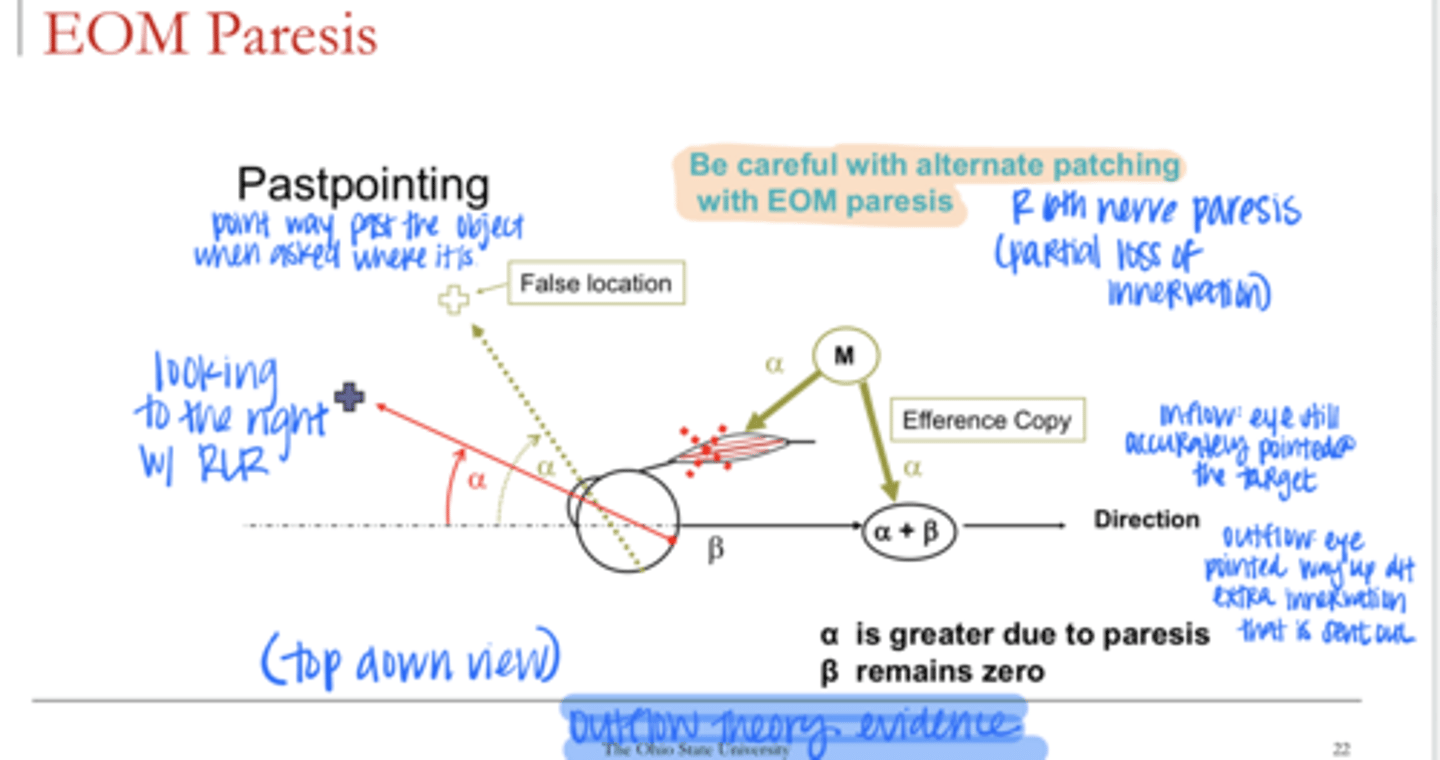
What happens in EOM paresis that is evidence for the outflow theory?
When asked to look at a target, the patient will send out extra innervation to that muscle in order to get it to the designated location. The eye will be pointed way over to the target d/t the extra innervation that is sent out. When asked to point to where the target is? The patient will point way past it d/t all of the extra innervation that is being sent to the paretic muscle. The brain does not know that the muscle is paretic.
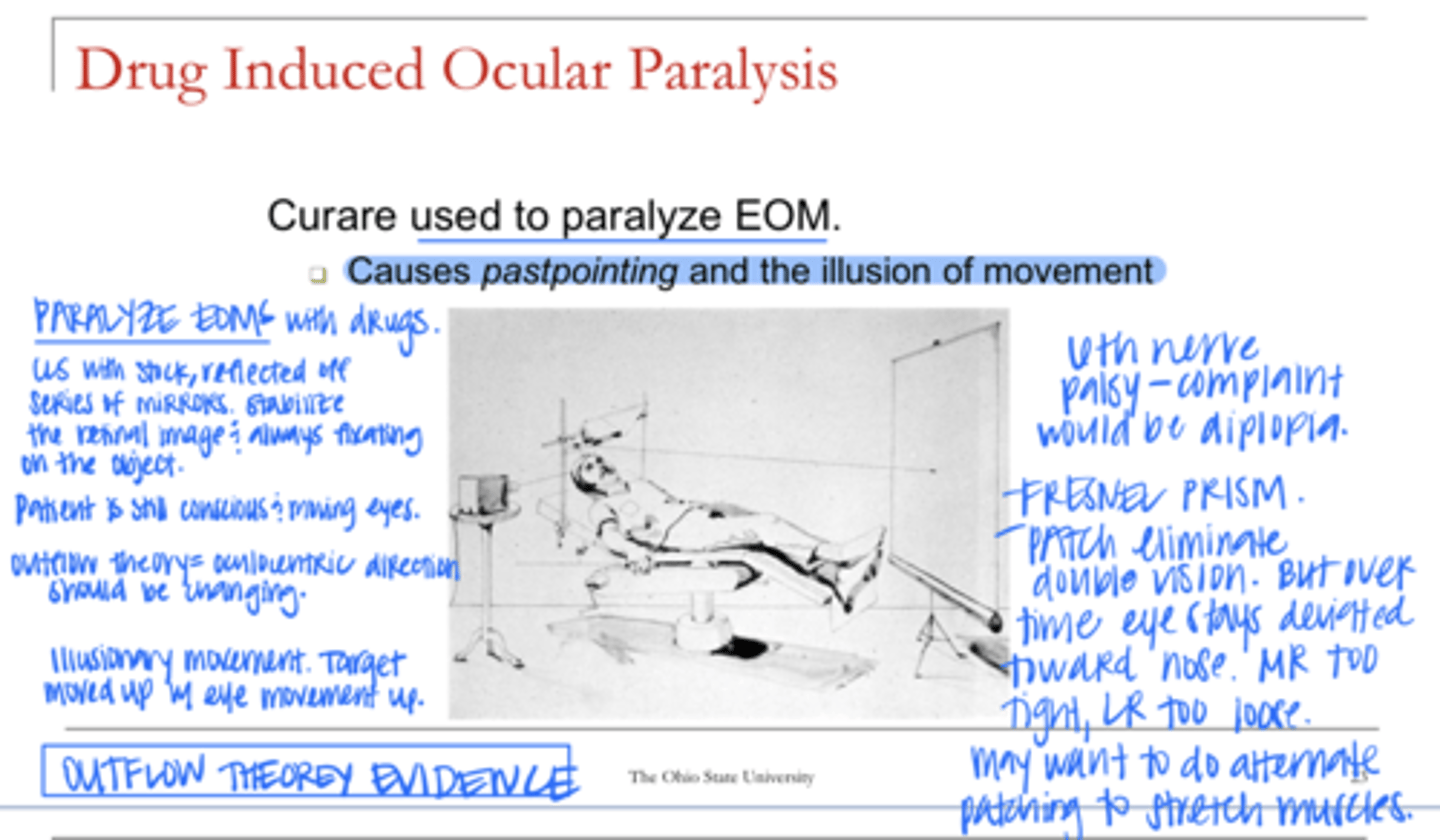
Describe α and β with EOM paresis
-α = greater d/t paresis
-β = remains zero
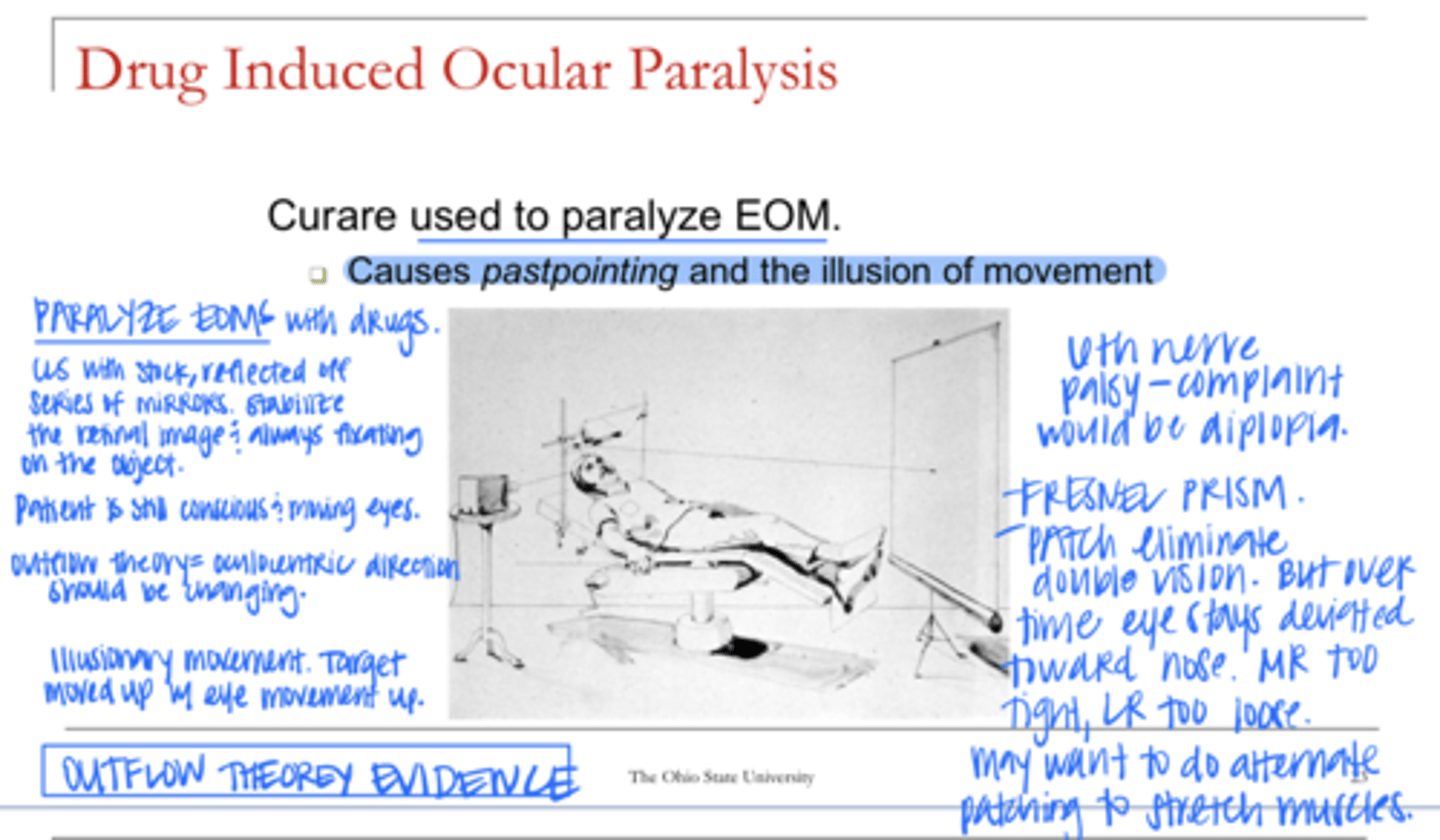
Curare used to paralyze the EOMs will cause what?
pastpointing and the illusion of movement
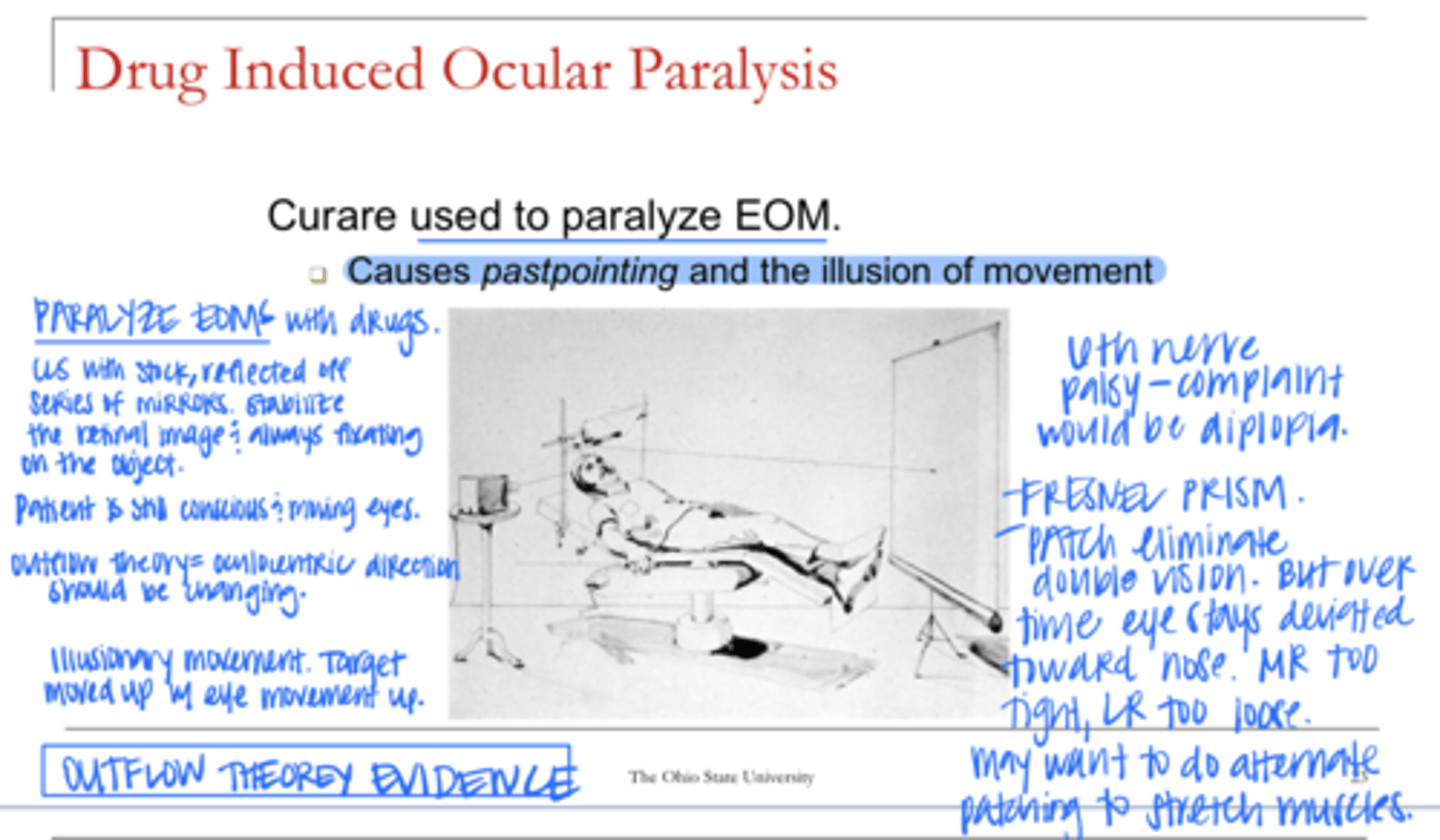
Drug Induced Ocular Paralysis is an example of (inflow/outflow) theory
outflow
gaze shifting movements
saccades
Saccades are ________
conjugate
Saccades are ballistic. What does this mean?
Once movement starts, it goes to completion. It cannot be adjusted on the fly.
What is the stimulus for a saccade?
-displacement from the fovea
-Non-zero β (oculocentric direction) for the object of interest
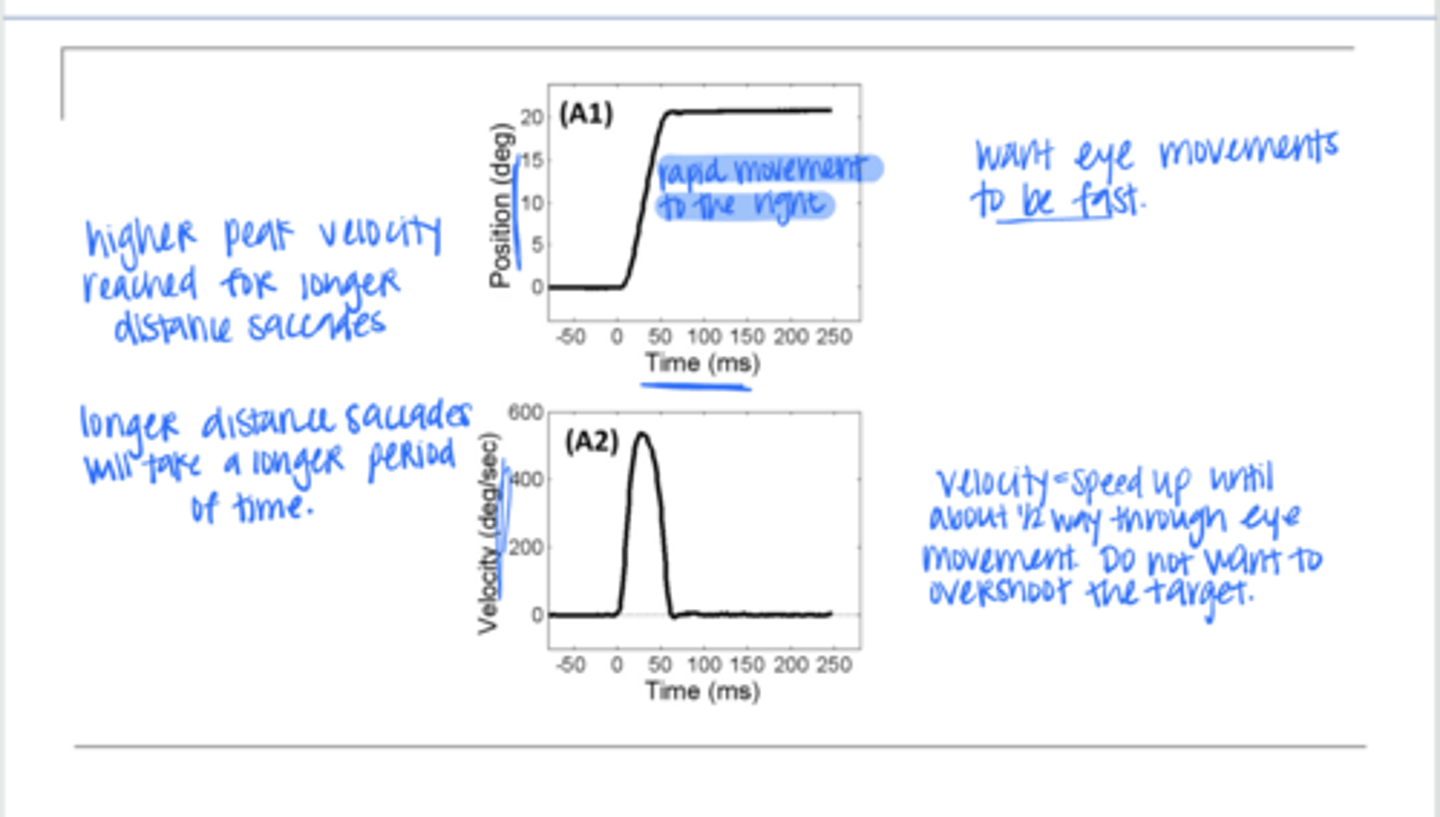
A saccade will accelerate until when?
Until 1/2 way to the target -- then will start to decelerate in order to not overshoot
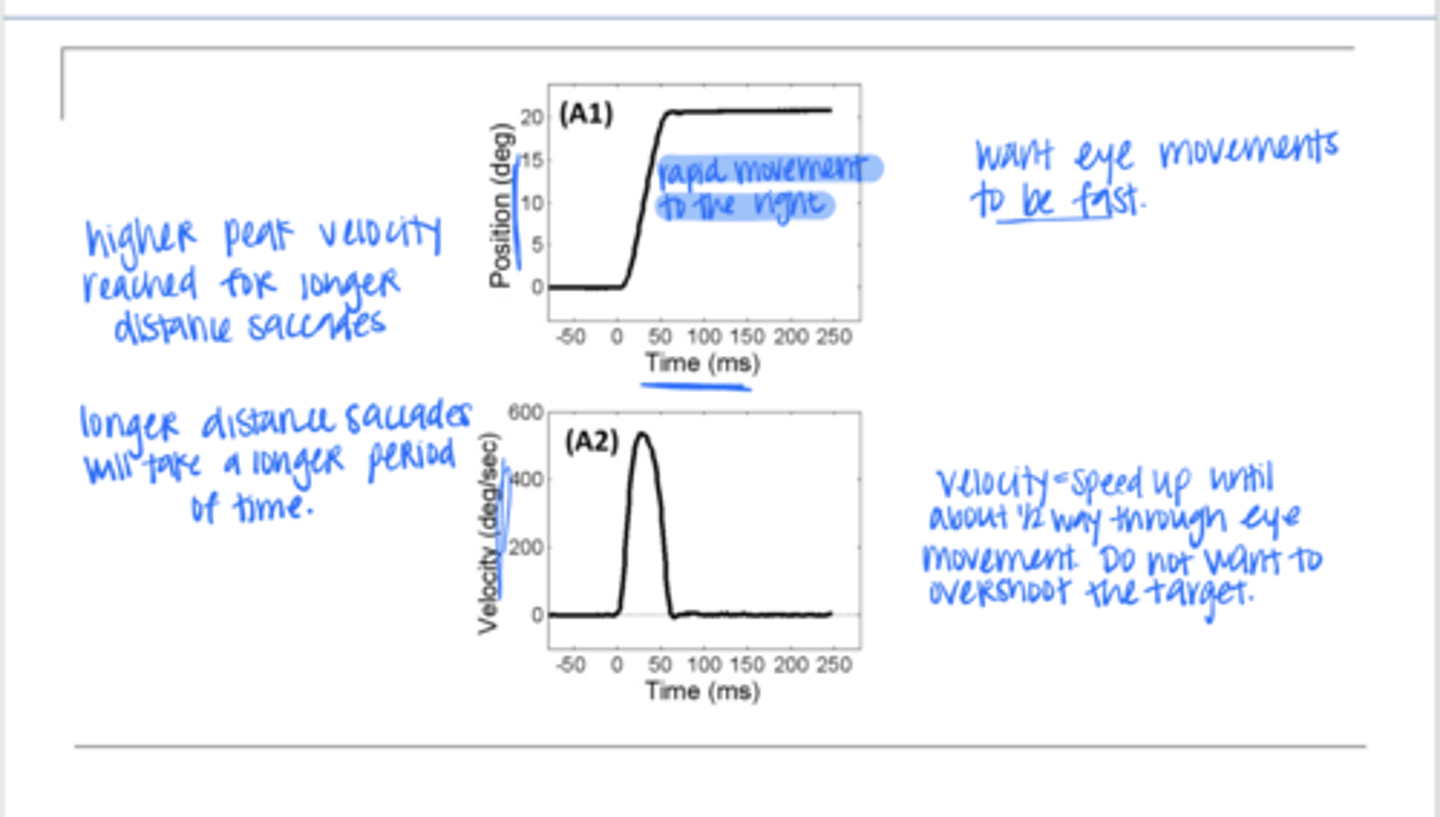
True or False:
We want our eye movements to be FAST
true
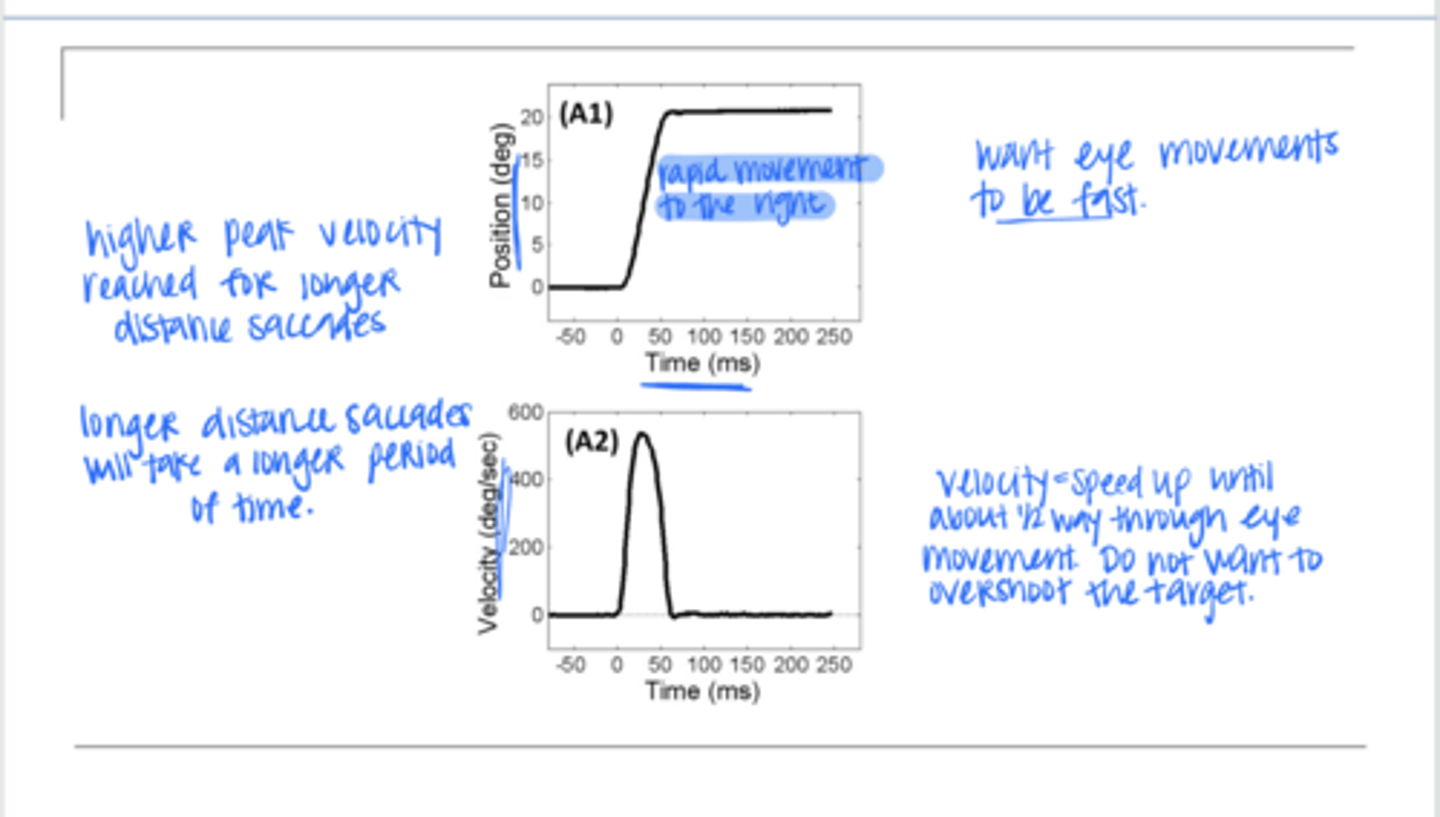
True or False:
Higher peak velocity is reached in longer distance saccades than shorter distance saccades
true
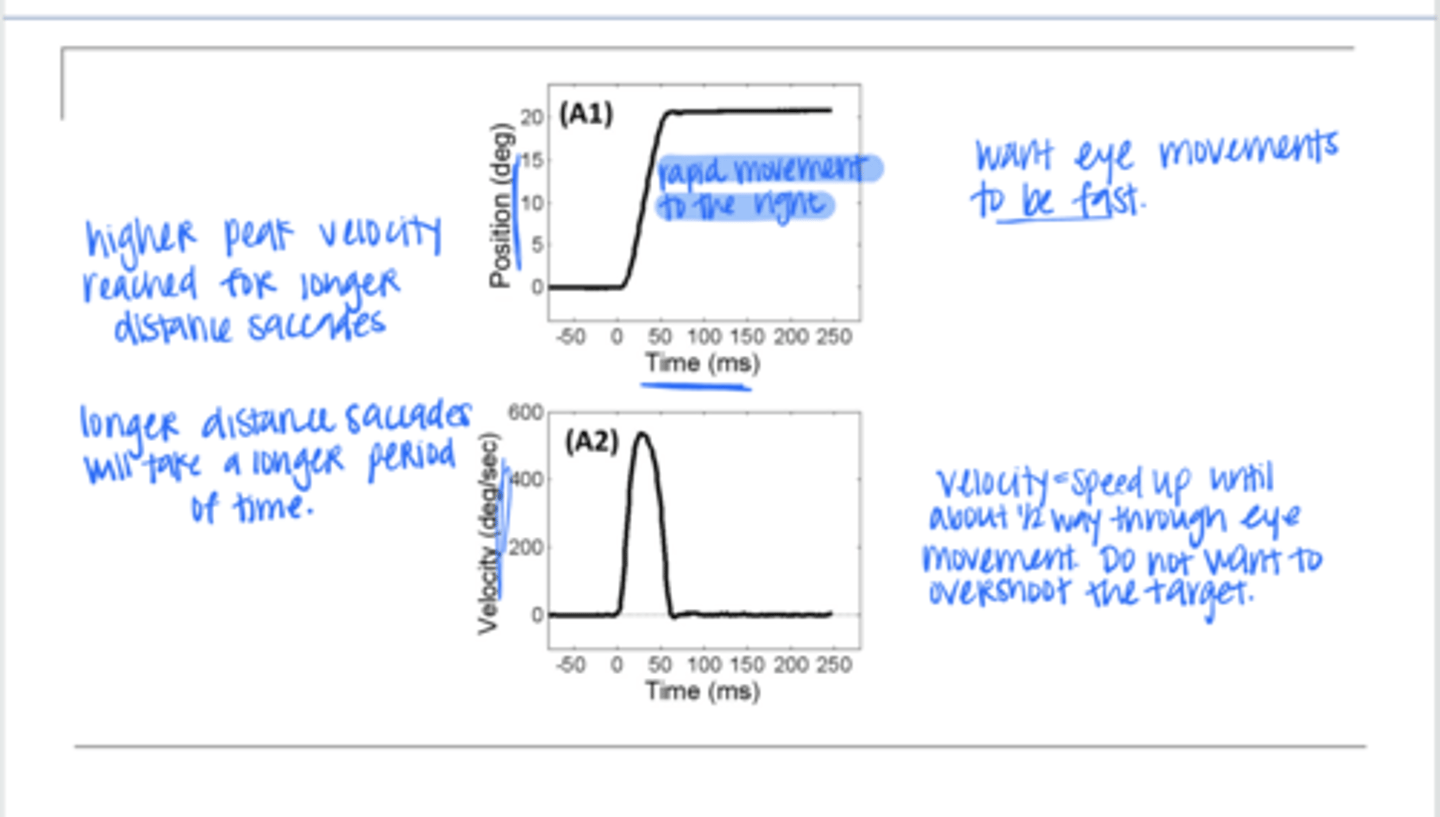
True or False:
Longer distance saccades will take a (longer/shorter) amount of time than a shorter distance saccade
longer
Most naturally occurring saccades are less than ______º
15
If a larger saccade (than 15º) is required, what is combined with the saccade in order to produce this movement?
a head movement combined with an eye movement
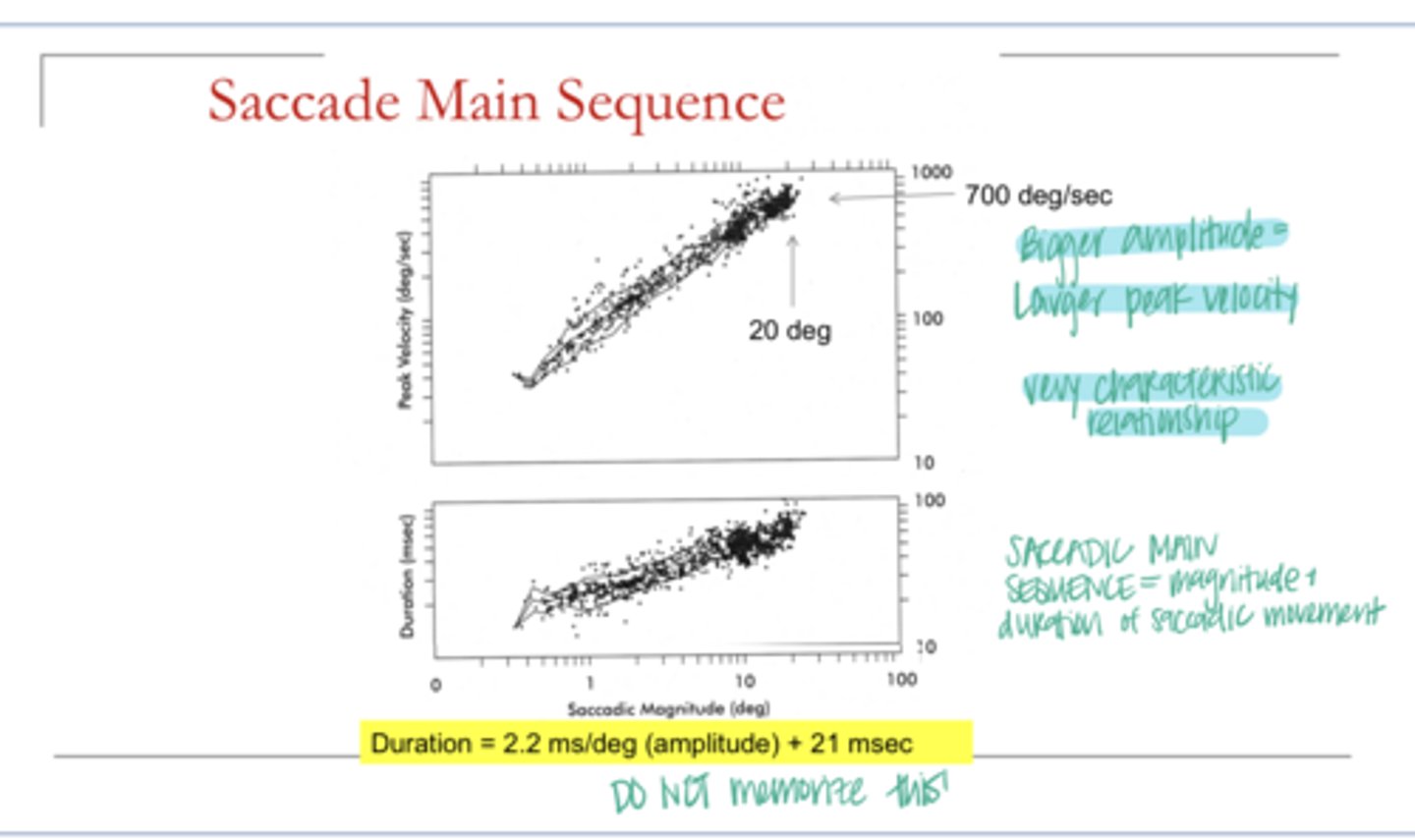
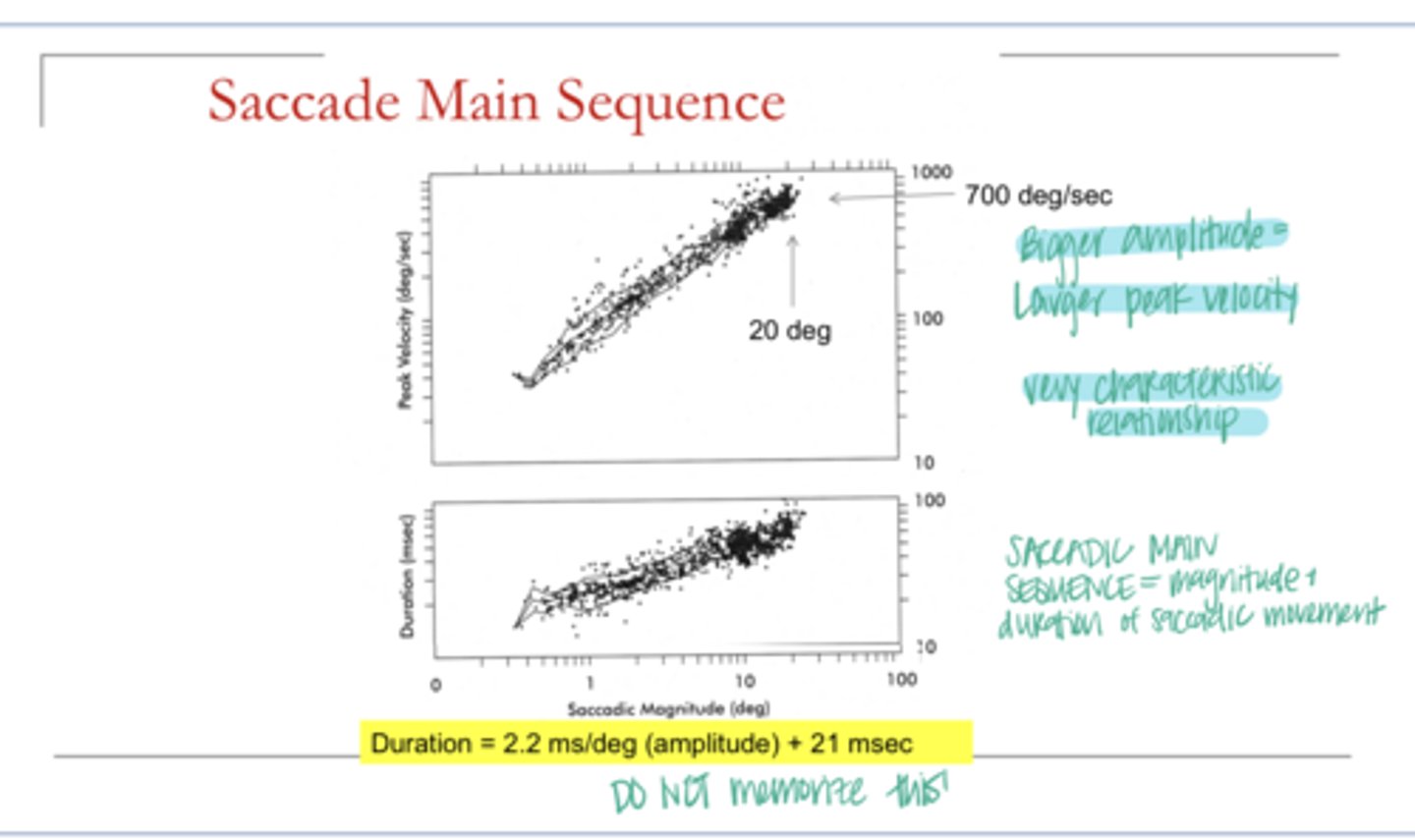
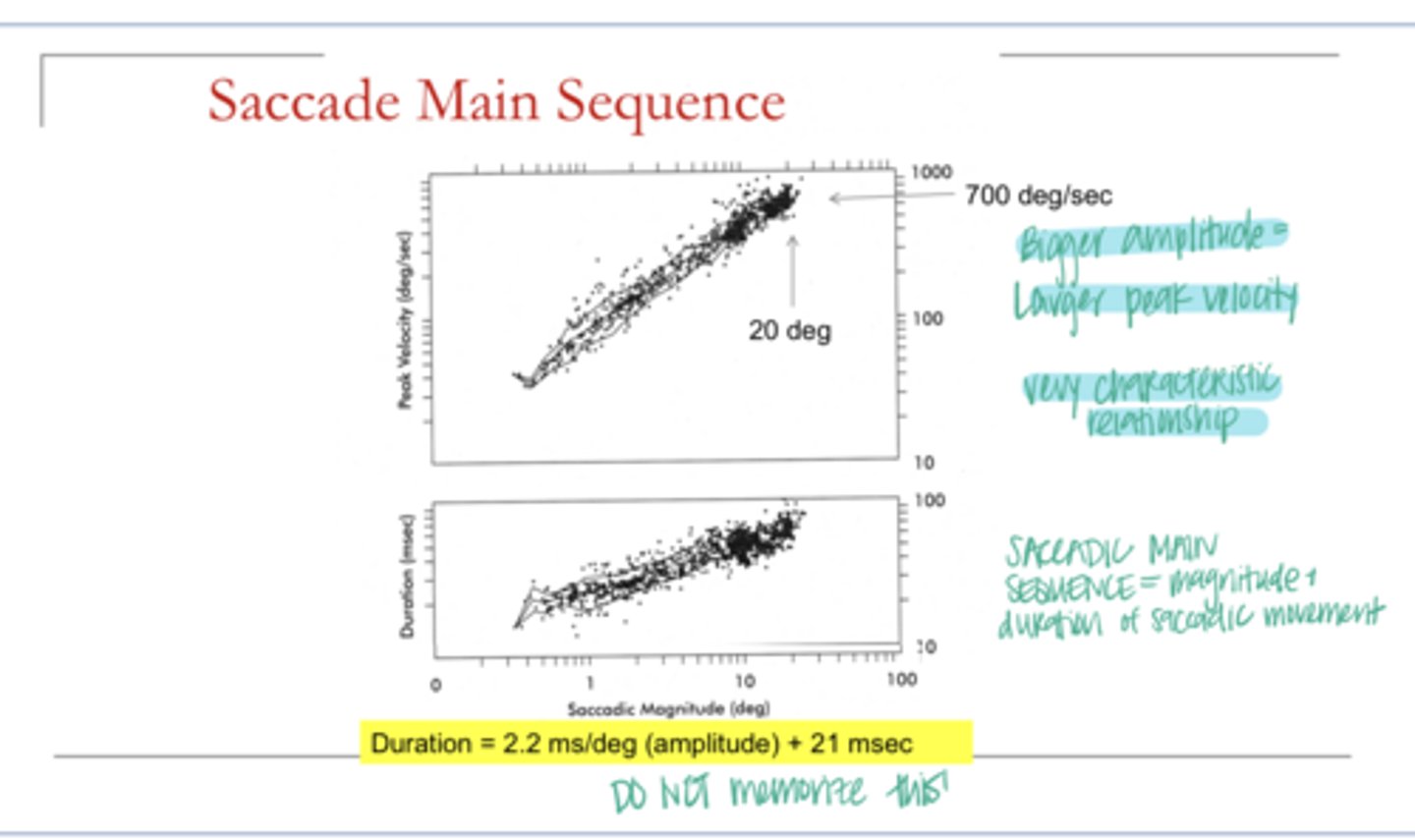
For large amplitudes, saccades can reach velocities of ________
700-1,000º/sec (very fast speeds)
True or False:
Plot of peak velocity (degree/sec) vs amplitude has a characteristic shape for saccades
true
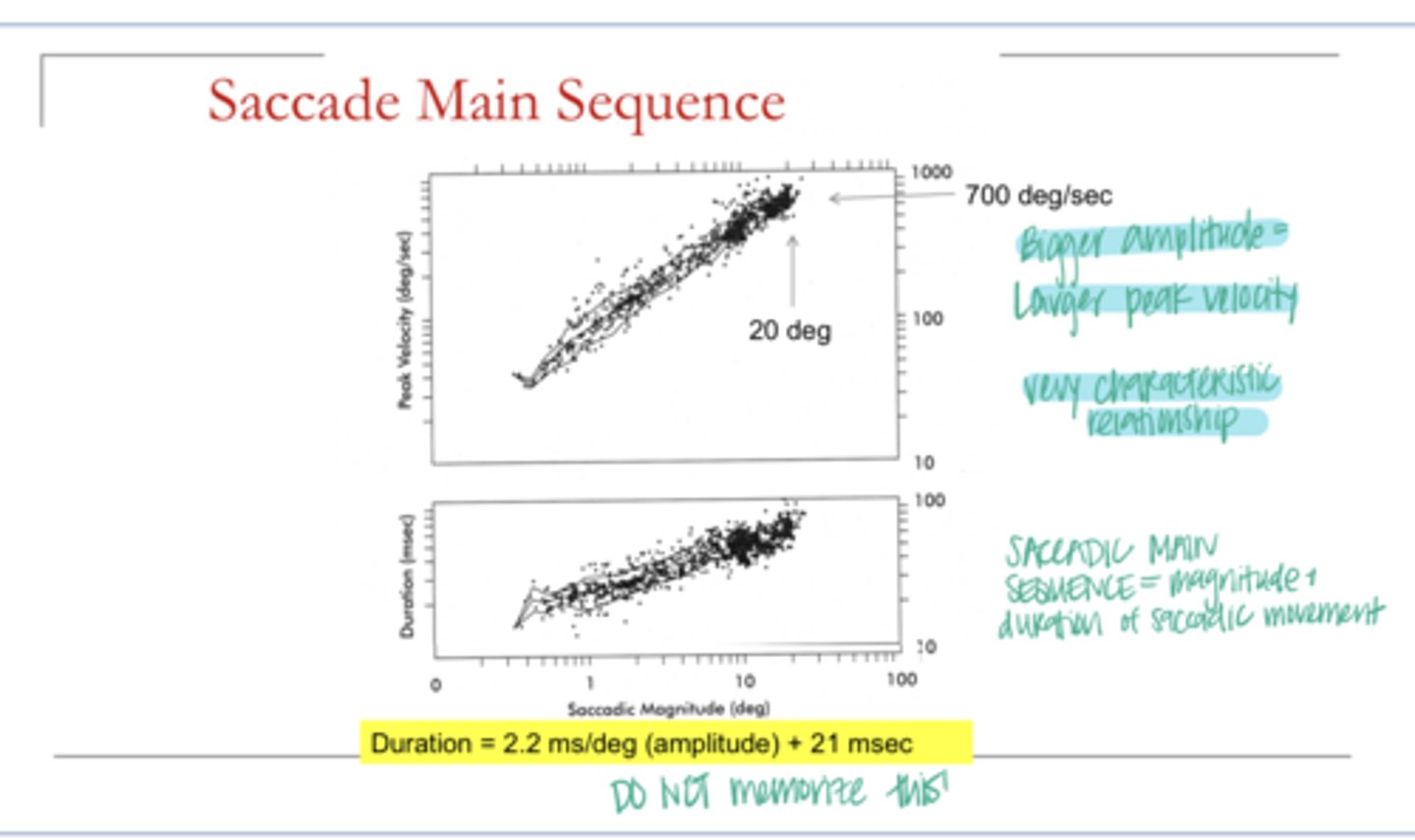
True or False:
The velocity of saccades increases much more slowly beyond about 20º
true
Velocity is higher for saccades towards what direction?
toward the straight ahead (compared to away)
The duration of a saccade also increased with (increasing/decreasing) amplitude
increasing
Saccade Main Sequence (Pic)
Saccade Main Sequence (Pic)
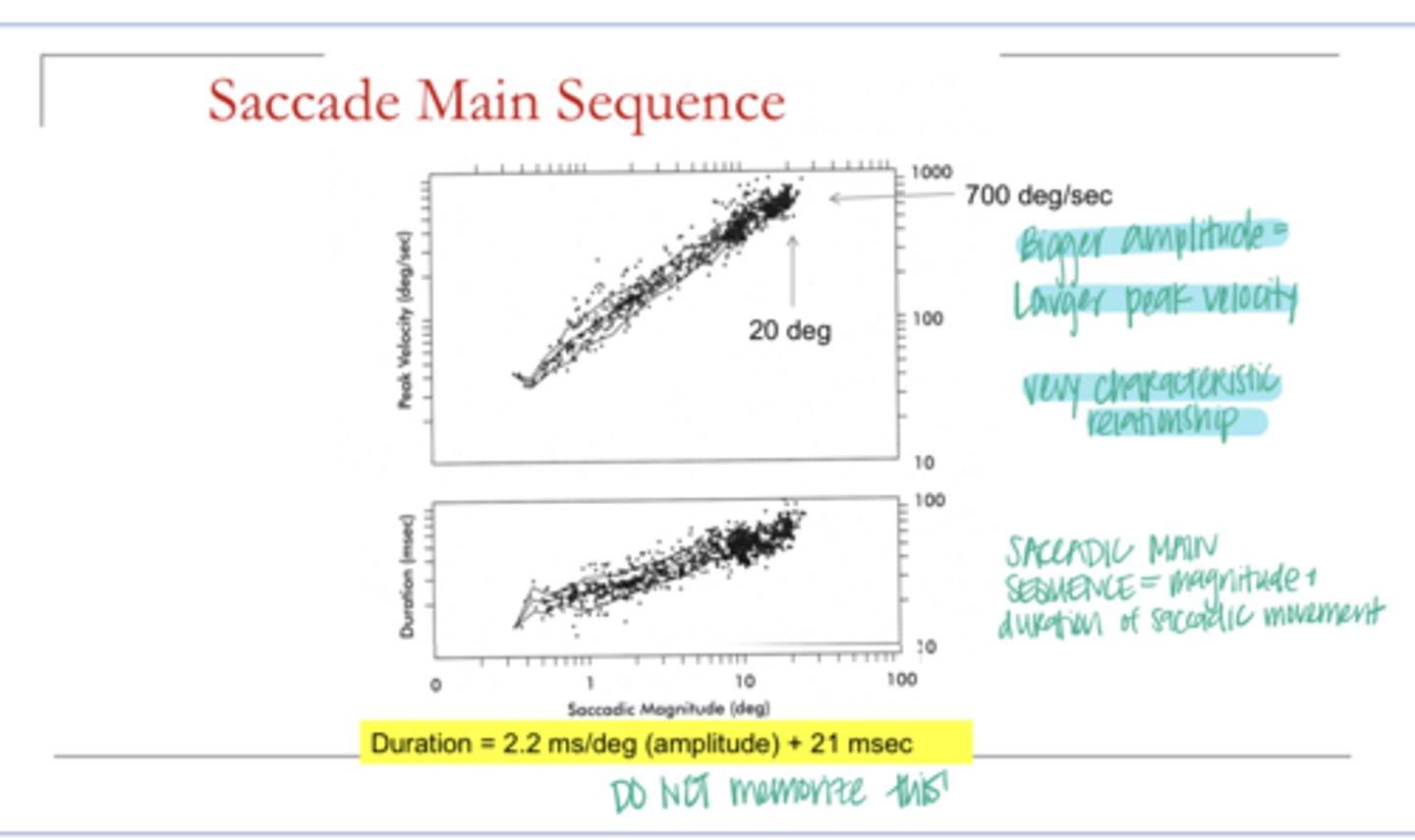
What comprises the saccade main sequence?
Magnitude and duration of the saccadic movement
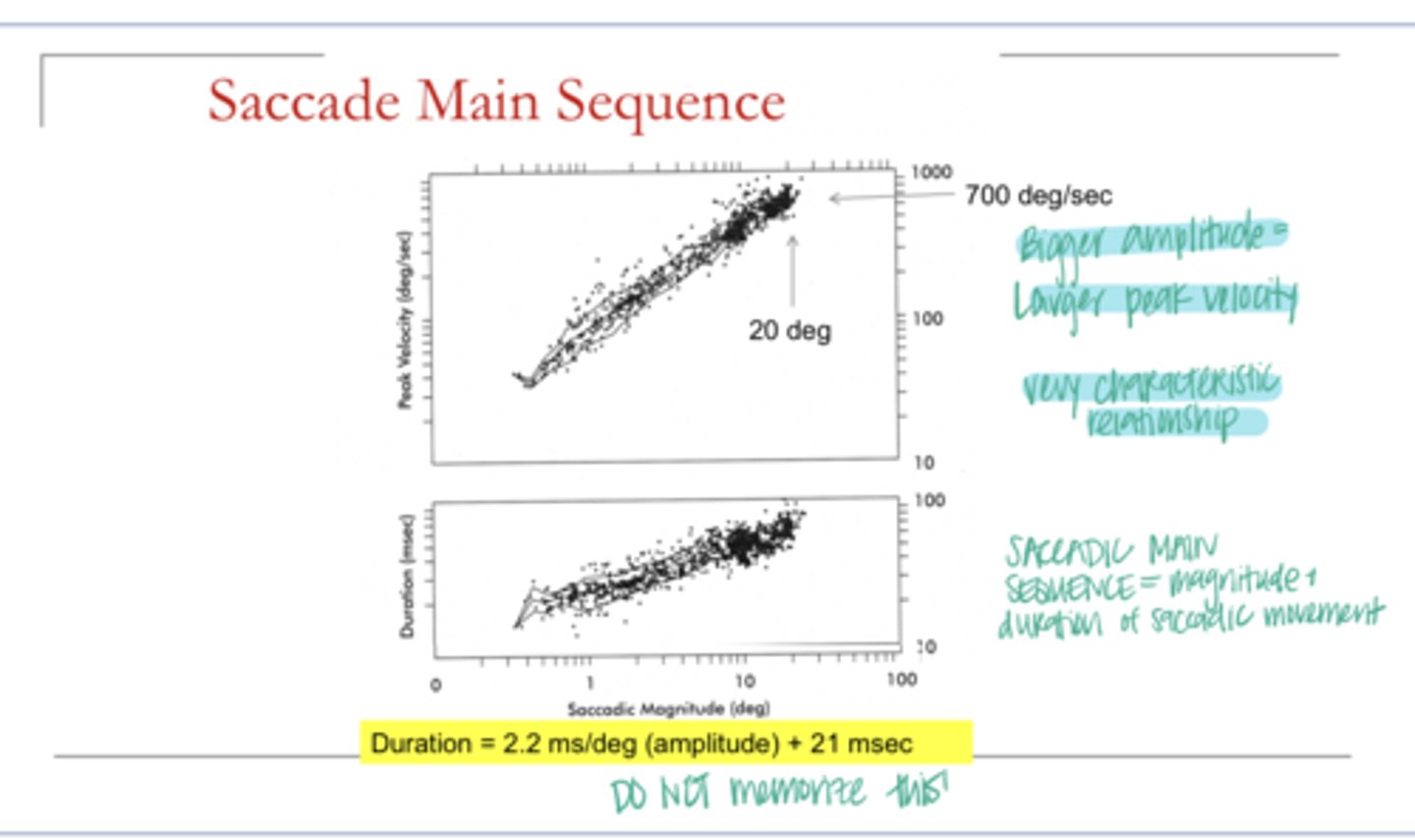
What does the main sequence help us identify?
-Helps us know if a saccade is really a saccade when recording eye movements
-If saccades are normal
Can the relationship between duration and velocity of saccades be altered in neurologic disease?
Yes
In terms of peak velocity, slower saccades have been reported in what situations?
-in infants
-with alcohol use
-with voluntary control
-with fatigue
-disease conditions: MS, stroke, tumor, aneurysm
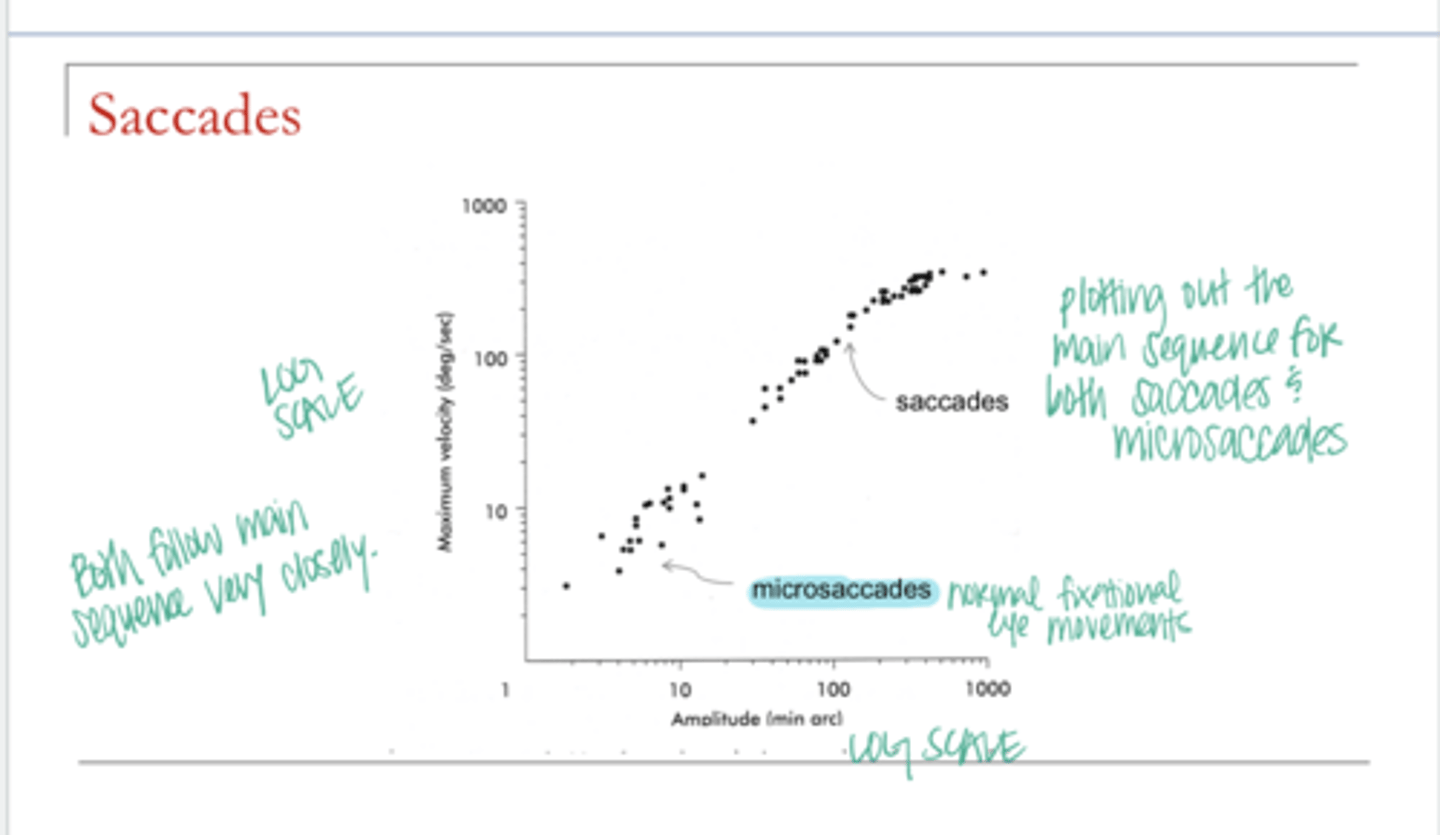
Saccades & Microsaccades (Max Velocity v Amplitude) (Pic)
Saccades & Microsaccades (Max Velocity v Amplitude) (Pic)
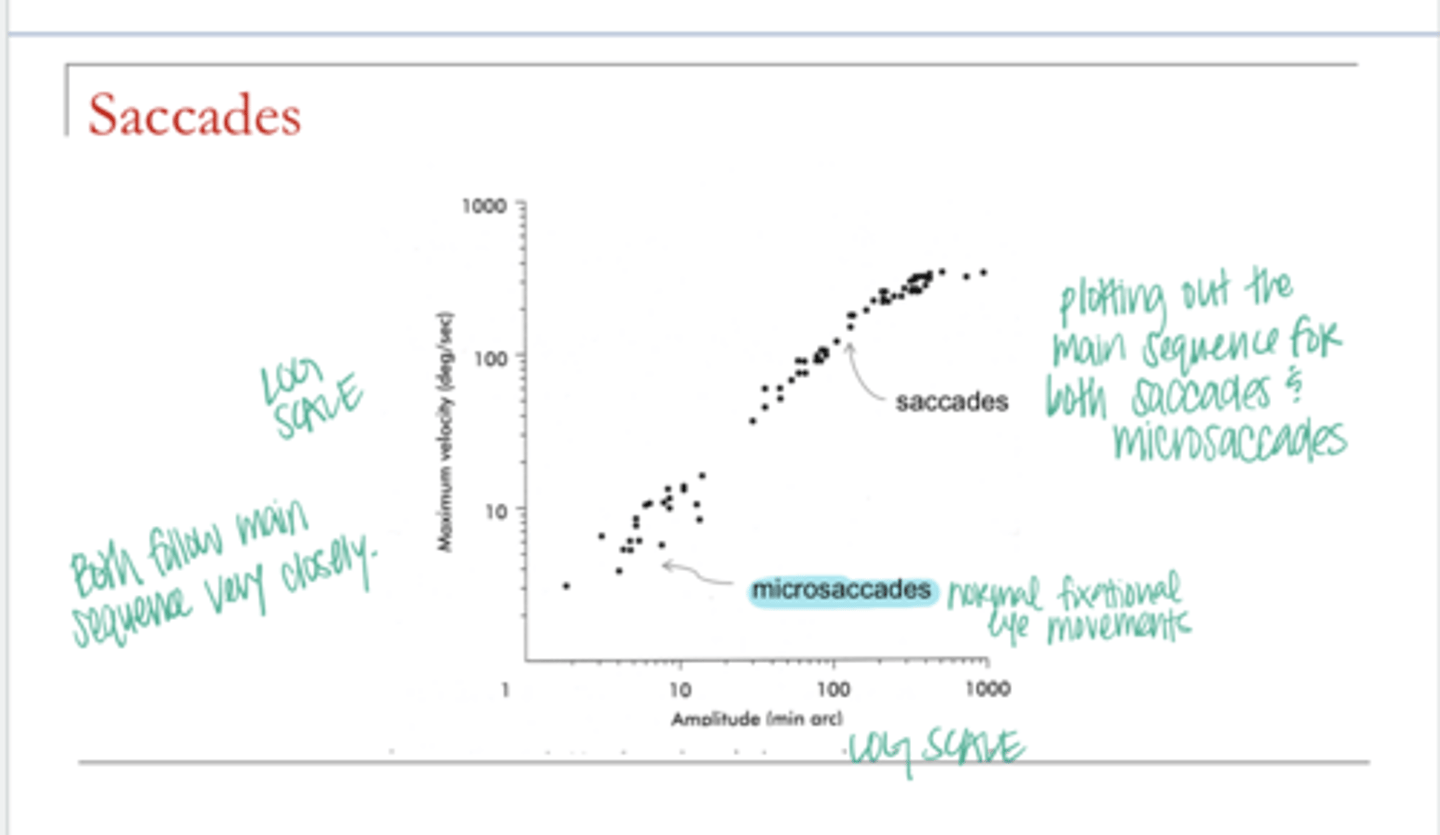
True or False:
Both saccades and microsaccades follow the main sequence very closely
true
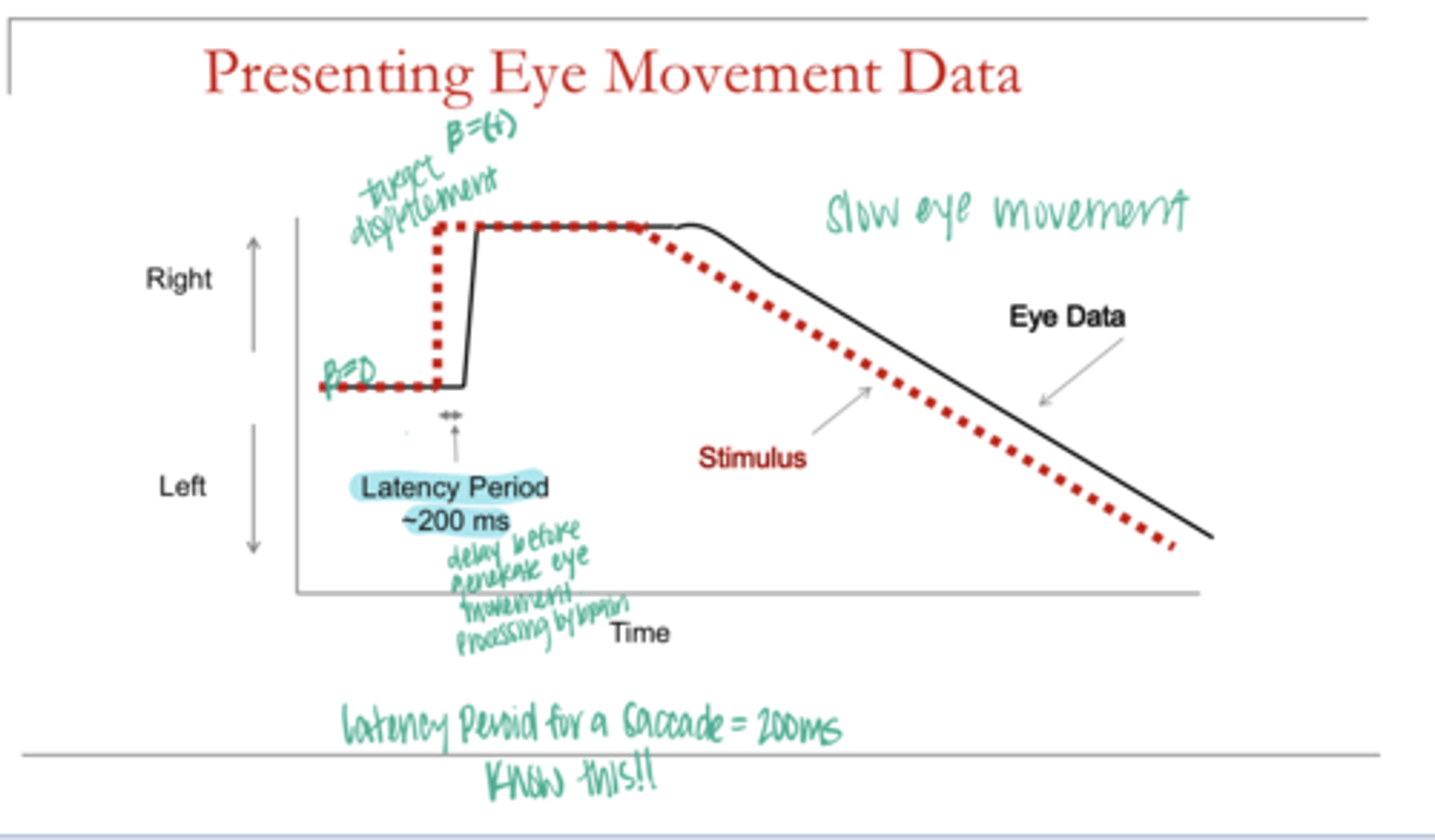
Eye Movement Data (Pic)
Eye Movement Data (Pic)
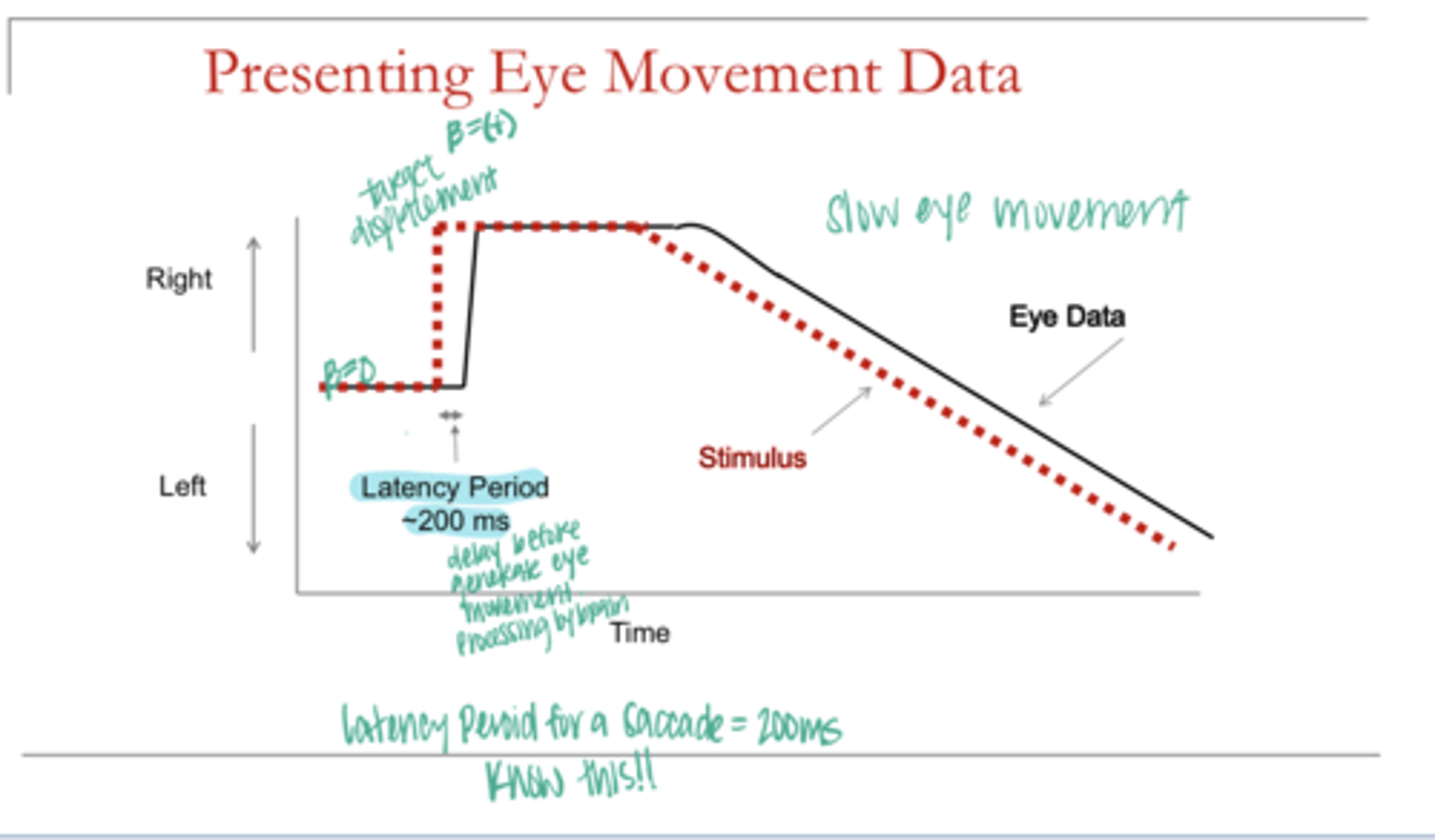
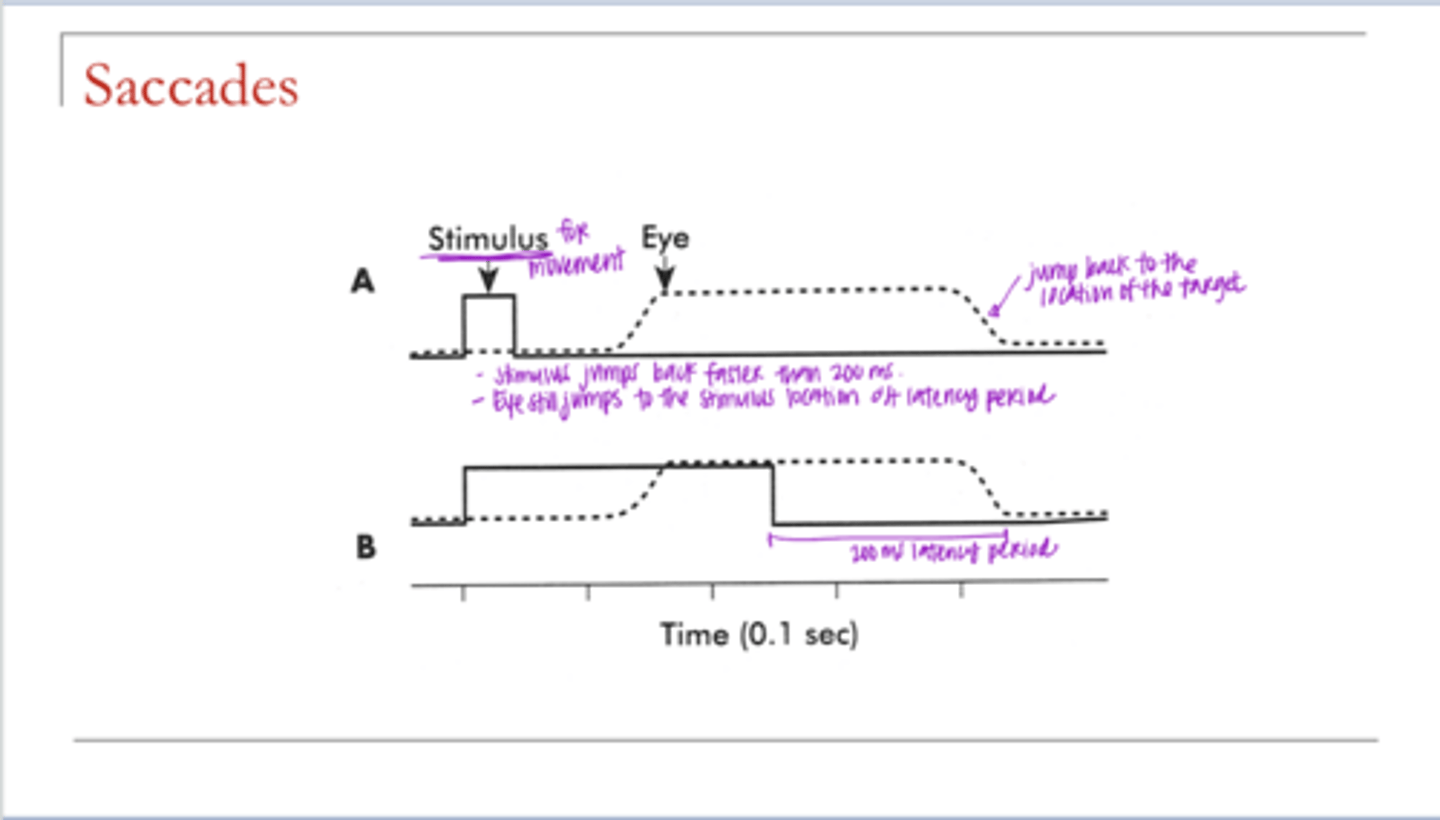
Does the target move before the eye is able to process this movement & initiate an eye movement?
Yes -- known as the latency period
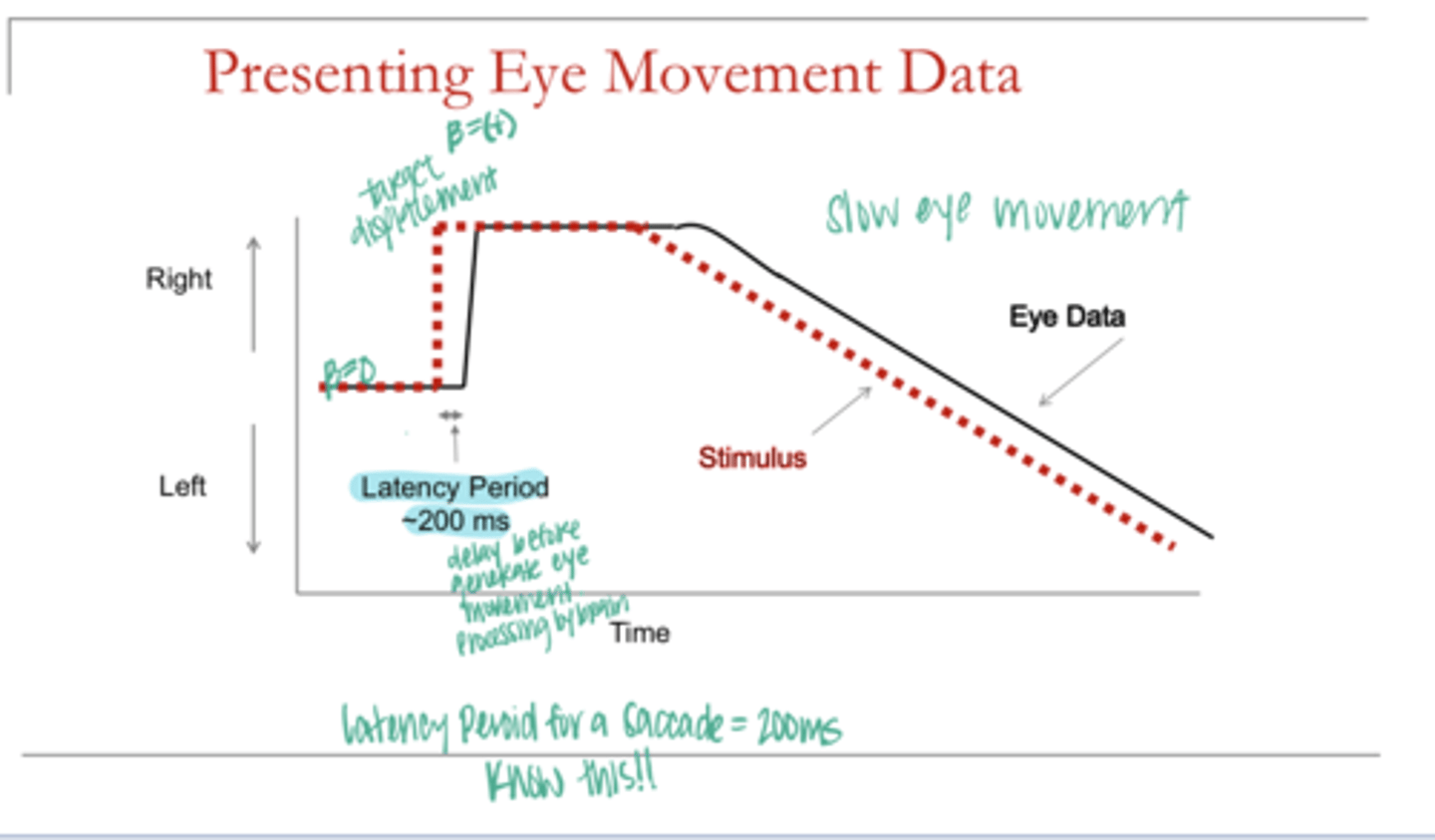
What is the latency period for a saccadic movement?
200ms
Saccadic Eye Movement Example #1
Two LED lights are positioned in front of patient. LED1 is straight ahead. LED2 is 10º to the left of straight ahead. You patch the patient's left eye and instruct her to look at the illuminated target. At time 0.000 sec LED1 turns on, at time 5.000 LED1 turns off/LED2 turns on.
Determine Ocular Direction, Oculocentric Direction, and Egocentric Direction at Time 4.000sec....
-Patient will be looking at LED1
-Ocular Direction: 0
-Oculocentric Direction: 0
-Egocentric Direction: 0
Saccadic Eye Movement Example #1
Two LED lights are positioned in front of patient. LED1 is straight ahead. LED2 is 10º to the left of straight ahead. You patch the patient's left eye and instruct her to look at the illuminated target. At time 0.000 sec LED1 turns on, at time 5.000 LED1 turns off/LED2 turns on.
Determine Ocular Direction, Oculocentric Direction, and Egocentric Direction at Time 5.100sec....
-Patient will be looking at LED1
-Ocular Direction: 0
-Oculocentric Direction: -10
-Egocentric Direction: -10
Saccadic Eye Movement Example #1
Two LED lights are positioned in front of patient. LED1 is straight ahead. LED2 is 10º to the left of straight ahead. You patch the patient's left eye and instruct her to look at the illuminated target. At time 0.000 sec LED1 turns on, at time 5.000 LED1 turns off/LED2 turns on.
Determine Ocular Direction, Oculocentric Direction, and Egocentric Direction at Time 5.600sec....
-Patient will be looking at LED2
-Ocular Direction: -10
-Oculocentric Direction: 0
-Egocentric Direction: -10
Saccadic Eye Movement Example #2
Two LED lights are positioned in front of patient. LED1 is 5º to the left of straight ahead. LED2 is 5º to the right of straight ahead. You patch the patient's left eye and instruct her to look at the illuminated target. At time 0.000 sec LED1 turns on, at time 5.000 LED1 turns off/LED2 turns on.
Determine Ocular Direction, Oculocentric Direction, and Egocentric Direction at Time 4.000sec...
-Patient will be looking at LED1
-Ocular Direction: -5
-Oculocentric Direction: 0
-Egocentric Direction: -5
Saccadic Eye Movement Example #2
Two LED lights are positioned in front of patient. LED1 is 5º to the left of straight ahead. LED2 is 5º to the right of straight ahead. You patch the patient's left eye and instruct her to look at the illuminated target. At time 0.000 sec LED1 turns on, at time 5.000 LED1 turns off/LED2 turns on.
Determine Ocular Direction, Oculocentric Direction, and Egocentric Direction at Time 5.100sec...
-Patient will be looking at LED1
-Ocular Direction: -5
-Oculocentric Direction: 10
-Egocentric Direction: 5
Saccadic Eye Movement Example #2
Two LED lights are positioned in front of patient. LED1 is 5º to the left of straight ahead. LED2 is 5º to the right of straight ahead. You patch the patient's left eye and instruct her to look at the illuminated target. At time 0.000 sec LED1 turns on, at time 5.000 LED1 turns off/LED2 turns on.
Determine Ocular Direction, Oculocentric Direction, and Egocentric Direction at Time 5.600sec...
-Patient will be looking at LED2
-Ocular Direction: 5
-Oculocentric Direction: 0
-Egocentric Direction: 5
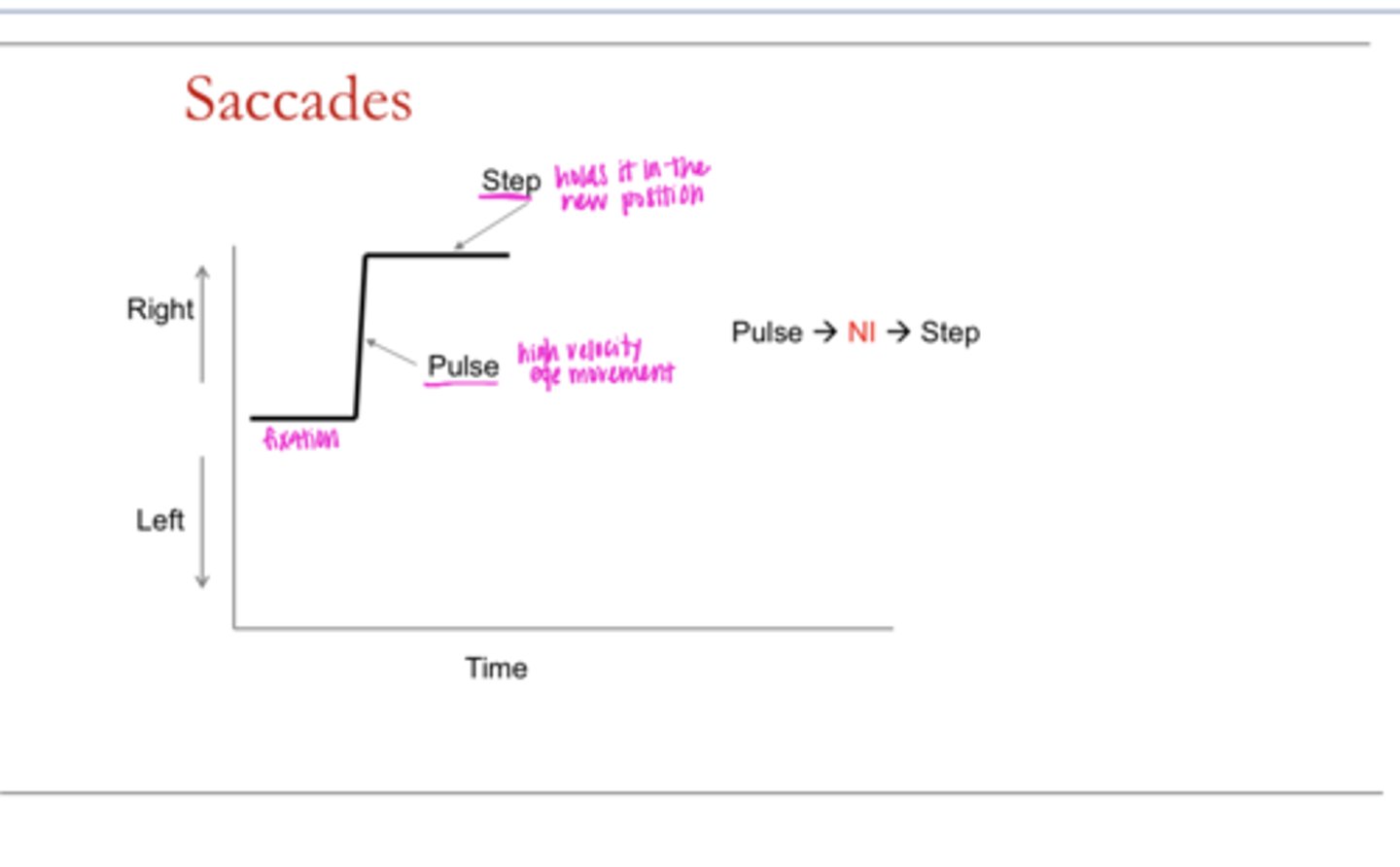
What are the 2 parts to a saccade?
-pulse
-step
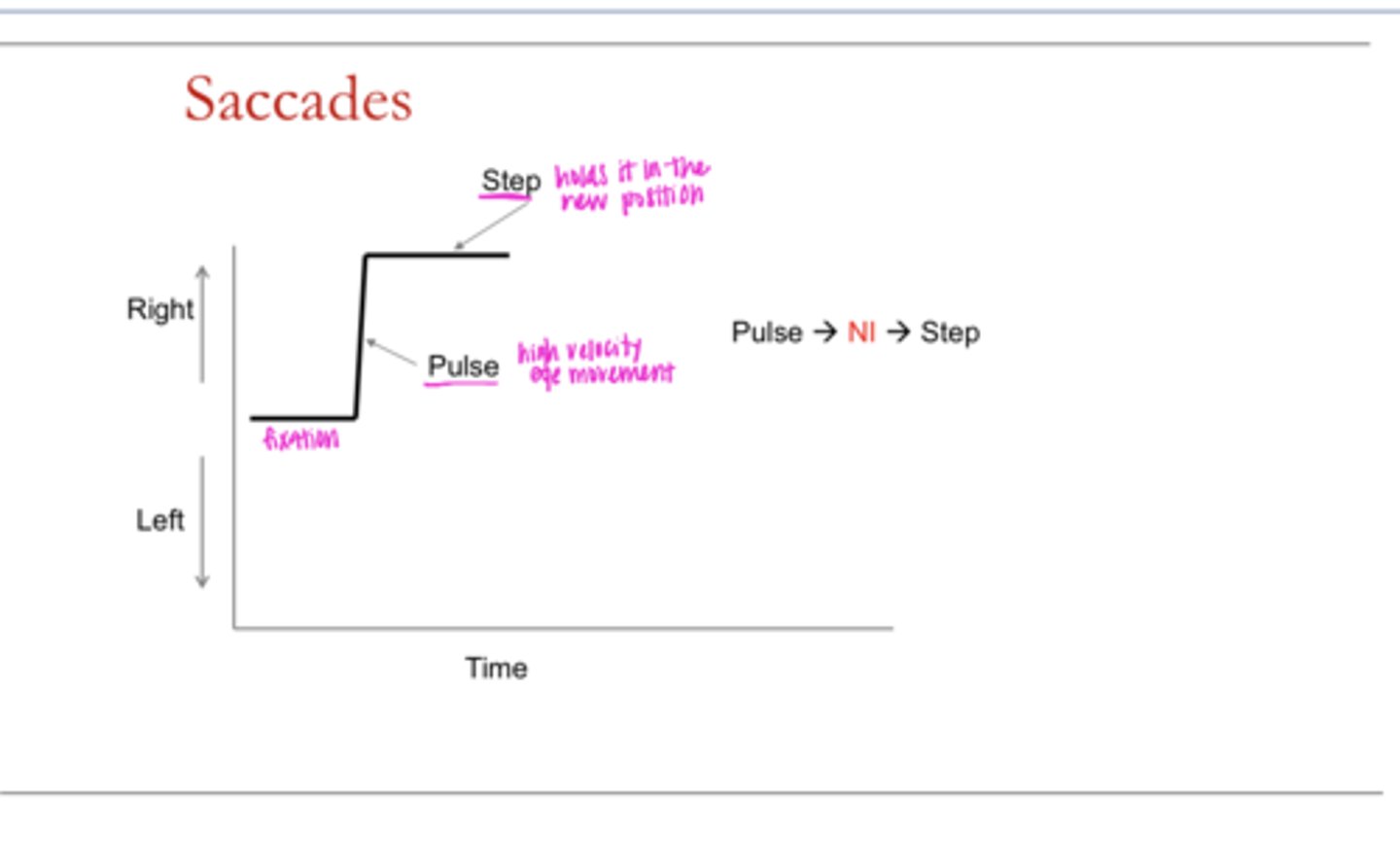
What is the pulse of a saccade?
Drives the eye to a new position; generated neurally by a pulse which overcomes the viscous resistance of the globe and its orbital contents
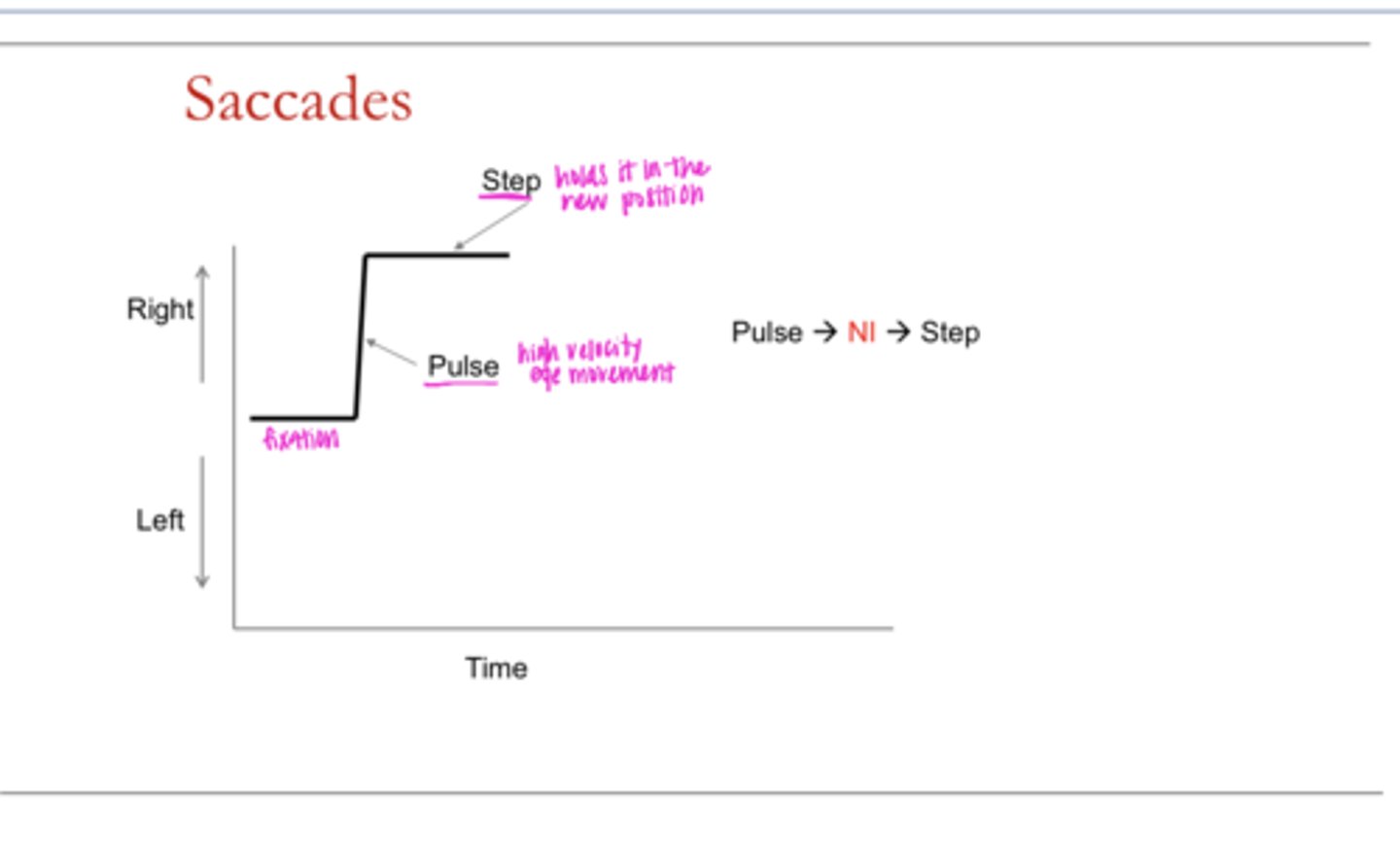
What is the step of a saccade?
Keeps the eye in a position; maintains eye in a new position; overcomes "elastic" forces tending to pull the eye back to its original position
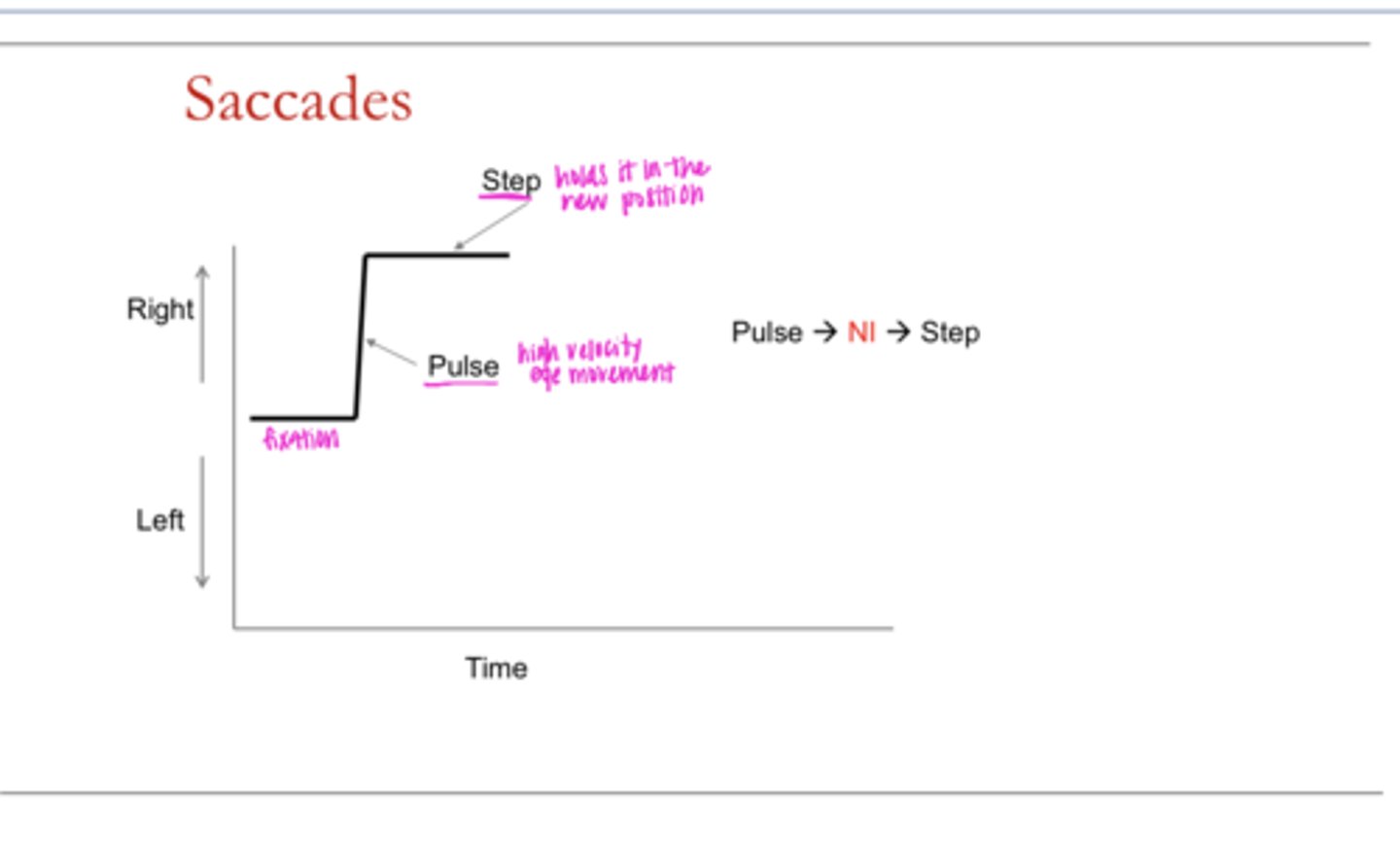
What is step created from?
pulse by a neural integrator
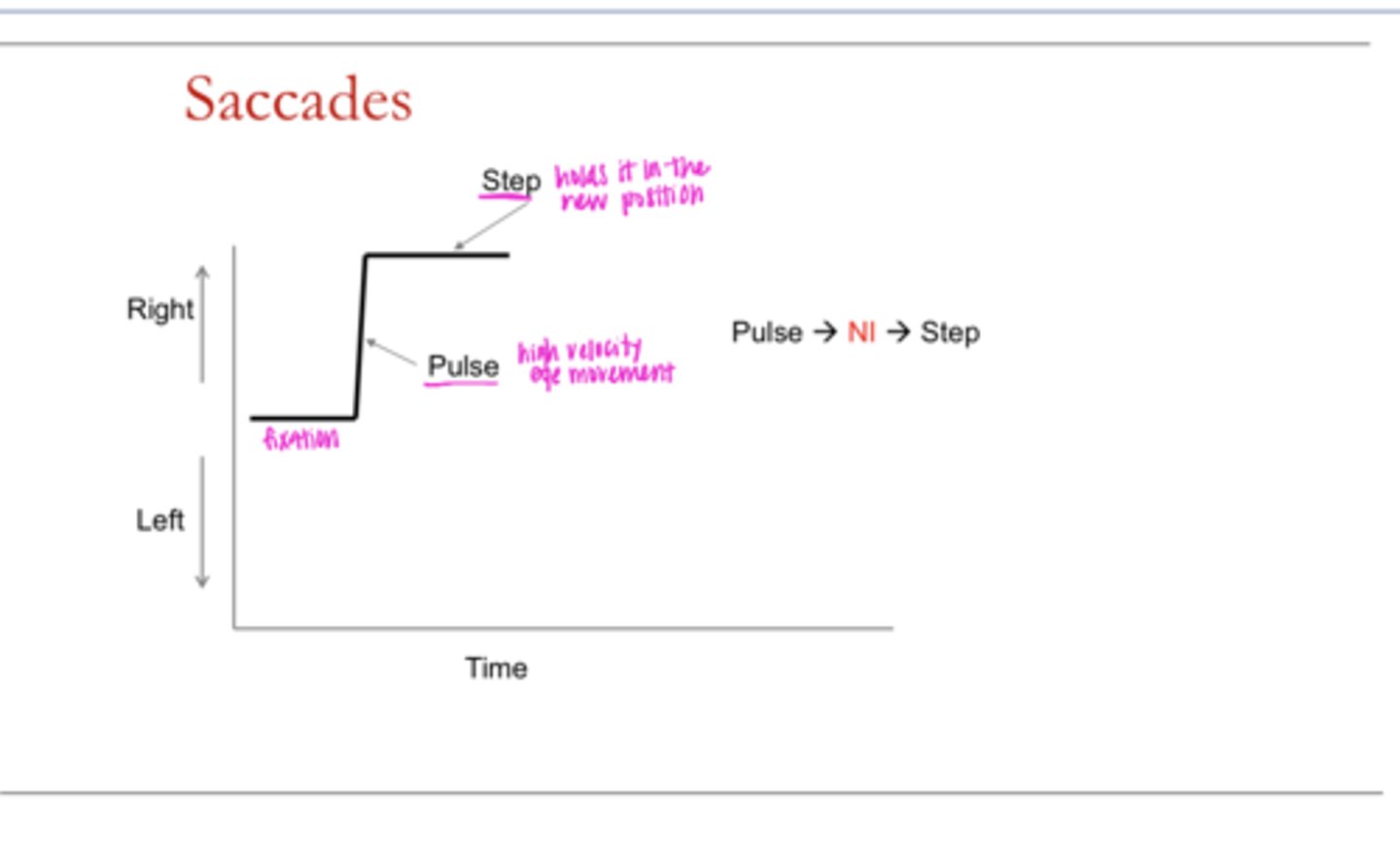
Saccade w/ Pulse and Step (Pic)
Saccade w/ Pulse and Step (Pic)
True or False:
Pulse and Step should be matched accurately to reach the proper position at the end of the saccade
true
If pulse and step are not matched correctly, what will happen to the eye after the pulse?
The eye will slowly go to where the step "wants to be"
Movements that get you to where you are supposed to be after a pulse
glissades
When do glissades occur?
between the pulse and step
What do glissades make up for?
inaccurate saccades
Are glissades fast or slow?
slow (100ms)
If the pulse is too long, what happens?
You will get an overshoot with a glissadic return - HYPERMETRIC SACCADE
If the pulse is too short, what happens?
You will get an undershoot with a glissadic return - HYPOMETRIC SACCADE
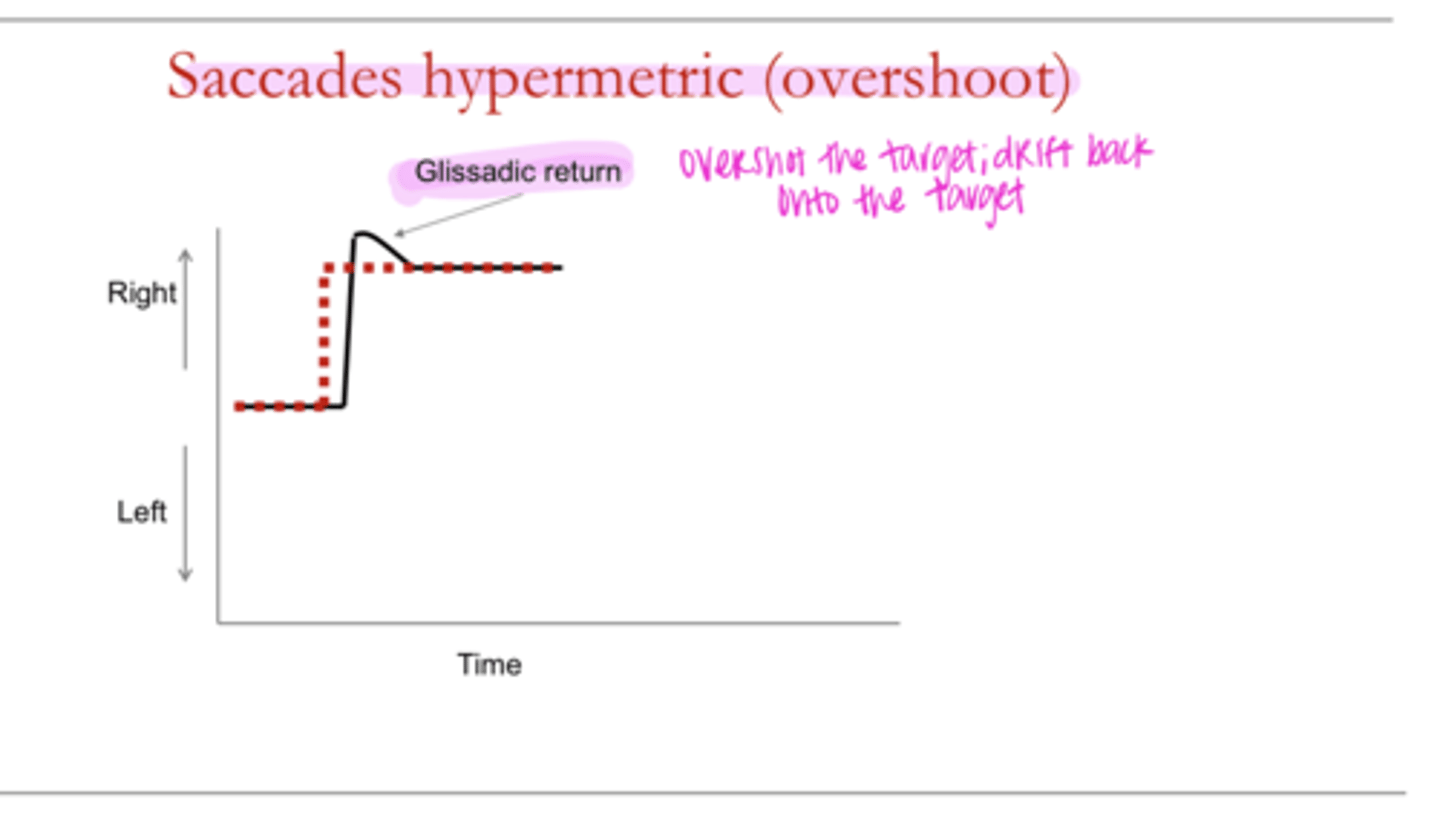
Saccades HYPERMETRIC Overshoot (Pic)
Saccades HYPERMETRIC Overshoot (Pic)
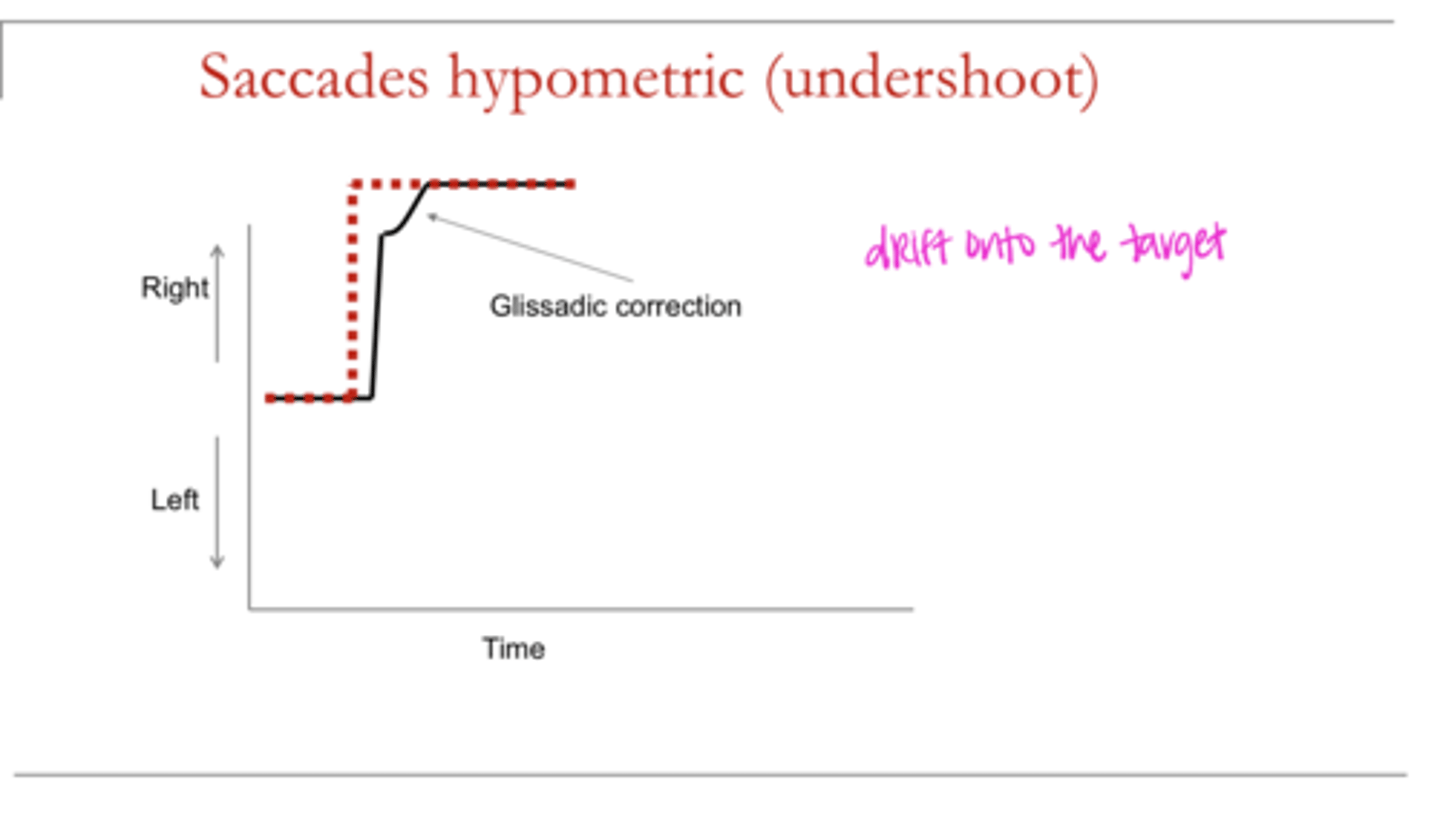
Saccades HYPOMETRIC Undershoot (Pic)
Saccades HYPOMETRIC Undershoot (Pic)
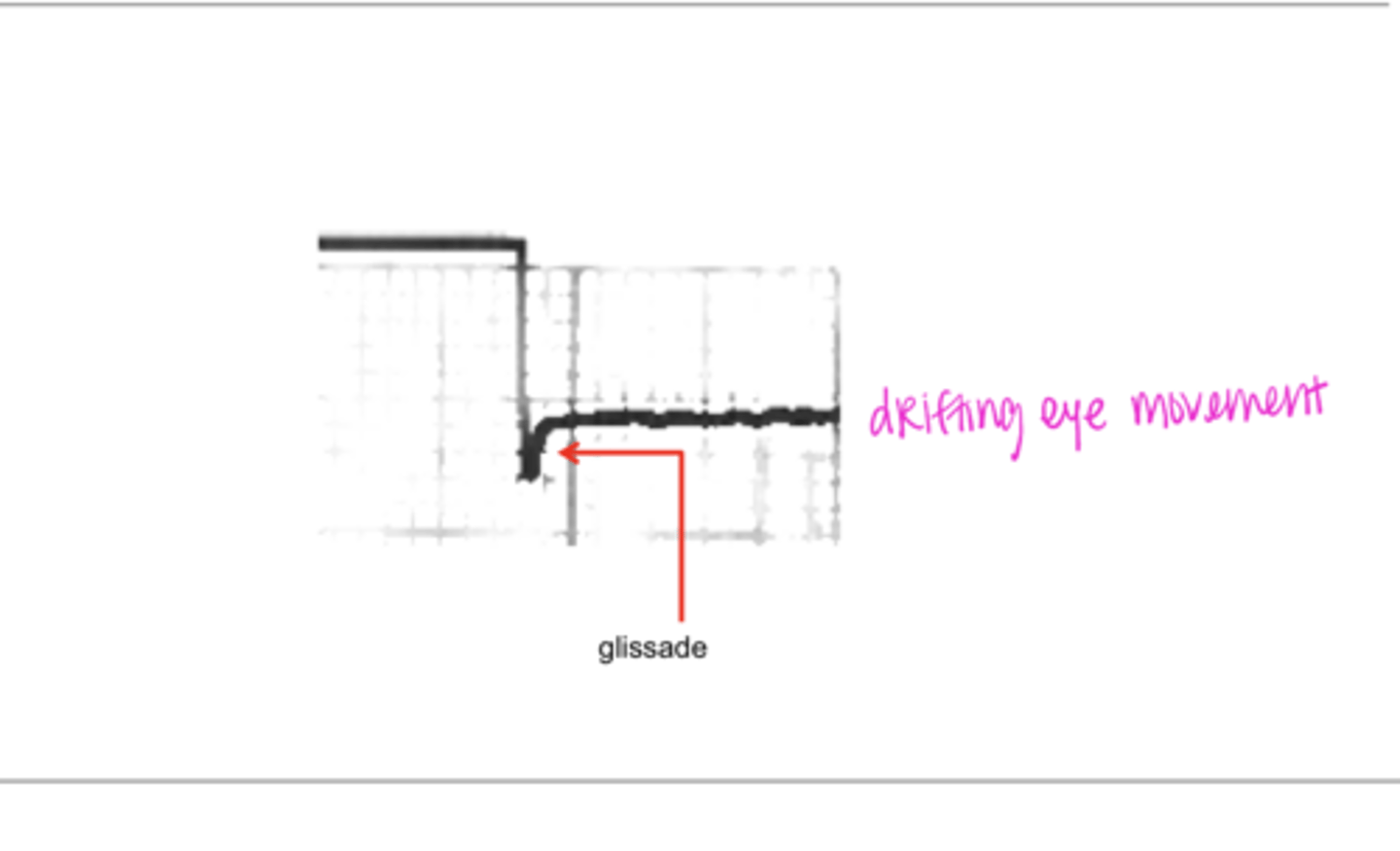
Glissade (Pic)
Glissade (Pic)
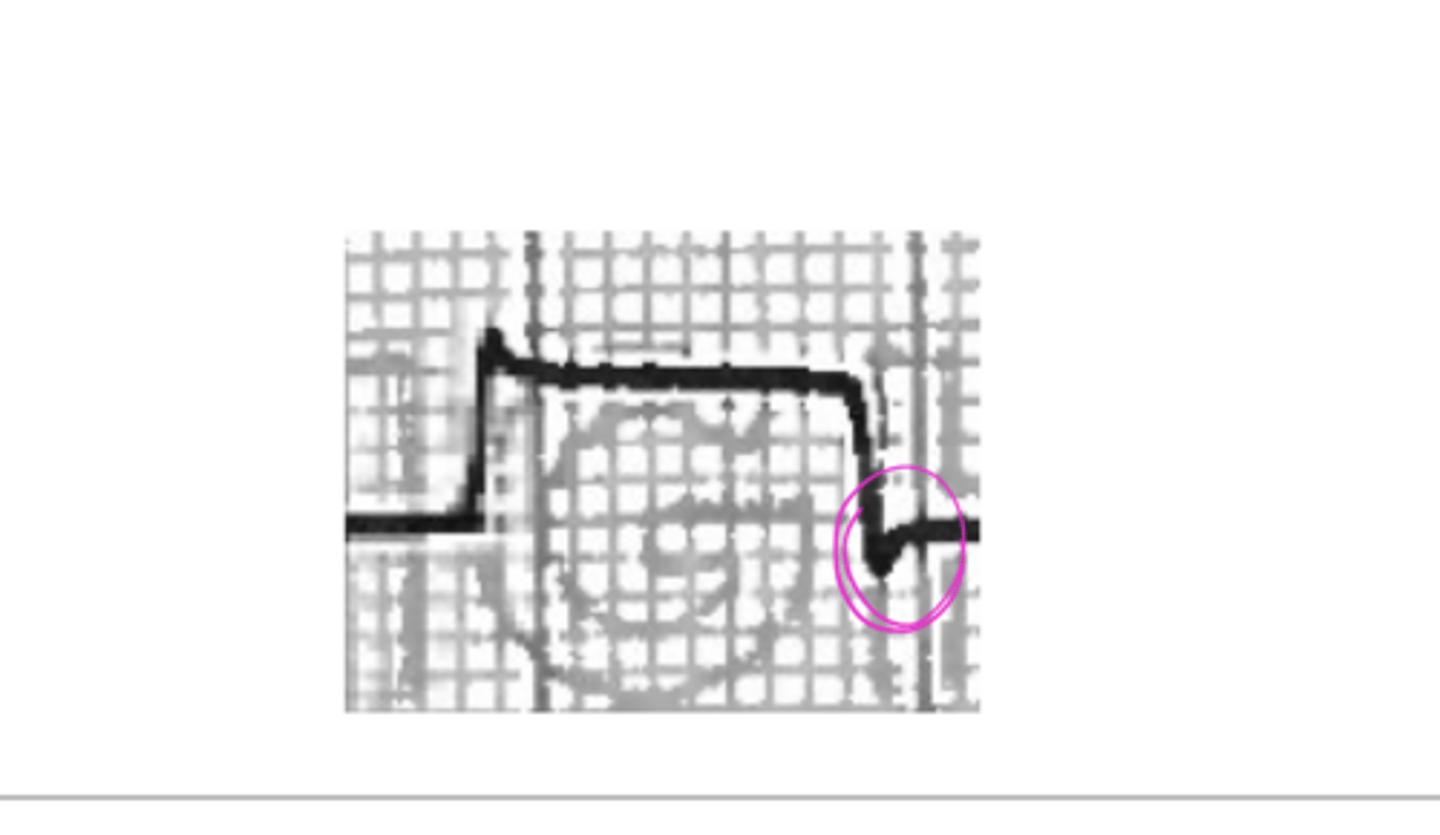
Glissade (Pic)
Glissade (Pic)
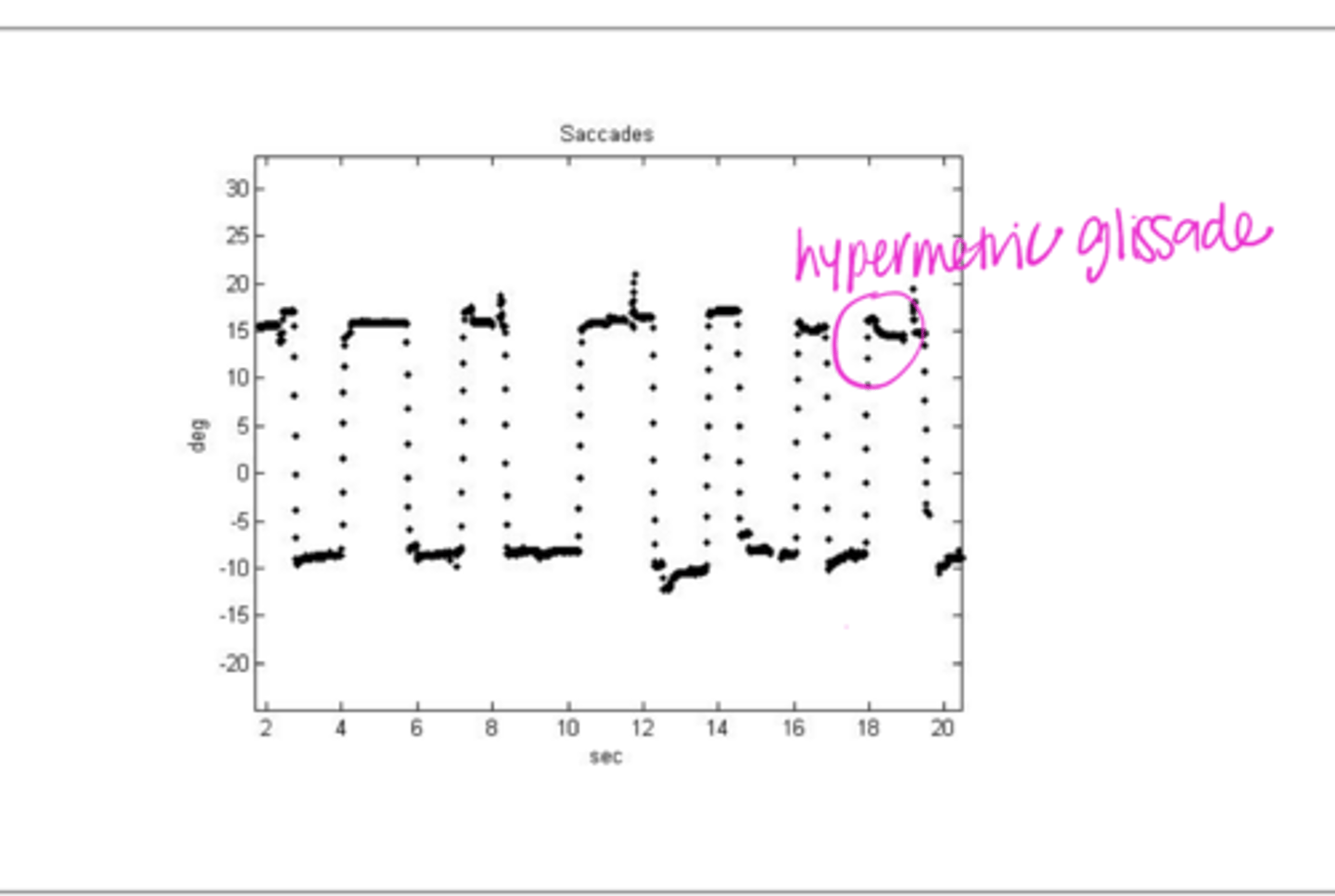
Glissade (Pic)
Glissade (Pic)
What is the typical behavior for a large saccade?
almost always will undershoot followed by a corrective saccade (this is not a glissade)
The latency period is traditionally said to be ______ ms on average
200
What is the duration of response in correlation to a saccade?
from when the eye starts to move to when it is actually pointed at a target (from the beginning to the end of a response)
Saccadic latency involves what?
trying to decide if there is a target at all and if so, whether to look at it
The greatest changes in latency are caused by what?
providing subjects with prior info about movement of the target
If the subject knows in advance where the target is going to appear, latency will (increase/decrease) compared to the case where the target can appear in one of two positions
decrease
Any warning signal before a saccade, that helps the subject predict when a target will appear will (increase/decrease) latency
decrease
Saccades that have a really short latency period d/t a warning period are called what?
express saccades
In general, a ______ msec latency period is required following completion of a saccade prior to a second saccade occuring
Saccades in Response to a Moving Target (Pic)
Saccades in Response to a Moving Target (Pic)
Saccades are very (low/high) velocity eye movements
high
True or False:
Image of the world will sweep across the retina very rapidly during a saccade
true
What is saccadic suppression?
elevation in the visual threshold before, during and after a saccade
Example of Saccadic Suppression
Detection of a brief flash of light decreases by 50% or more 20ms before to about 35ms after a saccade
Why would saccadic suppression be useful?
Otherwise smearing of the retinal image would occur during high velocity saccades
The change is visual threshold from saccadic suppression does not account for what?
the almost complete absence of a blurred percept during a saccade (would create a grayed out blur to be perceived during a saccade)
_______ is believed to be responsible for the lack of blurring during a saccade
Saccadic omission
What is saccadic omission?
Obscuration of a target by an immediately preceding (forward masking) or succeeding (backward masking) visual stimulus