Ruminant Anesthesia
 Call Kai
 Learn
Learn Practice Test
 Spaced Repetition
 Match
Match Flashcards
 Knowt Play
1/42

There's no tags or description
Looks like no tags are added yet.
Name | Mastery | Learn | Test | Matching | Spaced | Call with Kai |
|---|
No analytics yet
Send a link to your students to track their progress
43 Terms
T/F: Regurgitation is an important problem during ruminant anesthesia that can be prevented
False, it is an important problem but it can’t be prevented
Ruminants produce a lot of _______ which can be an additional unique factor for them during anesthesia
Saliva
Because Ruminants are prey species it can be much more difficult to assess their ____
Pain, they are much better at hiding it
What is the universal pain scale used for ruminants?
UNESP-Botchu pain scale (it has variations for each species. Cattle, sheep, goats)
What are the 5 goals of anesthesia?
Patient should be unconscious
Patient should be immobile
Provide Analgesia
Avoid complications
Safe induction and recovery
T/F: Like horses, ruminants should not be fasted before a procedure
False, fasting is very important for ruminants since regurgitation and chewing their cud is common and happens often
All ruminants should be fasted expect for _______
Neonates (their rumen isn’t fully developed yet and they are at risk of being hypoglycemic if you do)
How long before surgery should ruminants be fasted for?
Adult Cattle (18-24 hrs)
Adult sheep/goats (12-18 hrs)
What advantages are there to fasting ruminants before anestheisa?
Preserve a better FRC (Functional Residual Capacity) - which does reassess the risk of hypoxemia
Reduces the likelihood of bloat during anesthesia/recumbency
What is the FRC (Functional Residual Capacity)?
Air left in the lungs after normal passive exhalation
If the FRC decreases then the patient is more likely to develop hypoxemia
Prolonged fasting beyond the recommended time is not good for ruminants, what are some negative side effects of prolonged fasting (>24hrs)?
Hypomotility of the Rumen
Bradycardia (decreases rumenoreticular fill → increases parasympathetic tone → bradycardia)
Regurgitation more likely
Dehydration
Which act allows for ELDU (Extra Label Drug Use) in vet med?
AMDUCA of 1994
What are the requirements for ELDU?
When the animals health is threatened or death may result without intervention
When prescribing meds extra label, what resource can you use to estimate withdrawal times and get updates on prohibited ELDU?
FARAD (Food Animal Residue Avoidance Databank)
If you have a healthy and normal ruminant for a standard procedure, what type of pre-op BW is required?
PCV + TP
Weight is a very important objective piece of information that is necessary to gather before a procedure, what are the 2 methods of collecting a ruminants weight?
Scale
Estimation via girth circumference
What are the 5 non-species specific risks/complications of anesthesia?
Hypotension
Hypoxemia
Hypoventilation
Hypothermia
Bradycardia
4H1B
What are some ruminant specific anesthetic complications?
Regurgitation and excessive salivation
Aspiration pneumonia
Ruminal tympani (bloat)
Why are ruminants more prone to aspiration?
They are constantly regurgitating (active and passive)
How can you reduce the risk of fatal aspiration in ruminants?
Appropriate fasting and water deprivation
Protect the airway
Point head downwards (so regurgitations are less likely to be aspirated on)
Does giving Atropine (anticholinergic) help prevent excess salivation in ruminants?
No, it only reduces the aqueous portion of the saliva, which actually has the opposite effect making the saliva thicker and harder to clear
T/F: Like horses, you have to worry about neuropathy and myopathy in ruminants due to positioning
True
Why is bloat such a concern in ruminants during anesthesia?
Fermentation of their ingests continues while they are under anesthesia, so gas production doesn’t stop
Gas accumulation has negative side effects
Decreases the FRC and impedes ventilation
Increases the risk of regurgitation
T/F: Most routine surgical procedures in ruminants is performed via general anesthesia
False, it is typically done via sedation and line blocks
When sedating ruminants be careful administering ______ as they are sensitive to it
Xylazine
Which is more sensitive to Xylazine?
Goats or Cattle
Brahmans or Holsteins
Goats
Brahmans
What are some of the negative effects that can occur with Xylazine administration in ruminants?
Ruminal Hypomotility
Uterine contractions
It has oxytocin like effects
If you are trying to avoid causing rumen hypomotility, ____________ is a good alternative for sedation
Benzodiazepines (Diazepam/Midazolam)
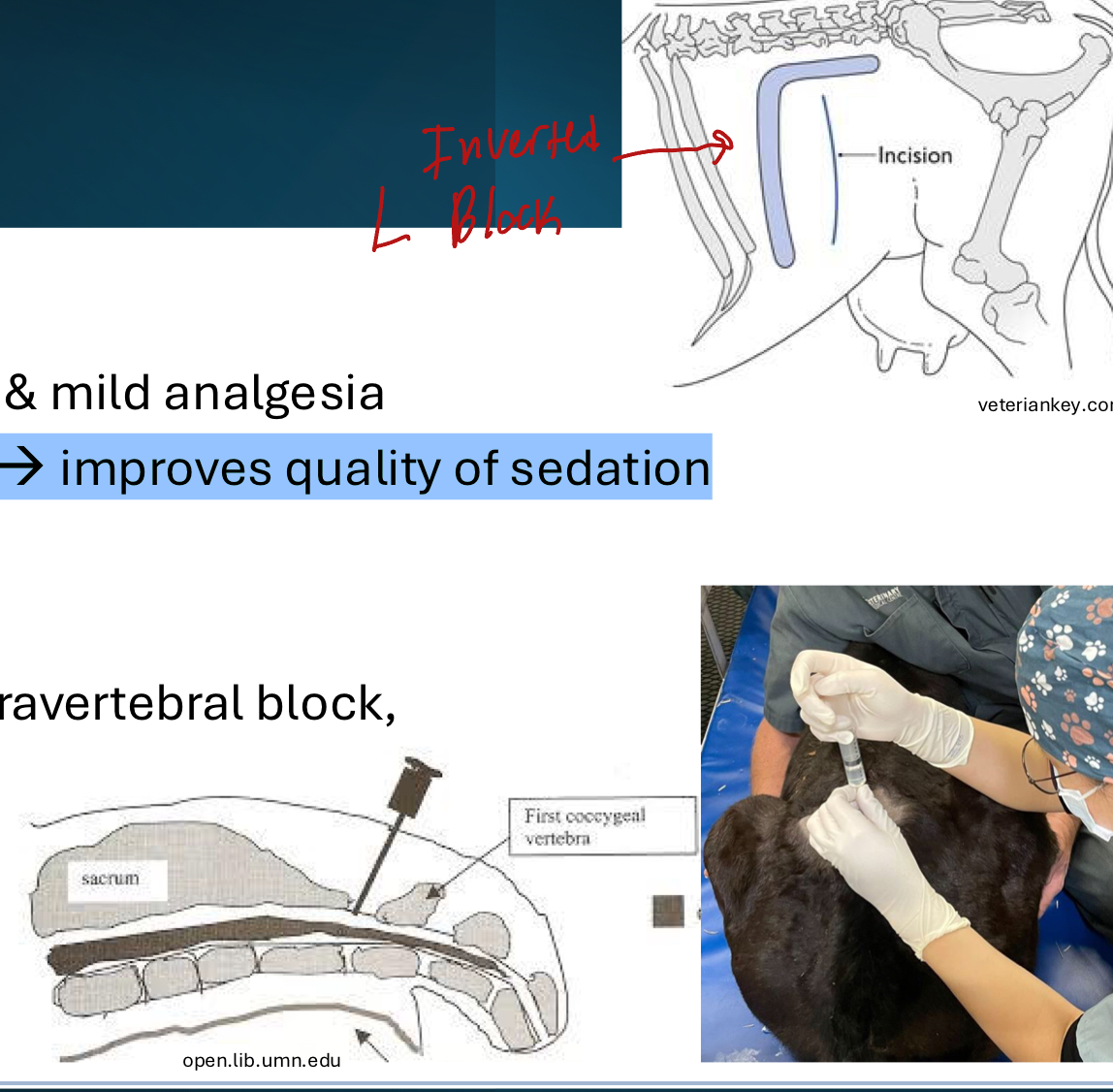
If you are performing an abdominal surgery in a ruminant, what are the 3 options for local blocks?
Paravertebral block
Inverted L block
Line Block
______________ (Analgesia) is prohibited from being used in dairy cattle >20 months of age
No Phenylbutazone
Which sedative when given to a ruminant in late gestation, has oxytocin-like effects and cause uterine contractions?
Xylazine (Alpha-2-Agonist)
Alpha-2 agonists can cause dose-dependent hypoxemia and Pulmonary edema in what species?
Sheep
What is the most common combination of induction drugs that are used in ruminants?
Ketamine + Benzodiazepine
T/F: While you can use Propofol + Alfaxalone as a induction agents for adult cattle, it is not practical due to price
True
Before intubating cattle for ET intubation why is it important to ensure that the patient is in the proper anesthetic depth
If the depth is not adequate then the gag reflex is still present → Increased risk of regurgitation
As soon that the ET tube has been placed what is the next step that should occur?
It should be inflated to prevent aspiration
What is the most common method used to intubate a ruminant?
Digital Palpation