ENTOM prelim 2
 Call Kai
 Learn
Learn Practice Test
 Spaced Repetition
 Match
Match Flashcards
 Knowt Play
1/87

There's no tags or description
Looks like no tags are added yet.
Name | Mastery | Learn | Test | Matching | Spaced | Call with Kai |
|---|
No analytics yet
Send a link to your students to track their progress
88 Terms
Immune defense
A defense system that protects the body from non-self, purpose is to attack or eliminate foreign materials, assumes colonization or invasion has occurred
Phagocytosis
Phagocytic immune cells engulf extracellular parasites and destroy them with powerful enzymes ex. Neutrophils, macrophages, eosinophils attack macroparasites, natural killer cells attack infected/stressed host tissue
Leukocyte
White blood cell, most (vertebrate) immune defenses mediated by white blood cells, WBCs play a role in innate and adaptive immune defenses ex. Neutrophil, eosinophil, basophil, monocyte, b-lymphocyte, t-lymphocyte
Antibody
Immune molecules produced by B-cells that bind to antigens
antigen
Antibody generator, molecule that stimulates an immune response
ANA
Anti-nuclear antibody. Autoantibodies that target host cell components, indicator of autoimmune activity
Melanization
Invertebrate defense, phenoloxidase cascade (series of enzymatic reactions) that ends in the deposition of melanin and toxins on the surface of the parasite that simultaneously walls and kills off the invader
Hemocyte
Invertebrate defenses, open circulatory system filled with hemolymph (non-cellular component of invertebrate blood (like plasma). Several major cell types
Hygiene Hypothesis
Allergy, autoimmune disease emerge from lack of exposure to parasites/microbes
Complement cascade
Innate defense III, production of anti microbial peptides. This consists of 20 proteins or protein fragments that make up the compliment system. These proteins do a couple of things – they first bind to the outside of pathogen cells to mark extracellular parasites in a way that makes it easier for white blood cells like neutrophils to locate and attach to them – this is called opsonization. Or, they work together to punch holes in the surface of cells – so they bind the cell membranes, as shown here, and make holes in them, opening them to an influx of fluids that then run in and explode the cell.
List two major types of host defenses other than the immune system.
Behavior defenses (avoid disease, physically remove parasites), physical barriers (skin and fur, fluids, mucous, cilia, commensal microbes)
Provide an example of a major genetic mutation that confers pathogen resistance in humans.
HIV resistance in humans can result from single mutation in CCR5 co-receptor, most common in northern europe. prevents disease from entering cells
Contrast innate vs. adaptive immune defenses and provide an example of each.
Innate: immediate, generally non-specific, animal could become re-infected if re-exposed. Adaptive (acquired): up-regulated following infection; specificity, memory to block re-infection but with a time delay
Innate immune defenses
First line of defense, non-specific, 3 major components: inflammation response, phagocytic immune cells, antimicrobial compounds
Invertebrate innate immune defenses
Barriers, phagocytosis(via hemocytes), melanization, encapsulation, antimicrobial peptides
List four key properties of adaptive immunity.
Specificity: ability to recognize and attack specific cell-types. Memory: the ability to remember cells that have invaded previously. Diversity: the ability to respond to a wide range of invasive organisms. Self tolerance: ability to recognize and not attack self
Contrast immune defenses that would be effective against an intra- vs. extra-cellular pathogen.
Intracellular pathogens are best controlled by cell-mediated immunity, which destroys infected cells(CD8+ and t-cells (TH1), MHC 1), while extracellular pathogens are targeted by humoral immunity, including antibodies and phagocytosis that act directly on the pathogen (b cells, antibodies, complement system, TH2, MHC2)
What's the difference between humoral immunity and cell-mediated immunity?
Cell mediated immunity is necessary to destroy pathogens within host cells (intracellular pathogens), humoral immunity attacks pathogens outside of host cells (extracellular pathogens)
Compare and contrast major components of invertebrate vs. vertebrate immunity.
Invertebrates: only innate, vertebrates: innate and adaptive immunity, specialized cells
What makes HIV successful at defeating the human immune system?
HIV is a retrovirus that lacks mechanisms to correct eros during replication (error rate of 10^-4 per base, or one mutation per genome per replication cycle), resulting in high genetic diversity of HIV. lymphocytes can't keep up with all the new antigen diversity. Evades immune detection
What is the allograft theory of devil facial tumor disease?
Transmissible cancer, hosts can't recognize tumor cells as foreign, consequence of low MHC diversity
Host resistance
Ability to prevent or limit parasite infection
Tolerance
Ability to perform well despite increasing pathogen burden.
Given the substantial benefits of disease resistance, why aren't all hosts resistant to most pathogens? (i.e., what factors maintain variation in host resistance to infection?)
Evolution of resistance can be limited by lack of genetic variation, host parasite genetic interactions, cost of resistance. Genetic variation not always available for selection to act upon (Tasmanian devils).
Describe several types of 'resistance costs' and provide an example of each.
Resistance costs are tradeoffs where investment in immune defense reduces fitness in other areas such as energy, reproduction, or survival; examples include energetic costs of immune activation, autoimmune damage, and genetic tradeoffs like sickle cell resistance to malaria.
List 3 ways that immune defenses can fail or malfunction.
Parasite evasion: parasites can hide from the immune system, interfere with host immune function, destroy elements of the immune system, produce molecules similar to the host or coat pathogen cells in host protein, change their surface antigens. Trade-offs within the immune system: Th1-Th2 trade-off (specific-general)
How is tolerance measured? Can it be measured in individuals?
Change in host fitness with infection load. Yes as long as fitness and pathogen load are tracked
Plot how host fitness varies with pathogen load for different scenarios of resistance and tolerance.
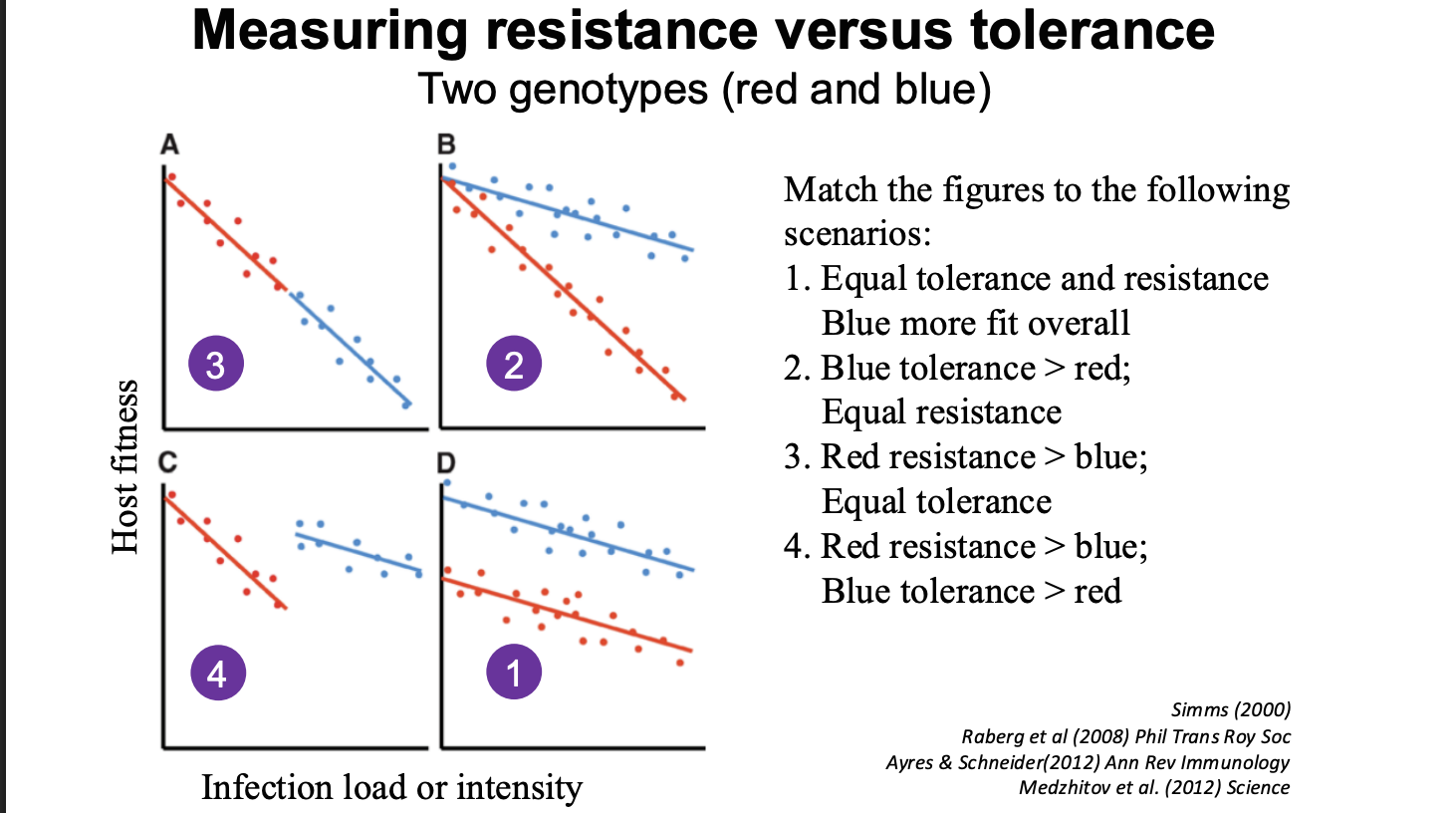
Mutualistic coevolution
All participants benefit as a result of the interaction (pollination, seed dispersal, fig wasps and ficus)
Antagonistic coevolution
At least one participant suffers as a result of the interaction (brood parasites, predator-prey)
Gene-for-gene model
Co-occurring gene for resistance in host and virulence in parasite. Hypothesis is that for each (mostly) resistant gene, there is a corresponding gene in the pathogen that can overcome resistance. Plants and their pathogens ex. Resistance is a dominant genotype in the host, infectivity is a recessive genotype in the pathogen
Matching alleles model
Successful infection only occurs when the parasite genotype matches the host genotype
Which model(s) is/are associated with arms races versus Red Queen dynamics?
Gene for gene leads to arms race (directional escalation), matching alleles model (red queen dynamics cycling)
Describe host-parasite coevolution according to the Red Queen hypothesis.
Species must constantly evolve just to maintain fitness, parasites track common host genotypes, hosts benefit from being rare, leads to negative frequency-dependent selection
Predictions of red queen negative frequency dependent selection
Parasites should be most infective in common hosts (and less able to infect rare hosts), parasites should better infect current host genotypes than those common in the past or future, parasites should better infect local hosts genotypes (sympatric) than those from elsewhere (allopatric)
Describe Muller's ratchet
Mutation elimination hypothesis. Most mutations are deleterious, deleterious mutations affect the success of asexual reproducers, each generation new mutations increase the average genome contamination, recombination/sex is directly beneficial by purging deleterious mutations
list five costs of sex.
Costs of sex: recombination scrambles genotypes, disrupting favorably adapted gene combinations, meiosis and syngamy take longer than mitosis (slows pace of reproduction), sex can be risky, males and females may have trouble finding each other when population densities are low, all else being equal sexual populations grow more slowly than asexual populations
Why would Red Queen dynamics favor sexual reproduction?
Sex would be favored in host-parasite interactions because it generates diverse progeny, some of which may have novel resistance genotypes and be able to withstand parasite attack or disease ex.
MHC
Major histocompatibility complex, chromosome 6 in humans, controls a range of recognized antigens. Recognition of non-self from self, a set of genes that express surface proteins on cells that represent a molecular antigenic signature that the immune system recognizes as self or non-self. Essential for an acquired immune system to recognize specific threats. MHC binds parasite peptide fragments and presents them on the cell surface for t-cell recognition
sexual selection
A form of selection where traits (including genetic traits like MHC) influence mating success often through mate choice preferences
balancing selection
Natural selection that maintains genetic diversity in a population rather than reducing it ex, heterozygote advantage, negative frequency-dependent selection
pathogen processing
The process by which pathogens are broken down into antigen fragments and presented by MHC molecules to immune cells, the binding of antigens and presentation to immune cells
Briefly explain the difference between MHC type I vs type II peptides
Class I is inside the cell, killing infected cells. Class II outside the cell activatingt he immune response
MHC Class I
expressed on all nucleated cells; present foreign molecules from inside cells. Activates cytotoxic T cells (CD8+) which kill infected cells
MHC Class II
Found in specialized immune cells, presents extracellular pathogens, activates helper t cells (CD4+) which stimulate antibody production
Why is MHC diversity important for pathogen defense, and is there evidence to support this relationship in wildlife systems?
Each MHC molecule recognizes specific pathogen peptide.antigen, multiple MHC alleles needed to recognize diversity of pathogens. High levels of variation (genetic polymorphism) needed to respond to variety of foreign antigens. Basically, higher MHC diversity improves pathogen defense. Ex. House finches with low MHC diversity were most susceptible, stickleback fish study MHC diversity predict immune response strength, tasmanian devils low diversity and severe disease spread and population decline
How might sexual selection operate on MHC genes, and how does this relate to studies of mate choice and MHC in humans and other animals?
MHC diversity can influence mate choice (inbred mice showed preference for partners that differ in MHC type from their own, stickleback study females can be tricked by chemical perfumes). Individuals prefer MHC-dissimilar mates which increases offspring heterozygosity. Preference for higher MHC diversity (signals health), sometimes preference for specific alleles
Describe balancing selection and how it relates to MHC diversity.
Balancing selection maintains multiple alleles in a population, and in the case of MHC genes, it preserves high genetic diversity because individuals with diverse or rare MHC types are better able to recognize and resist pathogens.
What are the two evolutionary processes of balancing selection? Give an example for both.
Heterozygote advantage: individuals with more diverse MHC alleles recognize more pathogens, Negative frequency-dependent selection: rare alleles are favored because pathogens adapt to common ones
List several host behaviors that can lower exposure to parasites, or remove parasites after infection occurs.
Avoidance behaviors, grooming/hygiene, mate choice, diet/self-medication, social structure changes
Why was the transmission mechanism of myxomatosis considered to make it a good candidate for biocontrol of rabbit populations?
Myxoma is a DNA virus in poxvirus family, spread mechanically by mosquitos and other insect vectors. Myxoma causes severe disease in European rabbits, after its introduction in 1950, the virus spread rapidly and caused widespread mortality. Evolution of pathogen undermined control efforts, initial high mortality rates declined with viral evolution
Contrast the conventional wisdom—that parasites will evolve to be benign—with the 'enlightened' trade-off theory of virulence evolution.
Conventional wisdom: parasites evolve to be less harmful over time, killing hosts reduces transmission. Trade off: virulence evolves to an optimal intermediate level, trade off between transmission rate (B), host survival and infection duration (1/(a+y))
Why is within-host replication a key to predicting optimal virulence for a pathogen?
Higher replication, increases transmission rate (more pathogen shed) and increase virulence (more host damage)
Describe an example that supports the tradeoff theory of virulence evolution.
Myxoma virus in rabbits, initially extremely virulent (kills very fast)< over time evolved to intermediate virulence which kept the host alive longer and allowed for more transmission
How is transmission mode thought to influence optimal virulence levels?
As virulence increases, dependence on host mobility decreases. If transmission depends on host mobility, high virulence is costly and evolves lower virulence. If transmission does not depend on host mobility (vectors or water), pathogens can afford to be more virulent.
Why might a pathogen evolve extremely high levels of virulence?
If transmission still occurs despite host death (ebola), high replication greatly increases transmission, host condition does not limit spread
Why does coinfection with more than one parasite strain (e.g. in the rodent malaria system) change the course of virulence evolution?
In coinfections, prudent strains pay the cost without reaping the benefits. Competitions occurs, each strain benefits from faster exploitation of host resources despite the cost. ex. mice infected with multiple strains had more severe diseases and parasite growth.
What is meant by the term 'imperfect vaccine'?
Does not completely prevent infection or transmission, instead may reduce symptoms, reduce pathogen growth, reduce transmission partially. Vaccinated hosts can still get infected and spread the pathogen.
Explain direct versus indirect selection from control efforts.
Direct selection acts on pathogen traits by differentially allowing survival of certain strains under control efforts (ex anitbiotics kill sensitive bacteria and resistant survive), while indirect selection occurs when control measures alter ecological or epidemiological conditions, thereby changing which traits are favored (ex vax reduce infections or coinfections, changes compeition)
When and why might vaccines select for pathogens that are more virulent in unvaccinated hosts?
When vaccines reduce disease severity but not transmission, allow infected hosts to survive longer. This increases virulence because with imperfect vaccines, the hosts don't die as quickly, so the cost of virulence is reduced
Imperfect vaccines that reduce disease but not transmission can remove the cost of virulence, allowing highly virulent pathogen strains to evolve and cause more severe disease in unvaccinated hosts
Imperfect vaccines that reduce disease but not transmission can remove the cost of virulence, allowing highly virulent pathogen strains to evolve and cause more severe disease in unvaccinated hosts
Give an example of vaccine-driven virulence evolution.
Marek's disease, vaccine prevents illness, not infection. Virus is shed in dander and causes tumors and neurological problems (poultry). Virulent strains perform better in vaccinated hosts and the virus has become much more virulent than it was
Why is vaccine resistance less common than drug resistance?
Vaccines act early in infection and often target multiple pathogen components, this makes it harder for pathogens to evolve resistance. Drugs act later and target specific pathways making resistance easier
Why might high-dose treatment accelerate resistance?
High dose treatment prevents replication in susceptible individuals. Kills susceptible strains completely, leaves resistant strains with no competition, and maximizes their advantage. Best strategies for public health differ from what is best for individuals.
Why does reducing transmission change virulence evolution?
It alters the timing of infection in the population. If infections are mostly early-stage, favor pathogens that transmit quickly. If infections are late-stage, favors pathogens that persist longer
Coinfection and competition
Coinfection is when one host is infected by multiple pathogen strains at once, strains can compete inside the host and that changes evolution.
How vaccines change coinfection rates
Vaccines reduce total infections, so fewer infected hosts overall, much lower chance of getting multiple strains at once. After vaccination, pathogens mostly alone in hosts so no competition constraint
degree day
A measure of the difference in the mean temp of a given day (x) from the Tmin for development. Used to estimate parasite development time (more warm days → faster development). Degree days(x) = ((max temp(x) + min temp(x))/2) - Tmin. total degre days = sum (degree days (x))
musk ox lungworm
50% population decline seen in Muskox. Lungoworm infects Musxok, life cycle involves intermediate host (slugs) and reproduction occurs in primary hosts. The larva has temperature dependent development, Tmin is 8.5 and 9.5. Number of degree days per year increasing over time
What can climate change effect
Ecophysiology of host-parasite interactions, community ecology or biodiversity, and host behavior and phenology
thermal performance curve
Nonlinear (usually unimodal) relationship between temperature and biological performance. Include tmin(minimum), topt (optimal), tmax(maximum)
Why might vector borne diseases respond positively to climate warming?
Mosquito life cycle and development are temperature dependent. Malaria is limited by cooler ambient temperatures. Future warming could result in decreases in malaria transmission in currently permissive regions for transmission and increase in cooler regions
What other general classes of pathogens might show such a positive response to climate change and why?
Parasites with environmental stages (lungworm as larvae develop outside host, water temp). Marine disease (coral disease, white pox and white band warmer water increased pathogen growth). Arboviruses (zika, dengue), strongly temperature dependent transmission, ticks (warming over winter increase in life stage synchrony), monarch butterfly protozoan parasite (migrating shorter distances)
Give two specific examples of pathogens/parasites that have increased with climate warming.
Musk ox lungworm, malaria, arboviruses like zika
What was the demonstrated or assumed mechanism in each case through which warming affected the host and/or pathogen?
Musk ok lungoworm: development depends on degree days, warming more accumulated heat, shift from multi year to annual. Malaria: temperature affects mosquito survival, biting rate, parasite development
Explain the main arguments for why we might not expect a net increase in infectious disease following climate warming.
Climate change will cause shifts in current distributions of parasites, with some regions experiencing increases in parasitism and others reductions. Thermal response non linear, peak at optimal temperature
What are the key IPCC predictions regarding global change in temperature and precipitation?
Global temperature is increasing, strongest over land and at high northern latitudes. More extreme precipitation events
randomized badger culling trial
Culling to reduce wildlife reservoirs for bovine TB, experimental study in the UK testing whether culling badgers reduces bovine TB in cattle. Social response
Rabies
Viral disease transmitted through bites. Challenges for rabies control because many different wild animal species can be sources of infections. It was discovered that rabies persisted in serengeti because it was maintained in domestic dogs, and vaccinating those dogs successfully reduced disease in wildlife and humans. other wildlife got infected but couldn’t sustain transmission long term
Approaches to managing wildlife disease
Eradicate, control, prevent
Discuss two distinct approaches to managing wildlife diseases, and provide a specific example of each approach.
Eradication in sabellids: sabellied polychaete worm in CA abalone, infestation costly to yield but not lethal. Removed 1.5 M adult abalone, drove host density below threshold for persistence. Vaccination: reduce susceptibility, create resistant individuals and reduce transmission (ex rabies in serengeti, vaccinated domestic dogs). Culling (reduce host density), reduce population size below threshold for transmission (ex badger culling for bovine TB)
When is eradication feasible?
When R0 is low, infections restricted to a small area, recent introductions, need to detect the first cases and mobilize fast, frequent vigilance and reporting mechanisms
Compare and contrast the goals of vaccination versus culling for the control of wildlife disease.
Vaccination goals: create resistant individuals, reduce transmission. high coverage, to drive R0 < 1, low coverage, prevent population extinction. Culling goals: reduce host density
Under what circumstances might culling be counterproductive and why?
If the quantity of needed reduction is unknown, not effective without simultaneously reducing carrying capacity (otherwise births could increase), not effective if social structure changes or culling leads to immigration, random culling can increase severity of epidemics
Culling can be counterproductive when it increases susceptible individuals, disrupts social structure, or promotes movement and immigration, thereby increasing contact rates and disease transmission instead of reducing it
Which pathogens posed problems for black-footed ferrets, why were they especially harmful, and what was done to address the problem?
Canin distemper posed a major threat, effective and safe vaccines for ferrets difficult to locate. Black footed ferret range had nearly vanished, captured ferrets to recover. Sylvatic plague (yersinia pestis) affects prairie dogs (main prey
Articulate two hypotheses with opposite predictions concerning parasite biodiversity and host conservation threat status. Review evidence for one of these predictions.
A positive hypothesis predicts that threatened species harbor more parasites due to increased susceptibility and study effort, while a negative hypothesis predicts fewer parasites due to host decline and co-extinction; evidence from Pedersen et al. (2007) supports the positive relationship, showing that disease contributes to threat status in several mammal species
What are some arguments in favor of preserving parasite biodiversity?
Ecological importance, promote genetic diversity, major component of biodiversity, ecosystem roles, economic and medical value
Under what circumstance(s) could parasites drive host species to extinction?
High virulence, multi-host reservoirs, small to declining populations
List 2 pathogens that are driving the entire host community toward extinction. What factors might be important for their spread and impacts?
Chytrid fungus: causes massive amphibian declines, ⅔ of harlequin frogs disappeared. Spread of pathogens, human traffic (transportation of soil and water). White nose syndrome and bats: 7 bat species endangered, spreading west across the US, fungal spores can spread and shoes and clothes