Unit 4.3 Exploring Protein Synthesis
 Call Kai
 Learn
Learn Practice Test
 Spaced Repetition
 Match
Match Flashcards
 Knowt Play
1/109

There's no tags or description
Looks like no tags are added yet.
Name | Mastery | Learn | Test | Matching | Spaced | Call with Kai |
|---|
No analytics yet
Send a link to your students to track their progress
110 Terms
What are the 4 nucleic acids that make up DNA? What are they ‘responsible’ for?
A, G, T, and C; responsible for the ‘diversity of life’
Recall! What are proteins made of, how they’re linked, and their shape?
Proteins are made of long chains of amino acids; linked together by peptide bonds; they are folded
What is DNA made up of?
The 4 nucleic acids
What is a codon? Give a random example
A “word” made up of 3 nucleic acids that specifies each amino acid (e.g. AGA)
The information stored in genes is only useful to a cell when? (2 things)
When it is read and turned into proteins
Are all genes in a cell synthesized into proteins?
No, some aren’t expressed
What is gene expression?
When the right genes are read at the right time to make the right proteins
Gene expression depends on the interaction between what two vague things?
Genetic code and environmental conditions
What does it mean when genes are turned “on” or “off”?
Genes are “on” when they are being expressed and creating proteins; genes are “off” when they are not
Understanding why genes are turned “on” and “off” could help us understand what?
How we develop/age; the origins of disease/cancer
In 2010, the Second Genetic Code was found. What does this mean?
That we can predict how a gene will be expressed under different conditions
Human genome has 20 000 genes will trees have 60 000. How does this make sense?
Because each human gene can be expressed in many ways depending on what happens to the RNA
What are the basic parts in the process of protein synthesis?
Sequence of amino acids for a protein is coded in DNA and they determine the protein’s final shape and function. Proteins are made of polypeptides which are long chains of amino acids joined together by peptide bonds
What is the definition of protein synthesis?
The process by which the genetic code in the DNA is decoded through different kinds of RNA into amino acids and eventually proteins
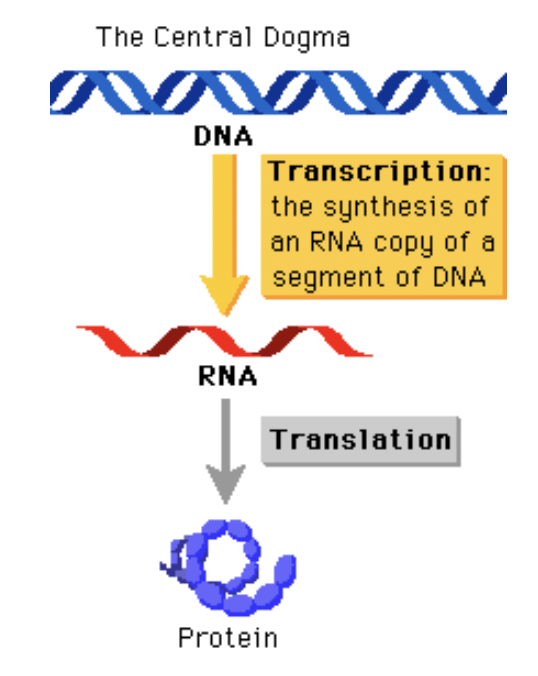
What are the names of the 2 stages of protein synthesis?
Transcription
Translation
#1 Where does transcription (1) start?
Starts in the nucleus
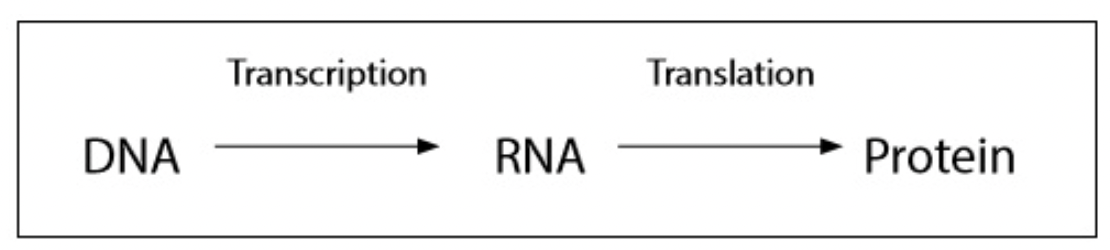
What is the “central dogma” of genetics?
Process of protein synthesis is a one-way sequence from DNA to protein and it is NOT reversible
What was Mendel’s big contribution using pea plants?
There is a relationship between genotype (genetic potential) and phenotype (observable traits); “(discrete) distinct genes were responsible for (discrete) distinct phenotypic characteristics”
Garrod in the early 1900’s proposed what?
That proteins were the type of molecule determined by the genes
How did Garrod come to this conclusion?
Studied a family with a genetic urine disease. Identified a mutation in a gene that coded for a specific protein. SO genes code for proteins
What was the hypothesis that Beadle and Tatum came up with in the 1940s?
One gene-one polypeptide hypothesis. Studied strains of genetic bread mould. 4 mutant strains each with a mutation in a different gene that affected only 1 enzyme. Pattern of 1 gene affecting 1 enzyme
Is Beadle and Tatum hypothesis still correct?
No, we now know that 1 gene can code for more than 1 polypeptide
What is hemoglobin?
The molecule that carries oxygen in red blood cells
Ingram (1956) discovered what difference between healthy people and those with sickle cell anemia?
People with sickle cell anemia differed in only one amino acid on one polypeptide chain in hemoglobin. Healthy people have the amino acid glutamate but sickle cell people, in the same spot, have valine. This small change affected how the polypeptide chain coiled (**change in shape means change in function**)
What did Crick discover about the genetic code? What did he name it? What was the hypothesis called?
That 3 sequential nucleotide letters make up a unit that codes for a particular amino acid; called a codon; “The Triplet Hypothesis”
Why does a codon need 3 letters? Why not two or one?
Because there are 4 letters and 20 amino acids. Need enough bases to make enough possibilities (e.g. a codon of only 2 letters would make only 16 possibilities)
Nirenberg and Khorana achieved what in 1968?
Identified all codons for all 20 amino acids
Because amino acids are coded for using RNA, what happens to Thymine?
It is replaced with Uracil
Making triplets out of 4 letters means we will have more codons for the 20 amino acids- what does this mean? Can it be good?
Means most amino acids can be coded by more than one codon; this redundancy helps to reduce the impact of minor mutations
What is special about UAA, UAG, and UGA?
They do NOT code for amino acids but instead are used to stop protein synthesis
What is special about AUG?
It codes for amino acids AND indicates the start of protein synthesis
Generally speaking, is the use of codons in genetic code that same in all organisms?
Yes
What is the regulatory region?
Region that regulates when and when not the gene is transcribed
What is the transcribed region?
The area of the gene that is actually transcribed into mRNA
ACTIVITY: how does negative and positive transcription factors affect RNA polymerase?
RNA polymerase will NOT work with negative transcription factors but will work with positive transcription factors
ACTIVITY: what is the purpose of an mRNA destroyer?
To destroy mRNA is there is an error
ACTIVITY: what happens if there’s 2 positive transcription factors?
Will make the process more effective
ACTIVITY: why is it important to destroy mRNA after making a sufficient amount of protein?
To be able to have the materials to use again for mRNA production in the future
ACTIVITY: how do both negative and positive transcription factors help maintain homeostasis?
To maintain balance. The body can control when too much protein is present and stop making more and vice versa when more is needed
ACTIVITY: what is a downside of gene expression without regulation?
Could harm the organism- cancer
ACTIVITY: what are the 3 factors that impact the rate of transcription?
Concentration of positive transcription factors
Affinity between positive transcription factors + regulatory region
Affinity between positive transcription factors + regulatory region + RNA polymerase
Recall! In quick terms, what happens during transcription (1) and translation (2)?
Within the nucleus the genetic code stored in the DNA is transcribed into an RNA copy of the information
In the cytoplasm the genetic information in the RNA gets translated into a sequence of amino acids and eventually into a protein
With arrows, what is the basic 3 step protein synthesis process?
DNA → mRNA → protein
Why couldn’t it be a simple one-step process that happens, say, solely in the cytoplasm?
Because the cytoplasm is dangerous for DNA molecules. Floating enzymes and chemicals could permanently damage them. SO stored safely in the nucleus protected by nuclear membrane
DNA is so important- describe the RNA copy
RNA is like a temporary throw-away copy of the DNA
#1 What could be the header for Stage 1 Transcription?
Making an RNA Copy of the Gene
#1 Transcription (1) occurs where and turns [what] into [what]?
Occurs in the nucleus; [DNA to mRNA]
#1 What are the names (and brief description using mRNA) of the 3 phases of transcription (1)?
Initiation (of mRNA transcription)
Elongation (of mRNA)
Termination (of mRNA transcription)
#1 What is the objective of transcription?
To make an accurate RNA copy of the gene
#1 During Initiation, are both DNA strands used? What are their names?
Only one strand of DNA; called the “Template Strand”. The other is called the untranscribed strand
#1 The promotor sequence is a region of mostly what 2 nucleotide bases?
A and T
#1 What is the purpose of the promoter sequence?
To ensure that the RNA polymerase begins transcribing at the right place at the start of the gene
#1 What happens during Elongation?
mRNA and transcription bubbles are made
#1 In DNA replication, a primer is needed to start adding nucleotides. Do we need that here in protein synthesis?
No, RNA polymerase does NOT need a primer
#1 So RNA polymerase has bonded to the DNA molecule and is unwinding and separating the 2 DNA strands. What does it do to the nucleotide bases and what happens when it moves?
It separates about 17 base pairs at a time; moves along forming a transcription bubble behind it
#1 Only certain segments of DNA are being exposed. Why?
We only need to expose the DNA segments that are actively being transcribed
#1 Now the copying starts? How? Starting at what end?
Nucleotides are added to the 3’end of the growing mRNA strand as the RNA polymerase moves down the DNA template strand
#1 What A is encountered on the template strand, what is added to the growing mRNA strand?
U
#1 The nucleotides (base, sugar, phosphate) on the new mRNA strand are joined together by what?
Phosphodiester bonds
#1 Once the RNA polymerase moves on, what happens to the original DNA strands? Why is what happens important?
They quickly rejoin and rewind; harmful enzymes floating inside the nucleus would destroy any exposed DNA
#1 When RNA polymerase moves on and a transcription bubble closes behind it, can another RNA polymerase enzyme attach and transcribe the same gene?
Yes! Means many thousands of mRNA molecules can be transcribed from the same gene in a short amount of time
#1 What happens during Termination? What is the mRNA strand called now?
Termination of mRNA transcription and the modification of the mRNA transcript before it leaves the nucleus
#1 What are the names of the 2 stages involved in Termination?
Termination sequence (GC hairpin)
Post-transcriptional modifications (in eukaryotes)
#1 How does RNA polymerase know when it’s time to stop transcribing? What happens to RNA polymerase?
When it reaches a sequence of DNA nucleotides at the end of the gene made of a loop of G and C pairs called “GC Hairpin”; dislodges RNA polymerase
#1 Now, at the end of Transcription (1), what happens? What happens to RNA polymerase?
The mRNA strand separates from the RNA polymerase and travels to the cytoplasm for Translation (2); RNA polymerase stays and is ready to be used again
#1 Right before leaving the nucleus and entering the cytoplasm, mRNA has to be modified in what 2 ways?
Protecting mRNA against enzymes
Removing non-coding DNA called “Introns”
#1 How is mRNA armoured to fight enzymes in the cytoplasm? Which ends are they at?
Extra nucleotide sequences are added to both ends → Guanine Triphosphate (GTP) cap at the 5’ end and repeating A nucleotides (poly-A-tail) at the 3’ end
#1 Besides protection, what is another purpose of adding the armour to mRNA’s ends?
Helps the ribosomes know which end they should bind to for translation
#1 What would be a good reason for having DNA/RNA eating enzymes in the cytoplasm?
To kill viral DNA/RNA that causes infections
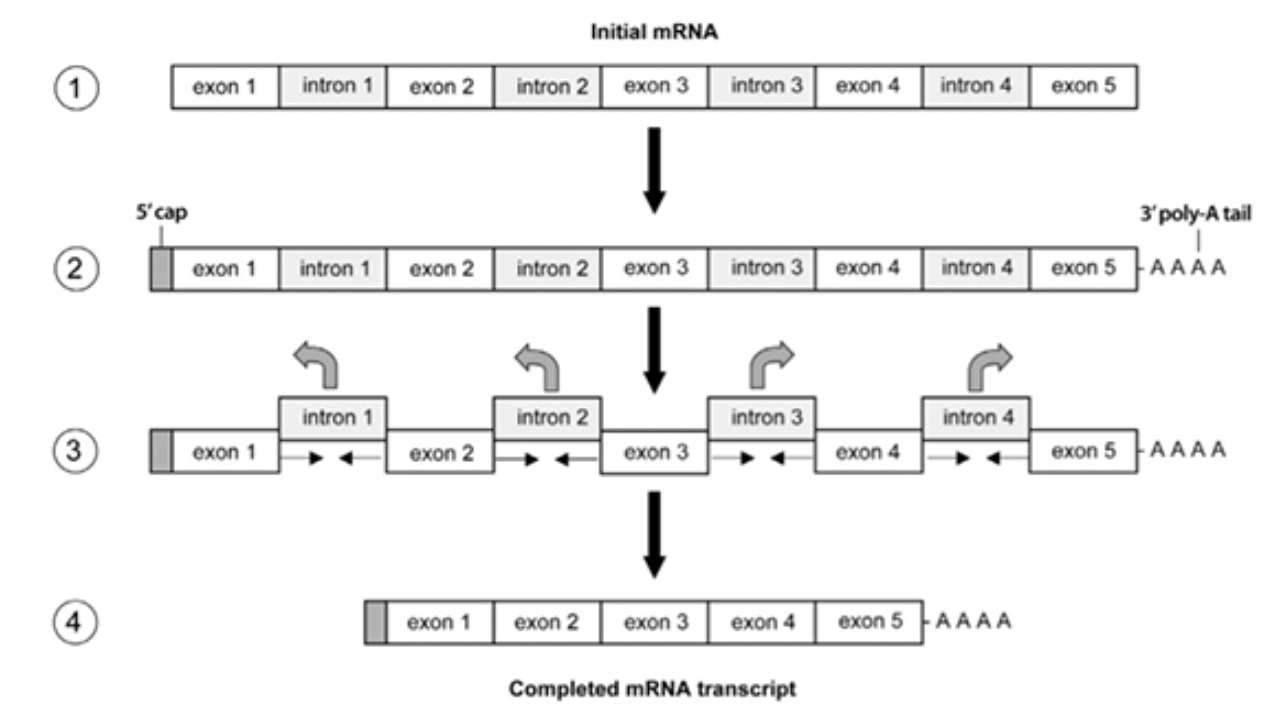
#1 What are introns?
Stretches of DNA that have been transcribed but will NOT be translated into proteins. They separate the exons that will become proteins
#1 Introns have to be removed into order to proceed to Translation (2). How?
RNA particles and Spliceosomes remove them→ They cut out introns and join up the exons
#1 When the introns are gone and the exons are joined, what is this continuous mRNA sequence called?
mRNA Transcript
#1 Since prokaryotes have no nucleus, how is it different? Where is the DNA?
DNA is always in the cytoplasm. Ribosomes bind to the growing mRNA strand and begin Translation (2) even before RNA polymerase has finished Transcription (1)!
#2 What is the header for Stage 2 Translation?
“Reading the RNA copy and assembling the polypeptide”
#2 Where does Translation (2) occur and between [what] and [what]?
Cytoplasm; [mRNA to protein]
#2 What are the 3 phases of Translation (2)?
Initiation
Elongation (making the polypeptide)
Termination
#2 What is the basic definition of Translation (2)?
The genetic code in the DNA gets translated into proteins
#2 Describe the importance of ribosomes in Translation (2)
mRNA transcript is translated into chains of amino acids by ribosomes
#2 What is the most important tRNA/amino acid complex? Why is it the most important?
met-tRNA complex (met is methionine). It is the Initiator tRNA used to position the first amino acid on the polypeptide chain
#2 How many binding sites does a ribosome have? Who binds to who and what are the binding sites named?
Each ribosome has 4 binding sites; 1 for the mRNA transcript and 3 (called E, P, A) for binding tRNA molecules.
#2 What happens during the Elongation phase?
The amino acids are attached together in a polypeptide chain
#2 How many amino acids can become linked?
Can be a few 100 to several 1000
#2 How does translation know when to stop?
Stops when the termination codon is encountered on the mRNA transcript
Why is it important to regulate protein synthesis?
Because it’s energetically costly so we don’t want to overdue it unnecessarily
What are the 4 levels of control of regulating protein synthesis?
Transcriptional
Post-transcriptional
Translational
Post-translational
How is protein synthesis regulated in two ways at the transcriptional level?
Determines which genes get transcribed OR controls the rate at which transcription happens
At the transcriptional level, what aids/hinders the RNA polymerase binding to the DNA?
Positive and negative transcription factors bind to the promoter region first. Their presence and concentration will determine whether or not a gene is transcribed AND how fast
What are operons in prokaryotes?
A group of genes under the control of a single regulatory protein so either they ALL get expressed together or not at all
How do all-or-nothing operon genes work?
They have a control region (ft. promoter and operator) that will determine if all operon genes will get expressed or not. Also have a coding region
With operons, how does negative regulation and positive regulation work?
Negative regulation is the binding of a repressor to prevent transcription. Positive regulation is the binding of an activator to stimulate transcription
How is protein synthesis regulated at the post-transcriptional level? 2 ways
If the mRNA molecule lacks the poly-A tail it will not be able to leave the nucleus; if it lacks the GTP cap enzymes will break it up back into its individual nucleotides
How is protein synthesis negatively regulated at the translational level?
Regulatory proteins in the cytoplasm can bind to the mRNA transcript and block the small ribosomal subunit
How is protein synthesis regulated at the post-translational level?
Once the polypeptide is released it can be modified by chaperone proteins which can affect the folding and thus activate or inhibit it
What are mutations?
When cells make errors while copying DNA
What 2 things cause mutations?
Mutagens→ environmental factors (e.g. UV light)
Chemical agents→ which are able to change the nucleotide sequence in DNA
What are somatic cell mutations? Can they be passed on?
Mutations in body cells; they CANNOT be passed on but can replicate in that organism and be dangerous
What are germ cell mutations? Can they be passed on?
Mutations in s3x cells; can be passed on