MB Test 1
 Call Kai
 Learn
Learn Practice Test
 Spaced Repetition
 Match
Match Flashcards
1/52

There's no tags or description
Looks like no tags are added yet.
Name | Mastery | Learn | Test | Matching | Spaced | Call with Kai |
|---|
No analytics yet
Send a link to your students to track their progress
53 Terms
All of the following individuals showed that cleanliness played a role in human disease EXCEPT
A) Lister
B) Nightingale
C) Semmelweis
D) Jenner
D) Jenner
Work by ______ laid the foundations of immunology with the development of vaccines.
A) Pauling and Woese
B) Lister and Pasteur
C) Jenner and Pasteur
D) Koch and Pasteur
E) Redi and Spallanzani
C) Jenner and Pasteur
Semmelweis advocated handwashing as a method of preventing which of the following diseases?
A) Yellow fever
B) Syphilis
C) Cholera
D) Anthrax
E) Puerperal fever
E) Puerperal fever
What is the CORRECT order for the application of Koch's postulates?
I. Incoulate suspect agent into test subject and observe that subject develops disease of interest.
II. Isolate and culture suspect agent in the laboratory.
III. Find suspect agent is every case of disease of interest but not in healthy hosts.
IV. Recover and isolate suspect agent from test subject.
A) III, II, I, IV
B) IV, II, I, III
C) III, I, II, IV
D) II, I, IV, III
E) I, II, III, IV
A) III, II, I, IV
The term ______ involves using living organisms to detoxify polluted environments
A) Immunology
B) Bioremediation
C) Chemotherapy
D) Serology
E) Etiology
B) Bioremediation
Which of the following would NOT be classified as a prokaryote?
A) All of these are prokaryotes
B) Archaea
C) Algae
D) Bacteria
E) E. coli
C) Algae
Which of the following types of microbial cells are most similar to animal cells (like humans) in terms of their structure and nutrition?
A) Prokaryotes
B) Protozoa
C) Fungi
D) Algae
E) Archaea
B) Protozoan
Which of the following microbes is generally the smallest?
A) Algae
B) Archaea
C) Viruses
D) Bacteria
E) Fungi
C) Viruses
The difference between a prokaryotic cell and a eukaryotic cell is the presence or absence of
A) Ribosomes
B) Genetic material
C) A cell wall
D) A cell membrane
E) A nucleus
E) A nucleus
Which of the following types of bacterial cells would have flagella located at only one end of the cell?
A) Monotrichous and amphitrichous
B) Amphitrichous
C) Monotrichous
D) Lophotrichous and monotrichous
E) Amphitrichous
D) Lophotrichous and monotrichous
Which of the following terms refers to a bacterium moving away from a chemical signal?
A) Positive chemotaxis
B) Negative phototaxis
C) Positive thermotaxis
D) Negative chemotaxis
E) Positive phototaxis
D) Negative chemotaxis
Axial filaments are specialized flagella found on
A) Vibrios
B) Spirochetes
C) Palisade bacilli
D) Staphylococci
E) Streptococci
B) Spirochetes
What role do the teichoic acids play within the cell wall of Gram-positive bacteria?
A) They serve as pores allowing passage of ions, nutrients, and amino acids into the cell
B) They serve as adhesins
C) They secure the periplasmic space
D) They act as cross-bridges
E) They stabilize the cell wall and hold it in place
E) They serve to stabilize the cell wall and hold it in place.
Which type of active transport protein moves two molecules, one into the cell, at the same time?
A. Uniport
B. Antiport and Symport
C. Symport
D. Antiport
E. All of these are correct
C. Symport
The hami of some archaea are used for which of the following processes?
A. Defense
B. Attachment
C. Reproduction
D. Nutrient sensing
E. Locomotion
B. Attachment
Which of the following prokaryotic cells contain an outer membrane?
A. All prokaryotes
B. Gram-negative bacteria only
C. Gram-positive bacteria only
D. Both Gram-positive and Gram-negative bacteria
E. Archaea
B. Gram-negative bacteria only
Which of the following is NOT a component of peptidoglycan?
A. NAG
B. Tetra-peptide cross-bridges
C. Connecting chains of amino acids
D. LPS
E. NAM
D. LPS
The ability of a lens to gather light is referred to as its
A. resolution limit
B. contrast ratio
C. refraction index
D. total magnification
E. numerical aperture
E. numerical aperture
Low contrast specimens are made easier to see by
A. adding color filters to the microscope.
B. drying them in a vacuum (lyophilization).
C. using dyes that react with their structures.
D. using smaller aperture lenses.
E. increasing the amount of light passing through the slide.
C. using dyes that react with their structures.
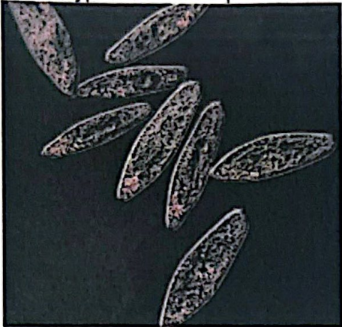
Which type of microscope was used to produce the image below?
A. Bright-field light
B. Fluorescent light
C. Dark-field light
D. Scanning electron
E. Differential interference contrast
C. Dark-field light
After Gram staining, Escherichia coli cells are red in color. This result is interpreted as
A. Gram-positive
B. Endospore negative
C. No wall is present in these cells
D. Gram-negative
E. Endospore positive
D. Gram-negative
A thin film of microorganisms on a slide to be viewed under a microscope is called a
A. mordant
B. smear
C. biofilm
D. stain
E. culture
B. smear
If a microbiology lab student left the safranin out of the Gram stain procedure, what would be the result?
A. Gram-positive cells would be colorless and Gram-negative cells would be pink.
B. Gram-positive cells would be purple and Gram-negative cells would be colorless.
C. All cells would be pink.
D. All cells would be purple.
E. Gram-positive cells would be pink and Gram-negative cells would be purple.
B. Gram-positive cells would be purple and Gram-negative cells would be colorless.
________ is a bacteria that lacks a cell wall and causes atypical pneumonia.
A. Streptococci pneumonia
B. Bacillus cereus
C. Pseudomonas fluorescens
D. Mycoplasma pneumonia
E. Nisseria sica
D. Mycoplasma pneumonia
Which of the following is a differential stain?
A. Methylene blue
B. Flagellar stain
C. Crystal Violet
D. Gram stain
E. Negative stain for capsules
D. Gram stain
The polymerization of individual amino acids to make longer protein chains is an example of
A. anabolism
B. feedback stimulation
C. allosteric inhibition
D. catabolism
E. substrate level phosphorylation
A. anabolism
In E. coli, the accumulation of excess isoleucine shuts down the enzymatic pathway that results in the synthesis of isoleucine. This is an example of
A. competitive inhibition
B. feedback inhibition
C. non-competitive inhibition
D. allosteric inactivation
E. allosteric induction
B. feedback inhibition
Which of the following is a complete active enzyme?
A. coenzyme
B. allosteric inducer
C. holoenzyme
D. apoenzyme
E. cofactor
C. holoenzyme
Amphibolic reactions are...
A. only found in archaea and bacteria
B. light-dependent reactions within chloroplasts
C. those that require the input of energy and are anabolic
D. those that can be either catabolic or anabolic depending on the metabolic state of the organism
E. those that release energy and are anabolic
D. those that can be either catabolic or anabolic depending on the metabolic state of the organism
What is the function of GTP in the Kreb's cycle?
A. A scaffolding molecule for carbon atom shuttling
B. A nucleotide in DNA production
C. An energy carrying molecule
D. An oxidizer to release CO2
E. An electron carrier
C. An energy carrying molecule
In eukaryotes, which of the following is the final electron acceptor during aerobic respiration?
A. NADH
B. H2O
C. FADH2
D. Carbonate ions
E. Molecular oxygen
E. Molecular oxygen
The conversion of pyruvic acid to acetyl-CoA can be described as ________ because a molecule of CO2 is produced as a by-product.
A. Exhalation
B. Decarboxylation
C. Oxidation
D. Decarbonation
E. Reduction
B. Decarboxylation
Fatty acids are catabolized into two carbon molecules during the process of
A. pentose-phosphate shunt
B. deamination
C. beta-oxidation
D. gluconeogenesis
E. fermentation
C. beta-oxidation
What molecule is used to capture light energy in photosynthesis?
A. Chlorophyll
B. ATP-synthase
C. NADPH
D. Water-splitting enzymes
E. ATP
A. Chlorophyll
Which of the following molecules is broken down in cellular respiration, providing fuel for the cell?
A. O2
B. Rubisco
C. CO2
D. Glucose
E. ATP
D. Glucose
In what organelle would you find acetyl CoA formation, the citric acid cycle, and the electron transport chain?
A. Nucleus
B. endoplasmic reticulum
C. chloroplast
D. golgi apparatus
E. mitochondrion
E. mitochondrion
What does the term facultative anaerobe mean?
A. Facultative anaerobes can grow with or without oxygen, but grow better when oxygen is present.
B. Facultative anaerobes will grow only in the presence of elevated oxygen concentration (above that of normal air).
C. Facultative anaerobes die in the presence of oxygen.
D. Facultative anaerobes require oxygen for growth.
E. Facultative anaerobes will grow only in the presence of nitrogen gas.
A. Facultative anaerobes can grow with or without oxygen, but grow better when oxygen is present.
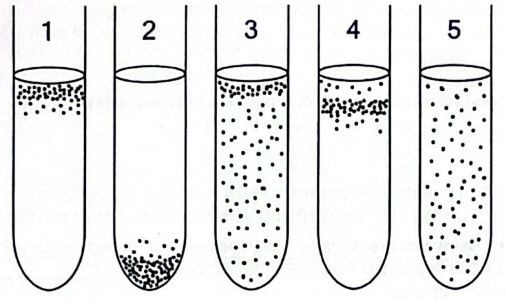
Thioglycolate broth was inoculated with a single species of bacteria and incubated for 24-hours. Which term below is most correctly used to describe the growth pattern seen in tube 1?
A. Microaerophile
B. Facultative anaerobe
C. Aerotolerant anaerobes
D. Obligate anaerobe
E. Obligate aerobe
E. Obligate aerobe
The goal of streaking for isolation is to spread an inoculum of bacteria thinner and thinner with each pass for the identification of individual colony-forming units. What action must be performed between each step to ensure this?
A. Flaming of the agar plate must be performed.
B. An additional inoculum of bacteria must be added.
C. Flaming of the loop must be performed.
D. The agar plate must be incubated overnight.
E. The number of colonies must be determined
C. Flaming of the loop must be performed.
A medium designed to change color in response to the growth of certain types of bacteria would be considered a
A. differential media
B. synthetic media
C. complex media
D. selective media
E. enrichment media
A. differential media
Fermented foods such as sauerkraut or pickles are kept from spoiling by the effects of which of the following?
A. increased temperature
B. hydrostatic pressure
C. increased carbon dioxide levels
D. pH
E. decreased oxygen levels
D. pH
A cell that uses an organic carbon source and obtains energy from light would be called a
A. lithoautotroph
B. photoheterotroph
C. chemoheterotroph
D. chemoautotroph
E. photoautotroph
B. photoheterotroph
________ are complex communities of various types of microbes that adhere to surfaces.
A. mix cultures
B. aggregates
C. biofilms
D. colonies
E. defined isolates
C. biofilms
Which of the following could be an optimal pH for the growth of an basophile?
A. pH 2.5
B. pH 11.2
C. pH 7.0
D. pH 6.5
E. pH 7.45
B. pH 11.2
A bacteria isolated from a newly discovered deep ocean active volcanic vent community where the water temperature is over 100 degrees C would best be characterized as a
A. barophile and hyperthermophile
B. psychrophile and aklaliphile
C. barophile only
D. mesophile and thermophile
E. barophile and psychrotroph
A. barophile and hyperthermophile
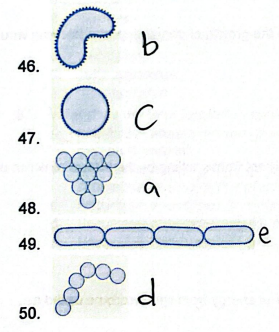
Match the Pictures and their correct descriptive terms:
A. Staphylococcus
B. Vibiro
C. Coccus
D. Streptococcus
E. Streptobacillus
46. B
47. C
48. A
49. E
50. D
A microbiologist inoculates a flask of broth with exactly 5 bacterial cells. The generation time of the species is 30 minutes, there is no lag phase, and none of the cells die during this experiment. How many cells will there be in the culture after 6 hours?
20,480 cells

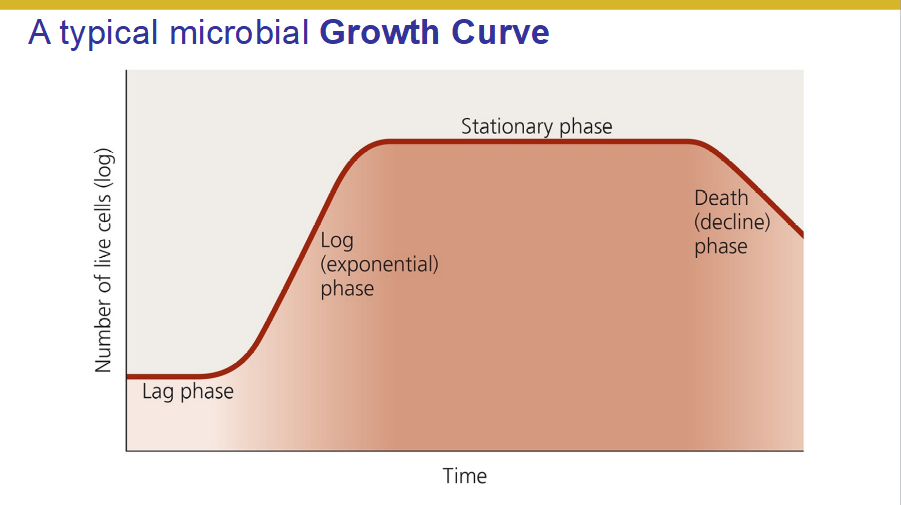
In the space below, draw a figure complete with labels of all phases and correctly labeled axes with units of a typical bacterial growth Curve.
Clearly indicate on your graph where the rates of cell division and cell death are approximately equal.
See the picture.
If you were viewing some bacteria through a microscope with an objective lens with 100x magnification and an ocular lens with 10x magnification, what is the total magnification as viewed by you?
100 x 10 = 1000x Total Magnification
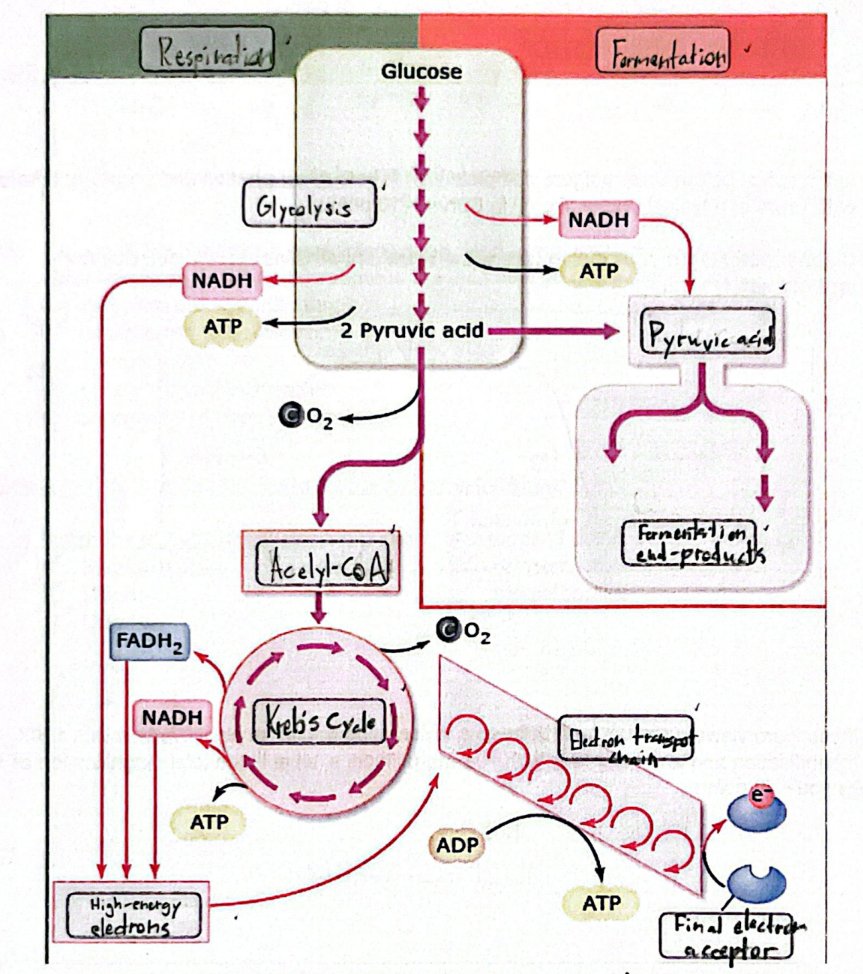
Complete the diagram below by labeling the empty boxes with the terms provided: Glycolysis, High-energy electrons, Electron transport Chain, Fermentation end-products, Pyruvic acid, Krebs' cycle, Final electron acceptor, Fermentation, Respiration, Acetyl-CoA:
See picture
Bacteria in the genera Bacillus and Clostridium can create ________ in order to survive harsh conditions.
endospores
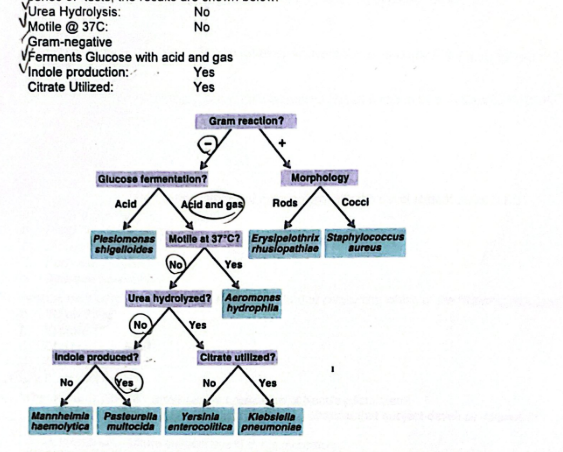
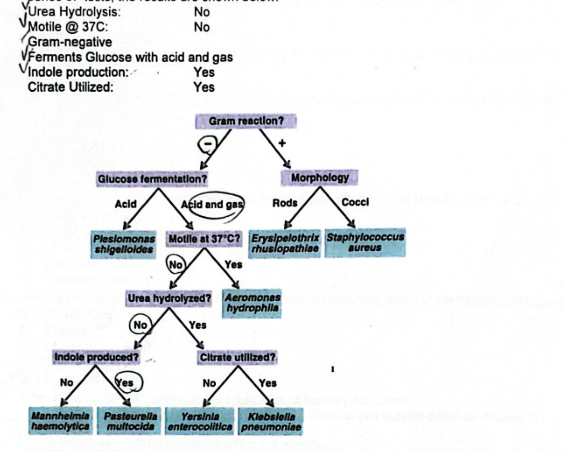
You are given a pure culture of a bacteria but don't know what it is. You decide to perform a series of tests, the results are shown below:
What Bacteria is present in your sample? State your answer using the full binomial name with proper formatting.
See pictures. Pasteurella multocida.
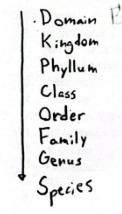
State the order of the hierarchical groups in our current taxonomical system from largest at the top to smallest at the bottom of your list.
See picture