Intro to Marketing Final Exam
 Call Kai
 Learn
Learn Practice Test
 Spaced Repetition
 Match
Match Flashcards
 Knowt Play
1/91

There's no tags or description
Looks like no tags are added yet.
Name | Mastery | Learn | Test | Matching | Spaced | Call with Kai |
|---|
No analytics yet
Send a link to your students to track their progress
92 Terms
The Five Step Marketing Process
Understand the marketplace and customer needs/wants
Design a customer-driven marketing strategy
Construct and integrated marketing program that delivers superior value
Engage customers, build profitable relationships and create customer delight
Capture value from customers to create profits and customer equity
Needs
A state of felt deprivation (basic physiological needs)
Wants
Needs shaped by cultural and individual personality
Demands
Wants backed by buying power
Production Concept
Focus on low labor costs, mass distribution, and availability at low prices
Product Concept
Focus on product quality and features
Selling Concept
Aggressive selling/promotion
Marketing Concept
Know and satisfy target market needs better than competitors
Societal Marketing Concept
Balance company profits, consumer wants, and society’s interests
Sustainable Marketing
Meets current and future needs of customers, company, and society
Customer-Driving Marketing
Understand customers’ needs before they do
Strategic Planning
Adapting the firm to take advantage of changing marketing opportunities. Occurs at the corporate, business-unit, and market levels, deals with long-term objectives, and focuses on external and internal environment
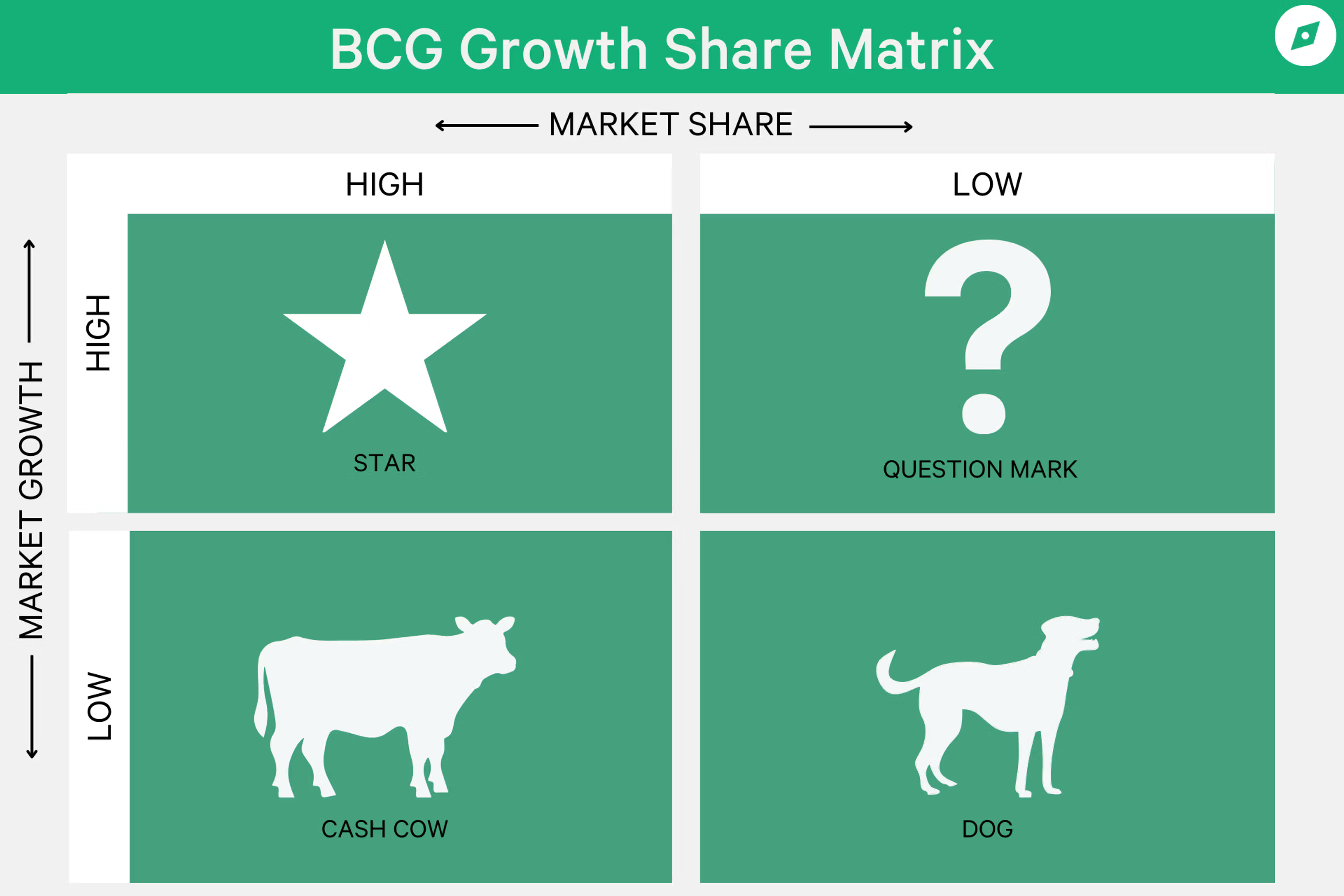
BCG Matrix
Market attractiveness measured by market growth rate, relative market share measures competitive strength of SBU.
Time consuming, difficult to implement
Stars: high growth, high market share, require heavy investment, should mature into cash cows
Question Marks: high growth, low market share, riskiest; invest or cut, consume cash w/out guaranteed returns
Cash Cows: low growth, high market share, dominant in mature market, generate more cash than they consume and can fund stars and question marks
Dogs: low growth, low market share
Mission Statement
Marketing-oriented mission statement should on serving customer needs, not just what is sold
Microenvironment
Internal/close, the company itself, suppliers, marketing intermediaries, competitors, publics, and customers
Macroenvironment
External/broad, demographic, economic, social, natural, technological, political/legal, and cultural forces
Marketing Information Systems (MIS)
Consists of people, equipment, and procedures to gather, sort, analyze, evaluate, and distribute needed, timely, and accurate information to marketing decision makers
4 Steps:
Assessing information needs
Developing marketing intelligence
Developing information (internal data, marketing research, competitive intelligence)
Making marketing decisions / distributing and using information
Old internal data become outdated quickly
Marketing Research
The systematic design, collection, analysis, and reporting of data relevant to a specific marketing situation facing an organization
4 Steps:
Defining the problem and research objectives
Developing the research plan (choosing approach; observational, survey, experimental)
Implementing the research plan (collecting and analyzing data)
Interpreting and reporting the findings
Observational Research
Gathering data by observing people, actions, and situations
Survey Research
Most flexible but can be biased
Experimental Research
Testing cause-and-effect by controlling variables. Most rigorous for casual data
Focus Groups
Small discussion groups for exploratory qualitative insights
Factors Influencing Consumer Behavior
Cultural
Culture: Learned values and behaviors from family
Subculture: Shared experiences, groups sharing value systems (nationalities, religions, geographic regions)
Social Class: Relatively permanent ordered divisions
Social: Reference groups, family, roles, and status
Personal: Age, life-cycle stage, occupation, economic situation, lifestyle, and personality
Psychological: Motivation, perception, learning, beliefs, and attitudes
Buyer Decision Process 5 Stages
Need Recognition
Information Search
Evaluation of Alternatives
Purchase Decision
Post-Purchase Behavior
Poor Service to Disadvantaged Consumers (Consumer Rights Issues)
Redlining: Refusing service in certain neighborhoods
Lack of accessible stores in low-income areas
Predatory lending
Food Deserts: Limited healthy foods access
Planned Obsolescence: Making products physically obsolete quickly
Perceived Obsolescence: Making products seem outdated through style changes
Solutions; community investment programs, regulation, fair pricing, local outreach
Market Segmentation Variables
Geographic
Demographic: Age, gender, income, occupation, education, social class
Psychographic: Lifestyle, values, personality
Behavioral: Usage rate, brand loyalty, benefits sought, occasions
5 Characteristics of Effective Market Segments (MASDA)
Measurable: Size, purchasing power, and profiles
Accessible: Can be effectively reached and served
Substantial: Large and profitable enough
Differentiable: Responds differently to marketing mix elements that other segments
Actionable: Effective programs can be designed to attract and serve the segment
Targeting Strategies
Undifferentiated (Mass) Marketing: One marketing mix for the whole market, modern marketers have doubts about its effectiveness
Differentiated Marketing: Different marketing mixes for different segments, higher cost but more targeted
Concentrated (Niche) Marketing: Focus on one or a few small segments, good for limited resources
Micromarketing: Tailoring products/programs to individuals or local customer groups
Convenience Product
Bought frequently with minimal effort
Shopping Product
Compared on price, quality, and style before purchase
Specialty Product
Unique characteristics; buyers will make special efforts to purchase without comparison shopping
Unsought Product
Ex: Life insurance or funeral service
Industrial/Capital Product
Used in production of other goods
Social Marketing
Marketing ideas that firms believe in
Idea Marketing
Promoting concepts, causes, or philosophies
Place Marketing
Attracting people to places
Person Marketing
Marketing individuals like celebrities
Organization Marketing
Building image of an organization
New Product Development Process 8 Stages
Idea Generation: internal sources, external: customers, competitors, distributors, suppliers, crowdsourcing
Idea Screening: Reducing the number of ideas
Concept Development and Testing
Marketing Strategy Development
Business Analysis
Product Development
Test Marketing
Commercialization
Reasons Products Fail
Priced too high, poorly advertised, launched at the wrong time, incorrectly positioned
Product Life Cycle Stages
Introduction: High costs, low sales, losses, heavy promotion, slow growth
Growth: Rising sales, profits start, competitors enter, improve quality, expand distribution
Maturity: Slowing growth, most competitive stage, profit stabilizes then falls, most products here
Decline: Sales/profits fall, consider discontinuing or harvesting
Price
The only element of the marketing mix that produces revenue, the other 3 P’s are costs
Price Ceiling
The maximum price, set by consumer perceptions of value, demand side
Price Floor
The minimum price, set by product costs, no profits below price floor, supply side
Cost-Based Pricing
Set prices based on expenses involved in producing, distributing, and selling + fair rate of return
Cost-Plus Pricing
Adds a standard markup to the cost of the product
Value-Based Pricing
Sets price based on buyers’ perceptions of value, not sellers’ cost
Good Value Pricing
Offering the right combination of quality and service at a fair price
Value-Added Pricing
Attaching value-adding features to justify higher price
Competition-Based Pricing
Setting prices based on competitors’ pricing
Break-Even Pricing
Setting a price to cover total costs at a given sales volume
Unit Cost =
Variable cost + (fixed costs / unit sales)
Markup Price =
Unit cost / (1 - desired return on sales)
ROI Price =
Price where (unit sales x (price - unit cost) - fixed costs) / investment = desired ROI
Break-Even Volume =
Fixed costs / (price - variable costs)
Break-Even Sales =
Break-even volume x price
Markup Pricing (based on selling price) =
Markup % = Markup amount / selling price
Selling price = cost / (1 - markup%)
Manufacturer Price =
Consumer price x (1 - retailer markup) x (1 - wholesaler markup)
Value Delivery Network
A company, its suppliers, distributors, and ultimately customers who partner to improve the performance of the entire system
Marketing Channel (Distribution Channel)
A set of interdependent organizations that help make a product or service available for use by consumers or business users
Marketing Intermediary
A member of the marketing channel that connects producers to end user, they do not include raw material suppliers
4 Types of Marketing Intermediaries
Retailers: Sell directly to final consumers
Wholesalers: Buy from producers and sell to retailers or other businesses; do not sell to final consumers
Brokers/Agents: Represent buyers or sellers; facilitate transactions without taking title to goods
Distributors: Similar to wholesalers; often exclusive to specific brands/territories
Key Functions Performed by Marketing Channel Members
Information gathering and dissemination
Promotion
Contact
Matching
Negotiation
Physical Distribution
Financing
Risk Taking
(Not Production)
Corporate Vertical Marketing Systems (VMS)
One company owns and controls all levels of the channel, provides full control over product sales
Contractual VMS
Independent firms join together through contracts (franchises, retailer cooperatives, voluntary chains)
Administered VMS
Leadership by one dominant channel member through size and power, not ownership
Specialty Store
Narrow product line with deep assortment
Department Store
Wide variety of product lines
Supermarket
Large, low-cost, self-service, mainly food and household products
Convenience Store
Limited selection, long hours, neighborhood location
Discount Store
Standard merchandise at lower prices
Big box like Walmart
Small box like Dollar Store
Off-Price Retailer
Irregular merchandise at lower prices, includes factory outlets and warehouse clubs
Category Killer
Giant specialty store that carries deep assortment in category (like Best Buy)
Retailer Cooperative
A group of independent retailers that band together to set up a jointly owned, central wholesale operation and conduct joint merchandising and promotion
Voluntary Chain
A wholesaler-sponsored group of independent retailers that engages in group buying and common merchandising
Corporate Chain
Two or more outlets that are commonly owned and controlled
Omnichannel Marketing
Creates a seamless cross-channel buying experience that integrates in-store, online, and mobile shopping
Marketing Channel Management Definition and 4 Key Responsibilities
The process of selecting, managing, and motivating individual channel members and evaluating their performance over time
Selecting channel members
Managing and motivating channel members
Evaluating channel member performance
Modifying channel arrangements
The 5 Elements of the Promotion Mix
Advertising
Personal Selling
Sales Promotion (short-term incentives)
Public Relations (PR)
Direct and Digital Marketing
Integrated Marketing Communications (IMC)
Carefully integrates and coordinates the company’s many communication channels to deliver a consistent, clear, and compelling message about the organization and it's products
New Marketing Communications Model
Strategies are more targeted, social, and engaging (not mass-media focused)
Moving away from mass-media, large segments, and print ads
Moving toward targeted, social, engaging, and digital approaches
Sales Force Structures
Territorial
Product
Customer (Market)
Complex (mix of the above)
Types of Salespeople
Order Taker
Order Getter (Creative Selling): Seek out customers to persuade them, find new or upgrade existing accounts
Social Selling: Use social media
Relationship Builder
Value Proposition
The set of benefits the company promises to deliver to customers to satisfy their needs
Customer Value
Benefits vs. costs
Customer Satisfaction
Perceived performance vs. expectations
Positioning
Arranging for a product to occupy a clear, distinctive, and desirable place in target customers’ minds relative to competing products
Product Levels
Core customer value - the fundamental benefit/service the customer is buying
Actual product - brand name, features, quality level, design, packaging
Augmented product - warranty, delivery, after-sale service, installation
Direct Marketing Channel
Producer sells directly to consumers - guarantees full control over product sales