Artificial Organs
 Call Kai
 Learn
Learn Practice Test
 Spaced Repetition
 Match
Match Flashcards
 Knowt Play
1/14

There's no tags or description
Looks like no tags are added yet.
Name | Mastery | Learn | Test | Matching | Spaced | Call with Kai |
|---|
No analytics yet
Send a link to your students to track their progress
15 Terms
Pace Maker
Cardiac muscle contracts by the electrical stimulation from the sinus node to the myocardium transmitted through the stimulation conduction system.
Pacemakers are used to treat dysfunctions of heart conduction system such as sick sinus syndrome.
An implanted pacemaker typically consists of two parts:
(1) the pulse generator, i.e., a small metal container housing a battery and the electrical circuitry that regulates the rate of electrical pulses
(2) leads (electrodes), i.e., one to three flexible, insulated wires placed in a chamber, or chambers, of heart.
The stimulation electrodes placed in the heart atrium have the function of synchronizing the stimulation or inhibiting the heart when spontaneous heart contraction is detected.
Pace makers have sensors that detect body motion or breathing rate, which signals the pace maker to increase the heart rate during e.g. exercise to meet the body’s increased demand for blood and oxygen.
Pacemaker is driven by a primary battery that occupies most of the volume of the generator.
Challenges: battery life, infections at the implant site and electrical interference from other electronic devices.
Sensors in artificial organs
Artificial organs are required to replace lost human senses that can happen due to various diseases or injuries or congenital deformations.
Sensory receptors
A neuron (or cell plus a neuron) that convert a stimulus (such as light or sound) into an electrical signal in the nervous system.
Sensory transduction
The process of converting a physical/chemical stimulus to an electrical signal
Senses of the human body
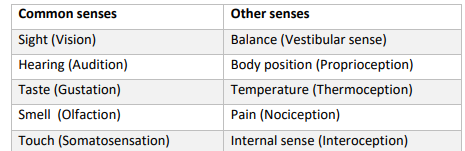
Hearing mechanism
Sound is defined as a time-varying physical disturbance in pressure, velocity, density, and temperature within a medium that propagates in space.
The human ear has evolved to perceive sounds typically propagated through air, also called air-conducted sound, where environmental sounds enter the ear directly via the pinna and the ear canal of the outer ear.
The sound waves then excite the tympanic membrane (eardrum), which in turn sets in motion the ossicles (malleus,incus, and stapes) in the middle ear.
The motion of the stapes creates sound waves in the fluid of the cochlear, in the inner ear, which in turn sets in motion hair cells within it.
The hair cells produce a pulse train of neural stimuli, which are transmitted to cortical auditory centers of the brain, where the final psychophysiological perception of sound takes place.
The sounds can be received via the body, also called body- or bone conducted sound, where environmental sounds excite the human body (skull, skin, bones, etc.), which in turn stimulates cochlea fluid and is registered by the hair cells in a similar way to air-conducted sound.
The vestibular system
The vestibular system acts as an inertia measurement unit (IMU) composed of three-axis gyroscopes and accelerometers.
The visual system (eyes) provides estimation of the location and motion relative to a fixed or moving world frame (i.e., ground, sky, walls, etc.).
The somatosensory is a complex network of various sensors, including the sense of touch, sense of position and movement (proprioception), and haptic perception.
Each of the three sensory systems provides parts of the full information needed for balancing.
Eye and vision
A visual prosthesis is an artificial organ that transmits visual information by artificially stimulating a part of the visual nervous system. In most cases, electrical stimulation is employed as the stimulation method.
It is well known that a pseudo-light perception called “phosphene” can be elicited by applying electrical stimulation to the visual nervous system.
A visual prosthesis provides visual information to the patients by using multiple phosphene.
Depending on the region to be stimulated, the visual prosthesis is classified into retinal prosthesis, optic nerve prosthesis, or cortical prosthesis.
The retinal prosthesis is further classified into categories according to the difference in the locations of the stimulating electrodes.
Challenge of Retinal Prosthesis
It stimulates only part of the retina and the field-of-view is limited (typically 10–15°). Research on the electrical stimulation of the optic nerve, which connects the retina and the brain has the advantage that it induces phosphene throughout the field-of-view but it is difficult to realize a high spatial resolution for optic nerve prosthesis because a large number of optic nerves (estimated at 1 million) is stimulated with only a small number of stimulating electrodes.
Passive artificial organs
Artificial joints
Breast prostheses
Artificial skin
Artificial Joint Details
Artificial joints of the hip and knee to treat rheumatism and osteoarthritis.
The development of biomaterials in this area has advanced dramatically such as new alloys and bioinert ceramics with excellent biocompatibility and abrasion properties.
Breast Prosthesis Details
Usually developed as soft tissue prosthetic materials.
They are implanted as a reconstruction after breast cancer surgery and for cosmetic purposes as well.
A breast implant consists of a silicone rubber bag with saline or silicone bag with silicone gel.
Artificial Skin Details
Through skin we sense pressure, temperature, humidity.
Replacement of tactile sensory function can be enabled using nerve stimulation while ensuring biocompatibility (using natural hydrogels, such as collagen and fibrin to interface with the skin tissue) and skin regeneration with implantable wireless tactile sensory system.
Mechanoreceptors and tactile neurons, located in the dermis layer of the skin, change their potential upon receiving external pressure and modulate the firing behaviour of tactile neurons, converting the external pressure into electrical pulse signals with different frequencies, depending upon the intensity of the pressure.
In cases of severe skin damage due to second or third-degree burns, chemical accidents, or industrial accidents, the consequences extend beyond structural impairment of the skin tissue, and tactile sensory dysfunction due to permanent damaged mechanoreceptors and associated nerves.
Nerve stimulation using an artificial neuromorphic tactile sensory system demonstrates the feasibility for replacement of tactile sensory function by enabling nerve stimulation through externally applied strain or pressure.
Conventional Stimulation Technologies
Neuroprosthetics, such as cochlear implants and visual prosthetics.
Neuromodulation devices, such as spinal cord stimulation (SCS) and deep brain stimulation (DBS)
SCS is used to activate motor neuron pools in the spinal cord, in order to bypass injuries.
DBS involves the implantation of electrodes into the brain to deliver electrical stimulation, proposed as a tool to treat disorders such as Parkinson's disease, epilepsy and depression.
Functional electrical stimulation (FES), is the electrical stimulation of a muscle, usually deprived of nervous control, for providing muscular contraction and producing a functionally useful movement.
Future stimulation technologies
Soft electrodes refer to electrodes made of soft substrate materials, conductive polymers and biodegradable materials.
Their mechanical properties are similar to those of soft tissue, a factor that reduces the mechanical damage to sensitive tissues and improves contact, reducing motion artifacts
They offer easy surface modification or entrapment of molecules that could prevent the foreign body response, a critical problem associated with implantation of electrodes
Microfluidic devices can be integrated with implantable soft electrodes for drug delivery.
Optogenetic stimulation uses light to stimulate genetically engineered neurons (e.g. using implanted LEDs). For humans, this might mean injecting in-vitro cultured light sensitive neurons into the brain.