Genetics
 Call Kai
 Learn
Learn Practice Test
 Spaced Repetition
 Match
Match Flashcards
 Knowt Play
1/11

There's no tags or description
Looks like no tags are added yet.
Name | Mastery | Learn | Test | Matching | Spaced | Call with Kai |
|---|
No analytics yet
Send a link to your students to track their progress
12 Terms
Meiosis
Except for the sperm and oocytes (gametes), during development and afterwards, all body cells have 46 total chromosomes: The 2n number is 23 x 2 = 46
Through the process of mitosis, all of the “somatic” cells replicate
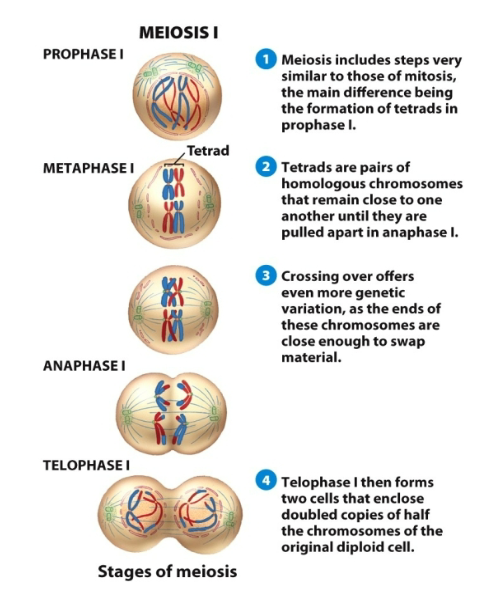
Gametes are produced by a process called meiosis, which is more complex than simple mitotic division because it has two separate cycles of division
Meiosis I
a reductive division from 2n to n
The homologous chromosomes are segregated from each other, then two haploid cells are formed, each containing one of the segregates
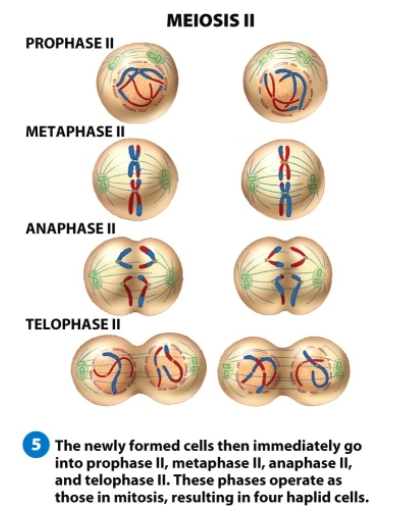
Meiosis II
consists of decoupling each chromosome's sister strands (chromatids), then segregating the DNA into two sets (each set having one of each homologue)
Two haploid cells with replicated sister chromatids go to form four haploid cells with single, unreplicated molecules of DNAs
Meiosis Summary
This summary of meiosis shows both rounds of division resulting in four haploid cells (containing half the genetic content of the original cell)
Important Concepts
Independent Assortment:
How each pair of homologous chromosomes separates has NOTHING to do with each other pair
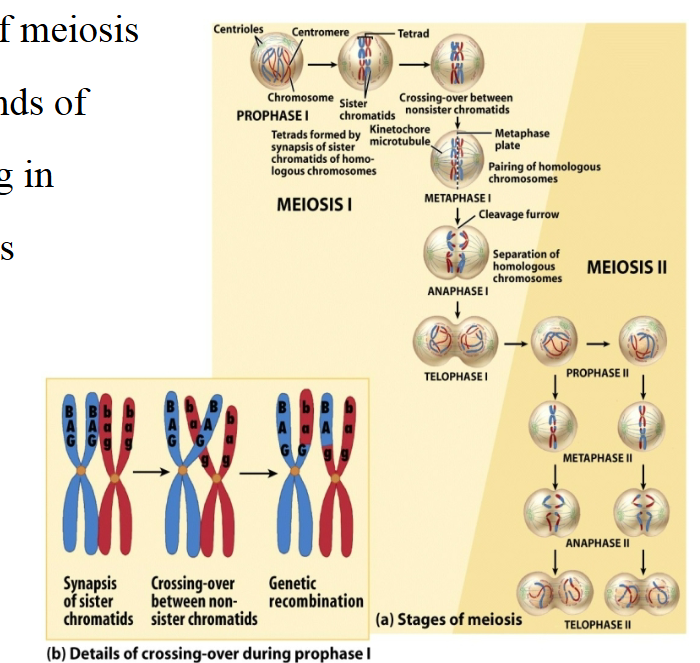
Recombination:
a result of crossing over, it means that even DNA on the same chromosome may go in different directions (part gets crossed over to the other homologous chromosome)… not all the time but occasionally
Genetics Vocabulary
Alleles: Different forms of homologous genes
Locus: Locations of genes on a chromosomes (different alleles have the same locus on the homologous chromosome)
Homozygous: both alleles identical
Heterozygous: alleles different
Genotype: complete set of genes and alleles
Phenotype: observed physical and functional traits (depends on interaction of alleles and environment)
Genetics involves 2 basic things: determining where the alleles for a genotype come from, and then determining the phenotype based on that genotype
Inheritance
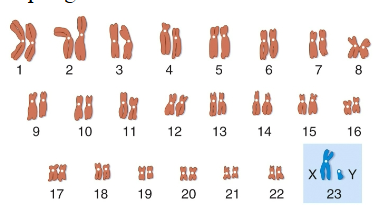
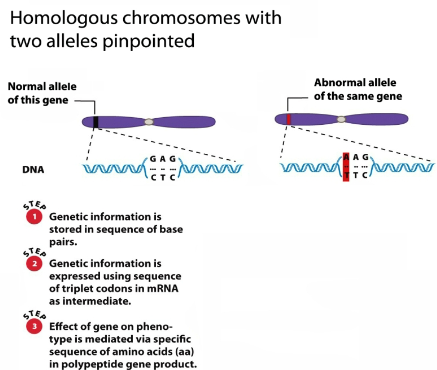
When the diploid number of chromosomes (2n) is reconstituted in a fertilized ovum, one chromosome in each pair came from the mother, and the other came from the father - these are called homologous chromosomes. Each pair in this genetic sampling of a human cell is a homologous pair
Each of the two homologues contains genes that control the same traits (make the same proteins), though they do so with individual variation characteristic of our species
Alternative forms of a gene that code for the same trait and are at the same location on homologous chromosomes are called alleles
Incomplete Dominance
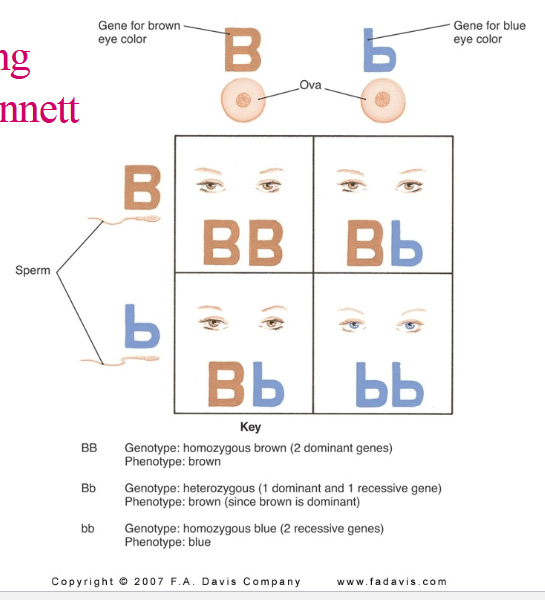
Punnet Squares
Determining Phenotype
Genotype and environment affect phenotype
Dominant alleles: gene always expressed, even if heterozygous
Recessive alleles: two copies of gene needed to be expressed, must be homozygous
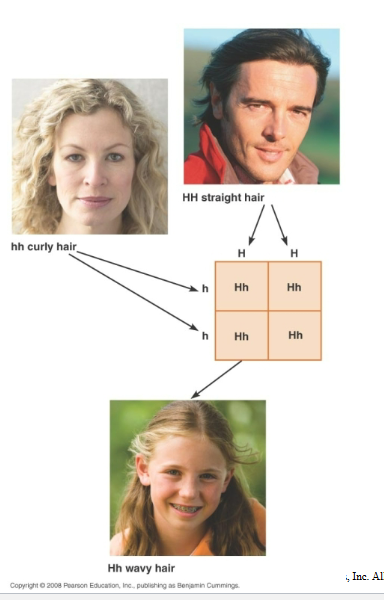
Incomplete dominance: heterozygote is an intermediate phenotype
Codominance: both phenotypes equally expressed
Multiallelic inheritance: more than 2 alleles involved
Polygenic inheritance: multiple genes involved
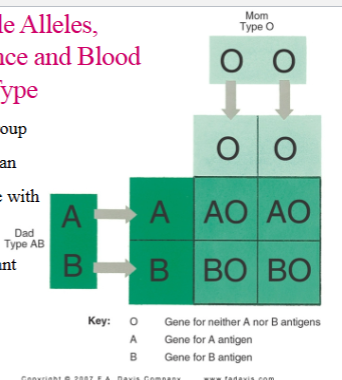
Multiple Alleles, Codominance and Blood Type
The ABO blood group gene in humans is an example for a gene with multiple alleles.
A+B are codominant
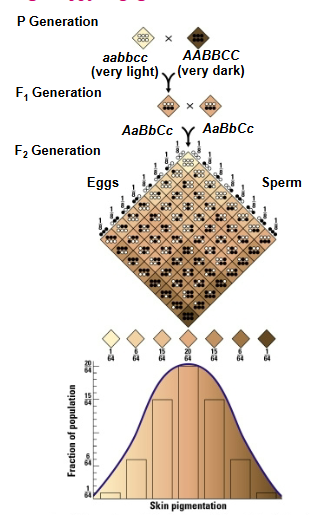
Polygenic Inheritance
If two or more genes have combined effects on the phenotype, this is called polygenic inheritance.
In this case each pair of genes assorts separately
Skin color is one example in humans
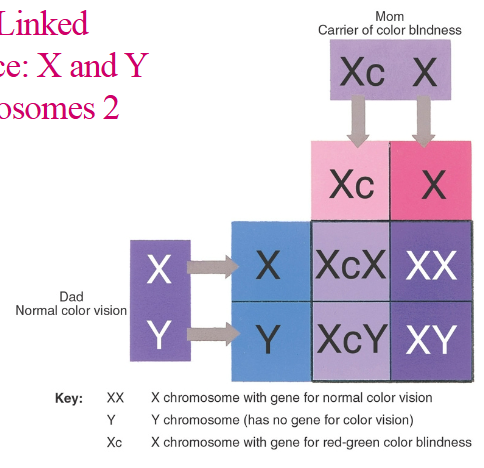
Sex-Linked Inheritance: X and Y Chromosomes
Y determines sex (presence of Y makes individual male)
Sex-linked genes located on sex chromosomes:
Sex-linked or X-linked inheritance
Characteristics: mostly males with disease (recessive, they only have one X copy), passed to sons by mother, father cannot pass the gene
Inheritance in Populations: Evolution
Populations are the units of evolution
A gene pool is the total collection of genes in a population at any one time. A gene pool for a particular trait can be though of as all the cards in a deck. Each diploid individual gets a 2 allele “hand”
Evolution is a change in the relative frequencies of alleles in a gene pool over time
Sexual reproduction doesn’t cause allele change
Sexual reproduction alone does not lead to evolutionary change in a population
Although alleles are shuffled, the frequency of alleles and genotypes in the population does not change
Similarly, if you shuffle a pack of cards, you’ll deal out different hands, but the cards and suits that are part of the deck do not change
Causes of evolution
Mutations (drawing on or erasing the cards)
Genetic drift in small populations(odds, probability v. actual results)
Gene flow between populations (adding/removing cards to/from the deck)
Natural selection (throwing away some hands and not others)
Mutation produces genetic variation, making evolution possible
Mutation, or changes in the nucleotide sequence of DNA, are rare and Random and have little effect on the total gene pool, but they are the Only ultimate source of new alleles
Key facts on Mutation:
Direction=Random, can be Totally new
Speed=Minimal (but it can provide a new allele that other mechanisms of microevolution can increase rapidly)
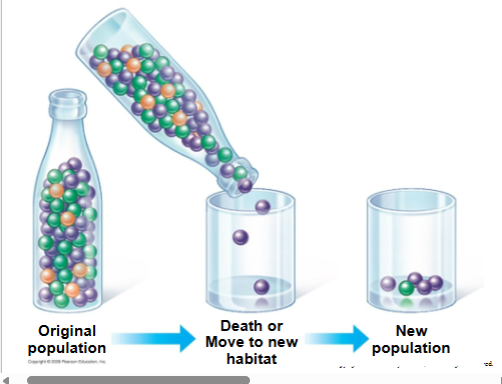
Change in allele frequencies
Natural selection, genetic drift, and gene flow alter allele frequencies in a population
Genetic drift
Genetic drift is a change in the gene pool of a population due to chance
In a small population, chance events may lead to the loss of genetic diversity (10 coin flips v. 10,000 coin flips)
Key facts on Genetic Drift:
Direction=Random
Speed=happens a lot faster with small numbers, large populations are usually closer to the actual odds, so they have minimal drift
Can happen suddenly when a population is separated
Gene flow
Gene flow is the movement of individuals or gametes/spores between populations and can alter allele frequencies in a population
Key facts on Gene flow:
Direction=Makes two populations Similar
Speed= depends on how many barriers there are to mating between the two populations
Natural selection
If individuals differ in their probable reproductive success, natural selection will alter allele frequencies
Key facts on Natural Selection:
Direction= Increase in alleles that give a phenotype making more children on average in the current environment
Speed= depends on how many more offspring that allele helps you get compared to others
Natural selection is the only mechanism that has a “direction” that is not random or determined by other populations. consistently leads to adaptive evolution
That direction is an increase in alleles that
produce a Phenotype that on Average
produces more Offspring in
the current Environment