Global Politics - Peace & Conflict Key Terms
 Call Kai
 Learn
Learn Practice Test
 Spaced Repetition
 Match
Match Flashcards
 Knowt Play
1/99

Earn XP
Description and Tags
Name | Mastery | Learn | Test | Matching | Spaced | Call with Kai | Chat |
|---|
No analytics yet
Send a link to your students to track their progress
100 Terms
Peace
A free state of security and calmness to coexist in harmony and freedom
Conflict
a perceived incompatibility of interests, needs and goals of parties
Violence
a perceived incompatibility of interests, needs and goals of parties
Basic human needs
security, welfare, identity & freedom
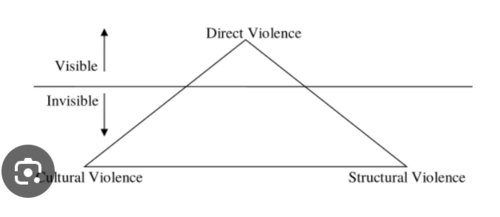
Direct Violence
Violence that can be physically perceived (physical/verbal) and can be clearly pointed out — highly interdependent with structural and cultural violence
Indirect Violence - Structural
Institutionalized forms of discrimination and exclusion reflecting unequal power — organized from structural frameworks, processes, deprivation & inequality
Indirect Violence - Cultural
Aspects of a culture that can be used to justify or legitimize the use of direct/structural violence
Negative Peace
"the absence of violence, of war" - Galtung criticized as being the 'low-hanging fruit'
Positive Peace
"the presence of justice, the structures that create and sustain peace" - Galtung
Galtung’s Violence Triangle
Johan Galtung
"violence is a needs deprivation"
"an act of violence is something stopping your actual circumstance from being more peaceful"
Dustin Sharp
believes that peace is a continuum for which one is not able to distinguish (positive or negative) as circumstances are relative
Morton Deutsch
views conflict as a universal feature of society
Mack and Snyder
define conflict as two or more partier with opposing goals linked to resources or positions available
Kissinger and Morgenhaus - Peace as a Balance of Power
Argue that peace and balance on an international scale cannot go hand in hand due to free-riders and chaining
Feminist Peace Theory
looks at overlapping cases of marginalization to include a variety of perspectives into peaceful institution building
Religious Peace
different faiths have varied views:
- Hinduism / Jainism: Ahimsa
- Buddhism: abstaining from harming all living things
- Christianity: "love thy neighbour as ourself"
- Islam: calls people to practice peace and not destroy lives
- Ubuntu: interconnected view of humanity
Latent Conflict
A hidden state of dispute
Manifest Conflict
Open visible disagreements
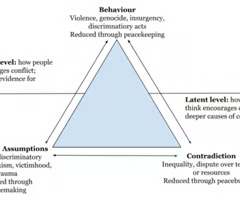
Galtung’s ABCs
A conflict analysis model
- Attitudes
- Behaviour
- Contradiction
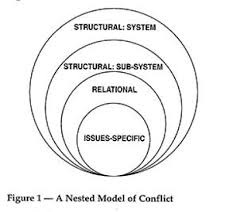
Dugan’s Nested Model of Conflict
A conflict analysis model
- Issue Specific: an incident
- Relational: relational conflicts which contribute to the conflict
- Structural Subsystem: established hierarchies, politics and economic systems
- Structural System: broader norms and social values
Non-Violence
a philosophy of not resorting to violence as a response to conflict or method to overcome barriers in the search of greater equality - has negative connotations
Principled Non-Violence
Religion or ethics
Strategic Non-Violence
the most effective tool for a desired outcome:
- more legitimacy
- increased information technology
- end of proxy wars
- maintains fairness
Pacifism
make and build peace (moral, anti-war, personal, feminist, universal, pragmatic, conscientious objectors)
Internal Conflict
Moral Struggle - Personal
Interpersonal Conflict
A disagreement between 2 or more individuals
Interstate Conflict
A conflict that occurs between 2 states for territorial acquisition or to influence policy
Intrastate Conflict
A conflict that occurs in a single state, usually government and a non-state actor (like guerillas, rebel groups, terrorist groups, ethnic/religious groups or lobby groups)
Non-State Conflict
Conflict between 2 or more organized groups for: territorial disputes, competition over resources, religious tensions or power struggles (like cartels in Mexico)
Extrastate Conflict
conflict between a state and non-state actor outside of the states borders (like the US pursuing Al-Qaeda)
Identity Conflict
Aspects of our culture, sense of self and belonging
In Group Conflict
Favor its own members
Out Group Conflict
Draws suspicion on other parties
Interest-Based Conflict
Clashes over scarce resources
Greed vs Grievance
Collier and Hoeffler find that greed is a catalyst for conflict that is driven in economic resource disputes that fuel negative emotions
Institutional Conflict
Structures of a society and how power is distributed
Ideological Conflict
Discussions over governance, resource allocation and exclusivity/oppression
John Burton Conflict Resolution
proposes that basic human needs - identity, freedom, safety and belonging - are non-negotiable and must be met to achieve lasting conflict resolution
Galtung’s PIN Framework
- Positions: explicit demands or claims made by parties in negotiation
- Interests: understanding "why" a party claims its position
- Needs: non-negotiable requirement essentials
Rothman's ARIA Identity Conflict Resolution
Successful in being a cyclical tool for re-evaluation
Antagonism: exert frustration
Resonance: common goods and responsibilities
Intervention: develop mutually beneficial solutions
Action: strategize implementing solutions
The Geneva Convention
A set of international treaties established in 1949 which establish legal standards for the humanitarian treatment of individuals during armed conflict. It has become customary law in which the moral legitimacy of the treaty makes everyone legally bound to the conventions (even though 196 countries have signed it)
Geneva Convention I
Protect the wounded, such, medical and religious personnel during conflict
Geneva Convention II
Care for the wounded, sick and shipwrecked at war
Geneva Convention III
treat prisoners of war with humanity
Geneva Convention IV
protect all civilians, including those in occupied territory
Geneva Convention Additional Protocol I
Protection of victims in international armed conflict by prohibiting attacks on citizens and prohibiting racist/anti-colonial regime conflicts.
Geneva Convention Additional Protocol II
Protection of victims in non-international armed conflicts such as prohibiting collective punishment, guarantees for individuals not involved in conflict and protecting survival.
Geneva Convention Additional Protocol III
Identities a Red Crystal, alongside the Red Cross and Red Crescent, for protection.
High Contracting Parties
Countries that have agreed to follow the Geneva Conventions
Parties to the Conflict
Countries that have not agreed to follow the Geneva Conventions but are still legally bound to them - mostly regarding the new Protocols I, II and III
Disputant
Person involved in a conflict, the primary party. They have a direct stake in the outcome of a conflict (primary party)
Conflictual
Behaviour that is in disagreement with the actions of a disputant (primary party)
Moderators
Negotiators of peace in a conflict but are unlikely to put anything on the line to help their side win (secondary party)
Hardliners
Support their favoured disputant while actively working to recruit support from others to support their side (secondary party)
Conflict Profiteers
They do not ideologically support any side of the conflict - they may be impartial - yet they supply resources to the conflict for their financial gains (secondary party)
Spoilers
Use tactics to prevent peace negotiations and construct actions which favour violence. These would like to see the profit end with genocide or forced migration (secondary party)
Third Parties to Conflicts
Mediators, arbitrators or dialogue facilitators
Bystanders
Those who are neither engaged nor willing to speak out on a conflict to promote reconciliation
Non-Combatant Parties
Parties which do not engage in fighting, such as children, but are negatively affected by conflict
Violent State Actors
Actors within the state which have the power to impose violence (militaries, paramilitaries - like militias who are trained citizens - & NATO)
NATO Treaty Article 5
An attack against one member is considered an attack against all. It provides:
- Collective defence
- Crisis Management
- Cooperative Security and Deterrence
- Partnership and Dialogue
- Responses to terrorism and cyber threats
Violent Non-State Actors
Terrorist Groups (extremist religious or ideological groups that target civilians), Rebel Groups (groups with political or economic complaints that target government facilities) and Mercenary Groups (private corporations hired to fight)
Non-Violent State Actors
Diplomats (negotiators with diplomatic immunity such as freedom from legal action) and UN Peacekeepers (as they can one fire when fired-upon)
Non-Violent Non-State Actors
Coined as Track II Diplomacy involving churches, think tanks, humanitarian organizations, art, entertainment, sports, student exchanges, NGOs (Red Cross, Amnesty International) and Medicine / Humanitarian Assistance.
Civilians
Person who is not a member of the armed police or army, nor is actively engaged in the conflict. 90% of deaths in conflict have been from civilians. They can also be affected by hunger and poverty and contain vulnerable groups such as children, women and people with disabilities.
Children at War
In 2005, the UN Security Council passed 6 grave violations against children in armed conflict: recruitment and use of children by armed actions, the killing / maiming of children, sexual violence, abduction of children, attacks on schools and hospitals & denial of access to humanitarian aid
Just War Theory (JWT)
morally justifiable reasons to engage in conflict (legitimacy)
Criticized as: having a state centric approach when there is a rise in non-state conflict, too easy justification for pacifists and overlooks the impacts of war on minorities
Jus Ad Bellum
right to go to war: just cause (like UN Article 51, Chapter VII, R2P), legitimate authority, just intentions (not seeking self or national interest), probability of success, last resort & proportionality
Jus In Bello
right conduct during war (International Humanitarian Law - like the Geneva Conventions): prohibition of civilian targets, prohibition of poisonous gas or biological weapons, excessive force, protection of prisoners of war and protection of medical personnel
Jus Post Bellum
justice after war: war crime trials, reconstruction and reconciliation
Religious/Cultural Justifications of War
May argue that religious traditions or a historical narratives of wrong justify attacks
Guerilla Warfare
hit and run tactics by small, mobile groups of fighters who use knowledge of local populations to fight larger militaries
Counterinsurgency (COIN)
strategies undertaken by a government or occupying power to suppress an insurgency (armed forces fighting the government) - like the US in Afghanistan
Terrorism
the use of surprise attacks, guerilla warfare, civilian targets and media coverage to create fear to achieve a given goal (through the government, civilians, infrastructure, military personnel or religious sites)
Cyber Conflict
an asymmetrical form of warfare through breaching data systems to expose: injustices, criminal organizations or make political statements
Non-Violence Conflict
- demonstration (collective stance)
- protest (disapproval)
- boycott (abstaining use)
- petition (formal written request)
- strike (work stoppage)
- civil disobedience (refusal to obey laws)
Chenoweth and Stephan on Non-Violence
Has had a surge in the last 50 years as it is able to attract a more diverse set of participants. Between 1900 to 2019, 325/628 mass movements were peaceful protests
Thaler on Non-Violence
Peaceful movements are not always useful in authoritarian governments so Chenoweth and Stephan ignore local contexts. Non-violence can put a strain on the group as they become larger targets and initiation of violence from a state rallies more support
Peacekeeping
Keeping people from attacking each other, putting some kind of barrier between them (often neutral soldiers → do not help settle dispute or negotiate peace, only keep them apart)
Peacemaking
Process of forging a settlement between disputing parties, can be done directly between 2 parties, or with a 3rd party mediator (citizens are getting involved more and more on these processes)
Peacebuilding
Not final step in peace process, process of normalizing relations and reconciling differences → between citizens & opposing factions (starts with peace accord → long-term peacebuilding)
Peace Agreement
A formal document, or set of documents, produced after discussions between two or more parties engaged in conflict and have reached an agreement to end the conflict
Negotiation
the process of combining conflict positions (PIN framework) into a joint agreement, which may not always be symmetrical. Created through:
- Compensation: make up for damage / loss
- Construction: an outcome that is beneficial to both sides
Relative Gains
a zero-sum game when any gain to one side is a loss to another, can be associated with concessions
Absolute Gains
allows both sides in negotiation to reach their goals, one actor must not be compromised at the expense of another
Mediation vs Arbitration
Help in finding a solution vs Making the final decision.
Treaties
formal agreements to end a conflict that include peace terms: territorial adjustments, reparations, disarmament & the return of POW
Sanctions vs Embargos
Measures of encouragement or punishment to reinforce a decision or make a policy authoritative vs A holistic form of sanction which creates general concessions against an actor
Arms Proliferation
Preventing the spread of weapons and transfer of knowledge to create the technology. Exists in: the Treaty of Nonproliferation of Nuclear Weapons (TPT), The Chemical Weapons Convention (CWC) & The Arms Trade Treaty (ATT)
Chapter VI Mission
consent based and focused on a peaceful resolution of dispute
Chapter VII Mission
have mandates that can include the use of force to an aggressor who threatens peace
Criticisms of UN Peacekeeping
- Broad and overly ambitious
- Failure to act when civilians are threatened (only 1/5 responses)
- Human rights abuses by peacekeepers
- Lack of financing
- The Veto power of UN members
Reforms of UN Peacekeeping
- Coordinate more closely with regional organizations
- Countries with advanced military technologies should help developing countries
- More inclusivity in peacekeepers (like women)
- More funding from major powers
Genocide
Deliberate extermination of a racial or cultural group
Right to protect (R2P)
Attempts to prevent acts of genocides through intervention. It aims to stop 4 crimes: genocide (Article 2), war crimes (Article 8), crimes against humanity (Article 7) and ethnic cleansing
Elements of Peacebuilding
- De-escalation -> disarmament, demobilization & reintegration (DDR)
- Rebuilding infrastructure / reforming institutions
- Addressing injustices
International Court of Justice (ICJ)
The judicial organ of the UN which holds International Criminal Court (ICC) when national courts fail to prosecute an offender
Restorative Justice
repairing the harm caused by crime and restoring harmony, requires the offender to acknowledge their actions
Truth & Reconciliation Commissions
- Complete fact finding
- Produce recommendations
- Exist for temporary periods
- Offer amnesty to those who admit to their actions