7.1
 Call Kai
 Learn
Learn Practice Test
 Spaced Repetition
 Match
Match Flashcards
 Knowt Play
1/20

There's no tags or description
Looks like no tags are added yet.
Name | Mastery | Learn | Test | Matching | Spaced | Call with Kai |
|---|
No analytics yet
Send a link to your students to track their progress
21 Terms
What is a pathogen?
A disease causing organism
What are infectious/communicable diseases?
Diseases that arespread from one person to another
also called transmissible diseases
What happens when we are exposed to pathogens?
Don’t realise that we’re exposed to it
But body has number of defences that protect us from them
Pathogens are prevented frome ntering the body or, if they do, are dealt with before they can cause symptoms of disease
Become ill → body’s immune system enables recovery without any medical intervention
What the types of pathogens?
Bacteria
Virus
What is bacteria?
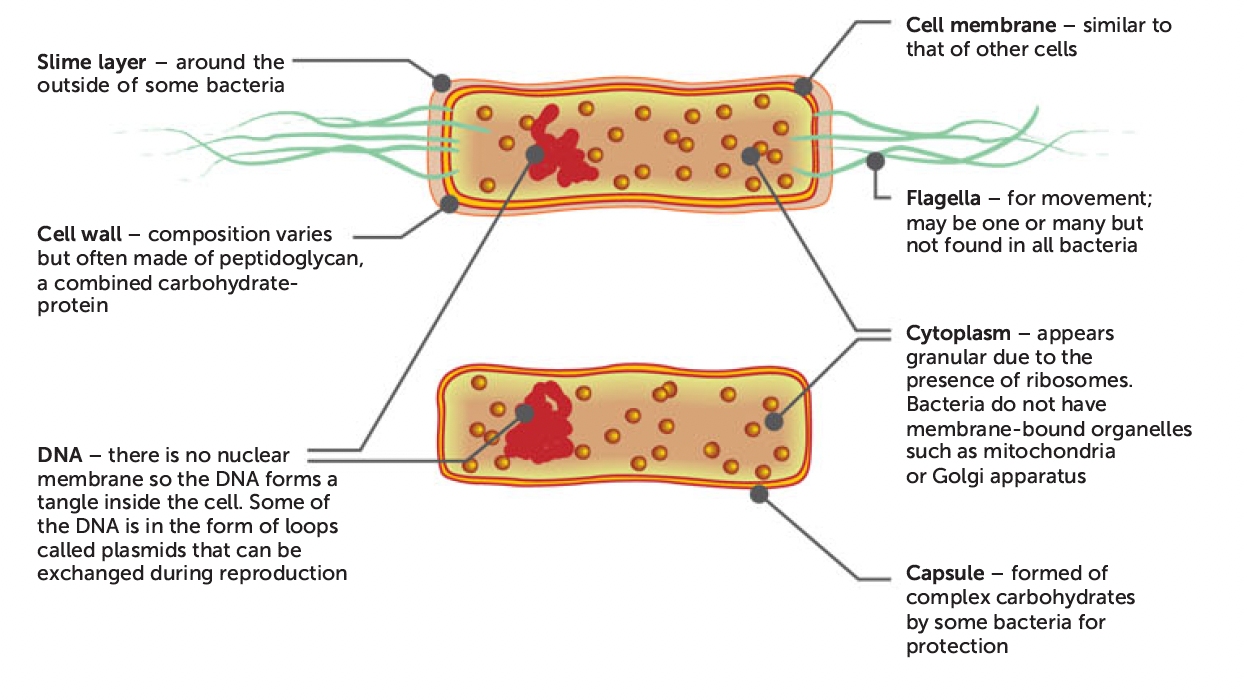
Unicellular, prokaryote organisms with a cell wall but lacking membrane bound organelles and organised nucleus
AKA as prokaryote
unicellular organisms with simple internal structure
lack a nucleus
DNA floats freely in cytoplasm or is in the form of circular plasmids
Majority are non-pathogenic
Bacteria affect body differently, depending on the species. effects may include producing toxins or inducing allergic response
Structures within bacteria
Role of bacteria?
Essential to life on earth
role in decomposition of organic material
cycling of elements
used in industrial processes (lactobacilli is used to make yoghurt and sauerkraut, flabours of cheese depends on the types of bacteria used in production)
Where are bacterial located?
Large number on skin
alimentary canal
armpit of adult male → two million bacteria per square centimetre of skin surface
intestines → so numerous that they are a major part of digestion process
no effect on ill health, but others can cause illness or death when present in relatively small numbers
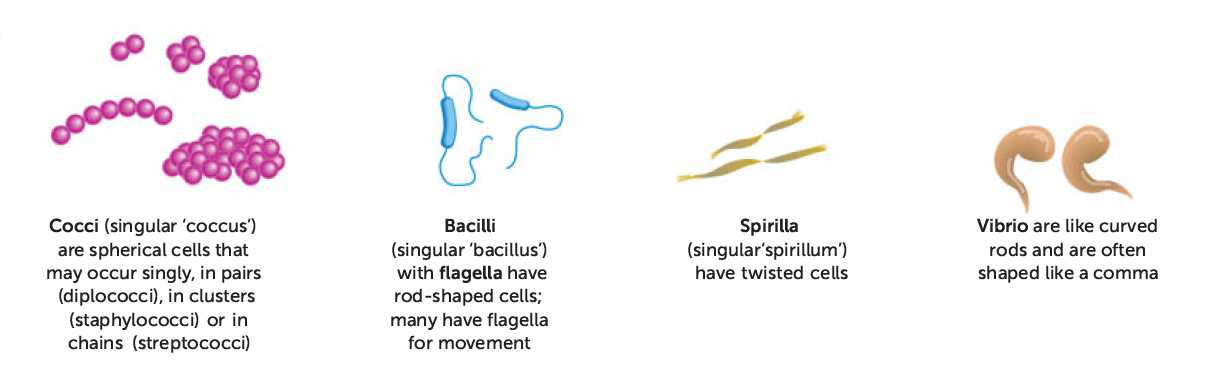
What are the types of bacteria?
How can bacteria be identified?
To identify a bacterium, it is first grown on an agar plate or growth medium in specific conditions.
Then it can be stained and viewed under a microscope.
What are viruses?
An infectious agent, too small to be seen with a light microscope, consisting of protein sheath surrounding a core of nucleic acid; viruses are totally dependent on living cells for reproduction
Contain genetic material in the form of either DNA or RNA but not both
molecule of DNA or RNA is surrounded by a coat of protein
some have external lipid envelope
What do viruses do?
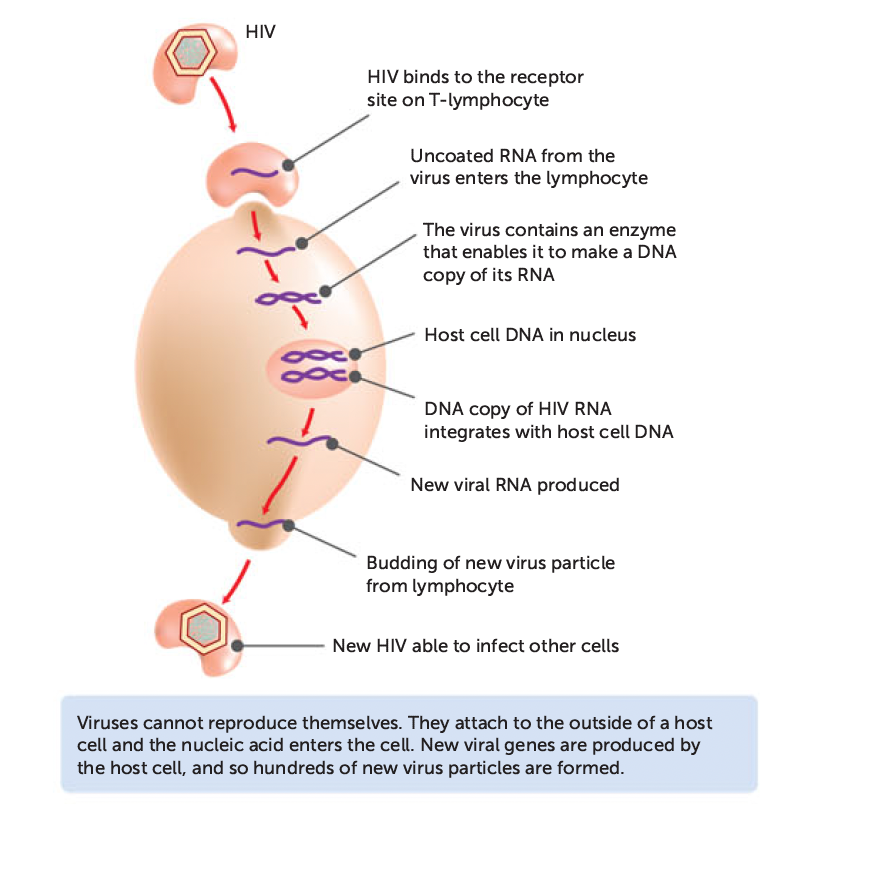
No in living things because they can’t reproduce by themselves - infect a living cell and it’s DNA or RNA induces the cell to manufacture more virus particles
New virus particles are then able to leave the host cell to infect others
in this process, cells become damaged or changed, or die
Differ in the type of cell they invade, so symptoms shown relate to the tissue that is affected
some multiply in bacterial cells, causing death of bacterium (such viruses are called bacteriophages)
Example of process of viral replication illustrated by HIV
How are communicable diseases by spread
By transmission of pathogenic organism from one person to another
such diseases are said to be contagious
directly passed from one person to another
may be spread by vectors → intermediate hosts of the pathogen such as mosquitoes or fleas
Types of transfer
Transmission by direct contact
Ingestion of contaminated food or Drink
Transfer of body fluids
Infection by droplets
Airborne transmission
Transmissinon by vectors
Transmission by direct contact
Spread of pathogen by actual physical contact
contact may be direct → actually touching infected person
indirect → touching object that has been touched by infectious person
e.g. skin infections, STI’s
Ingestion of pathogen contaminated food or drink
Can result in disease
dysentery, typhoid fever, salmonella
Transfer of body fluids?
from one person to another can result in the transmission of a number of infections.
When blood or other body fluids from an infected person comes into contact with the mucous membranes, such as in the nose, mouth, throat and genitals, or the bloodstream of an uninfected person, such as through a needle stick or a break in the skin, t pathogens may enter the body of that person.
The human immunodeficiency virus, and hepatitis B and C, are spread in this way.
Infection by droplets
tiny droplets of moisture containing pathogenic organisms are emitted when breathing, talking, sneezing or coughing.
droplets may be breathed in by others, or may settle on food or utensils to be later ingested with food.
Many viral infections, such as those causing Ebola, COVID-19, mumps, colds and influenza, can be spread by droplets
Airbone transmission
When the moisture in exhaled droplets evaporates, many bacteria are killed, but viruses and some bacteria remain viable and can cause infection when inhaled.
As these particles are lighter, they remain viable for a greater distance than those transmitted by droplets.
Measles and chickenpox are spread by this method
Transmission by vectors
transfer of pathogens by other animals, such as insects, ticks or mites.
Some vectors transfer the pathogen directly; others, such as house flies, may spread the pathogen to food or water, which is then ingested.
Many vector-borne diseases are spread by a specific vector. For example, malaria and dengue fever are spread by mosquitoes, trypanosomiasis (African sleeping sickness) is spread by the tsetse fly, Lyme disease is spread by ticks, and bubonic plague is spread by fleas from rats and mice.