Saving my grade
 Call Kai
 Learn
Learn Practice Test
 Spaced Repetition
 Match
Match Flashcards
 Knowt Play
1/59

There's no tags or description
Looks like no tags are added yet.
Name | Mastery | Learn | Test | Matching | Spaced | Call with Kai |
|---|
No analytics yet
Send a link to your students to track their progress
60 Terms
What is ECOLOGY
The study of interactions among living things (biotic factors), and between biotic factors and their environment (abiotic factors)
What is a Habitat
A place where an organism lives where an organism finds food, shelter, and mates
What is a Niche
The role an organism plays in its environment how an organism finds food, shelter, and mates
What is an Ecosystem
A geographic area where biotic and abiotic factors interact
What is a Biome
A very large ecosystem that contains a number of smaller but related ecosystems within it
What is a Community
Two or more populations of different species occupying the same geographic area at the same time.
What is a Population
A group of organisms that belong to the same species and live in a particular place at the same time
Population Density
How crowded a population is. The number of individuals per unit area or volume.
Population Size
The number of individuals a population contains
What does Population Size depend on
Immigration
Emigration
Births
Deaths
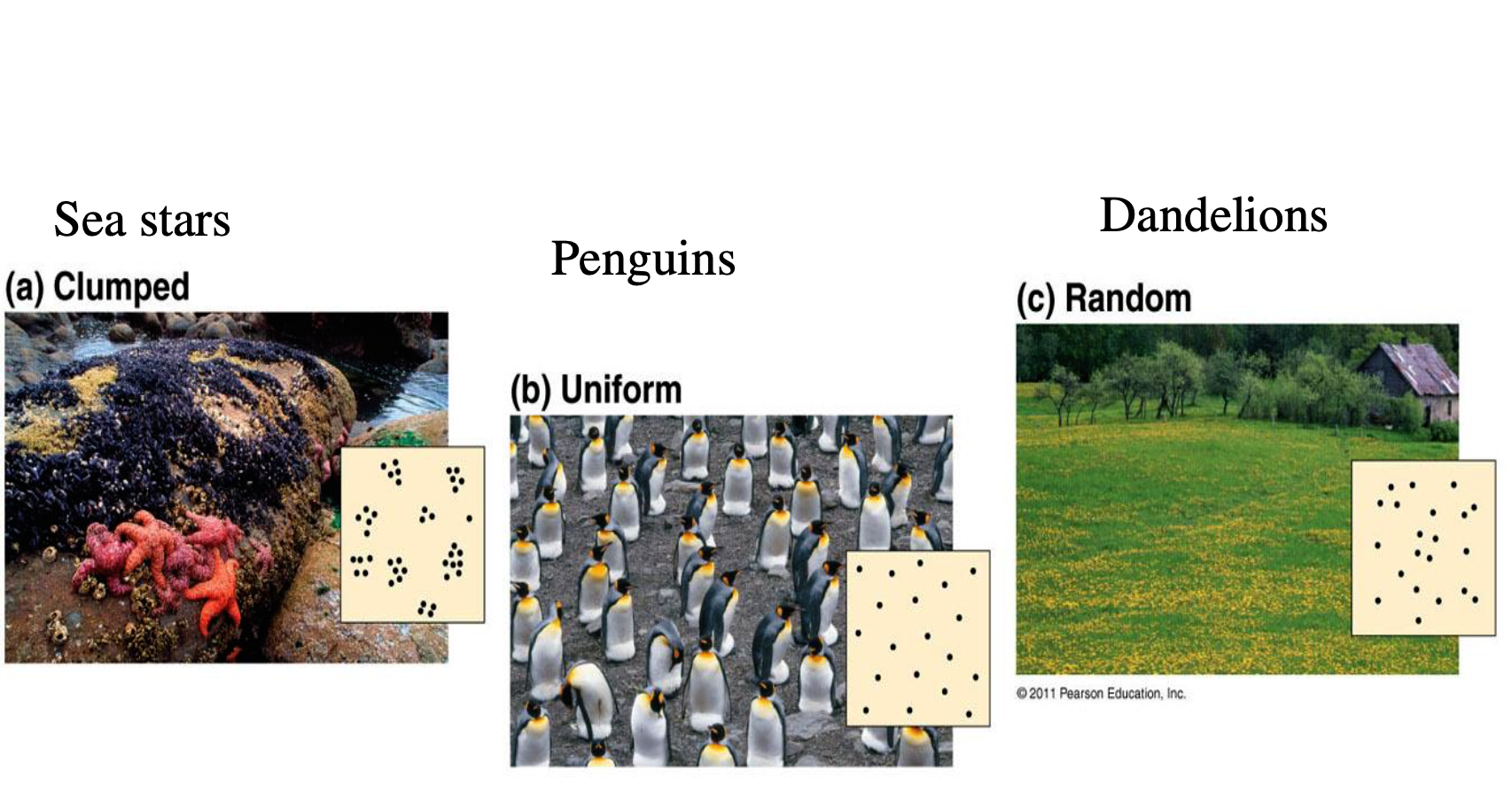
What is Population distribution
the location of individuals relative to one another
What is Exponential Growth Rate
The accelerating increase that occurs during a time when growth is unregulated (an abundance of resources and no predators)
What is the Logistic Growth Model
growth rate decreases the larger the population becomes and eventually stabilizes it
What is Carrying Capacity
The maximum population that a given area can sustain
What factors limit the size of a population
Density Independent Population Regulation and Density Dependent Population Regulation
What are Density-independent factors
Natural or human-caused disasters
Extreme weather
What are Density-dependent factors
Interspecies competition for resources
Predator-prey interactions
Parasitism
Disease
Coevolution
Joint evolution of two closely interacting species
Each is a selective agent for traits of the other
Each adapts to changes in the other
What are the Five types of symbiotic relationships
Predation (+ / –)
Parasitism (+ / –)
Mutualism (+ / +)
Commensalism (+ / 0)
Interspecific competition (+ / –)
What is Predation
Members of one species (predator) capture kill, and feed on another species (prey)
What is Parasitism
One organism (parasite) lives and feeds on another organism (host)
What is Mutualis m
Two species interact in a way that benefits both
What is Commensalism
One organism benefits from another, but neither helps nor harm that other organism
Interspecific Competition
One species gains more resources (space, food, etc) than the other species
What is Biodiversity
A measure of variation at the genetic, species, and ecosystem levels
What are the two components of biodiversity
Species richness and Species evenness
What is Species richness
The number of species
What is Species evenness
The relative abundance of individuals of each species
How can a single species change an entire ecological community
By being a Keystone species or Invasive species
What is a Keystone species
A species that has a disproportionately large effect on community structure
Are often top predators
How can removing a Keystone species affect an Ecosystem
Causes a destructive domino effect that collapses the food chain, destroys habitats, and ruins the entire ecosystem.
What is a Invasive species
A species that evolved in one community and later became established in a different one
More than 4,500 exotic species have become established in the United States
How does an Invasive species effect the Ecosystem
Multiplying rapidly without natural predators, outcompeting native wildlife for food and water, and permanently destroying habitats
How does energy and nutrients move through ecosystems?
Energy flows through an ecosystem in a one-way path and is eventually lost as heat, while nutrients recycle continuously to be used over and over again
What are Food chains
A straight line that shows exactly who eats whom in an ecosystem, tracking how energy and nutrients move from one organism to the next
What is Trophic level
The position of an organism in a food chain (producer, consumer, decomposer)
What is a Producer(Plants)
An organism that makes its own food (organic compounds) from inorganic materials and usually the sun’s energy
What is a Primary Consumer(Herbivore)
An organism that eats producers for food
What is a Secondary consumer(Carnivore)
An organism that eats Primary Consumers for food
What is a Tertiary consumer(Apex Predator)
An organism that eats Secondary Consumers for food
What are Decomposers
Break down dead material to recycle nutrients (Without decomposers, all ecosystems would collapse!)
What is an Indicator species
A plant or animal whose health, behavior, or population size reveals the overall condition of its environment
What is a Food Web
A network of interconnected food chains that shows all the overlapping feeding relationships in an entire ecosystem
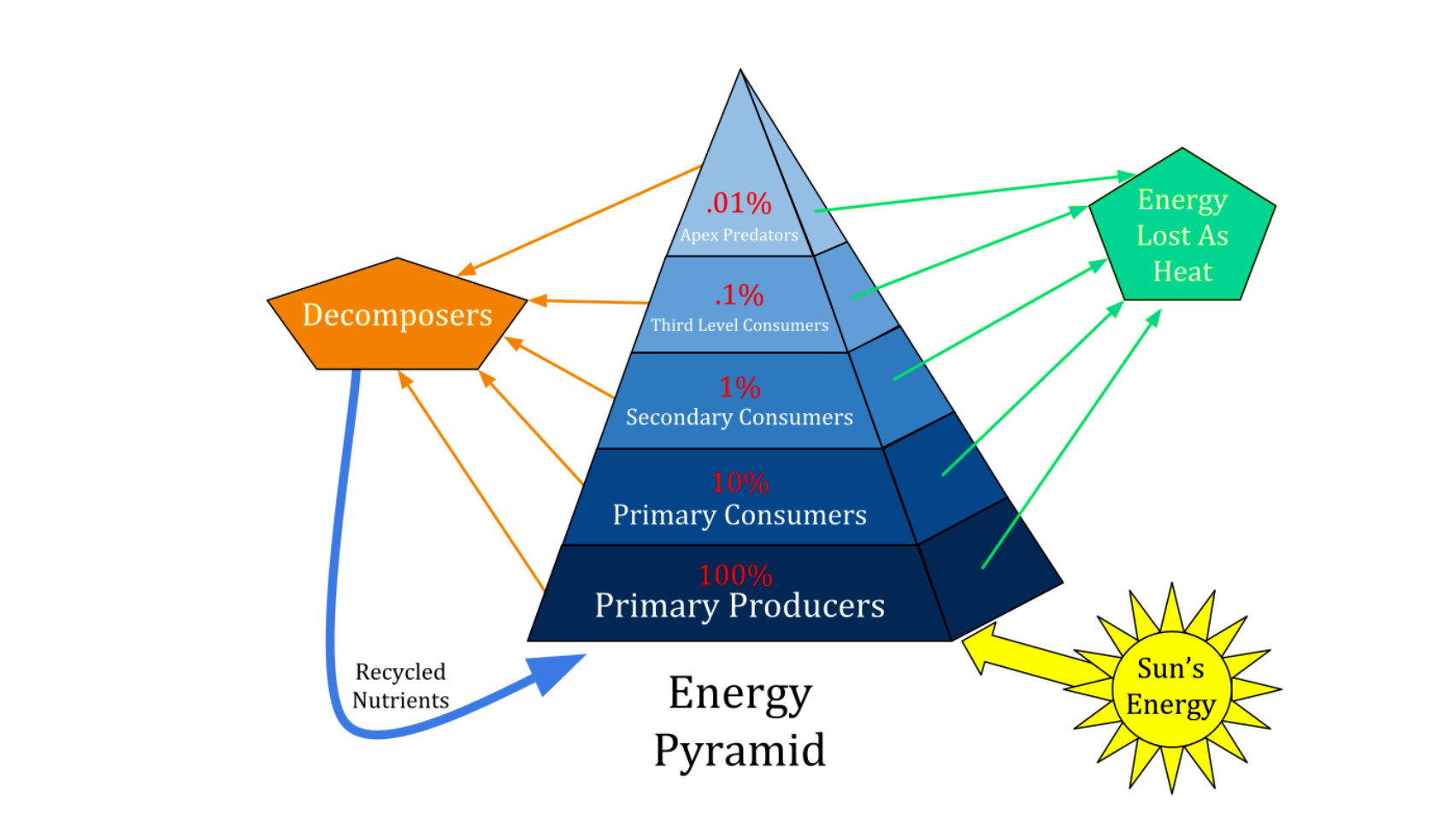
What is the Energy pyramid
A graphical model that shows how much energy is available at each trophic level of an ecosystem. The higher you go on the pyramid, the less energy is available in the ecosystem!
What is The 10% Rule
Only 10% of the energy from one trophic level is passed up to the next level
What is the The Carbon Cycle
The continuous process by which carbon travels from the atmosphere into organisms and the Earth, and then back into the atmosphere
What is a Reservoir
Where matter is stored (ex. rocks, plants, fossil fuels, deep ocean, marine biosphere, ocean’s surface, soil, atmosphere)
What is a Flux Mechanism
How matter moves from one place to another
What is Residence Times
How long matter stays in one place
What is Global Warming
Refers to the increase in Earth’s average surface temperature due to rising levels of greenhouse gases
What is Climate Change
A broader term that refers to significant changes in global temperature, precipitation, wind patterns, and other measures of climate that occur over several decades or longer
What are Greenhouse gases
Gases in Earth's atmosphere that trap heat from the sun
What is the Greenhouse effect
The natural process where gases in Earth's atmosphere trap heat from the sun to keep the planet warm enough for life to survive
What is Net Primary productivity
The amount of plant energy that remains after plants use what they need to stay alive
What is Gross primary productivity
The total amount of solar energy that plants and other producers capture and turn into chemical energy (sugar) through photosynthesis over a specific period
State the levels of organization in the field of ecology
Organism
Population
Community
Ecosystem
Biome
Biosphere
Differentiate between density dependent and density-independent limiting factors.
Density-Dependent Factors change their impact based on how crowded a population is, while Density-Independent Factors strike a population with the exact same force regardless of its size
Describe examples of the five types of symbioses.
Mutualism
Commensalism
Parasitism
Predation
Intraspecific competition
Explain why ecosystems usually contain only a few trophic levels
Because of the inefficient transfer of energy from one level to the next
Give an example of how a single species can alter the structure of an ecological community
Sea urchins eat giant kelp, a massive seaweed that forms underwater forests, and without kelp to slow down waves, shoreline erosion increases