CL for astigmatism
 Call Kai
 Learn
Learn Practice Test
 Spaced Repetition
 Match
Match Flashcards
 Knowt Play
1/26

There's no tags or description
Looks like no tags are added yet.
Name | Mastery | Learn | Test | Matching | Spaced | Call with Kai |
|---|
No analytics yet
Send a link to your students to track their progress
27 Terms
What is the power meridian
meridian of greatest curvature/optical power
steepest >D or smallest mm
Axis meridian
meridian of least curvature/optical power
What is residual astigmatism
the astigmatic refractive error that left uncorrected when a CL is placed upon the cornea to correct the existing ametropia
How can residual astigmatism be induced?
Tilted &/or decentred CL
Toricity &/or bitoricity of CL
CL dislocation → rotation and/or decentration
Warpage and flexure of CL
(likely in a soft CL if lens is rotated off axis)
Physiological residual astigmatism
un-neutralised corneal astigmatism
posterior corneal astigmatism
lenticular astigmatism
tilted crystalline lens
Refractive index anomalies
oblique aberrations
What is the purpose of toric CL stabilisation?
maximise the predictability of CL axis location
max CL physiological performance
what resists the lens moving on your eye ?
Lids
forces applied by upper lid more significant than lower lid
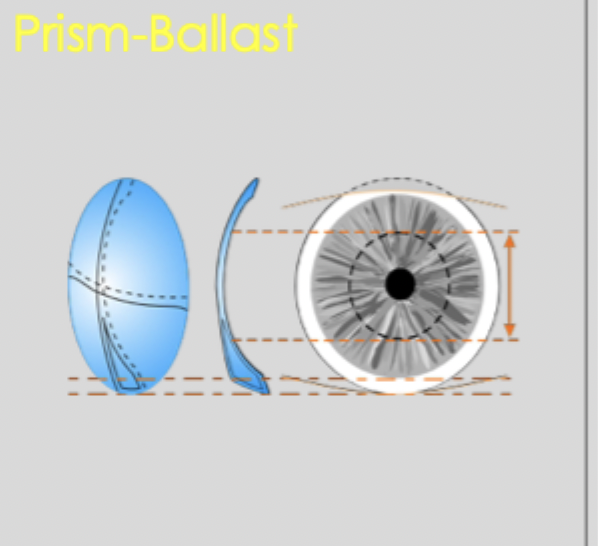
What is Prism-Ballast for Toric stabilisation
1 to 1.5 D Base-down prism (thicker at the bottom)
stabilised by prism-induced CL thickness differences
however decrease in CL O2 transmissibility
discomfort with CL-lid interaction
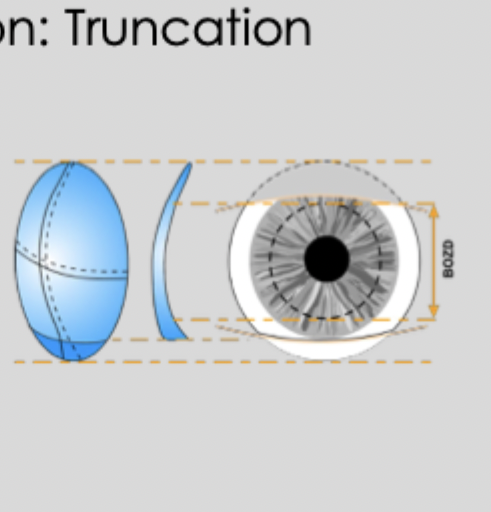
What is truncation → Toric SCL stabilisation
Truncation aligned with LOWER lid margin can create some CL stabilisation
Truncation can cause some discomfort
Truncation not always successful
more px visits can be required
not used now
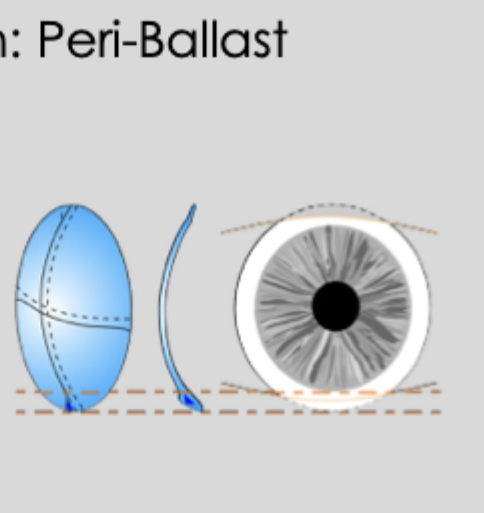
What is Peri-Ballast → Toric SCL stabilisation ?
minus carrier converted to base down prism effect
uses thickness prisms as stabilising component → thinner superiorly , thicker inferiorly
prism free optic zone
can get discomfort with CL-lid interaction at the thicker inferior half
decrease in CL O2 transmissibility in thicker regions
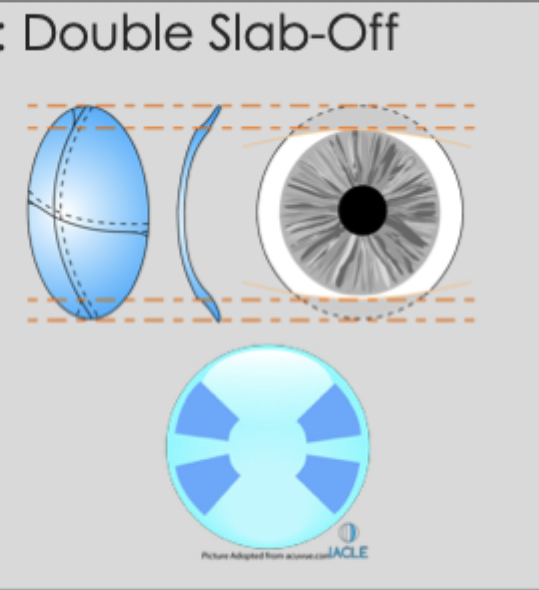
What is the double slab-off → toric SCL stabilisation?
better comfort due to a decrease in CL thickness
Thin zones Superiorly AND Inferiorly
Lid forces (upper and lower) maintain orientation
CL is symmetrical
can exhibit less rotational stability if low spheres, WTR astigmatism
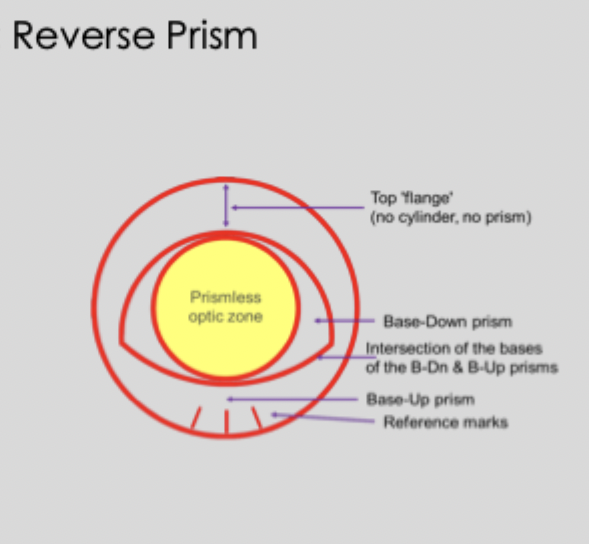
What is Reverse prism method for Toric SCL stabilisation?
BOTH base up and base down prism
results in thinner and more comfortable lenses than just the thicker base down prism ballast design
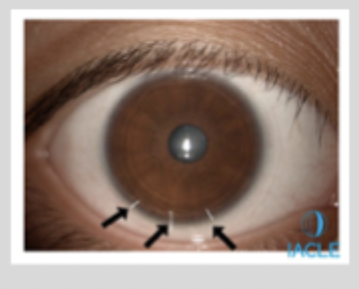
What is Bausch and Lomb reference marks on a CL
3 lines around 6 O’clock
30 degree separation (15 each)
Purevision Toric, Purevision 2 toric
Optima Toric
Soft CL toric
Reference markers on Alcon CL?
3,6 & 9 O’clock Positions
6 O’clock line thicker
Air Optic for astigmatism CL
Cooper vision reference markers on CL
single vertical line @ Base of CL → 6 O’clock position
Biofinity toric
Avaira Toric
Clarity Toric
Johnson and Johnson CL reference markers
Vertical lines at 6 & 12 O’clock position
1 Day Acute moist for Astigmatism
Acute Oasys + Advance for astigmatism
What are the indications of fitting a Toric CL
when spherical CLs fail to mask corneal stigmatism → unsatisfactory VA with BVS
GP CLs leave residual astigmatism due to physiological aspects
GP CLs cause discomfort
High sphere to Cyl ratio
cyl a third or more of total refraction
What to do when selecting a trial for Toric CL ?
measure Rx & vertex distance
select CL power (BVP) to match corneal-plane Rx
vertex correct each meridian >4D
Select BOZR &.or TD
(K1+K2/2) +0.9mm
HVID +2mm
always lowest minus if possible
if refraction 45 e.g decide on preference between 40 or 50 in trial frame
What stock do CL come in
start at 0.75 and go up in 0.50 steps
-0.75
-1.25
-1.75
-2.25
IN 10 DEGREE axis jumps
What is a good fit of a CL
full corneal coverage , good centration and movement , quick reorientation if mislocated
0.2-0.5mm movement
Describe a tight fit CL
Good centration , initially uncomfortable , little or no movement
slow reorientation if mislocated
Describe a loose fit CL
excessive movement , poor centration and uncomfortable
CL orientation unstable & inconsistent
LARS rule
Right = subtract
Left =Add
if contact lens moved to the right and was 70
subtract how much it moved by → 10 degrees example
70-10=60
reorder at 60
What should you do if the reordered CL rotates again
LEAVE IT
second lens should fit in the same orientation
could be due to persons anterior eye surface and not lens design
Hyperopia CL
CL have shorter distance over which to focus light than spectacles
Therefore, the contact lens power must be MORE POSITIVE than the glasses prescription.
Myopia CL
CL have a longer distance over which to focus light than spectacles
Therefore, the contact lens power must be LESS NEGATIVE (lower minus) than the glasses prescription.
When do we carry out over-refraction
only over-refract a lens that has less than 5 degrees rotation
use loose sense in trial Frame → check sphere, axis and cycle power
ensure if change that it can be accommodated for in a new lens
-0.50 jumps in soft lenses
10 degree jumps in soft lenses