Chemistry Quiz 4
 Call Kai
 Learn
Learn Practice Test
 Spaced Repetition
 Match
Match Flashcards
 Knowt Play
1/49

There's no tags or description
Looks like no tags are added yet.
Name | Mastery | Learn | Test | Matching | Spaced | Call with Kai |
|---|
No analytics yet
Send a link to your students to track their progress
50 Terms
Solvation
process of a solute dissolving into a solvent
what is the universal solvent?
water
how does solvation work for water?
with hydrogen
water is _________ covalent
polar
what factors effect solvation?
stirring, surface area, temperature
how does stirring effect solvation?
enables solute to dissolve
how does surface area effect solvation?
large bulky solutes take longer to dissolve
how does temperature effect solvation?
warmer temp → faster solute will dissolve
Gas = warm temp → more/less soluble the gas becomes
less
solubility
amount of solute dissolves in a solvent
soluble
solute that dissolved easily
unsaturated
solution that contains a minimum of solute
supersaturated
certain solutes that have the ability to dissolve more solute over saturation point
which solutes are able to supersaturate?
sodium thiosulfate and sodium acetate
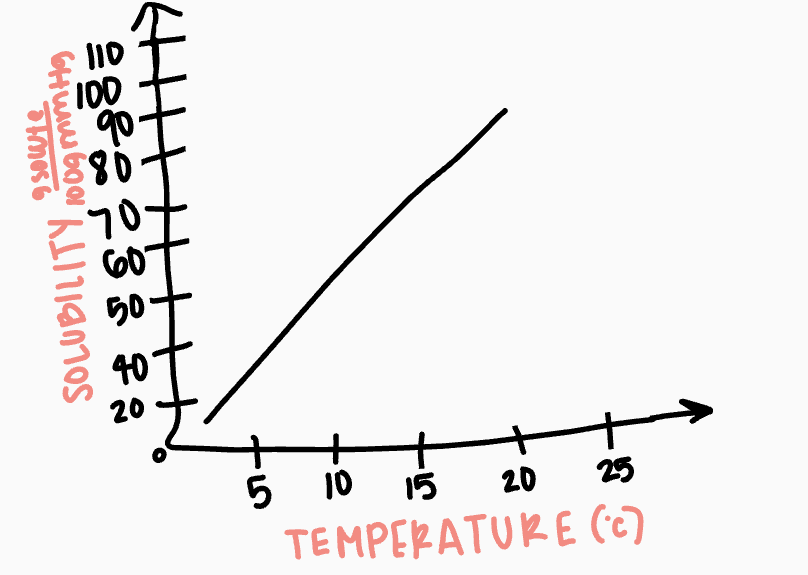
what is this called?
solubility curve
which way do solids and liquids go on a solubility curve?
upwards
which way do gases go on a solubility curve?
downward
Henry’s Law formula
P2/P1 = S2/S1
what do bubbles signify in Henry’s Law?
effervescence
solubility of CO2 in a solution is 0.003 M. When pressure is 2 atm. What is solubility at 6 atm?
0.009 M
A carbonated beverage has a solubility of 2.1M at 345 mmHg. If solubility changes to 4.5 M. What happened to pressure?
740 mmHg
what are colligative properties?
properties that deal with the effect of solute dissolves in a solvent
What are two types of colligative properties?
freeze point depression and boil point elevation
how do colligative properties affect freezing point?
lower the freezing point
how do colligative properties affect boiling point?
raise the boiling point
what are reaction rates?
speed with which a reaction happens
What are two stipulations for a reaction to be successful?
particles must collide with enough kinetic energy and they must collide in correct orientation in a specific place
what is the activation complex?
a transition state, old bonds are broken and new ones are formed
what is activation energy?
particles that hit hard enough → correct kinetic energy
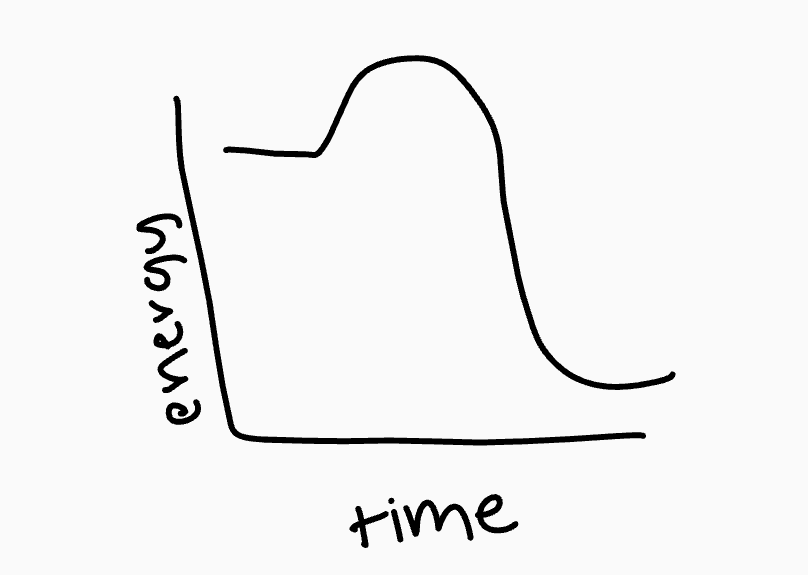
what type of graph is this?
exothermic
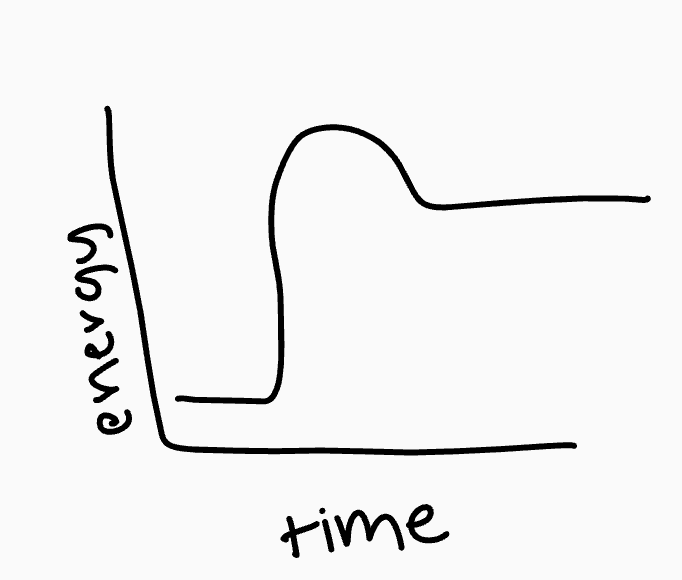
what type of graph is this?
endothermic
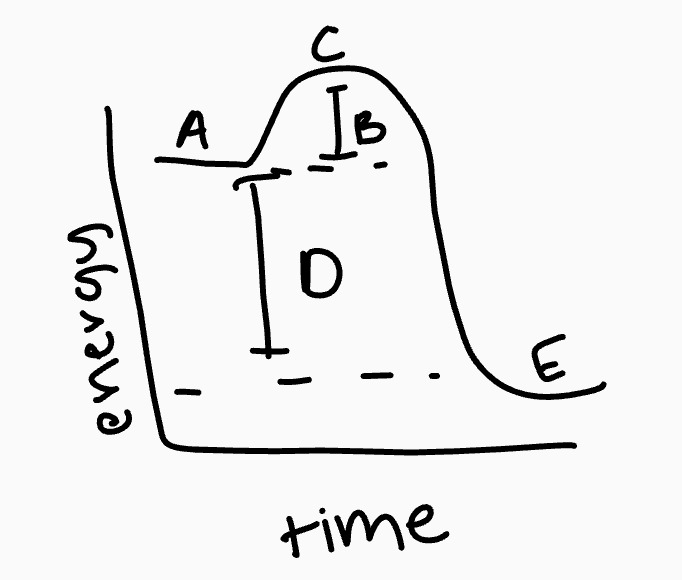
What is A locating?
reactant energy
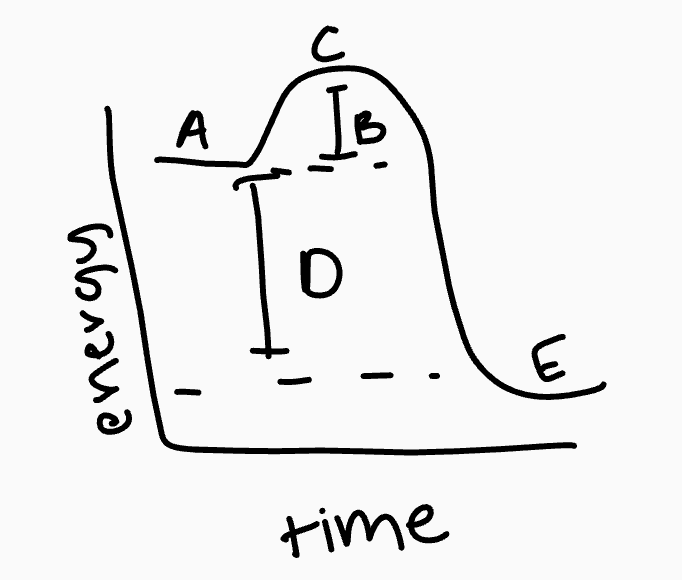
What is B locating?
activation energy
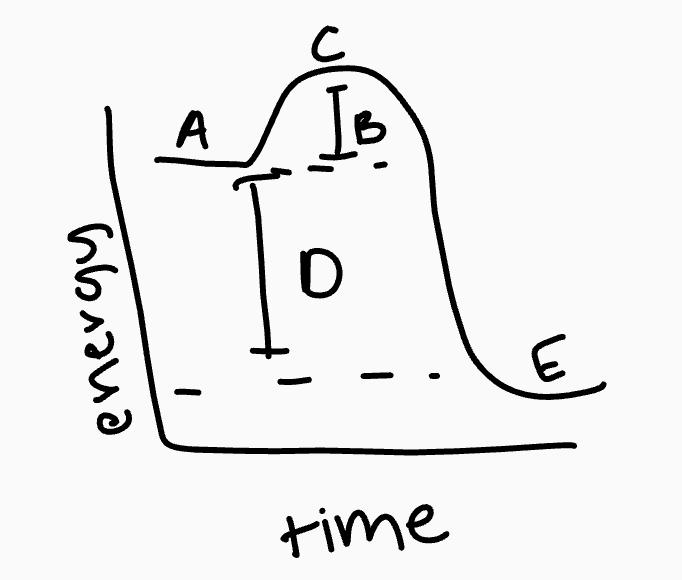
What is C locating?
activation complex
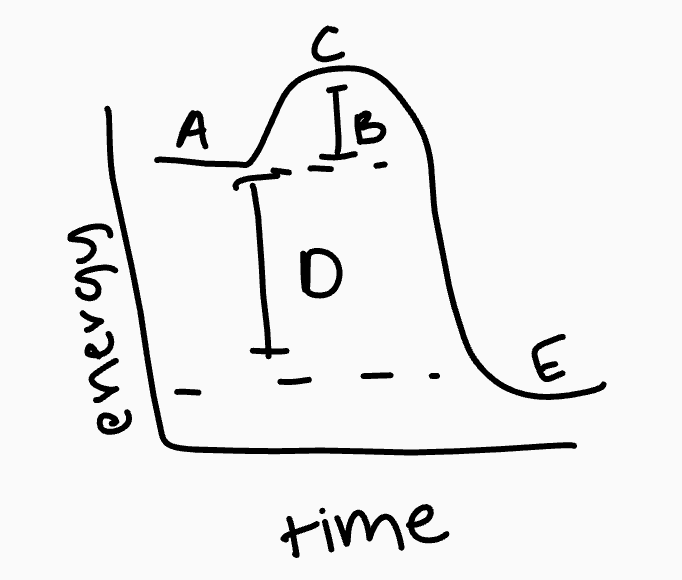
What is D locating?
ΔH
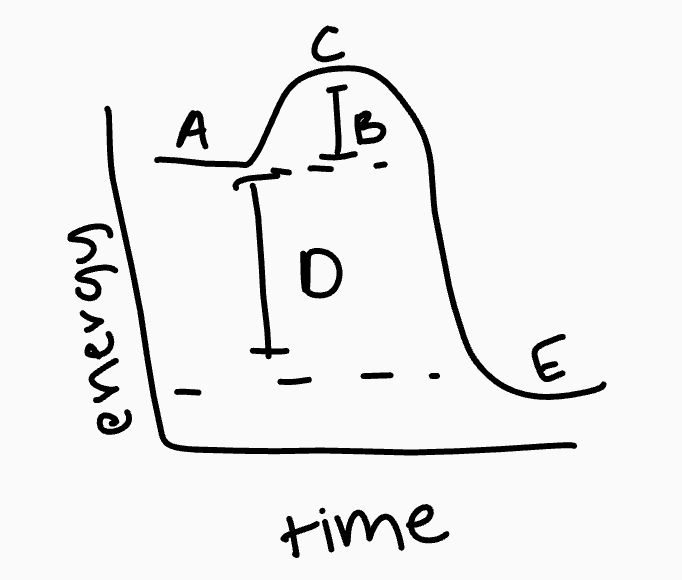
What is E locating?
product energy
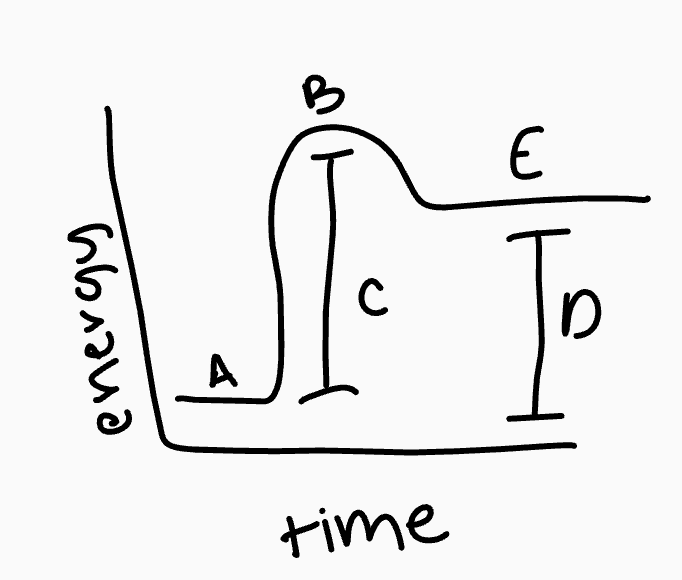
What is A locating?
reactant energy
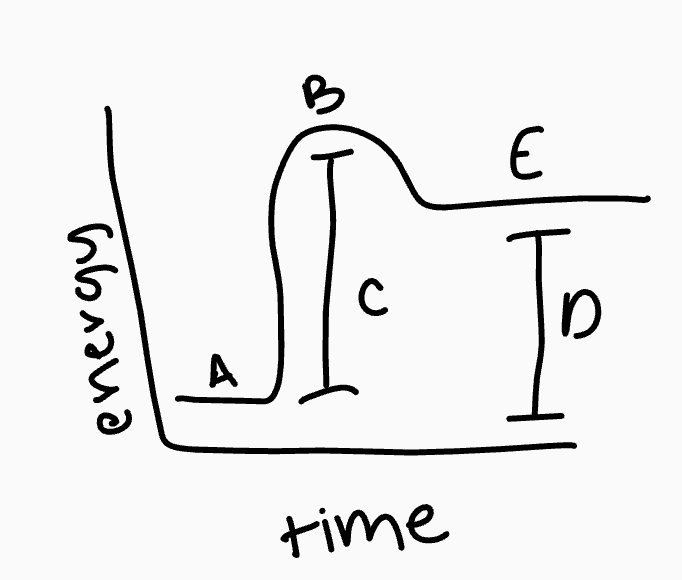
What is B locating?
activation complex
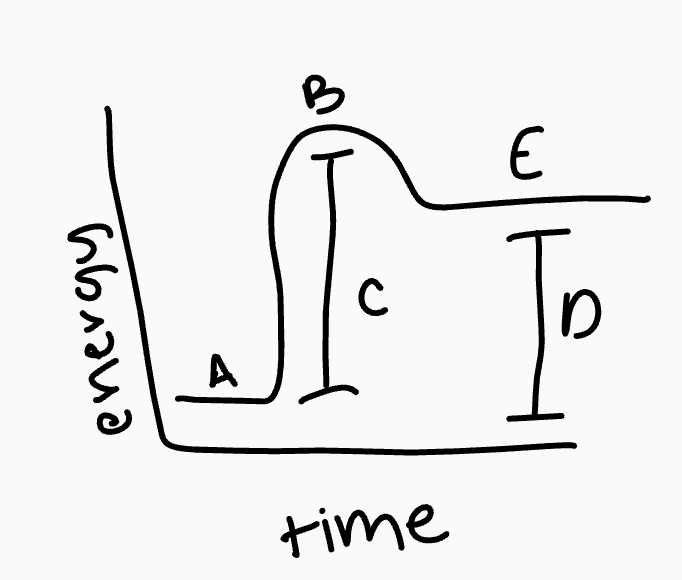
What is C locating?
activation energy
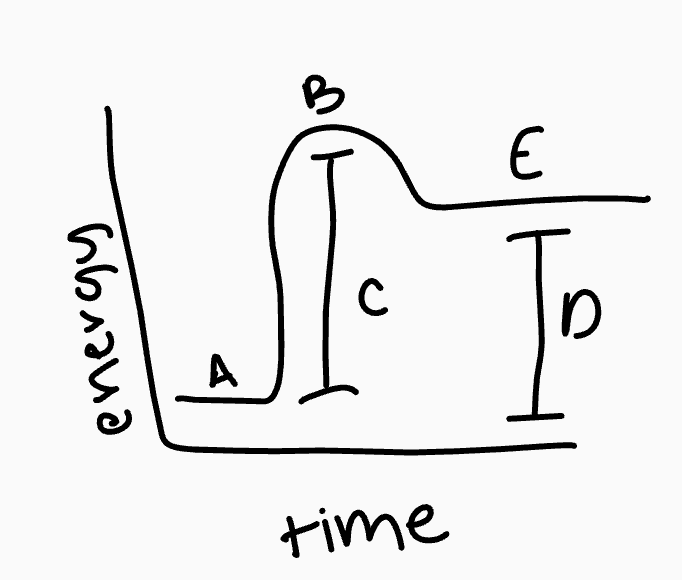
What is D locating?
ΔH
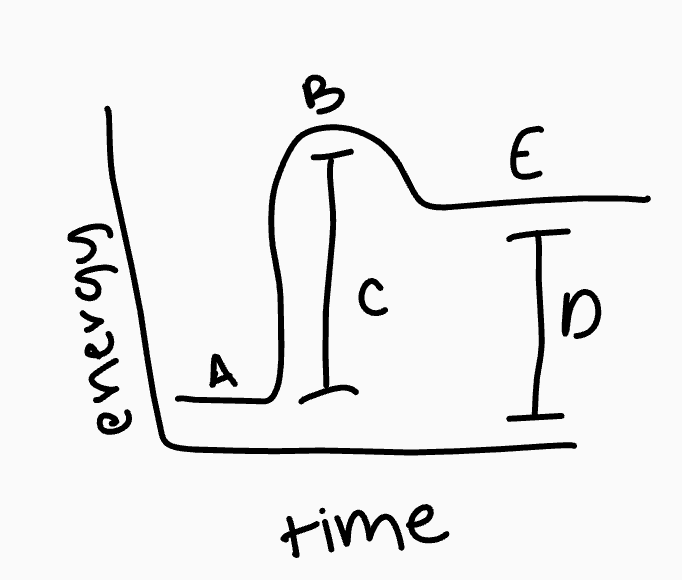
What is E locating?
product energy
What does ΔH mean?
product energy - reactant energy
What factors effect the reaction rate?
nature of the reactants, concentration, surface area, temperature, catalyst, and inhibitor
What are the two main equilibrium reactions?
one way and two way/ reversable
Why is equilibrium referred to as dynamic?
dynamic means ongoing, the reaction never stops
What does Keq > 1 mean?
the reactant favors the product
What does Keq < 1 mean?
reaction favors the reactants
Given: C2H6 + O2 →← CO2 + H20. Write Keq expression for reaction
Keq = [CO2]4[H20]6/ [C2H6]2[O2]7
Fe2O3 + H2 <-> Fe + H2O
At 340 C, Keq is 0.64. If concentration of Fe = 0.45 M, H20 = 0.37, and Fe2O3 = 0.72, what is molar concentration of the hydrogen?
x = 0.27 M
what are reaction rates?
factors that affect the rate of reaction