Unit 1 & 2 ATAR Psychology
 Call Kai
 Learn
Learn Practice Test
 Spaced Repetition
 Match
Match Flashcards
 Knowt Play
1/304

Earn XP
Description and Tags
Literally everything on the syllabus + more (help)
Name | Mastery | Learn | Test | Matching | Spaced | Call with Kai |
|---|
No analytics yet
Send a link to your students to track their progress
305 Terms
Harlow’s Monkey Experiment (1958): Hypothesis
It is hypothesised that the 8 rhesus monkeys will prioritise contact comfort over nursing comfort across both condititions.
Harlow’s Monkey Experiment (1958): Aim
To determine the importance of contact comfort as opposed to nursing comfort in developing a bond between a primary caregiver and an infant
Harlow’s Monkey Experiment (1958): IV, DV, Research Design
IV: The mother surrogate which lactates
DV: Time spent with cloth and wire mother
Research Design: Experimental
Harlow’s Monkey Experiment (1958): Method
Immediately after birth, 8 newborn rhesus monkeys are placed into one of 2 conditions:
EC1: Wire mother lactated
EC2: Cloth mother lactated
Harlow’s Monkey Experiment (1958): Findings
Rhesus monkeys spent more time with the cloth mother regardless of which one provided food.
Both conditions spent, on average, 16-17 hours per day with the cloth mother, and less than 30 minutes on the wire mother.
Harlow’s Monkey Experiment (1958): 3 Contributions
Emphasised importance of providing a child with an enriched childhood
Proved that love is not developed solely from the provision of food
Showed that parents need to take a more active role in their child’s development
Harlow’s Monkey Experiment (1958): 3 Criticisms
The study has never been replicated
Humans are more complex than rhesus monkeys, therefore we cannot generalise
Low ecological validity due to monkeys being taken out of their habitats, meaning they may have acted abnormally
Harlow’s Monkey Experiment (1958): 3 Ethical Issues
Informed consent: the monkeys are not able to understand the risks of an experiment and cannot consent
Protection from harm: the monkeys were harmed due to a lack of social interation and isolation from habitats
Right to withdraw: the monkeys were not given the opportunity to return to their natural habitat
The 3 R’s in animal ethics
Replacement with other subjects if possible that will experience less pain and stress
Reduction of animals in the experiment in total
Refinement of experimental conditions in order to increase the wellbeing of the animals
The 7 ethical guidelines applied to human research
Protection from physical / psychological harm
Informed consent
Withdrawal rights
Limited deception with debreifing
Confidentiality post-research
Privacy during research
Voluntary participation
The role of ethics comittees
Approving and overseeing experiments to ensure ethical guidelines are kept, and closing any experiments that go against ethical guidelines.
Piaget’s Stages of Cognitive Development
0-2: Sensori-motor
2-7: Preoperational
7-12: Concrete operational
12+: Formal operational
Sensori-motor stage
0-2. Children learn and develop through use of their senses, developing early schemas.
They develop object permanence at around 8 months, and begin speaking late into the period.
Sensori-motor: Object permanence
The ability to understand that once an object is not in sight, it still exists. Children learn this through sensory experimentation. Time of development varies, but it tends to be around 8 months.
Sensori-motor: Invisible Displacement
An example of this task involves grabbing a childs attention with a toy, then hiding that toy. If the child tries to find the toy, they have developed object permanence.
Pre-operational stage
2-7, development of symbolic representation, big imaginations, learning through play, animism, centration, and egocentrism is common. Seriation is developed.
Pre-operational: Egocentrism
A common thing in younger children, where they believe all points of views and opinions match their own.
Pre-operational: Centration
The inability for children to focus on all aspects of a scenario. They will fixate on one area and ignore all others. For example, seeing themselves with more cookies despite all being smaller than their siblings.
Pre-operational: Seriation
The childs ability to group items based off height, weight, etc.
Pre-operational: Animism
The childlike belief that objects have human-like qualities and are capable of action.
Pre-operational: Symbolic Thought
The use of certain items to represent other people, places, or things.
Pre-operational: Three Mountains Task
The child is required to describe the scene of a mountain from another persons perspective, testing egocentrism.
Concrete operational stage
7-12, concrete understanding of logic and conservation, such as conservation of mass, number, volume
Concrete Operational: Conservation Task
A test in which a material is manipulated. If the child understands that the material is still the same, they understand conservation.
Formal operational stage
12+. Can understand abstract and hypotheticals, can predict outcomes of hypothetical scenarios.
Formal Operational: Pendulum Task
The child will be given a pendulum and will be able to methodically test ways to make the pendulum swing faster - string length, weight, height.
Piaget’s studies were limited because…
He used anecdotal evidence, rarely would properly establish the origins of his subjects, and had bias when selecting subjects
Piaget’s studies were beneficial because…
He permanently changed the education systems across the world for the better, enhanced peoples understanding of development, and paved the way for better future studies and experiments
Bowlby’s Definition of Attachment
An emotional bond that is characterised by the need to frequently seek out and maintain proximity to a particular attachment figure, particularly in times of distress, in order to maintain comfort and a sense of security
ASCMI Acronym
The various aspects of Bowlby’s Theory of Attachment
Adaptive
Social Releases
Critical Period
Monotropy
Internal Working Model
Attachments are adaptive:
Babies have social releases:
Unlock the biological tendency of adults to care for them.
These include physical releases (‘baby face’ and bodily proportions), and behavioural releases (laughing, crying)
Critical Period
0-2. The primary caregiver and infant foster a connection. If no connection is made or if the primary caregiver disappears, it can lead to maternal deprivation or privation.
Sensitive Period
0-5. Bowlby would later revise his theory, stating that a connection can still form after the critical period, however it is far more difficult.
Monotropy
The biological tendency of young children to bond very closely to a single person - this evolved from a survival mechanic
The Internal Working Model (Definition)
A prototype for all future social relationships, allows individuals to control, predict, and manipulate interactions with others.
Main features of the Internal Working Model:
A model of others as being trustworthy
A model of the self as being worth of healthy relationships and love
A model of the self as a good communicator
Privation
The lack of any maternal connection ever being formed with a primary caregiver
Maternal Deprivation
The loss of the primary caregiver, whether through death or other means
Bowlby’s Hypothesis: Continual disruption of the attachment between infant and primary caregiver could result in long-term cognitive, social, and emotional difficulties for that infant, such as (7 things):
Lack of ability to form meaningful connections, lack of guilt, antisocial behaviour, delinquency, delays in sexual development, sleep and appetite issues
Applications of Bowlby’s Attachment Theory
Allowed for therapists to use childrens behavioural issues to predict why they may be having those issues, allowed for greater efficiency in family counseling, emphasised the importance of providing a child with an enriched childhood.
Criticisms of Bowlby’s Theory
Focus on mother-child relationship without accounting for other important childhood relationships, some question whether attachment patterns may differ cross-culturally and socially
Two main nervous systems
Central nervous system (CNS), peripheral nervous system (PNS)
Branches of the CNS
Brain and spinal cord
Branches of the PNS
Somatic nervous system (SNS), autonomic nervous system (ANS)
Branches of the ANS
Sympathetic nervous system, parasympathetic nervous system
Central Nervous System (CNS)
Receives sensory information from the PNS, and tells the PNS how to respond via motor neurons
Peripheral Nervous System (PNS)
Carries information to and from the CNS, carrying motor messages to organs and muscles
Somatic Nervous System (SNS)
Controls all skeletal muscle movement, both voluntary and involuntary (reflexive). Carries messages to and from the CNS.
Autonomic Nervous System (ANS)
Controls and regulates non-skeletal muscles, such as the cardiac muscle and other internal organs
Sympathetic Nervous System
Controls fight or flight response - regulates glands and internal organs in high-intensity / stressful situations. Dilates pupils, increases heart rate, redirection of oxygen-rich blood
Parasympathetic Nervous System
Calms down the body after being initiated by the sympathetic nervous system. Contracts pupils, slows heart and breathing rate, and moves blood back to the digestive system
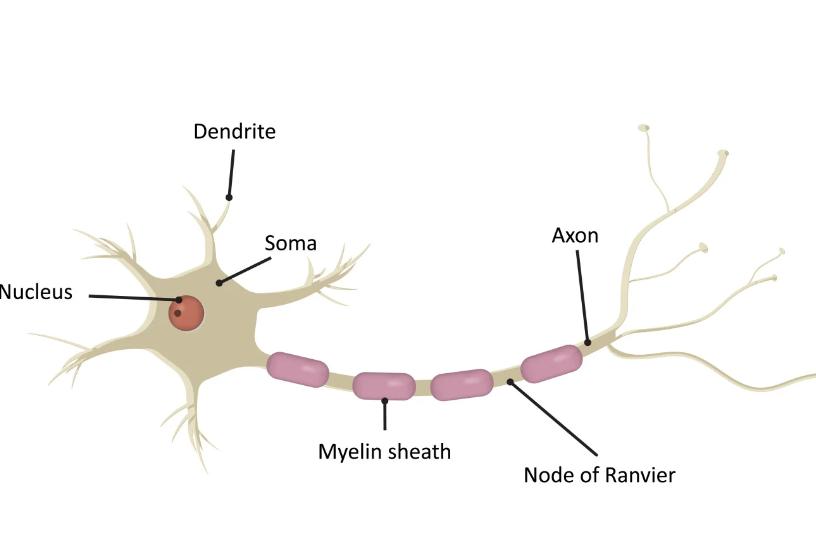
Motor Neurons
Efferent neurons, travel from the CNS to the PNS and carry messages instructing muscle movement
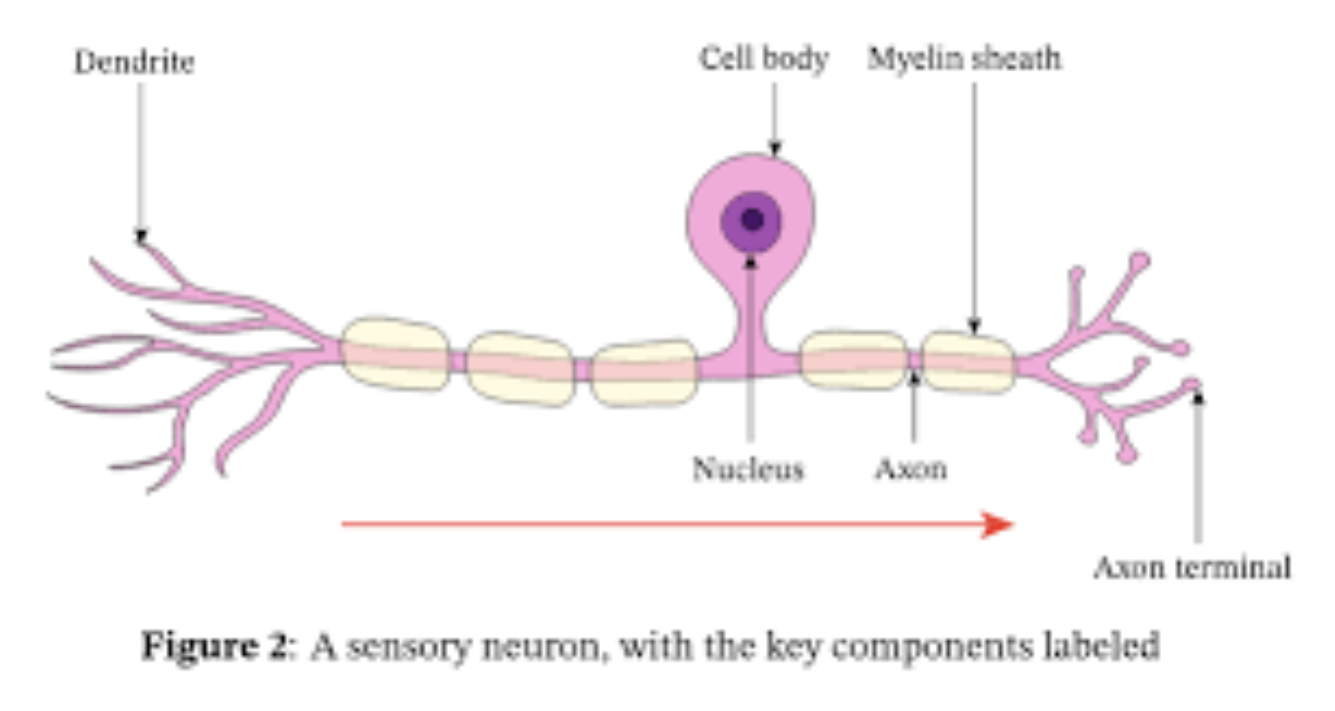
Sensory Neurons
Receives information from neuron receptors, carrying them from the PNS to the CNS. These are afferent.
Interneurons
Neurons that can both relay motor messages and recieve sensory messages. These are seen widely in the CNS.
The spinal cord
A band of nerve fibers running from the brain to the lower back. Protected by the spine bone structure, it serves as a connecting point between the brain and the PNS.
Dendrite
The receiving parts of the neurons, receiving chemical messages from other neurons.
Myelin sheath
A layer of fat insulating the axon and allowing for the electrical signals to travel faster.
Axon
The portion of the nerve cell that carries electrical impulses away from the cell body and towards the axon terminals.
Cell body / soma
The core of the neuron containing the nucleus. It contains genetic information, maintains the neurons structure, and provides energy to drive activities.
Axon terminal
The end of the cell - these release neurotransmitters to transmit a chemical signal across the synapse and into the dendrite of another neuron.
Reuptake
The concept that any unused neurotransmitters are taken back into the axon terminal.
Vesicle
A small structure inside the axon terminal that contains neurotransmitters. When necessary, they open and release the neurotransmitters across the synapse.
Action Potential
The electrical message being transferred across the axon
Electro-chemical signal
The message travelling across neurons is referred to as ‘electro-chemical’ due to the electrical message travelling across the axon turning into a chemical signal once reaching the synapse.
The Synapse
The gap between two neurons allowing for the transfer of chemical messages from one neuron to the next.
Hindbrain
Controls various autonomic functions, such as breathing, heart rate, motor reflexes, and sleep/wake activity.
Frontal lobe (Location, 8 Functions)
Forebrain (at the front of the brain)
Controls voluntary movement
Planning and decision making
Logic, reasoning, and problem solving
Ability to organise information
Expression of personality
Recognition of emotions
Speech production
Impulse control
Parietal lobe (Location, 3 Functions)
Forebrain (top of the brain)
Processing of tactile stimuli (temperature, pain, pressure, weight)
Responsible for spatial awareness
Responsible for the awareness of the location and movement of body parts
Temporal lobe (Location, 7 Functions)
Forebrain (aside the temples)
Understanding speech
Interpret auditory information
Processes smell
Facial recognition
Recognition of bodily language
Partly responsible for recognition of emotions
Involved in long-term memory formation
Occipital lobe (Location, 4 Functions)
Forebrain (back of the brain)
Processing of visual stimuli
Interpretation of visual information
Facial recognition
Depth and distance perception
Hypothalamus (Location, 2 Functions)
Forebrain (sits below the thalamus)
Regulates:
Sleep
Eating
Temperature
Sex drive
Maintains homeostasis through hormones
Thalamus (Location, 2 Functions)
Forebrain (just above the brainstem)
Has an influence on sleep patterns
Relays sensory information from all senses (excluding smell) to the cortex
Cerebellum (Location, 4 Areas of Control)
Hindbrain (under the occipital lobe)
Controls:
Balance
Coordination
Judgment of distance
Coordination of fine motor movement
Medulla Oblongata (Location, 3 Functions)
Hindbrain (lowest area of the brainstem)
Relays info between the spinal cord and the brain
Controls vital life processes, such as cardiovascular and respiratory systems
If this is damaged, person is left braindead
Reticular Formation (Location, 3 Functions)
Midbrain (located within the length of the brainstem)
Helps maintain wakefulness and alertness
Aids in regulation of the sleep-wake cycle
Can control what comes to conscious attention
This is done by controlling what sensory signals reach the thalamus / cerebral cortex
Broca’s Area (Location, Description)
Located in the left hemisphere’s frontal lobe.
Controls the physical motor act of speaking - when damaged, we can fully understand words and think of them, but have trouble speaking them and articulating them (Broca’s Aphasia)
Wernicke’s Area (Location, Description)
In the left hemisphere, encompassing the primary auditory cortex.
Controls our understanding of words and their meanings - if this area is damaged, we speak complete nonsense. We can say words that are coherent, but our ability to communicate those words with coherent grammar is difficult
Primary Motor Cortex
A headband-shaped construct located in the frontal lobe, on the border between the frontal lobe and parietal lobe.
Generates signals that control complex voluntary movements.
Primary Sensory Cortex
Sits right next to the primary motor cortex, only in the parietal lobe.
Responsible for processing somatic sensations.
Primary Auditory Cortex
It is located to the left of Wernicke’s area, around the very middle of the brain.
Processing of auditory stimuli. Different frequencies are represented in different areas of the cortex.
Primary Visual Cortex
Located at the back half of the occipital lobe, above the cerebellum.
Receives visual information, and sends it to other areas of the brain to be analysed and utilised.
Pre-Frontal Cortex (Location, 5 Functions)
In the anteriormost portion of the frontal lobe.
Planning
Decision making
Expression of personality
Moderation of social behaviour
Controlling aspects of language
Amygdala
Controls the fear response of the brain and assesses the situation for danger.
Contralateral Control
The concept that the left side of the brain primarily controls the right side, and vice versa.
Left Hemisphere
The left side of the brain is primarily responsible for logic, reaoning, and language production.
3 Functions of the Right Hemisphere
Primarily responsible for imagination, spatial awareness, and awareness / appreciation of art.
Corpus Callosum
A bundle of nerve fibers that allow the left and right hemispheres of the brain to communicate. Plays a role in how we coordinate movements, and allows us to associate objects with their names without sight.
Lobotomy
A surgical process which involves the severing of connections within the pre-frontal cortex as a treatment for neurological disorders
Case Study: Phineas Gage
In the late 1840’s, Gage - a railroad foreman - survived an iron rod being blasted through his head, tearing out chunks of his brain.
Effects of the accident on Phineas Gage
His once gentle personality greatly shifted into a rude and profane man unable to control his emotions.
Case Study: Roger Sperry
Through severing the corpus calossum, Sperry discovered that the two halves of the brain can function independently from one another.
Roger Sperry’s Split-Brain Experiment: Method
Sperry would get the particpants to look at a black dot in the centre of a screen. When a word was flashed to the right of the screen, their left hemisphere would be able to say what they saw in word form. If flashed to the left of the screen, the right brain would interpret the word through drawing it.
Findings of Sperry’s study (contralateralism and hemispheric lateralisation)
He discovered in early studies that the brain was contralateral - one half of the brain controlled the other side of the body.
He also discovered that different sides of the brain have different functionalities - hemispheric lateralisation
About _____ patients in the US received a lobotomy, and Freeman himself carried out lobotomies on about _____, _____ of which were children. The youngest was _____ years old.
50,000, 3,500, 19, 4
Effects of Lobotomies (2 Intended and 5 Side Effects)
Intended effect: reduced tension and agitation (many early patients did get this)
Common side effects: Apathy, passivity, lack of initiative, poor concentration, general decrease in depth / intensity of emotion
Computerised Tomography (CT) Scans
Uses a moving x-ray that rotates around the patient
Captures cross-sectional images
Shows abnormalities in the brain
Does not show activity
Magnetic Resonance Imaging (MRI)
Uses a strong magnetic field and radio frequency pulses
Shows brain structures in far more detail than CT
Not functional / moving
More long and expensive than CT scans
Functional MRI (FMRI)
Measures activity of the brain when neurons consume sugar
Metabolically active areas light up, showing which areas of the brain are being used
Can be used to locate tumours
No use of radiation
Electroencephalogram (EEG)
Measures total brain activity rather than isolated areas
Used by placing electrodes on the scalp
Measured via a wiggly line (brain waves and their frequency)
Different brain waves for different states of mind