Unit 4: Sensory Systems

0.0(0)
Studied by 0 people
call kaiCall Kai
learnLearn
examPractice Test
spaced repetitionSpaced Repetition
heart puzzleMatch
flashcardsFlashcards
GameKnowt Play
Card Sorting

1/71

encourage image

There's no tags or description

Looks like no tags are added yet.

Last updated 11:55 PM on 4/17/26
Name
Mastery
Learn
Test
Matching
Spaced
Call with Kai

No analytics yet

Send a link to your students to track their progress

72 Terms

1
New cards

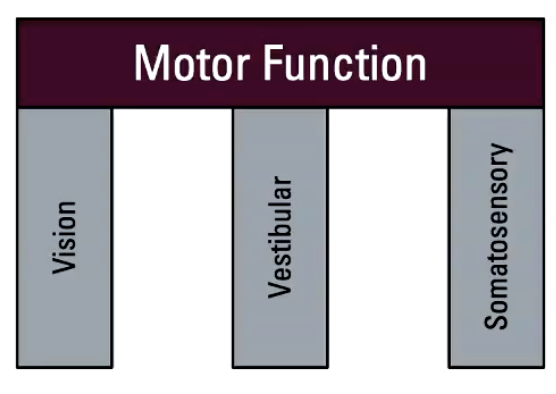
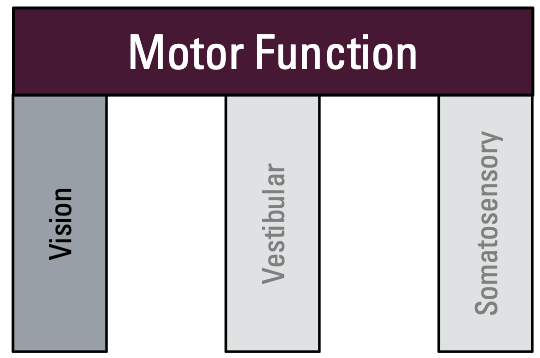
What is the integration of sensory systems?

  • Movement is supported by 3 categories of sensory systems

  • Motor Function

    • Vision (see)

    • Vestibular (where body is in space)

    • Somatosensory (touch)

<ul><li><p>Movement is supported by 3 categories of sensory systems</p></li><li><p>Motor Function</p><ul><li><p>Vision (see)</p></li><li><p>Vestibular (where body is in space)</p></li><li><p>Somatosensory (touch)</p></li></ul></li></ul><p></p>
2
New cards

How do we see?

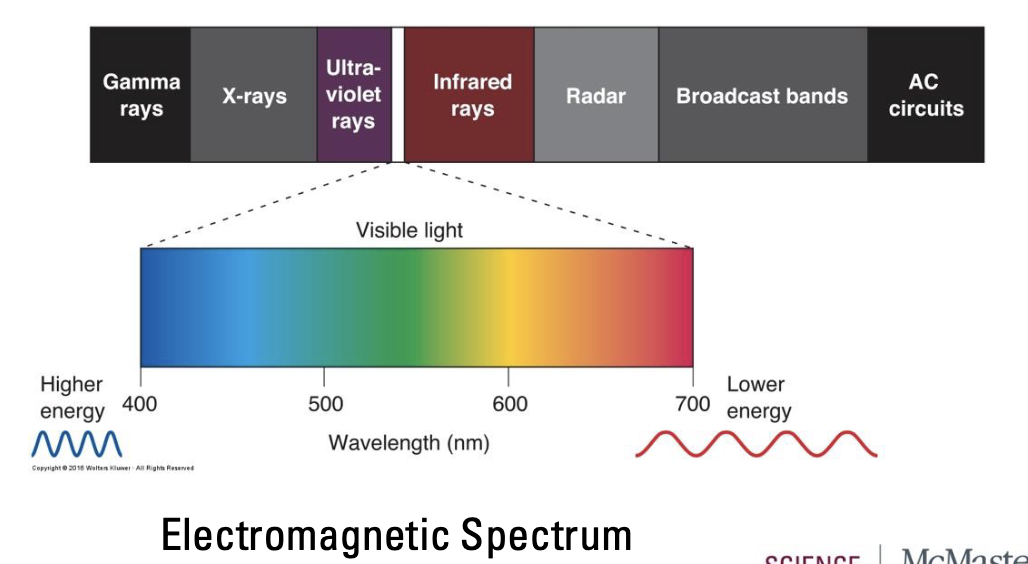
  • Neurons in the visual system create perception of world (images) based on electromagnetic radiation (light)

  • Eyes have evolved to only detect visible light (400-700nm)

  • Colour is not inherent in the world

    • Brain’s interpretation of wavelengths

  • Visual Pathway

    • Retina → Thalamus → Primary visual cortex
<ul><li><p>Neurons in the visual system create perception of world (images) based on electromagnetic radiation (light)</p></li><li><p>Eyes have evolved to only detect visible light (400-700nm)</p></li><li><p>Colour is not inherent in the world</p><ul><li><p>Brain’s interpretation of wavelengths</p></li></ul></li><li><p>Visual Pathway</p><ul><li><p><strong>Retina → Thalamus → Primary visual cortex</strong></p></li></ul></li></ul><p></p>
3
New cards

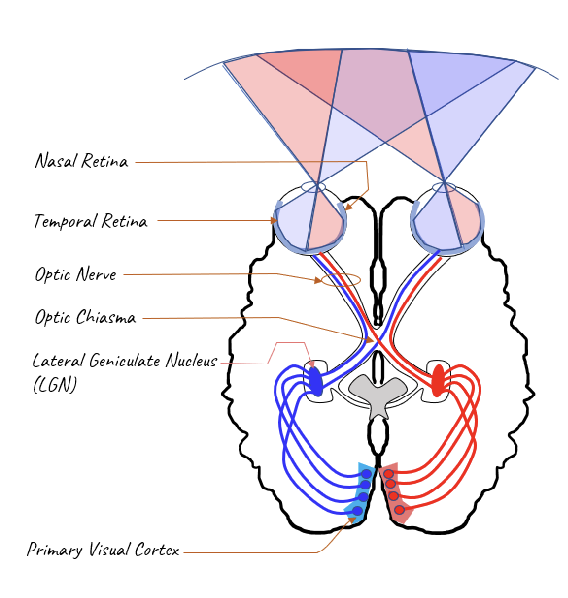
What is retinofugal projection?

  • “Flees the retina”

  • Retina to Thalamus to Primary visual cortex

    • Retina – receives sensory information

    • Optic Nerve – before decussation

    • Optic Chiasm – decussation (partial)

    • Optic Tract – after decussation

    • Lateral Geniculate Nucleus (of the thalamus)

    • Primary Visual Cortex (V1 or Brodman’s 17)

**Remember: “N” before “T”
<ul><li><p>“Flees the retina”</p></li><li><p>Retina to Thalamus to Primary visual cortex</p><ul><li><p><em>Retina</em> – receives sensory information</p></li><li><p><em>Optic </em><strong><em><u>N</u></em></strong><em>erve</em> – before decussation</p></li><li><p><em>Optic Chiasm</em> – decussation (partial)</p></li><li><p><em>Optic </em><strong><em><u>T</u></em></strong><em>ract</em> – after decussation</p></li><li><p><em>Lateral Geniculate Nucleus (<u>of the thalamus</u>)</em></p></li><li><p><em>Primary Visual Cortex</em> (V1 or Brodman’s 17)</p></li></ul></li></ul><p></p><p><em>**Remember: “N” before “T”</em></p>
4
New cards

What is the primary visual cortex?

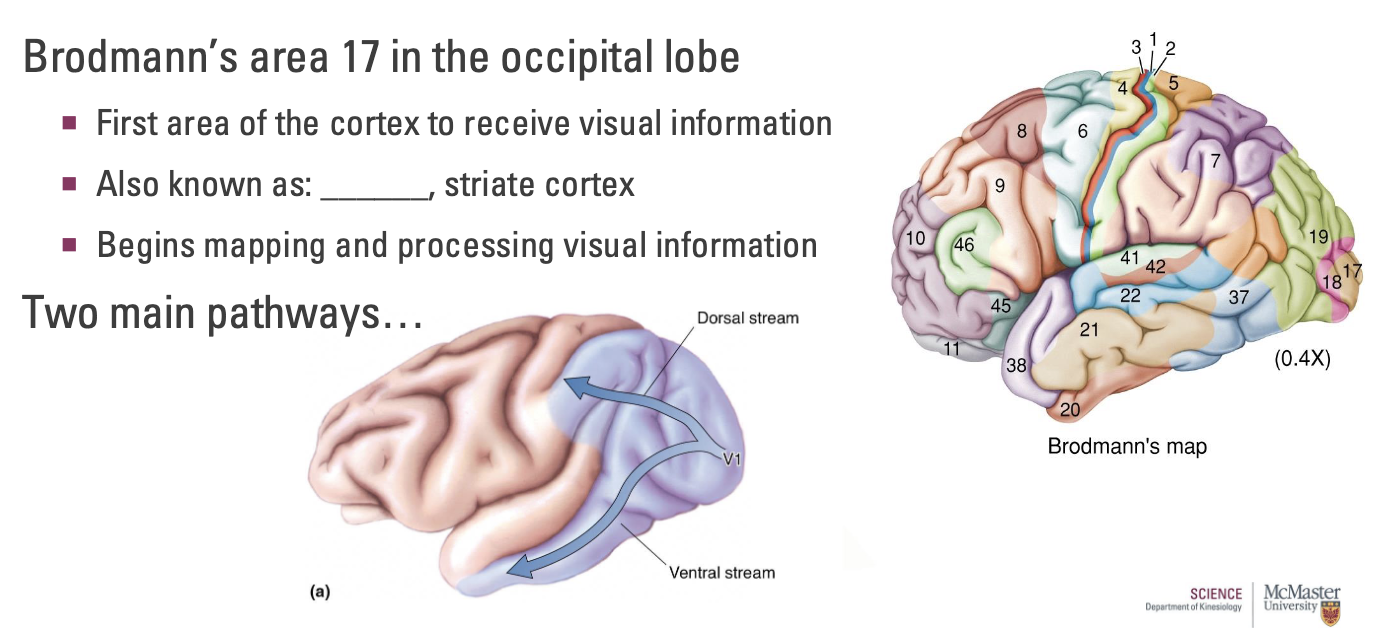
Brodmann’s area 17 in the occipital lobe

  • First area of the cortex to receive visual information

  • Also known as: V1, striate cortex

  • Begins mapping and processing visual information

Two main pathways: Dorsal and ventral stream
<p>Brodmann’s area 17 in the occipital lobe</p><ul><li><p>First area of the cortex to receive visual information</p></li><li><p>Also known as: <strong><u>V1</u></strong>, striate cortex</p></li><li><p>Begins mapping and processing visual information</p></li></ul><p>Two main pathways: Dorsal and ventral stream</p>
5
New cards

What is the Dorsal Stream of V1?

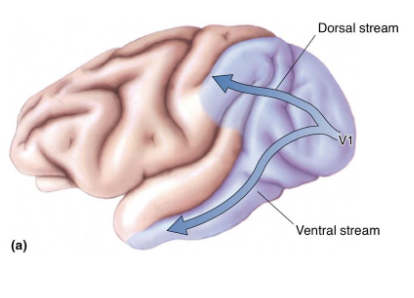
Information passed toward the parietal lobe

Specialized processing of visual motions

  • Navigation – perceiving the direction and speed of objects helps us navigate safely

  • Directing eye movements – sense motion and quickly react to it

  • Motion perception – interpretation of moving objects
<p>Information passed toward the parietal lobe</p><p>Specialized processing of visual motions</p><ul><li><p><em>Navigation</em> – perceiving the direction and speed of objects helps us navigate safely</p></li><li><p><em>Directing eye movements </em>– sense motion and quickly react to it</p></li><li><p><strong><em>Motion perception </em></strong>– interpretation of moving objects</p></li></ul><p></p>
6
New cards

What happens if there is damage to Dorsal Stream of V1?

  • Case Study 1: Can see objects that aren’t moving, but once objects start moving, they become invisible.

  • Case Study 2: Told to pour coffee to fill a cup. Can see coffee on the bottom of the cup, but doesn’t register coffee filling up and coffee overflows.

7
New cards

What is the Ventral Stream in V1?

  • Information passed toward the temporal lobe

  • Specialized processing of vision other than motion

    • Object perception and facial recognition

      • Not only recognize features, but remembering faces (ex: babies recognizing parents faces)

8
New cards

What is the pathway for processing visual information?

Retina → Thalamus → Primary visual cortex

  • “maps” and processes visual information

  • Complex integration of parallel sensors and processing (colour, shape, motion, etc.)
<p>Retina → Thalamus → Primary visual cortex</p><ul><li><p>“maps” and processes visual information</p></li><li><p>Complex integration of parallel sensors and processing (colour, shape, motion, etc.)</p></li></ul><p></p>
9
New cards

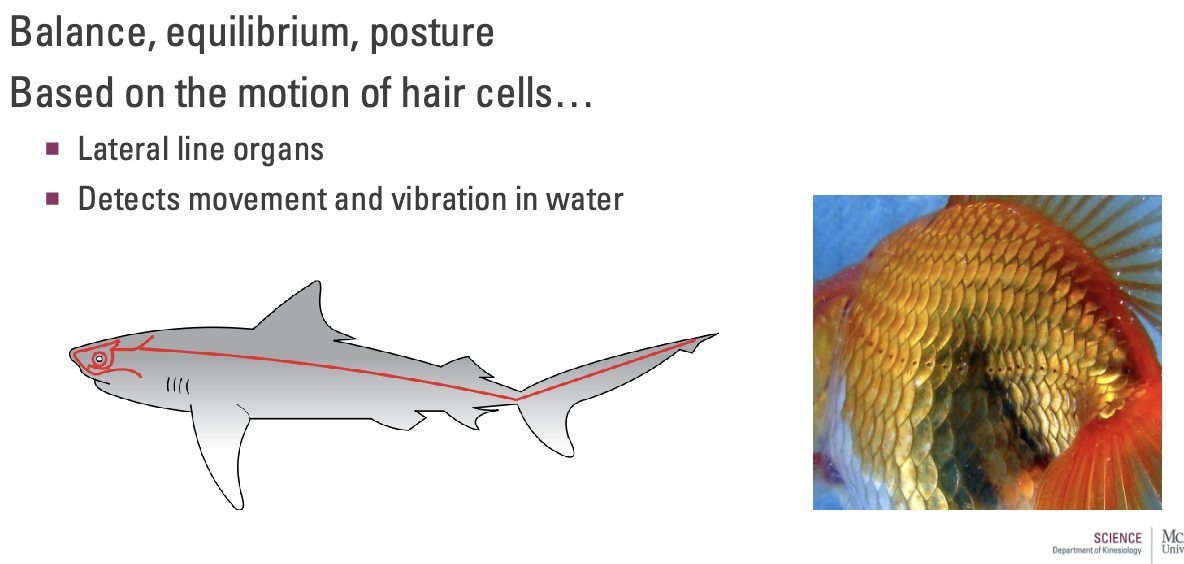
What is the Vestibular System?

Balance, equilibrium, posture

Based on the motion of hair cells...

  • Lateral line organs (similar to fish)

  • Detects movement and vibration in water
<p>Balance, equilibrium, posture</p><p>Based on the motion of hair cells...</p><ul><li><p>Lateral line organs (similar to fish)</p></li><li><p>Detects movement and vibration in water</p></li></ul><p></p>
10
New cards

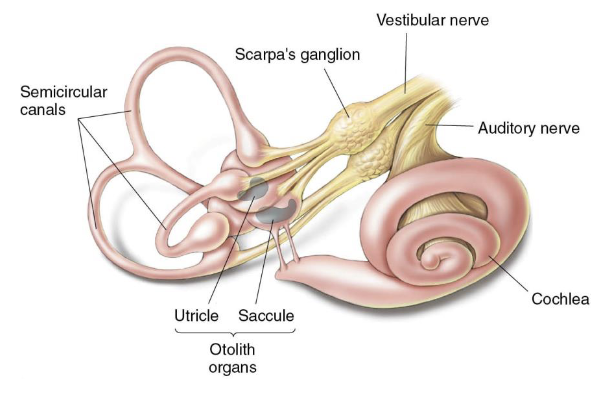
What is the Vestibular System in humans?

Humans = Vestibular labyrinth

  • Otolith organs – acceleration and tilt

  • Semicircular canals – head rotation

  • Both use hair cells to detect changes

  • ~20,000 vestibular axons

    • Cell bodies in Scarpa’s ganglion

<p>Humans = <strong><u>Vestibular labyrinth</u></strong></p><ul><li><p>Otolith organs – acceleration and tilt</p></li><li><p>Semicircular canals – head rotation</p></li><li><p>Both use hair cells to detect changes</p></li><li><p>~20,000 vestibular axons</p><ul><li><p>Cell bodies in Scarpa’s ganglion</p></li></ul></li></ul><p></p>
11
New cards

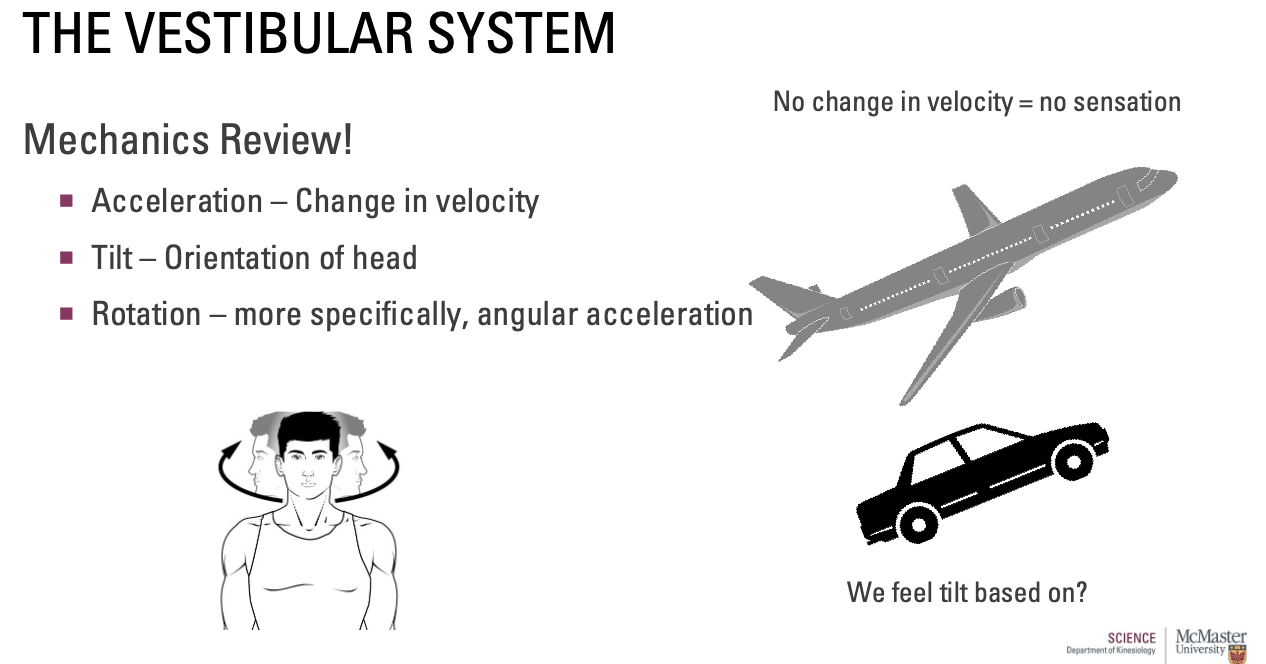
How does the Vestibular System relate to mechanics?

  • Acceleration – Change in velocity

    • Airplane at a consistent speed = no change in velocity = no sensation

  • Tilt – Orientation of head

    • Due to gravity

  • Rotation – more specifically, angular acceleration

    • Due to the semicircular canals

<ul><li><p>Acceleration – Change in velocity</p><ul><li><p>Airplane at a consistent speed = no change in velocity = no sensation</p></li></ul></li></ul><ul><li><p>Tilt – Orientation of head</p><ul><li><p>Due to gravity </p></li></ul></li><li><p>Rotation – more specifically, angular acceleration</p><ul><li><p>Due to the semicircular canals</p></li></ul></li></ul><p></p>
12
New cards

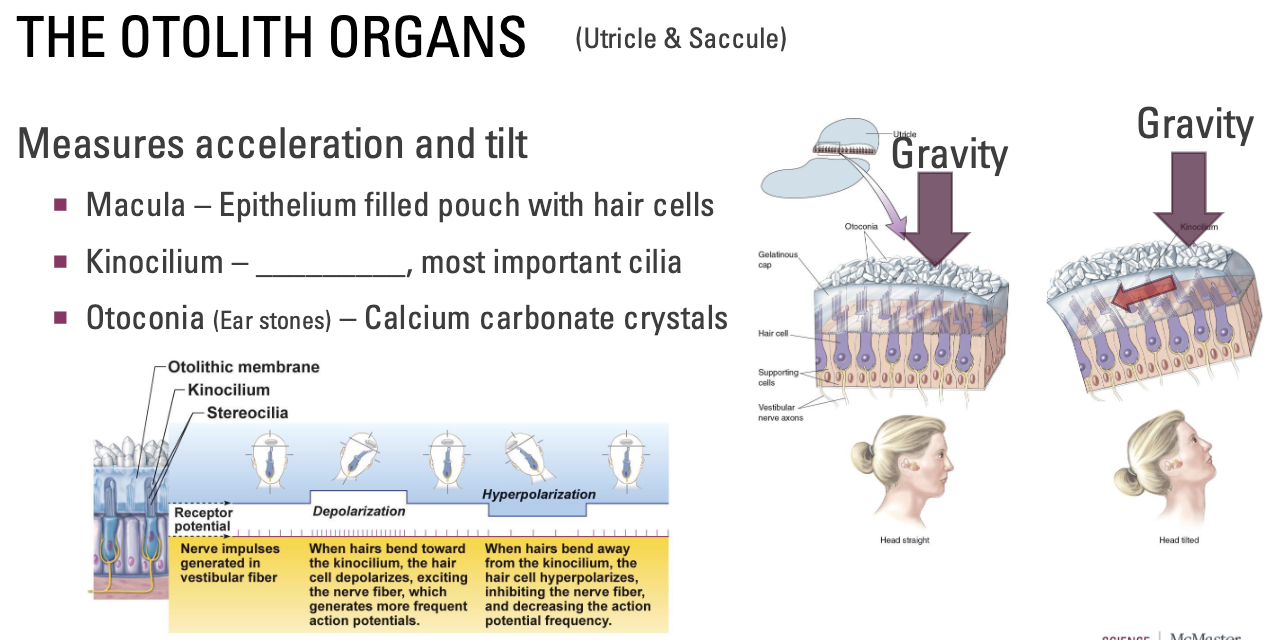
What are the Otolith Organs (Utricle and Saccule)?

Measures acceleration and tilt

  • Macula – Epithelium filled pouch with hair cells

  • Kinocilium – Tallest, most important cilia

    • When fluid fills the hairs, we feel the small hairs (stereocillia) in relation to the big hair

  • Otoconia (Ear stones) – Calcium carbonate crystals

    • Tilt: Gravity pushes on otoconia → pushes on liquid → pushes on little hairs relative to this big hair → hair cells receive information and send down vestibular axons

  • Baseline of action potentials; firing rate increase/decreases depending on the amount of tilt

    • Cilia bend toward big hair = depolarization

    • Cilia bend away from big hair = hyperpolarization
<p>Measures acceleration and tilt</p><ul><li><p>Macula – Epithelium filled pouch with hair cells</p></li><li><p>Kinocilium – <strong><u>Tallest</u></strong>, most important cilia</p><ul><li><p>When fluid fills the hairs, we feel the small hairs (stereocillia) in relation to the big hair</p></li></ul></li><li><p>Otoconia (Ear stones) – Calcium carbonate crystals</p><ul><li><p>Tilt: Gravity pushes on otoconia → pushes on liquid → pushes on little hairs relative to this big hair → hair cells receive information and send down vestibular axons</p></li></ul></li></ul><ul><li><p>Baseline of action potentials; firing rate increase/decreases depending on the amount of tilt</p><ul><li><p>Cilia bend toward big hair = depolarization</p></li><li><p>Cilia bend away from big hair = hyperpolarization</p></li></ul></li></ul><p></p>
13
New cards

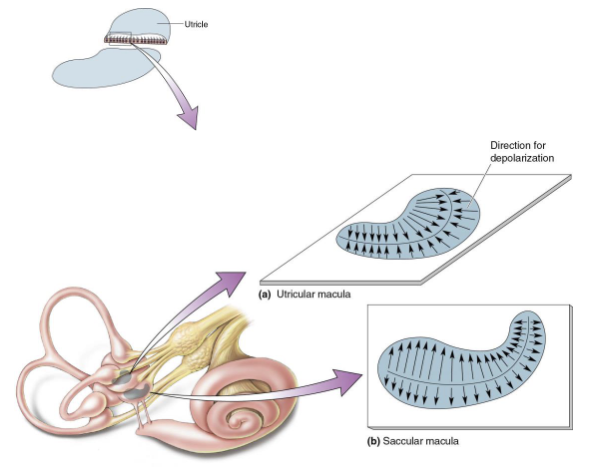
What is Macular Orientation?

Array of orientations within organ

  • Saccular macula – vertically oriented

  • Utricular macula – horizontally oriented

Allows measures of all possible linear movements
<p>Array of orientations within organ</p><ul><li><p>Saccular macula – vertically oriented</p></li><li><p>Utricular macula – horizontally oriented</p></li></ul><p>Allows measures of <strong><u>all possible linear movements</u></strong></p><p></p>
14
New cards

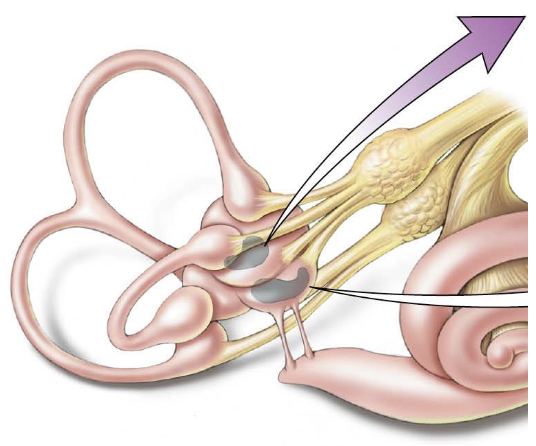
What are the Semicircular Canals?

Measures head rotation (angular acceleration)

  • Three semicircular canals on each side

  • Help sense all possible head rotation angles
<p>Measures head rotation (angular acceleration)</p><ul><li><p>Three semicircular canals on each side</p></li><li><p>Help sense all possible head rotation angles</p></li></ul><p></p>
15
New cards

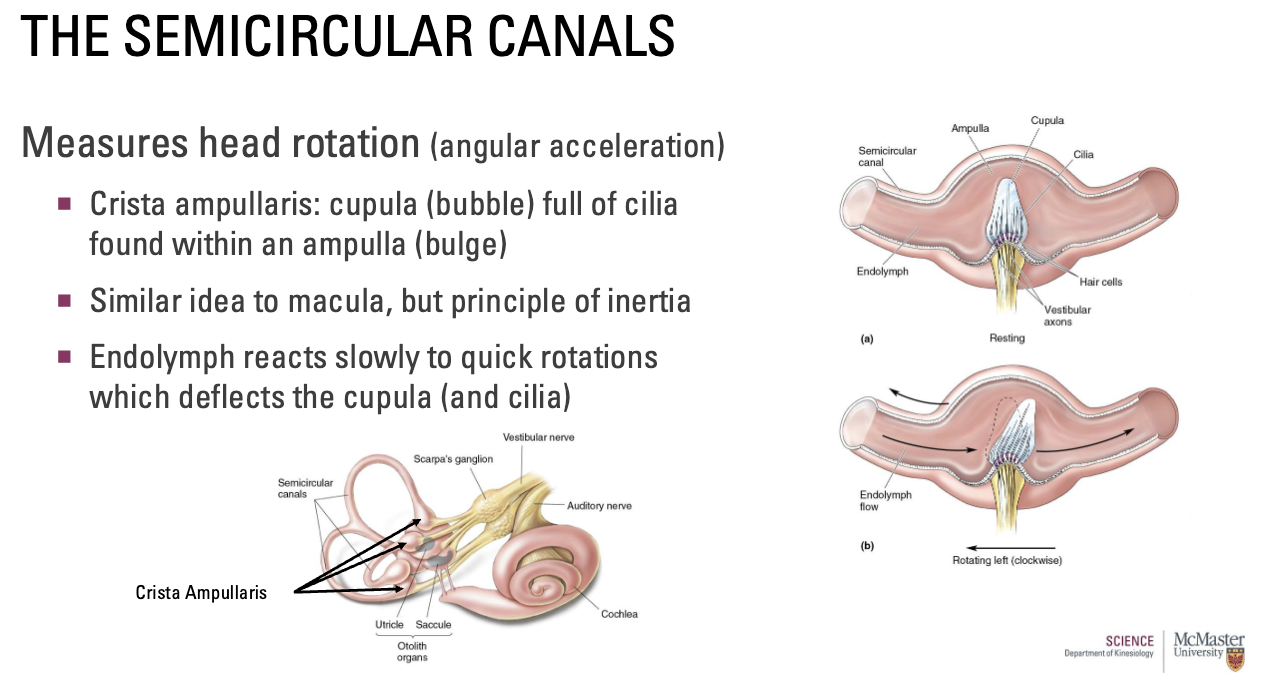
What are the Crista ampullaris?

  • Crista ampullaris: cupula (bubble) full of cilia found within an ampulla (bulge)

  • Similar idea to macula, but principle of inertia

  • Endolymph reacts slowly to quick rotations which deflects the cupula (and cilia)
<ul><li><p>Crista ampullaris: cupula (bubble) full of cilia found within an ampulla (bulge)</p></li><li><p>Similar idea to macula, but principle of inertia</p></li><li><p>Endolymph reacts slowly to quick rotations which deflects the cupula (and cilia)</p></li></ul><p></p>
16
New cards

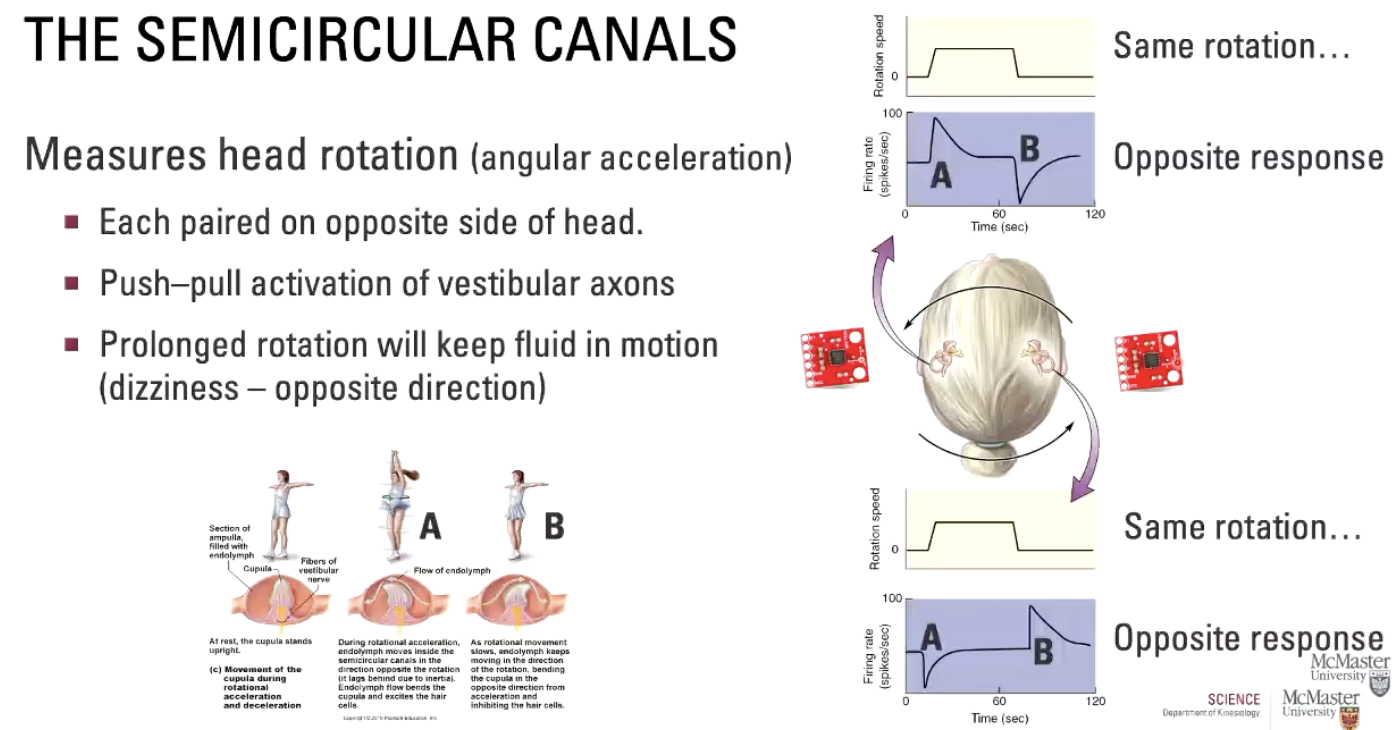
How are the Semicircular Canals organized?

  • Each paired on opposite side of head.

  • Push–pull activation of vestibular axons (same rotation but opposite response)

  • Prolonged rotation will keep fluid in motion (dizziness – opposite direction)

    • A → initiate movement, B → stop movement
<ul><li><p>Each paired on opposite side of head.</p></li><li><p>Push–pull activation of vestibular axons (same rotation but opposite response)</p></li><li><p>Prolonged rotation will keep fluid in motion (dizziness – opposite direction)</p><ul><li><p>A → initiate movement, B → stop movement</p></li></ul></li></ul><p></p>
17
New cards

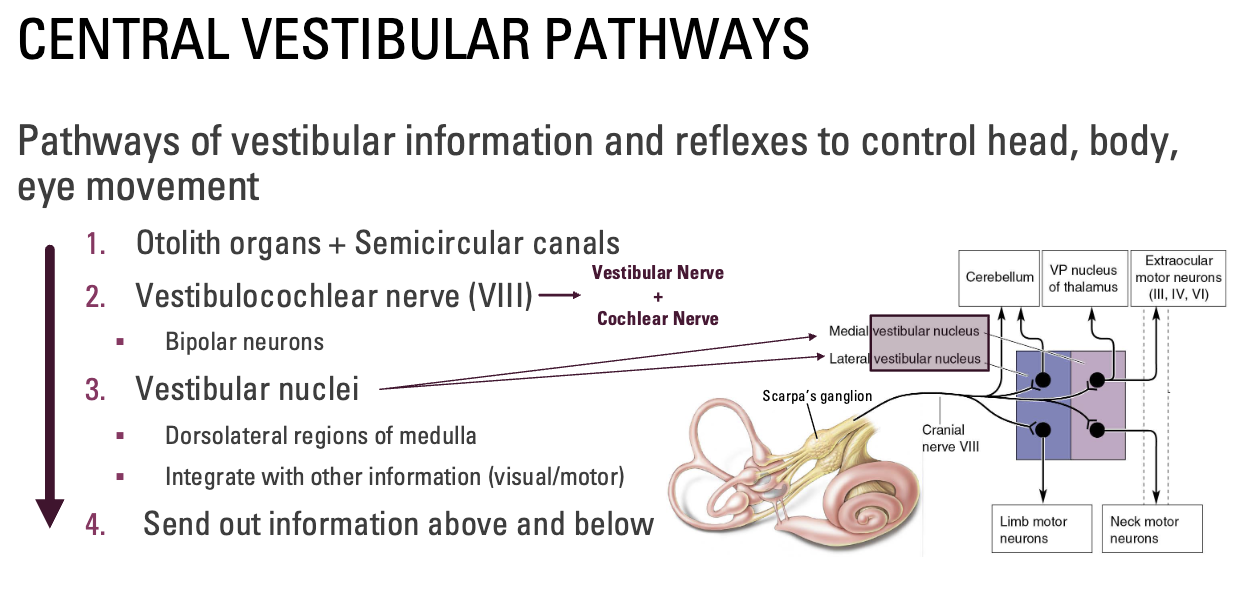
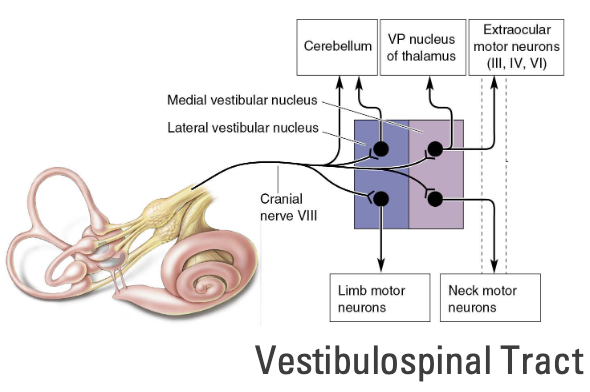
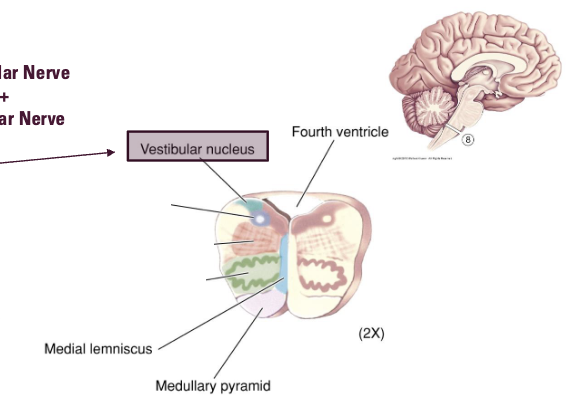
What are the Central Vestibular Pathways?

Pathways of vestibular information and reflexes to control head, body, eye movement

1) Otolith organs (Acceleration, tilt) + Semicircular canals (Rotation)

2) Vestibulocochlear nerve (VIII)

  • Bipolar neurons

    • Merges with auditory information

3) Vestibular nuclei

  • Dorsolateral regions of medulla

  • Integrate with other information (visual/motor)

4) Send out information above and below
<p>Pathways of vestibular information and reflexes to control head, body, eye movement</p><p>1) <strong>Otolith organs</strong> (Acceleration, tilt) + <strong>Semicircular canals </strong>(Rotation)</p><p>2) <strong>Vestibulocochlear nerve</strong> (VIII)</p><ul><li><p>Bipolar neurons</p><ul><li><p>Merges with auditory information</p></li></ul></li></ul><p>3) Vestibular nuclei</p><ul><li><p>Dorsolateral regions of medulla</p></li><li><p>Integrate with other information (visual/motor)</p></li></ul><p>4) Send out information above and below</p><img src="https://knowt-user-attachments.s3.amazonaws.com/6f35b0cb-538f-4dd3-836d-65df9edc9511.png" data-width="50%" data-align="center"><p></p>
18
New cards

Where do the Central Vestibular Pathways send information out to?

1) Cerebellum

  • Vestibular sensations needed for coordinating movements

2) Thalamus (ventral posterior nucleus)

  • Then projects to Postcentral gyrus

  • Info received by the cortex maintains a representation of the body in space

3) Extraocular motor neurons

  • Reflexive eye movements

  • Primary goal: Maintain gaze

4) Limbs

  • Reflexive limbs movements

  • Primary goal: Keep body upright

5) Neck and trunk

  • Reflexive neck/trunk movements

  • Primary goal: Keep head upright

<p>1) <strong><em>Cerebellum</em></strong></p><ul><li><p>Vestibular sensations needed for <strong><u>coordinating movements</u></strong></p></li></ul><p>2) <strong><em>Thalamus (ventral posterior nucleus)</em></strong></p><ul><li><p>Then projects to <strong><u>Postcentral gyrus</u></strong></p></li><li><p>Info received by the cortex maintains a representation of the body in space</p></li></ul><p>3) <strong><em>Extraocular motor neurons</em></strong></p><ul><li><p>Reflexive eye movements</p></li><li><p>Primary goal: <strong><u>Maintain gaze</u></strong></p></li></ul><p>4) <strong><em>Limbs</em></strong></p><ul><li><p>Reflexive limbs movements</p></li><li><p>Primary goal: <strong><u>Keep body upright</u></strong></p></li></ul><p>5) <strong><em>Neck and trunk</em></strong></p><ul><li><p>Reflexive neck/trunk movements</p></li><li><p>Primary goal: <strong><em>Keep head upright</em></strong></p></li></ul><p></p>
19
New cards

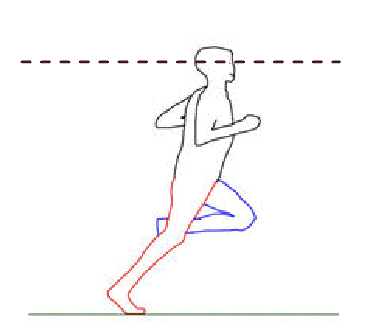
What is the Vestibulo-ocular Reflex (VOR)?

  • Function: To fixate line of sight on visual target during head movement

  • Mechanism: Senses rotations of head, commands compensatory movement of eyes in opposite direction

  • Ex: Seen in chickens due to their weak eyesight, this reflex helps them maintain gaze.
<ul><li><p><strong>Function</strong>: To fixate line of sight on visual target during head movement</p></li><li><p><strong>Mechanism</strong>: Senses rotations of head, commands compensatory movement of eyes in opposite direction</p></li><li><p>Ex: Seen in chickens due to their weak eyesight, this reflex helps them maintain gaze.</p></li></ul><p></p>
20
New cards

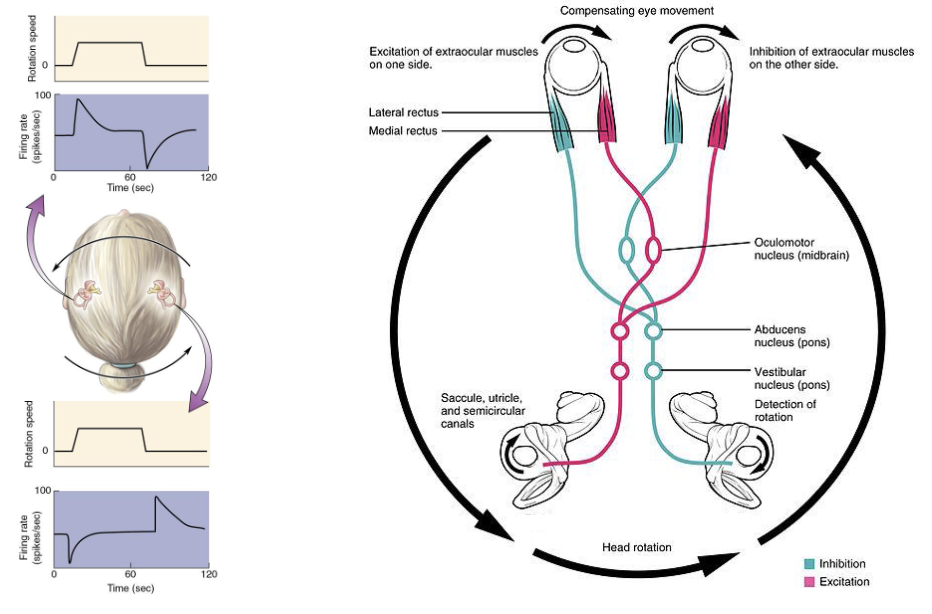
How do Vestibular Connections mediate horizontal eye movements?

  • Example: Rotating head left but maintaining eyes on a fixed point

  • Excite the red side (contract) and inhibit the blue side (relax)

(Vestibular nucleus - medulla/pons)
<ul><li><p>Example: Rotating head left but maintaining eyes on a fixed point</p></li><li><p>Excite the red side (contract) and inhibit the blue side (relax)</p></li></ul><p><em>(Vestibular nucleus - medulla/pons)</em></p>
21
New cards

What are the peripheral vestibular changes with age?

Peripheral changes – likely occur first

  • Otolith organs

    • Loss of cilia

    • Alterations in otoconia (size and shape)

  • Semicircular Canals

    • Loss of cilia, to a greater extent than otolith organs

    • Greater impact in VOR and fall risk

22
New cards

What are the central vestibular changes with age?

Central changes – likely occur later (after 60 years of age)

  • Vestibular nuclei – slow loss of neurons

  • Cerebellum – slow loss or change in connectivity

Together, this leads to a reduction in sensory information necessary to control head, eyes, and body and maintain balance

  • Add this to a multitude of changes to other sensory structures (vision, touch, proprioception) and loss of muscle strength = Increased fall risk

23
New cards

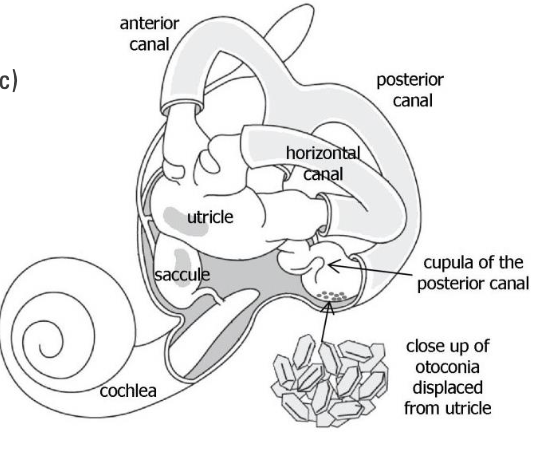
What is BPPV (most common)?

Benign Paroxysmal Positional Vertigo

  • Benign = harmless in the long-term

  • Paroxysmal = Sudden onset/recurrence of symptoms (<60sec)

  • Vertigo = Sensation of spinning/dizziness

    • Vertigo itself is a symptom (not an illness)

Caused by:

  • Ear stones (otoconia) migrating into semi-circular canals

  • Disrupting the cupula located in ampulla

Treatment:

  • Often resolves on own, but...

  • Specific head manoeuvres can reposition debris out
<p><strong><em>Benign Paroxysmal Positional Vertigo</em></strong></p><ul><li><p><u>Benign</u> = harmless in the long-term</p></li><li><p><u>Paroxysmal</u> = Sudden onset/recurrence of symptoms (&lt;60sec)</p></li><li><p><u>Vertigo</u> = Sensation of spinning/dizziness</p><ul><li><p><strong><u>Vertigo itself is a symptom (not an illness)</u></strong></p></li></ul></li></ul><p>Caused by:</p><ul><li><p>Ear stones (otoconia) migrating into semi-circular canals</p></li><li><p>Disrupting the cupula located in ampulla</p></li></ul><p>Treatment:</p><ul><li><p>Often resolves on own, but...</p></li><li><p>Specific head manoeuvres can reposition debris out</p></li></ul><p></p>
24
New cards

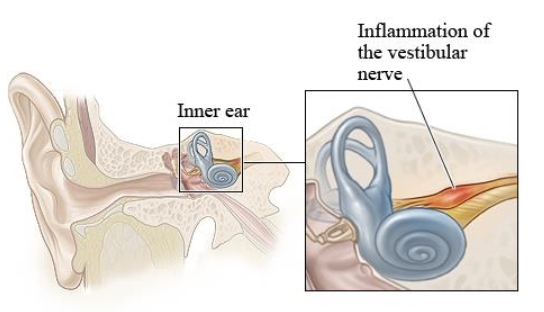
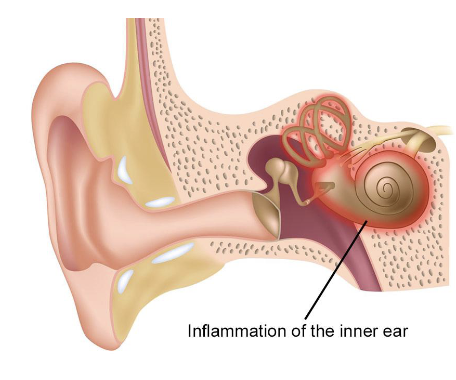
What is Vestibular Neuronitis (second most common)?

Caused by:

  • Inflammation of the vestibular nerve

Symptoms:

  • Sudden vertigo that can last for several days

  • Does not affect hearing

Treatment:

  • Anti-nausea medication until inflammation reduces

  • Steroids to reduce inflammation

  • Physical therapy/activity can help the body compensate (help with balance training)
<p>Caused by:</p><ul><li><p>Inflammation of the <strong><u>vestibular nerve</u></strong></p></li></ul><p>Symptoms:</p><ul><li><p>Sudden vertigo that can last for several days</p></li><li><p><u>Does not</u> affect hearing</p></li></ul><p>Treatment:</p><ul><li><p>Anti-nausea medication until inflammation reduces</p></li><li><p>Steroids to reduce inflammation</p></li><li><p>Physical therapy/activity can help the body compensate (help with balance training)</p></li></ul><p></p>
25
New cards

What are Labyrinthitis?

Caused by:

  • Inflammation of the entire inner ear due to infection

Symptoms:

  • Sudden vertigo that can last for several days

  • Does affect hearing

Treatment:

  • Treat infection

  • Anti-nausea medication until inflammation reduces

  • Physical therapy/activity can help the body compensate

<p>Caused by:</p><ul><li><p>Inflammation of the <strong><u>entire inner ear</u></strong> due to infection</p></li></ul><p>Symptoms:</p><ul><li><p>Sudden vertigo that can last for several days</p></li><li><p><u>Does</u> affect hearing</p></li></ul><p>Treatment:</p><ul><li><p>Treat infection</p></li><li><p>Anti-nausea medication until inflammation reduces</p></li><li><p>Physical therapy/activity can help the body compensate</p></li></ul><p></p>
26
New cards

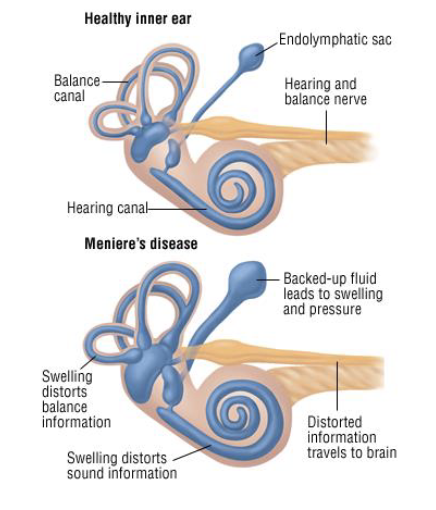
What is Meniere’s Disease?

Caused by:

  • Excessive fluid build up in inner ear

  • Unknown why this occurs

Symptoms:

  • Sudden episodes of: tinnitus, hearing loss, and/or vertigo

  • Each episode can last minutes to hours

  • May occur in clusters, then subside for years

Treatment:

  • No cure; managing symptoms

  • Can lead to permanent hearing loss, but rare
<p>Caused by:</p><ul><li><p>Excessive fluid build up in inner ear</p></li><li><p>Unknown why this occurs</p></li></ul><p>Symptoms:</p><ul><li><p>Sudden episodes of: tinnitus, hearing loss, and/or vertigo</p></li><li><p>Each episode can last minutes to hours</p></li><li><p>May occur in clusters, then subside for years</p></li></ul><p>Treatment:</p><ul><li><p>No cure; managing symptoms</p></li><li><p>Can lead to permanent hearing loss, but rare</p></li></ul><p></p>
27
New cards

What does Somatosensory system respond to?

  • Distributed all over body

  • Responds to many kinds of stimuli

  • Subgrouped into 4 senses:

    • Touch

    • Pain

    • Temperature

    • Proprioception

28
New cards

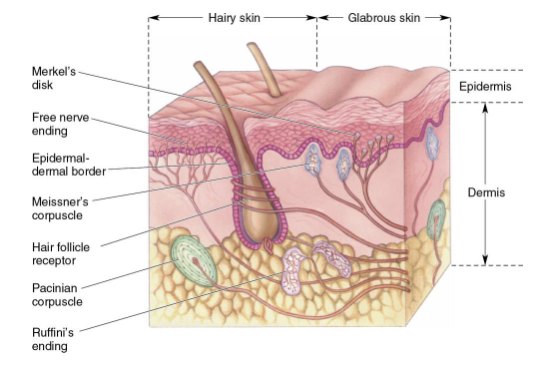
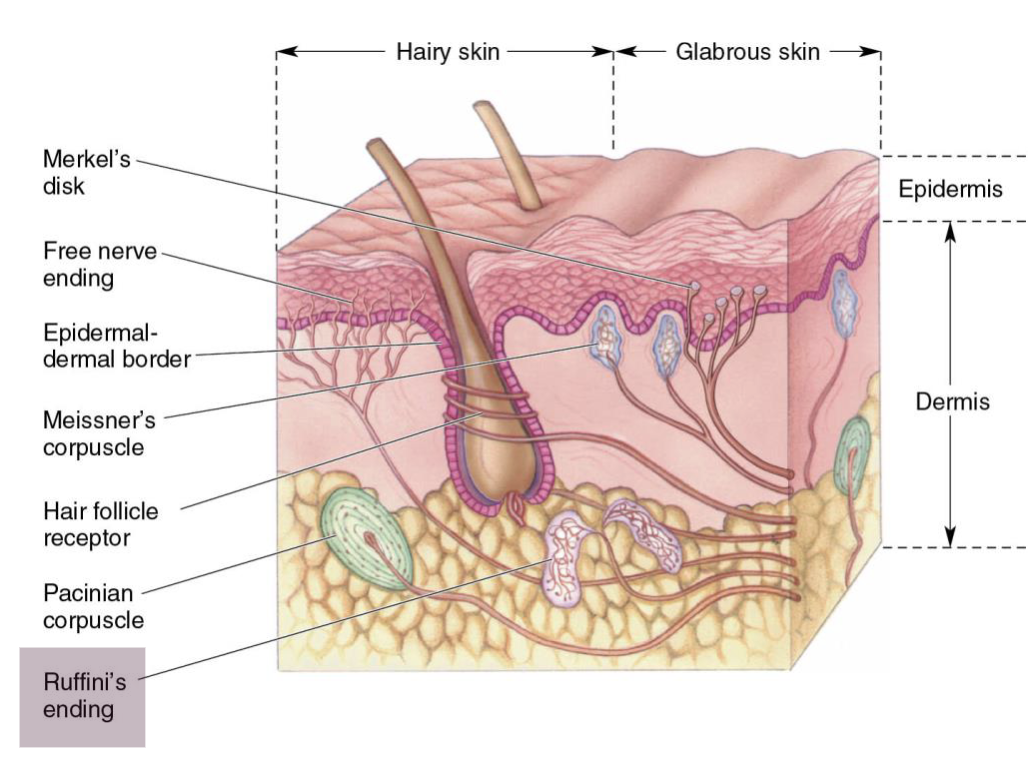
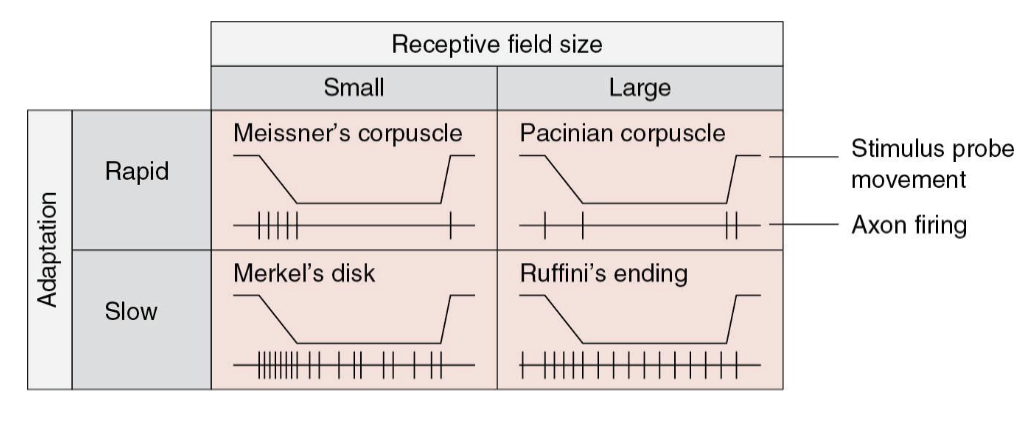
What are mechanoreceptors in skin?

Most somatosensory receptors are mechanoreceptors

  • Receptive to physical distortion

4 primary receptors in skin

  • Pacinian corpuscles

  • Meissner's corpuscles

  • Ruffini’s endings

  • Merkel's disks

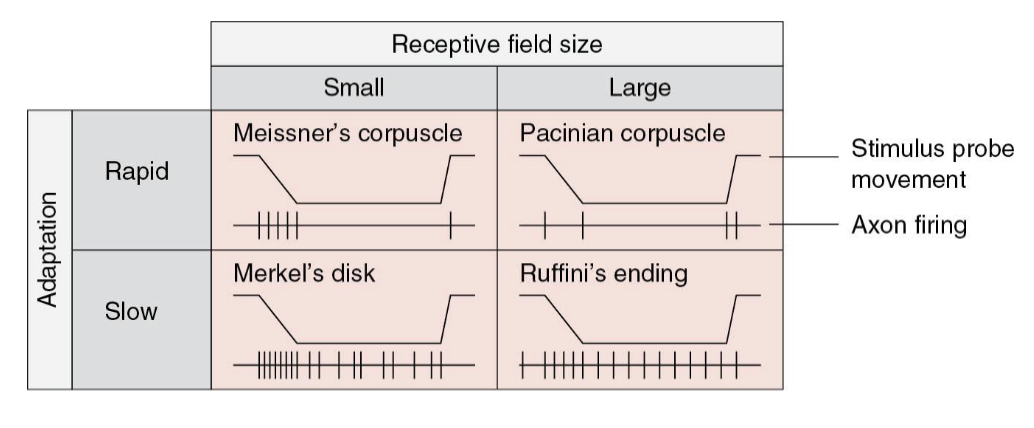
Vary in terms of:

  • Receptive field (large vs. small)

  • Adaptation (rapid vs. slow)

<p>Most somatosensory receptors are mechanoreceptors</p><ul><li><p>Receptive to physical distortion</p></li></ul><p>4 primary receptors in skin</p><ul><li><p>Pacinian corpuscles</p></li><li><p>Meissner's corpuscles</p></li><li><p>Ruffini’s endings</p></li><li><p>Merkel's disks</p></li></ul><p>Vary in terms of:</p><ul><li><p><strong>Receptive field (large vs. small)</strong></p></li><li><p><strong>Adaptation (rapid vs. slow)</strong></p></li></ul><p></p>
29
New cards

Which two mechanoreceptors in skin are likely measuring a small receptive field?

Merkel’s disk and Meissner’s corpuscle (closer to surface)

30
New cards

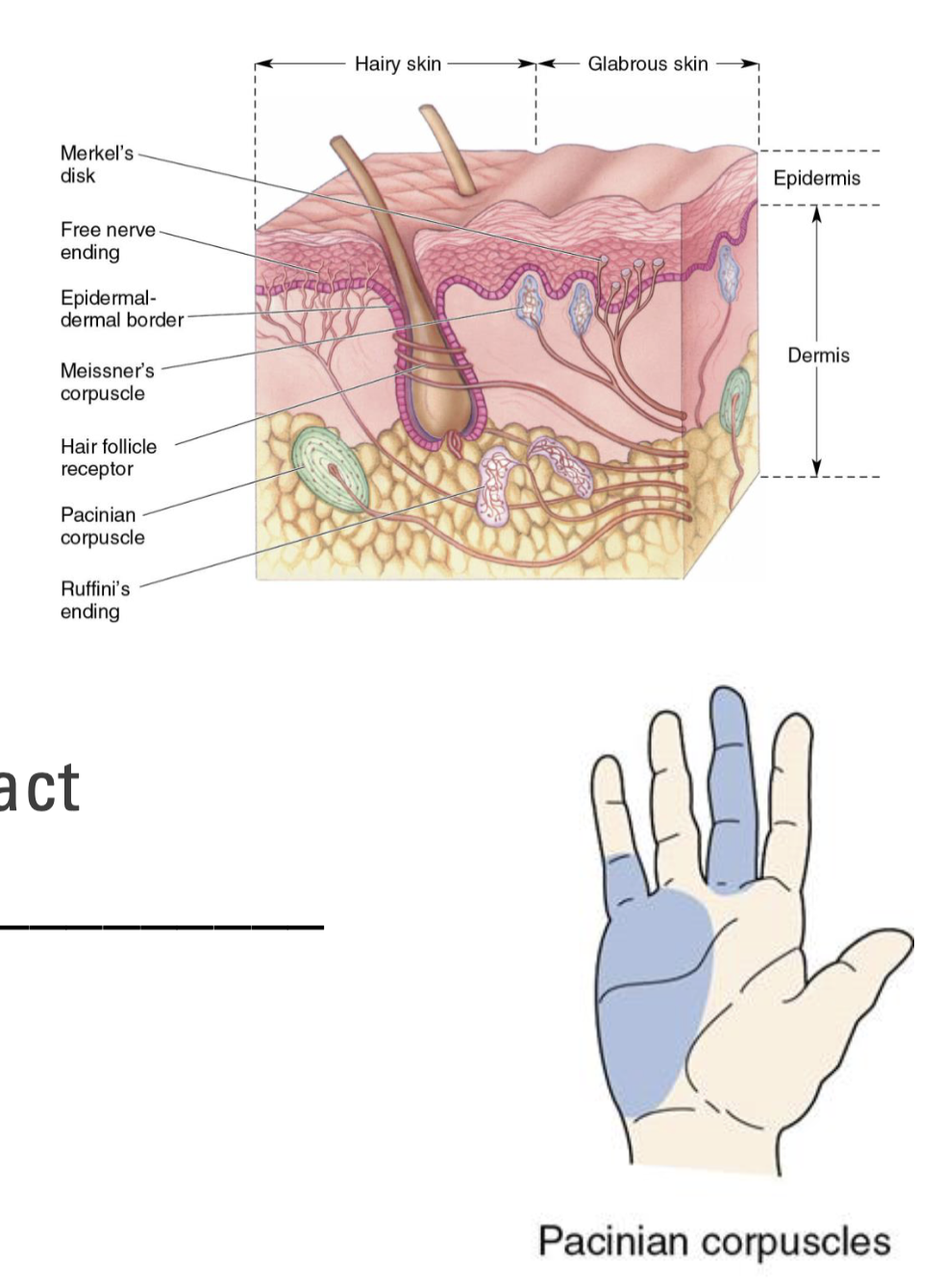
What are Pacinian Corpuscles?

Largest and deepest mechanoreceptor in skin

Get compressed and detect pressure and vibration

  • Large receptive field

  • Rapid adapting

    • React quickly to initial contact, but not sustained contact

    • Best at detecting finer textures and high frequency vibrations
<p>Largest and deepest mechanoreceptor in skin</p><p>Get compressed and detect pressure and vibration</p><ul><li><p>Large receptive field</p></li><li><p>Rapid adapting</p><ul><li><p>React quickly to initial contact, but not sustained contact</p></li><li><p><strong>Best at detecting finer textures and high frequency vibrations</strong></p></li></ul></li></ul><p></p>
31
New cards

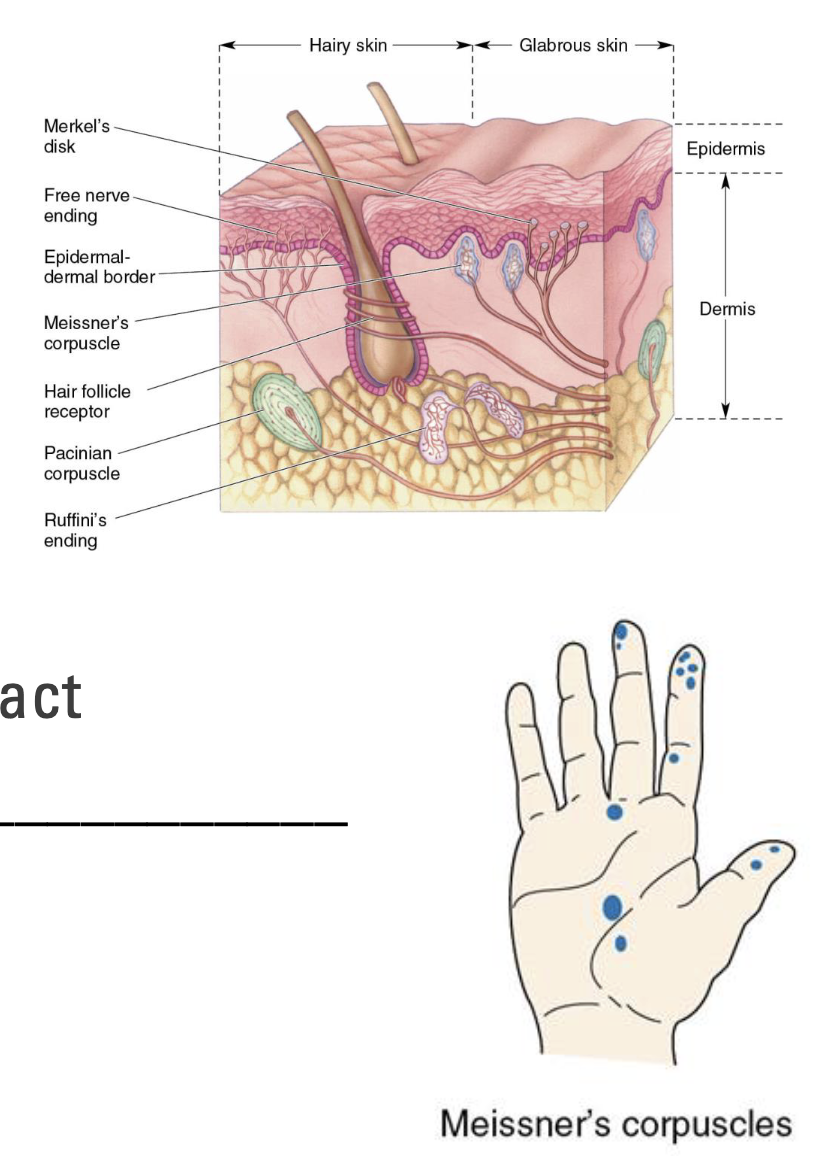
What are Meissner’s Corpuscles?

Small receptors in upper dermis; common in fingers

Detect fine touch and pressure

  • Small receptive field

  • Rapid adapting

    • React quickly to initial contact, but not sustained contact

    • Best at detecting heavier textures and lower frequency vibrations
<p>Small receptors in upper dermis; common in fingers</p><p>Detect fine touch and pressure</p><ul><li><p>Small receptive field</p></li><li><p>Rapid adapting</p><ul><li><p>React quickly to initial contact, but not sustained contact</p></li><li><p><strong>Best at detecting heavier textures and lower frequency vibrations</strong></p></li></ul></li></ul><p></p>
32
New cards

Explain rapid adapting mechanoreceptors and vibrations.

Lower frequency vibration signal (Contours/waves are further apart)

  • Meissner's corpuscles better at low frequency (Heavier texture)

  • E.g. Moving fingers across keys on a keyboard

Higher frequency vibration signal (Contours/waves are closer together)

  • Pacinian corpuscles better at high frequency (Finer texture)

  • E.g. Moving hand across the surface of smooth table
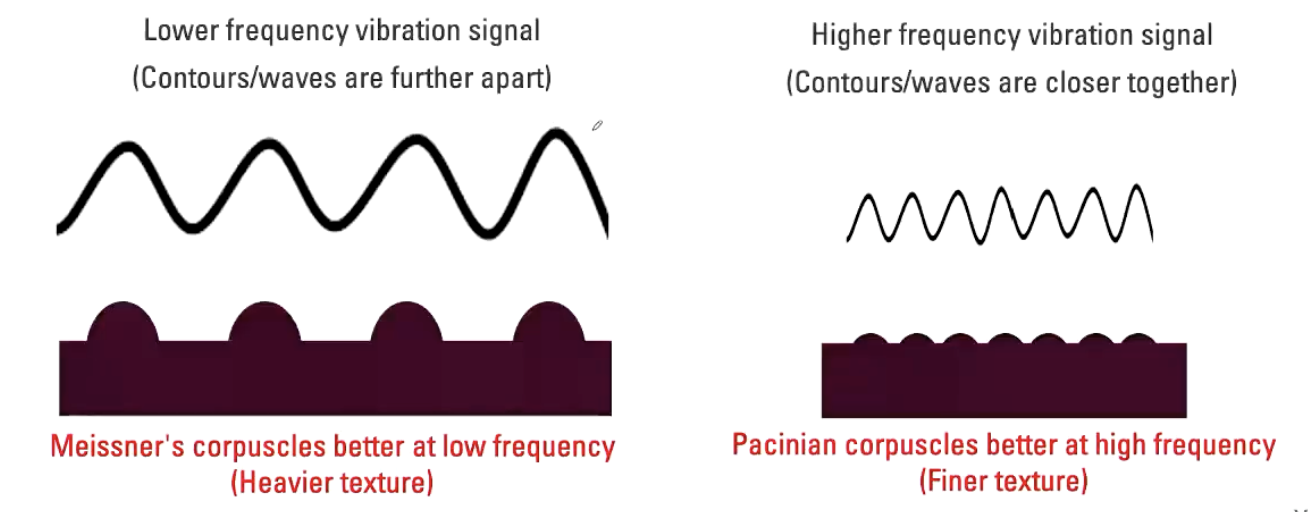
<p>Lower frequency vibration signal (Contours/waves are further apart)</p><ul><li><p><strong>Meissner's corpuscles better at low frequency (Heavier texture)</strong></p></li><li><p>E.g. Moving fingers across keys on a keyboard</p></li></ul><p></p><p>Higher frequency vibration signal (Contours/waves are closer together)</p><ul><li><p><strong>Pacinian corpuscles better at high frequency (Finer texture)</strong></p></li><li><p>E.g. Moving hand across the surface of smooth table</p></li></ul><p></p>
33
New cards

What are Ruffini Endings?

Large receptors in the dermis layer

Detect stretch and deformation

  • Large receptive field

  • Slow adapting

    • React to sustained deformations

    • Best at detecting grip/position

<p>Large receptors in the dermis layer</p><p>Detect stretch and deformation</p><ul><li><p>Large receptive field</p></li><li><p><strong><u>Slow</u></strong> adapting</p><ul><li><p>React to sustained deformations</p></li><li><p><strong>Best at detecting grip/position</strong></p></li></ul></li></ul><p></p>
34
New cards

What are Merkel’s Disks?

Small receptors in epidermis, common in fingers

Detect fine touch and pressure

  • Small receptive field

  • Slow adapting

    • React to sustained deformations

    • Best at static discrimination of shapes/textures
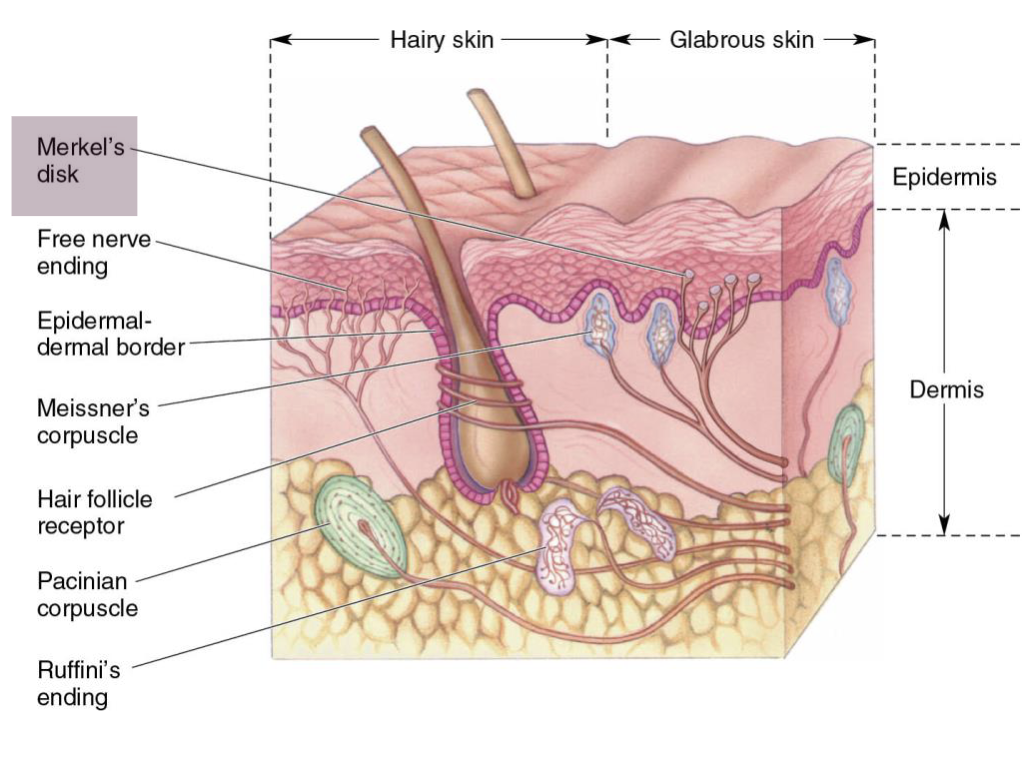
<p>Small receptors in epidermis, common in fingers</p><p>Detect fine touch and pressure</p><ul><li><p>Small receptive field</p></li><li><p><strong><u>Slow</u></strong> adapting</p><ul><li><p>React to sustained deformations</p></li><li><p><strong>Best at static discrimination of shapes/textures</strong></p></li></ul></li></ul><p></p>
35
New cards

What is the receptive field size and adaptation rate?

  • We can combine all 4 into a 2x2 chart

  • Most things we feel involve some input from all

Examples:

  1. Catching a football? Pacinian corpuscle

  2. Reaching into your backpack to find your favourite pen? Merkel’s disk

  3. Holding someone’s hand? Ruffini’s ending

  4. Petting your dog? Pacinian corpuscle

  5. Holding guitar cord? Merkel’s disk

<ul><li><p>We can combine all 4 into a 2x2 chart</p></li><li><p>Most things we feel involve some input from all</p></li></ul><p>Examples:</p><ol><li><p>Catching a football? <span><strong><span>Pacinian corpuscle</span></strong></span></p></li><li><p>Reaching into your backpack to find your favourite pen? <strong>Merkel’s disk</strong></p></li><li><p>Holding someone’s hand? <strong>Ruffini’s ending</strong></p></li><li><p>Petting your dog? <strong>Pacinian corpuscle</strong></p></li><li><p>Holding guitar cord? <strong>Merkel’s disk</strong></p></li></ol><p></p>
36
New cards

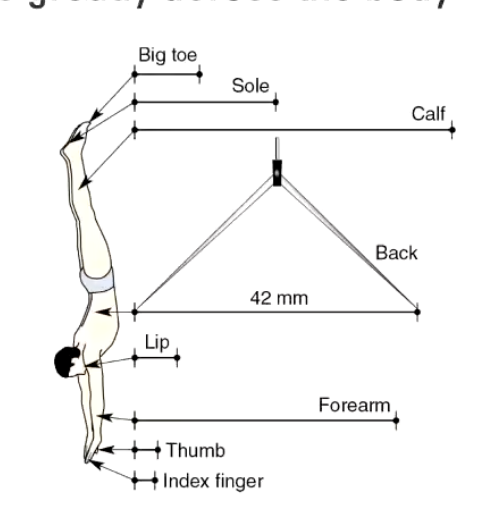
What is Two-Point Discrimination?

Sensitivity to discriminate small points varies greatly across the body

More sensitive in important places

Accomplished by:

  • Greater density of mechanoreceptors

  • Smaller field size (2 M’s - Meissner/Merkel)

  • Greater brain tissue devoted to those areas
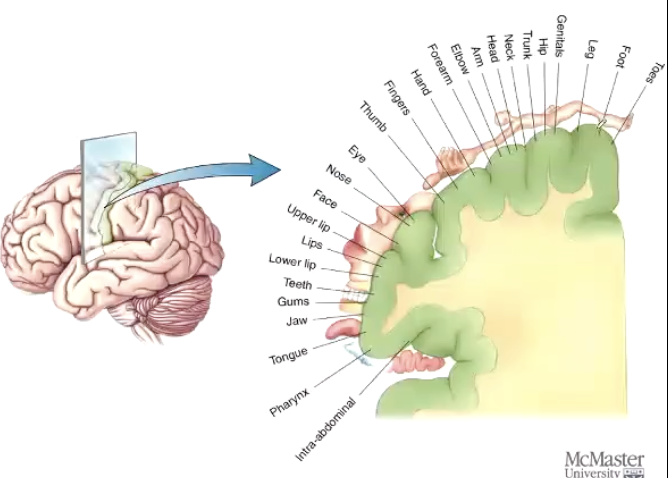
<p>Sensitivity to discriminate small points varies greatly across the body</p><p>More sensitive in important places</p><p>Accomplished by:</p><ul><li><p>Greater density of mechanoreceptors</p></li><li><p>Smaller field size (2 M’s - <em>Meissner/Merkel</em>)</p></li><li><p>Greater brain tissue devoted to those areas</p></li></ul><img src="https://knowt-user-attachments.s3.amazonaws.com/13881e52-180e-4c63-be7e-b7e3e27b2d1b.png" data-width="75%" data-align="center"><p></p>
37
New cards

Could barefoot running or walking be better than “shod”?

  • Improve sensory information coming from the feet

  • Could this improve/speed up the rapid mechanical receptor time period?

  • Can we train our fast adaptors?

  • Highly debated!

38
New cards

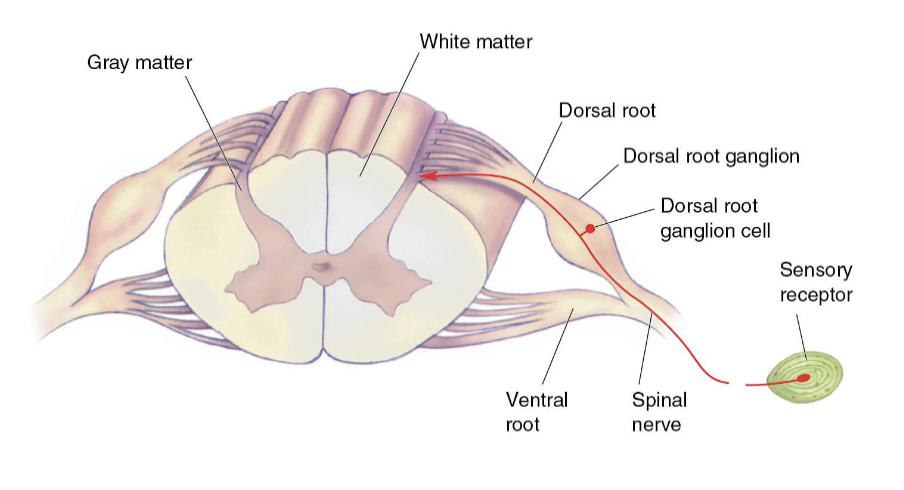
What is the path to the brain, beginning with an axon?

  • Primary Afferent Axon

    • AKA: First order neuron; Sensor to spinal cord

  • Enters spinal cord at dorsal root

  • Cell bodies lie in dorsal root ganglion

    • Pseudo-unipolar neurons

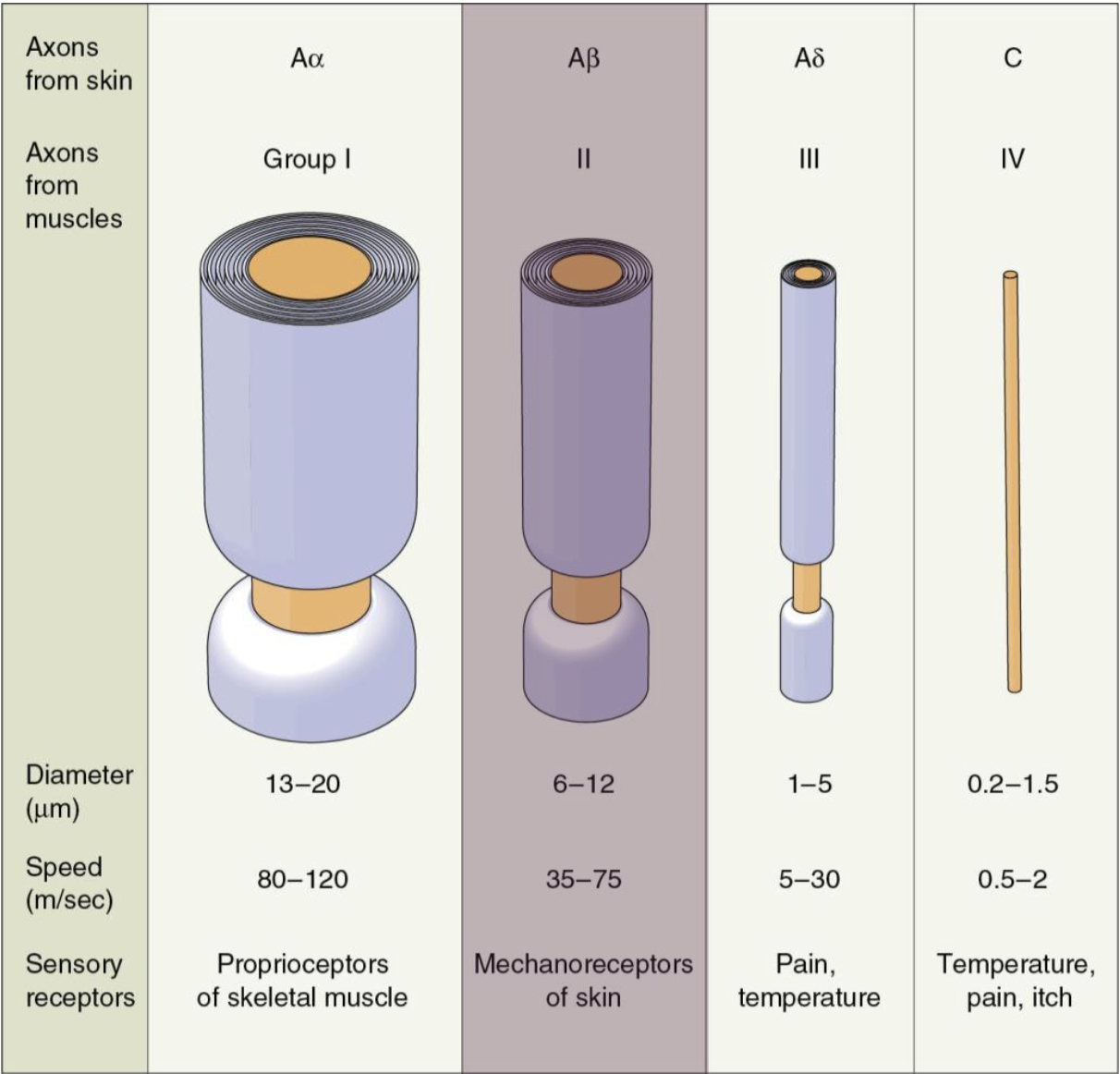
Four types of primary afferent axons:

  • Aα (proprioception), Aβ (touch), Aδ (pain), C axons (slow pain/itchy)

  • Aβ mediates touch

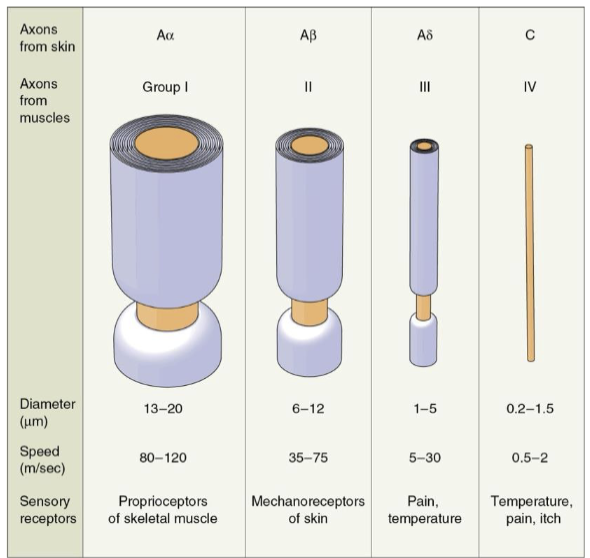
<ul><li><p>Primary Afferent Axon</p><ul><li><p><strong>AKA: First order neuron</strong>; Sensor to spinal cord</p></li></ul></li><li><p>Enters spinal cord at <em>dorsal root</em></p></li><li><p>Cell bodies lie in <em>dorsal root ganglion</em></p><ul><li><p><em>Pseudo-unipolar neurons</em></p></li></ul></li></ul><p><u>Four types of primary afferent axons:</u></p><ul><li><p>A<span>α (proprioception), Aβ (touch)</span>, Aδ (pain), C axons (slow pain/itchy)</p></li><li><p><strong>A<span>β</span></strong> <strong>mediates touch</strong></p></li></ul><p></p>
39
New cards

What are the various sizes of primary afferent axons?

All A’s are myelinated

  • Larger + myelination = faster

  • Aα proprioceptors are faster than Aβ mechanoreceptors for quick reflexes

C’s are NOT myelinated

  • Smaller and slower

<p>All A’s are myelinated</p><ul><li><p>Larger + myelination = faster</p></li><li><p>Aα proprioceptors are faster than A<span><span>β </span></span>mechanoreceptors for quick reflexes</p></li></ul><p>C’s are NOT myelinated</p><ul><li><p>Smaller and slower</p></li></ul><p></p>
40
New cards

What is the path to the brain, into the spinal cord?

Two branches:

  • Directly ascending the spinal cord to the brain

  • Synapses with second-order sensory neuron (for reflexes)

Most second-order sensory neurons lie in the dorsal horn
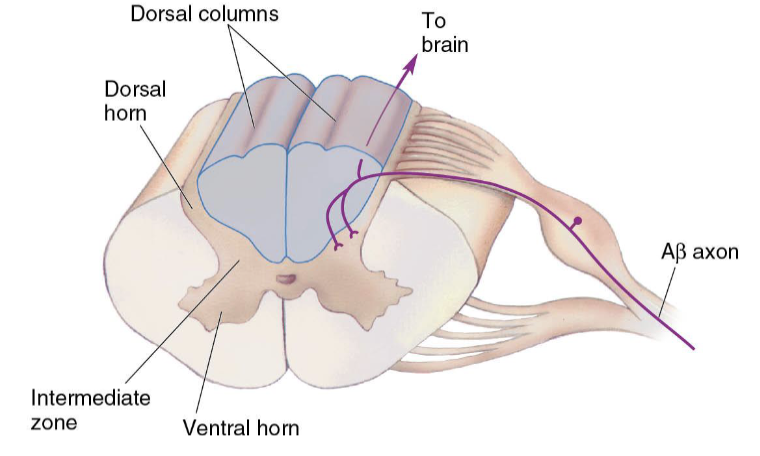
<p>Two <span>Aβ</span> branches:</p><ul><li><p>Directly ascending the spinal cord to the brain</p></li><li><p>Synapses with second-order sensory neuron (for reflexes)</p></li></ul><p>Most second-order sensory neurons lie in the dorsal horn</p>
41
New cards

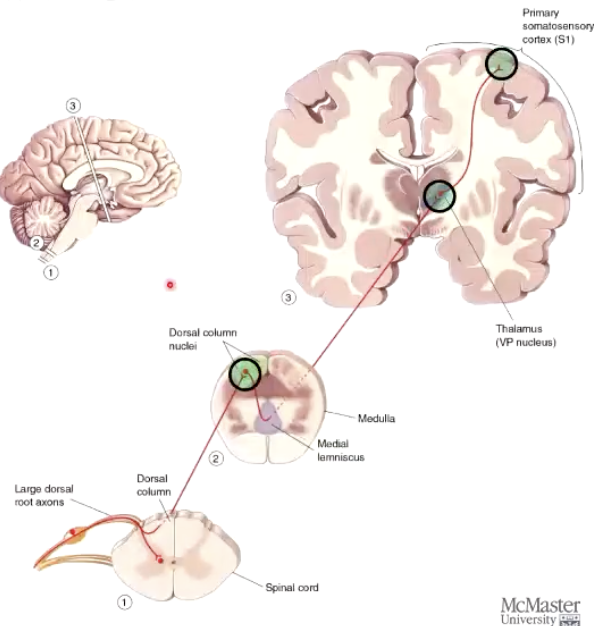
What is the Dorsal Column (Touch Information)?

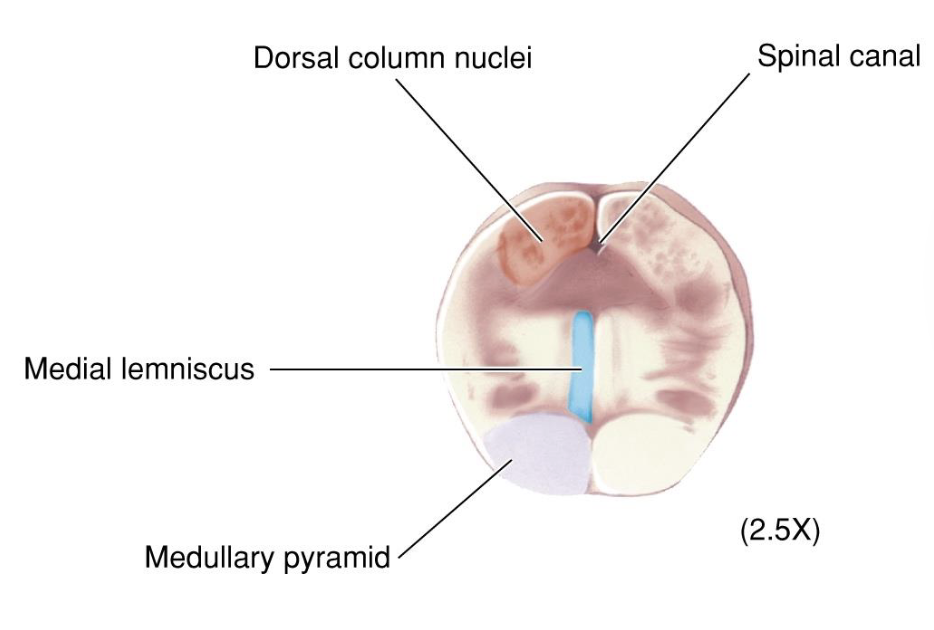
Dorsal Column-Medial Lemniscal Pathway (DCML)

  1. Ascending branch goes up the dorsal column

  2. Synapse on the dorsal column nuclei in medulla

  3. Dorsal column nuclei axons decussate and ascend the medial lemniscus

  4. Synapse in the VP nucleus of the thalamus

  5. Neurons in the VP nucleus project to somatosensory cortex

Terms: Ipsilateral (Same side) vs. Contralateral (Opposite side)
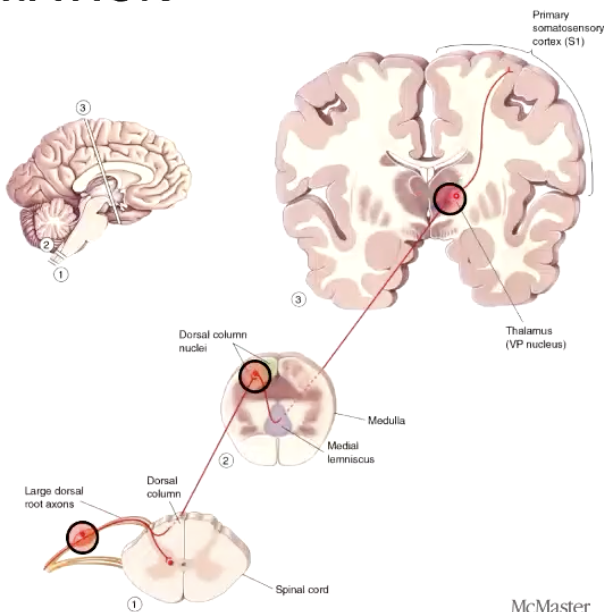
<p>Dorsal Column-Medial Lemniscal Pathway (DCML)</p><ol><li><p>Ascending branch goes up the dorsal column</p></li><li><p>Synapse on the <u>dorsal column nuclei</u> in medulla</p></li><li><p>Dorsal column nuclei axons decussate and ascend the medial lemniscus</p></li><li><p>Synapse in the VP nucleus of the thalamus</p></li><li><p>Neurons in the VP nucleus project to somatosensory cortex</p></li></ol><p></p><p><em>Terms: Ipsilateral (Same side) vs. Contralateral (Opposite side)</em></p>
42
New cards

What is the DCML?

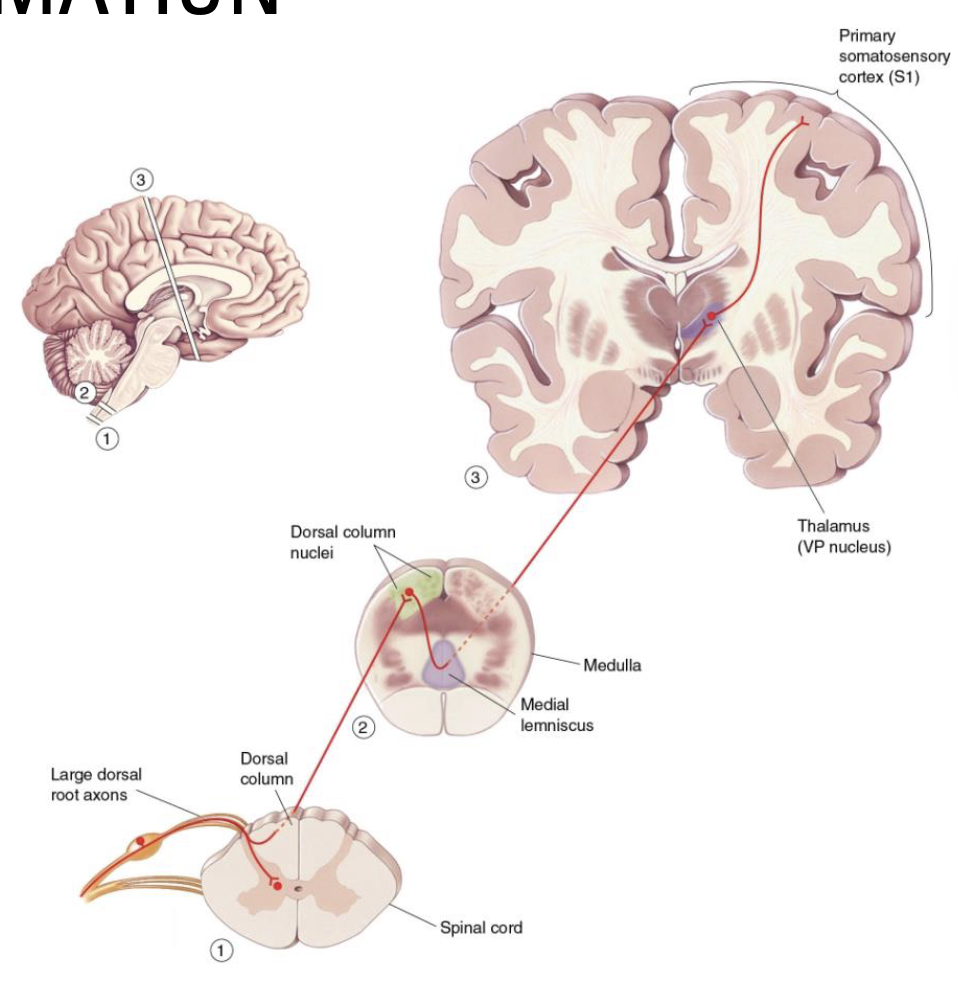
DCML = 3 neuron pathway with 3 synapse points required to reach S1

  • These exist for a reason other than simply passing along information

  • We can assume information is altered at each synapse

  • Adjacent inputs can be inhibited to enhance tactile stimuli
<p>DCML = 3 neuron pathway with 3 synapse points required to reach S1</p><ul><li><p>These exist for a reason other than simply passing along information</p></li><li><p>We can assume information is altered at each synapse</p></li><li><p>Adjacent inputs can be inhibited to enhance tactile stimuli</p></li></ul><p></p>
43
New cards

What are the 3 neurons, and 3 synapses of DCML?

3 neurons (Red)

  • First-order, second-order, third-order

3 synapses (Green)

  • First to second, second to third, third to cortex

  • No synapse until it reaches medulla

<p>3 neurons (Red)</p><ul><li><p>First-order, second-order, third-order</p></li></ul><p>3 synapses (Green)</p><ul><li><p>First to second, second to third, third to cortex</p></li><li><p>No synapse until it reaches medulla</p></li></ul><img src="https://knowt-user-attachments.s3.amazonaws.com/d10629ee-96cd-4967-85c6-4f8573f20523.png" data-width="50%" data-align="center"><p></p>
44
New cards

What is the segmental organization of spinal cord?

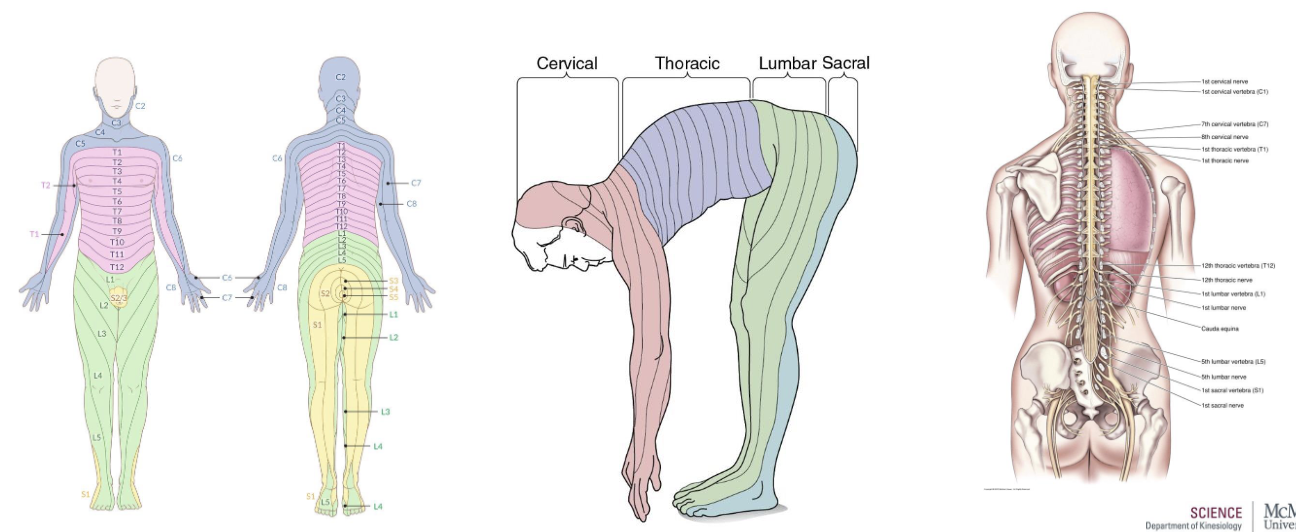
Dermatomes diagram – The distribution/mapping of spinal nerves

  • Comes from an evolutionary standpoint (all 4s → bipedalism)
<p>Dermatomes diagram – The distribution/mapping of spinal nerves</p><ul><li><p>Comes from an evolutionary standpoint (all 4s → <span><span>bipedalism)</span></span></p></li></ul><p></p>
45
New cards

What is a Herniated Disc?

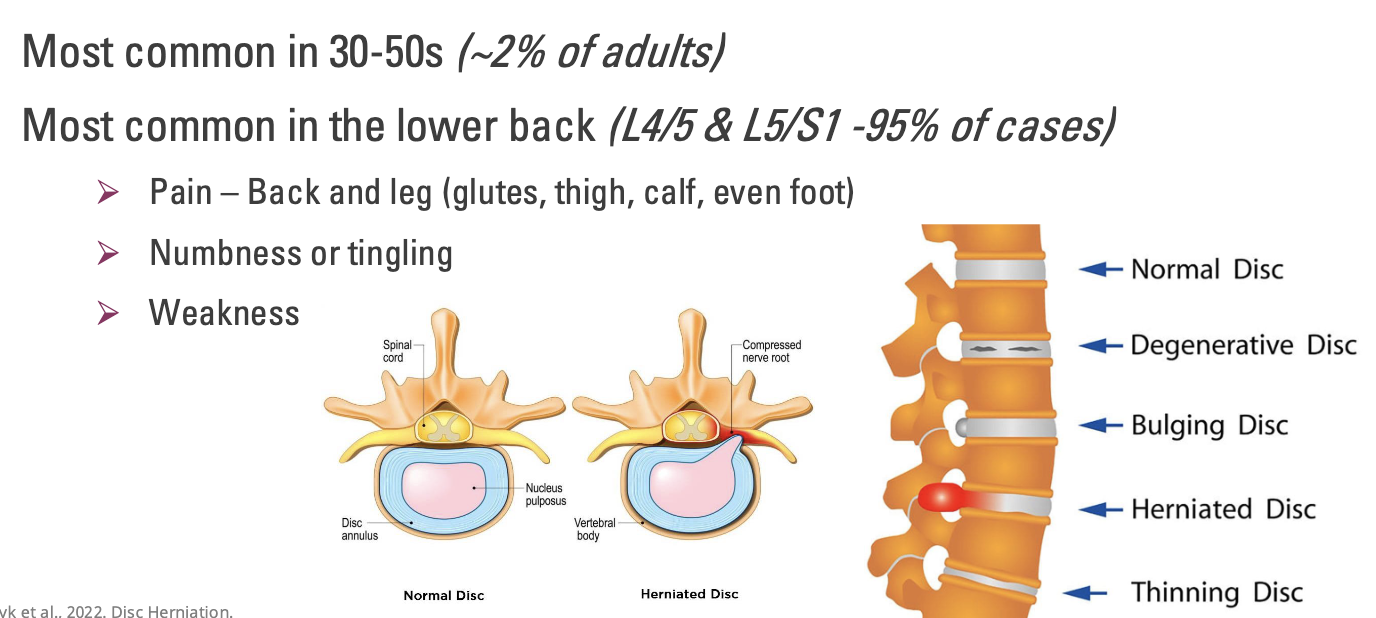
Most common in 30-50s (~2% of adults)

Most common in the lower back (L4/5 & L5/S1 -95% of cases)

  • Pain – Back and leg (glutes, thigh, calf, even foot)

  • Numbness or tingling

  • Weakness

**Reported as pairs, because we talk about the disc in between the 2 vertebra
<p>Most common in 30-50s <em>(~2% of adults)</em></p><p>Most common in the lower back (<em>L4/5 &amp; L5/S1 -95% of cases</em>)</p><ul><li><p>Pain – Back and leg (glutes, thigh, calf, even foot)</p></li><li><p>Numbness or tingling</p></li><li><p>Weakness</p></li></ul><p></p><p><em>**Reported as pairs, because we talk about the disc in between the 2 vertebra</em></p>
46
New cards

How to test for Herniated Disc?

Physical exam, Imaging, and/or even nerve tests for diagnosis

  • Herniated discs cause localized and radiating pain by compressing the spinal cord or nerve roots, with pain location often indicating the affected level
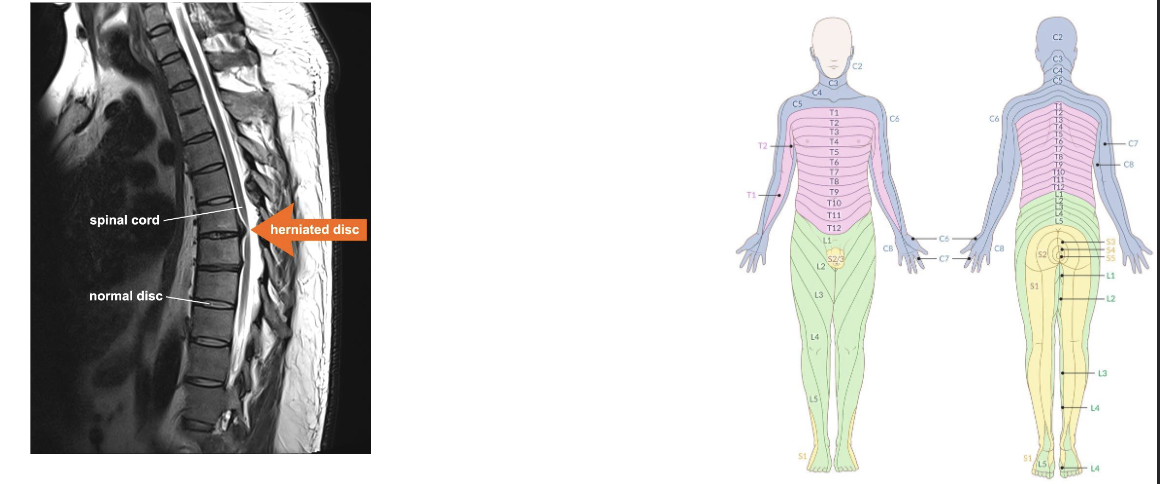
<p>Physical exam, Imaging, and/or even nerve tests for diagnosis</p><ul><li><p><span><span>Herniated discs cause localized and radiating pain by compressing the spinal cord or nerve roots, with pain location often indicating the affected level</span></span></p></li></ul><p></p>
47
New cards

What are treatment options for Herniated Disc?

1. Rest, physical therapy, pain medications

  • 85% resolve in 8-12 weeks

2. Surgical – Discectomy/Microdiscectomy

  • Conservative failed to resolve

  • Progressive/debilitating pain, numbness, and weakness
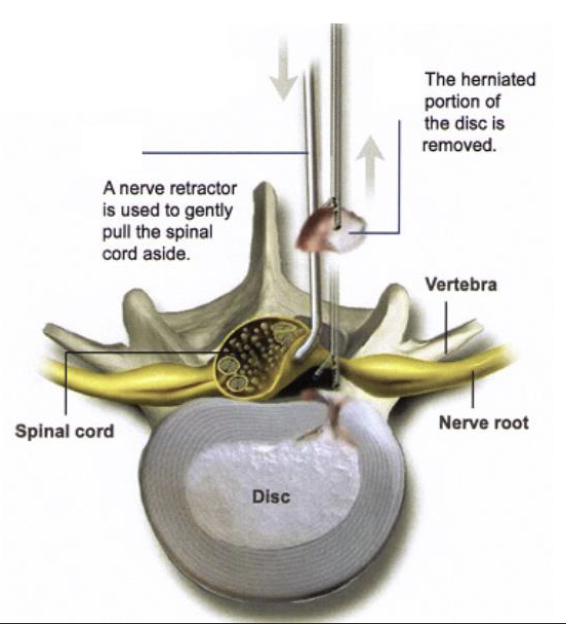
<p>1. Rest, physical therapy, pain medications</p><ul><li><p>85% resolve in 8-12 weeks</p></li></ul><p>2. Surgical – Discectomy/Microdiscectomy</p><ul><li><p>Conservative failed to resolve</p></li><li><p>Progressive/debilitating pain, numbness, and weakness</p></li></ul><p></p>
48
New cards

Why is lateral inhibition (overlapping neurons) important for touch information?

  • Inhibit adjacent inputs to enhance tactile sensitivity

  • Increases contrast to allow for more precise/finer location of sensation

Graph: Purple shows frequency of APs
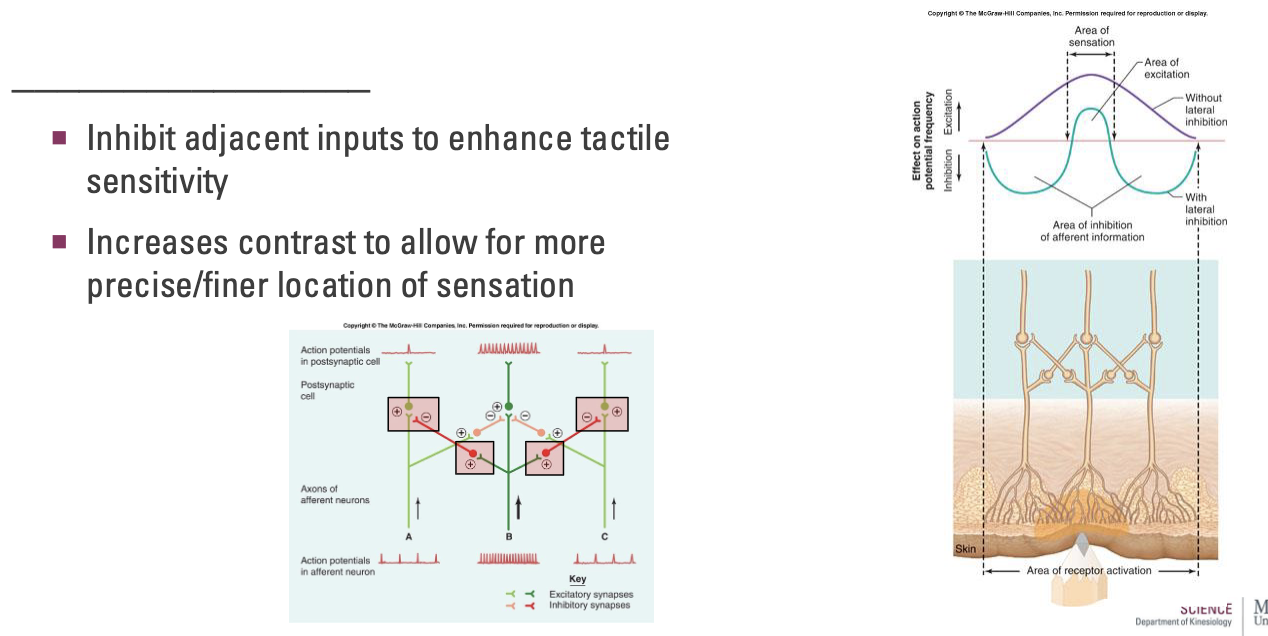
<ul><li><p>Inhibit adjacent inputs to enhance tactile sensitivity</p></li></ul><ul><li><p>Increases contrast to allow for more precise/finer location of sensation</p></li></ul><p></p><p><em>Graph: Purple shows frequency of APs</em></p>
49
New cards

What is Sensory gating?

  • Corticothalamic feedback influences sensory processing

  • Cortex helps to filter irrelevant or repetitive information

  • “Feel what you want to feel”

  • However, these complex pathways remain unclear

  • May be related to many cognitive disorders...

    • Ex: Schizophrenia (extreme), ADHD (less extreme)
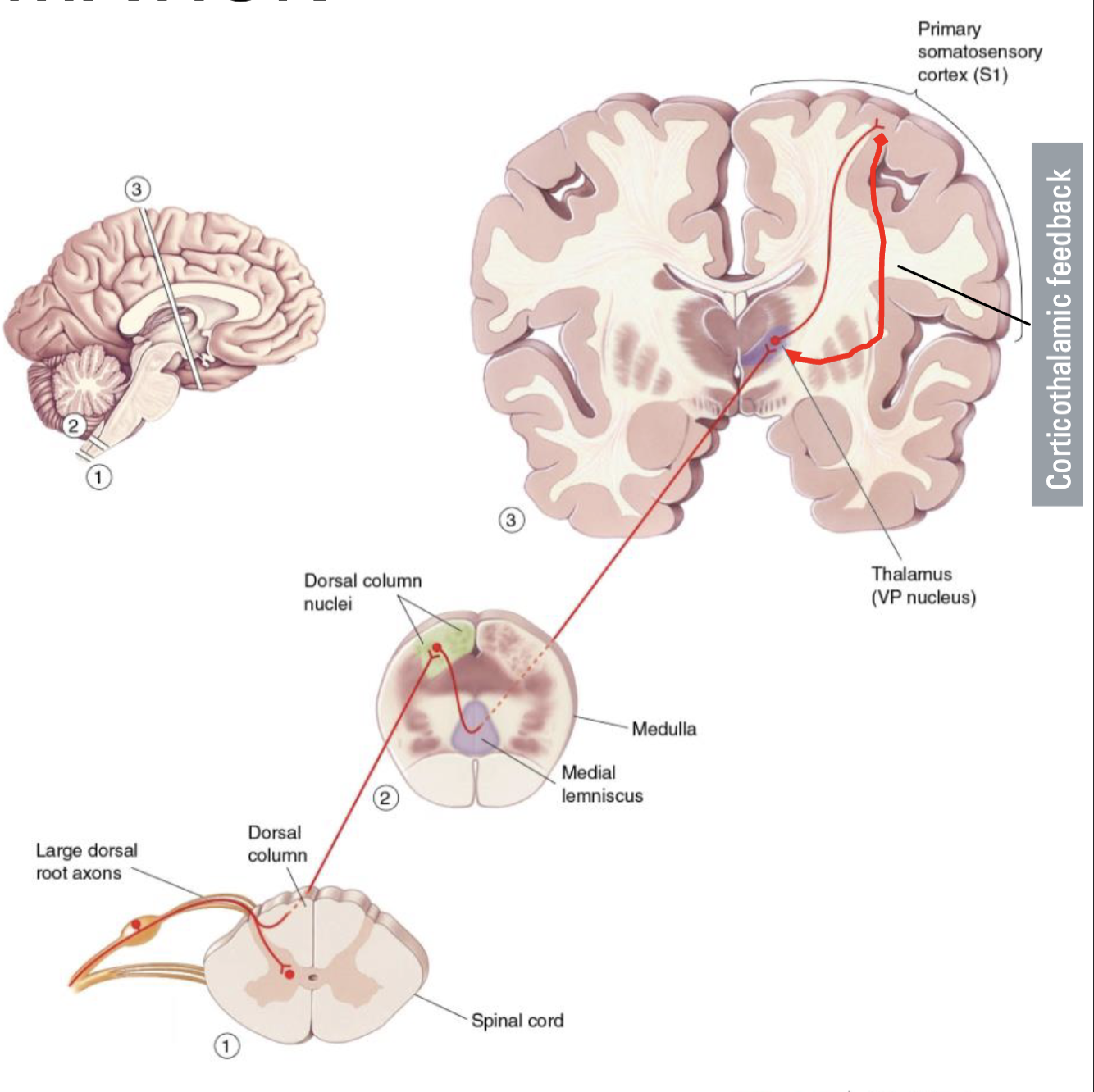
<ul><li><p>Corticothalamic feedback influences sensory processing</p></li><li><p>Cortex helps to filter irrelevant or repetitive information</p></li><li><p>“Feel what you want to feel”</p></li><li><p>However, these complex pathways remain unclear</p></li><li><p>May be related to many cognitive disorders...</p><ul><li><p>Ex: Schizophrenia (extreme), ADHD (less extreme)</p></li></ul></li></ul><p></p>
50
New cards

How do we know 3b is the primary input site?

Primary somatosensory cortex = 3b

  1. Receives inputs from VP nucleus

  2. Highly responsive to somatosensory input

  3. Damage impairs sensation

  4. Electrical stimulus creates sensations
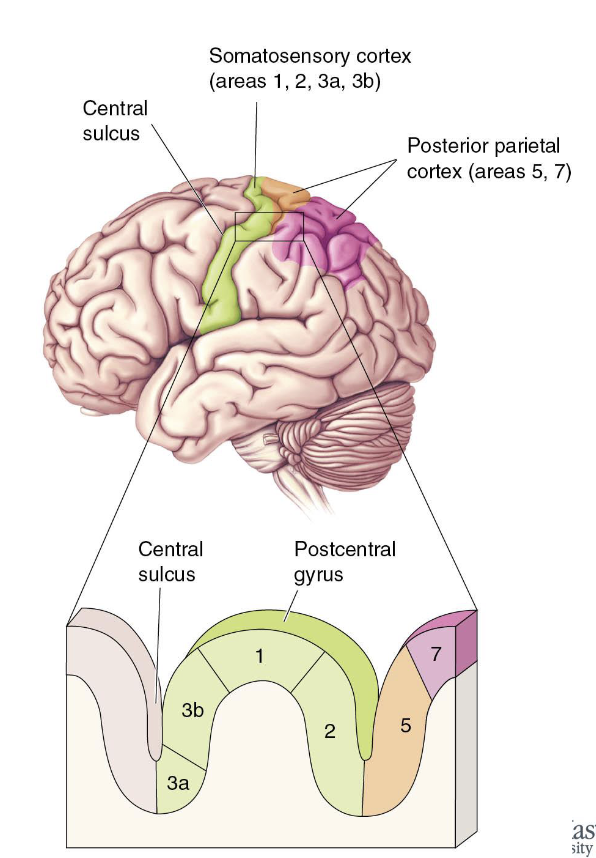
<p><strong><u>Primary</u></strong> somatosensory cortex = 3b</p><ol><li><p>Receives inputs from VP nucleus</p></li><li><p>Highly responsive to somatosensory input</p></li><li><p>Damage impairs sensation</p></li><li><p>Electrical stimulus creates sensations</p></li></ol><p></p>
51
New cards

What are the areas adjacent to 3b?

Somatosensory 3a

  • Dense thalamus input, but more body position

Somatosensory 1 & 2

  • Receives information from 3b

  • Generally related to texture, size, and shape
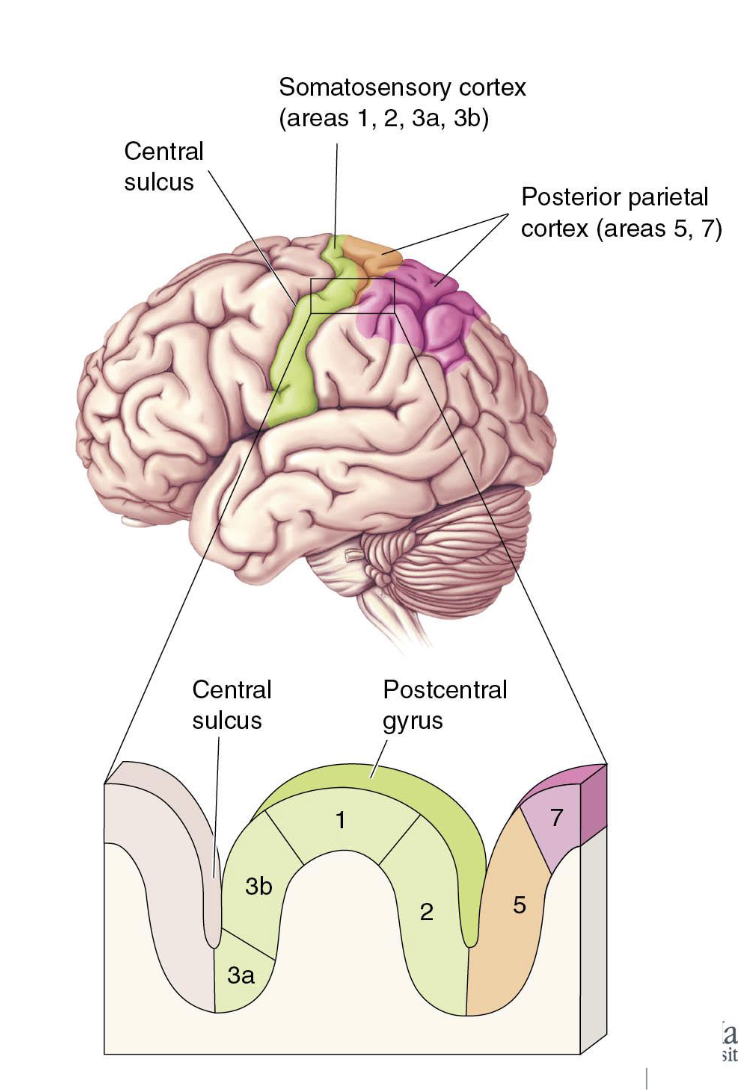
<p>Somatosensory 3a</p><ul><li><p>Dense thalamus input, but more body position</p></li></ul><p>Somatosensory 1 &amp; 2</p><ul><li><p>Receives information from 3b</p></li><li><p>Generally related to texture, size, and shape</p></li></ul><p></p>
52
New cards

What is the contribution of Wilder Penfield?

  • American-Canadian neurosurgeon

  • Discovered stimulating parts of the cortex could evoke vivid and specific memories, including sounds and smells

53
New cards

What is Cortical Somatotopy, Homunculus?

  • Mapping of the somatosensory cortex

  • Homunculus represents the density of sensory input
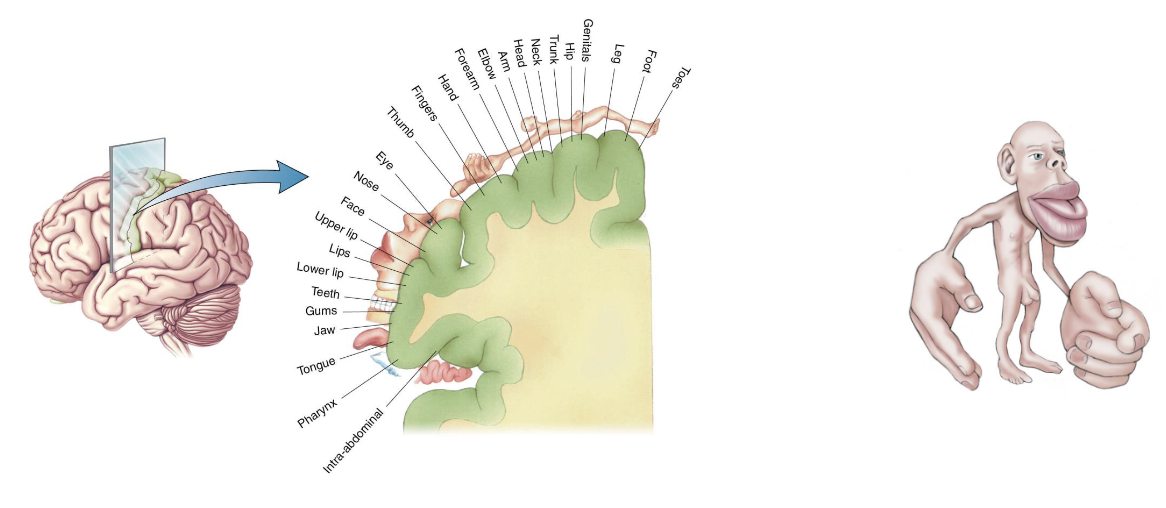
<ul><li><p>Mapping of the somatosensory cortex</p></li><li><p>Homunculus represents the density of sensory input</p></li></ul><p></p>
54
New cards

What is the Posterior Parietal Cortex?

Allows for the processing of basic sensory information and integration with other senses

Posterior parietal cortex 5 (orange)

  • Sensory integration for the planning and organization of movement

Posterior parietal cortex 7 (pink)

  • Sensory integration for object recognition and spatial relationships
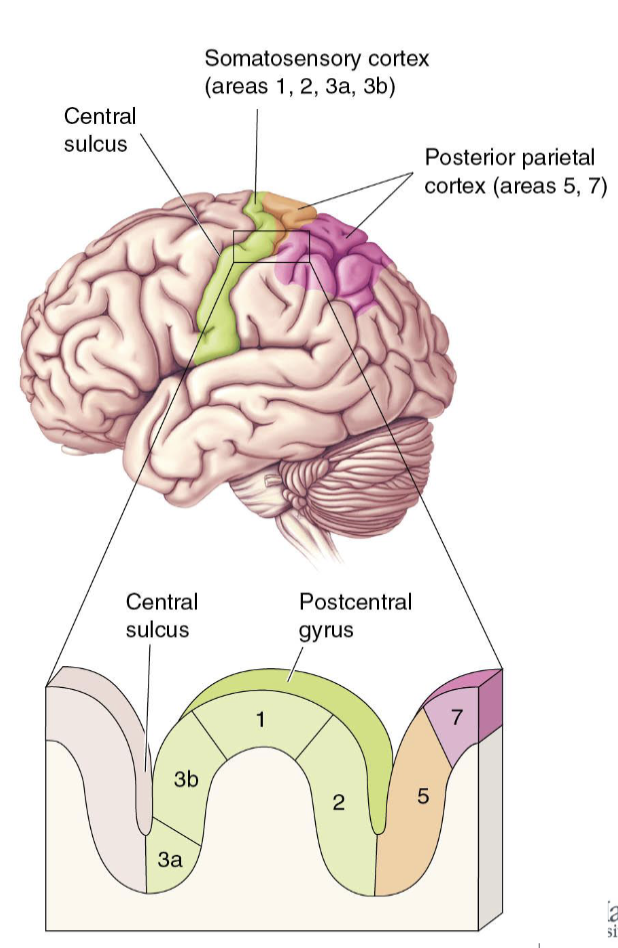
<p>Allows for the processing of basic sensory information and integration with other senses</p><p>Posterior parietal cortex 5 (orange)</p><ul><li><p>Sensory integration for the <u>planning and organization of movement</u></p></li></ul><p>Posterior parietal cortex 7 (pink)</p><ul><li><p>Sensory integration for <u>object recognition and spatial relationships</u></p></li></ul><p></p>
55
New cards

What is pain and nociception?

Nociceptors: receptors of painful stimuli

Activated by stimulus that may damage tissue

  • Strong mechanical stimulation, temperature extremes, oxygen deprivation, chemicals; even substances released by damaged cells (lactic acid, histamine, etc.)

Nociception ≠ pain

  • Nociception = sensory process that provides the signals that MAY trigger pain

  • Pain = sore, aching, throbbing sensations we “feel”; can be influenced by past experiences

    • Nociception can exist without pain

    • Pain can exist without nociception

56
New cards

What are types of Nociceptors?

Free nerve endings, which bring the sensation of pain to CNS

Types of Nociceptors

  • Mechanical nociceptors - Respond to damage such as cutting, crushing, or pinching

  • Thermal nociceptors - Respond to temperature extremes

  • Chemical nociceptors - Respond to histamine and other chemicals

  • Polymodal nociceptors - Respond equally to all kinds of damaging stimuli
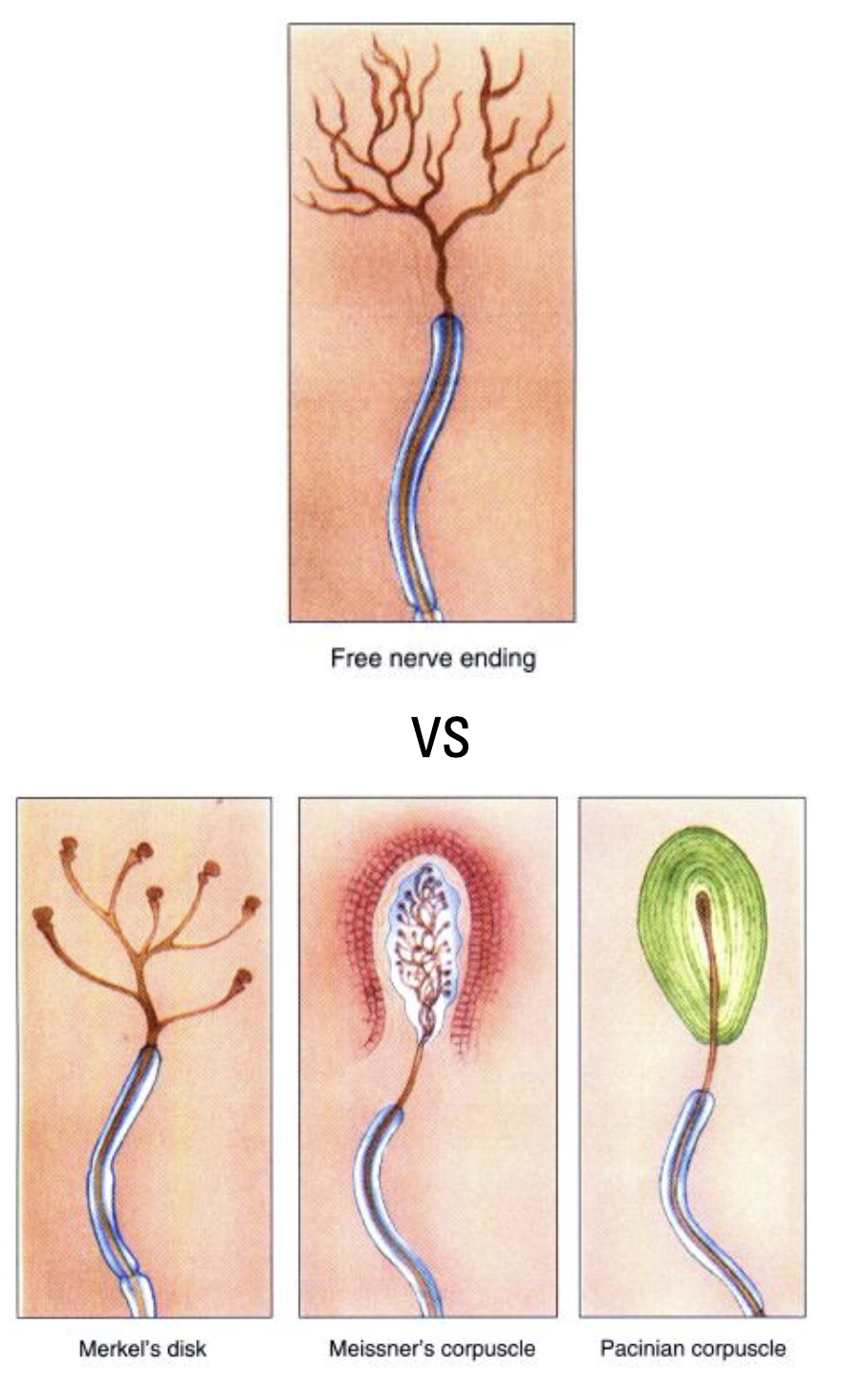
<p><strong><u>Free nerve endings,</u></strong> which bring the sensation of pain to CNS</p><p>Types of Nociceptors</p><ul><li><p><u>Mechanical nociceptors</u> - Respond to damage such as cutting, crushing, or pinching</p></li><li><p><u>Thermal nociceptors</u> - Respond to temperature extremes</p></li><li><p><u>Chemical nociceptors</u> - Respond to histamine and other chemicals</p></li><li><p><u>Polymodal nociceptors</u> - Respond equally to all kinds of damaging stimuli</p></li></ul><p></p>
57
New cards

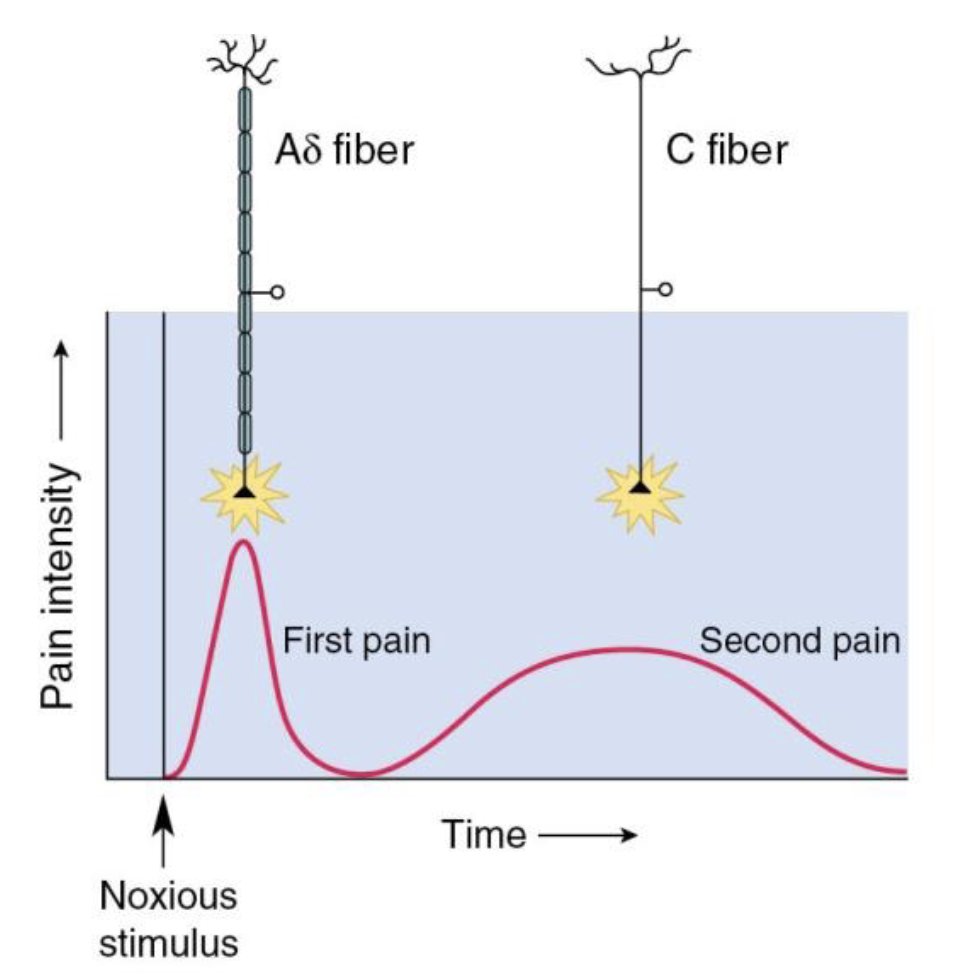
How do different types of pain involve different types of fibers?
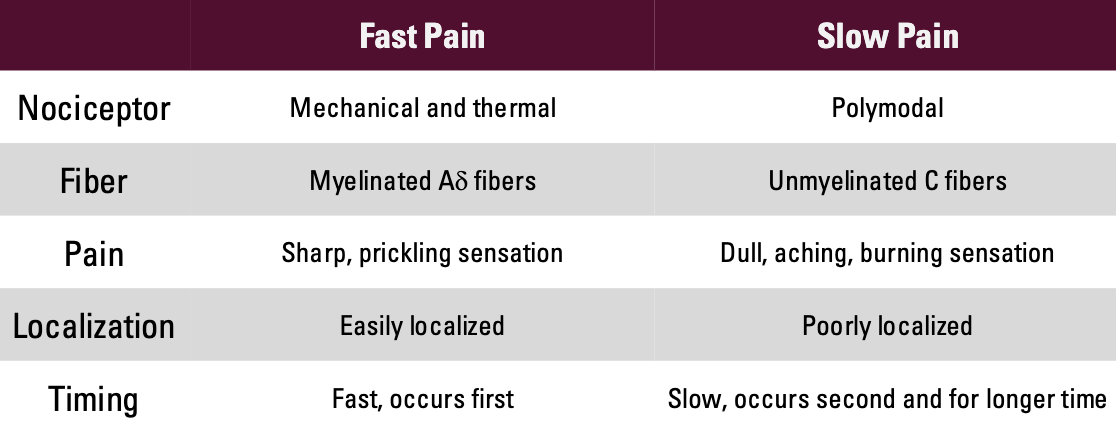
<img src="https://knowt-user-attachments.s3.amazonaws.com/e0e7d3f0-8df2-4ac2-a238-30328c0a3e51.png" data-width="100%" data-align="center"><p></p>
58
New cards

What is the Spinothalamic Tract?

To carry nociceptive information to brain

  • Cell bodies in dorsal root ganglion

  • Axons enter dorsal horn of spinal cord
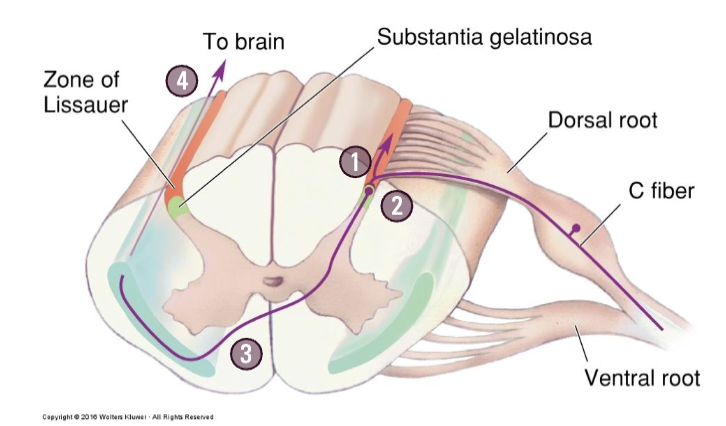
<p><em>To carry nociceptive information to brain</em></p><ul><li><p>Cell bodies in dorsal root ganglion</p></li><li><p>Axons enter dorsal horn of spinal cord</p></li></ul><p></p>
59
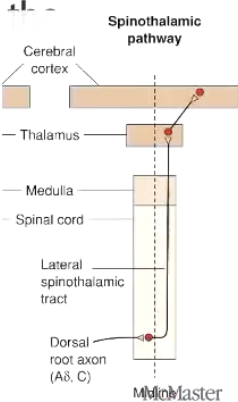
New cards

What is the pathway of carrying nociceptive information through Spinothalamic Tract?

  1. Enter zone of Lissauer (ascend or descend slightly)

  2. Synapse in the substantia gelatinosa (in the dorsal horn)

  3. Second order neurons in the spinal cord immediately decussate

  4. Ascend to the brain in the ventrolateral surface of the spinal cord

  5. Synapse with VP nucleus (and other areas) in the thalamus

  6. Information then projected the somatosensory cortex

NOTE: Pain is complex and can be difficult to localize in the brain. It is also highly integrated with medial structures related to emotion/memory
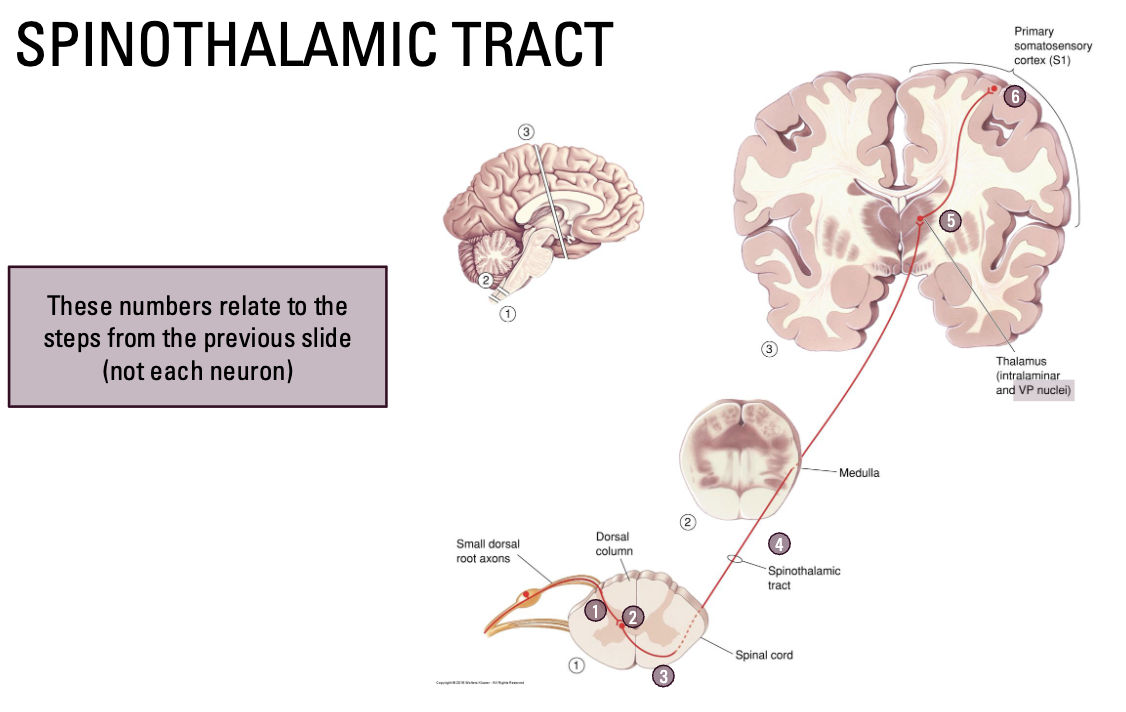
<ol><li><p><em>Enter zone of Lissauer (<u>ascend or descend slightly</u>)</em></p></li><li><p><u>Synapse</u> in the substantia gelatinosa (in the dorsal horn)</p></li><li><p>Second order neurons in the spinal cord <u>immediately decussate</u></p></li><li><p>Ascend to the brain in the ventrolateral surface of the spinal cord</p></li><li><p>Synapse with VP nucleus (and other areas) in the thalamus</p></li><li><p>Information then projected the somatosensory cortex</p></li></ol><img src="https://knowt-user-attachments.s3.amazonaws.com/ed32671c-49f1-47b4-b54f-64cfe351f1e8.png" data-width="50%" data-align="center" alt=""><p><em>NOTE: Pain is complex and can be difficult to localize in the brain. It is also highly integrated with medial structures related to emotion/memory</em></p>
60
New cards

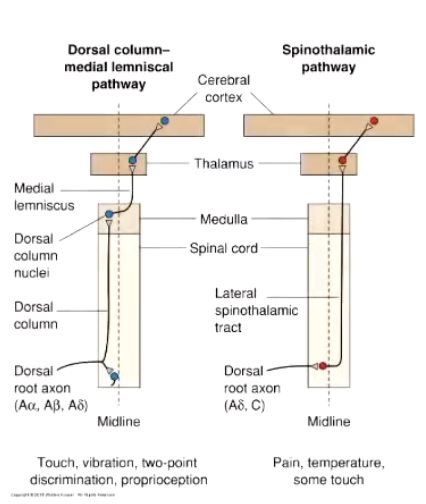
How can you compare the 2 major ascending pathways?

  • # of neurons?

    • DCML: 3

    • STT: 3

  • Ipsilateral vs. contralateral and where?

    • DCML: Ipsilateral to start, contralateral at medulla

    • STT: Contralateral immediately and stays contralateral

NEXT TEST

  • Area of spinal cord?

    • DCML: Dorsal column

    • STT: Lateral spinothalamic tract

  • Type of axons in the pathways?

    • DCML: Aα (proprioception), Aβ (touch), Aδ (pain)

    • STT: Aδ (pain), C axons (slow pain/itchy)
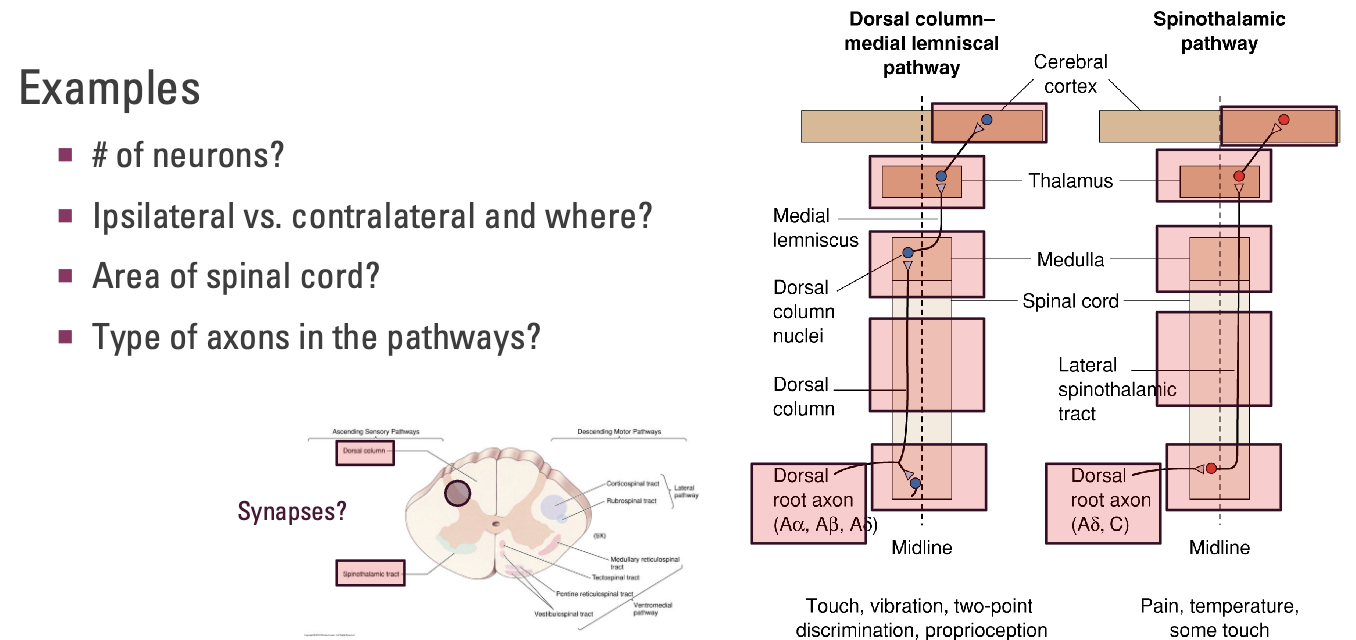
<ul><li><p><strong># of neurons?</strong></p><ul><li><p>DCML: 3</p></li><li><p>STT: 3</p></li></ul></li></ul><ul><li><p><strong>Ipsilateral vs. contralateral and where?</strong></p><ul><li><p>DCML: Ipsilateral to start, contralateral at medulla</p></li><li><p>STT: Contralateral immediately and stays contralateral</p></li></ul></li></ul><p></p><p>NEXT TEST</p><ul><li><p><strong>Area of spinal cord?</strong></p><ul><li><p>DCML: Dorsal column</p></li><li><p>STT: Lateral spinothalamic tract</p></li></ul></li><li><p><strong>Type of axons in the pathways?</strong></p><ul><li><p>DCML: A<span>α (proprioception), Aβ (touch)</span>, Aδ (pain) </p></li><li><p>STT: Aδ (pain), C axons (slow pain/itchy)</p></li></ul></li></ul><p></p>
61
New cards

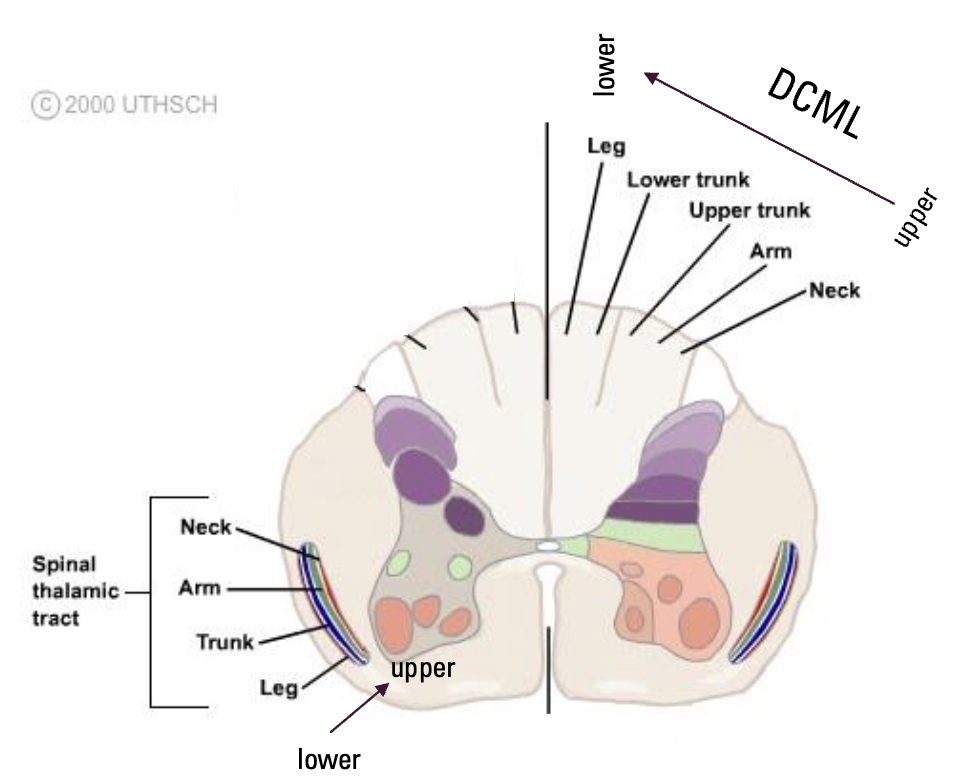
What is the general organization of these pathways?

DCML

  • Upper body tracts more lateral

  • Lower body tracts more medial

Spinothalamic

  • Upper body tracts more deep

  • Lower body tracts more superficial

<p>DCML</p><ul><li><p>Upper body tracts more lateral</p></li><li><p>Lower body tracts more medial</p></li></ul><p>Spinothalamic</p><ul><li><p>Upper body tracts more deep</p></li><li><p>Lower body tracts more superficial</p></li></ul><p></p>
62
New cards

Pain Regulation - Afferent Regulation

Pain can be reduced by the activity of mechanoreceptors

Gate control theory of pain

  • Neurons in the spinothalamic tract may be inhibited by Aα or sensory nerves (touch) in the dorsal horn of the spinal cord.
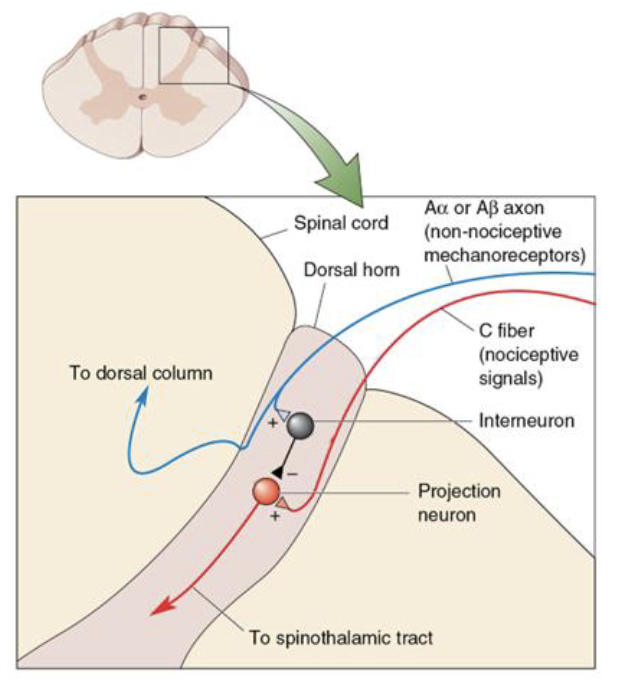
<p>Pain can be reduced by the activity of mechanoreceptors</p><p><strong><u>Gate control theory of pain</u></strong></p><ul><li><p>Neurons in the spinothalamic tract may be inhibited by A<span>α</span> or <span>Aβ </span>sensory nerves (touch) in the dorsal horn of the spinal cord.</p></li></ul><p></p>
63
New cards

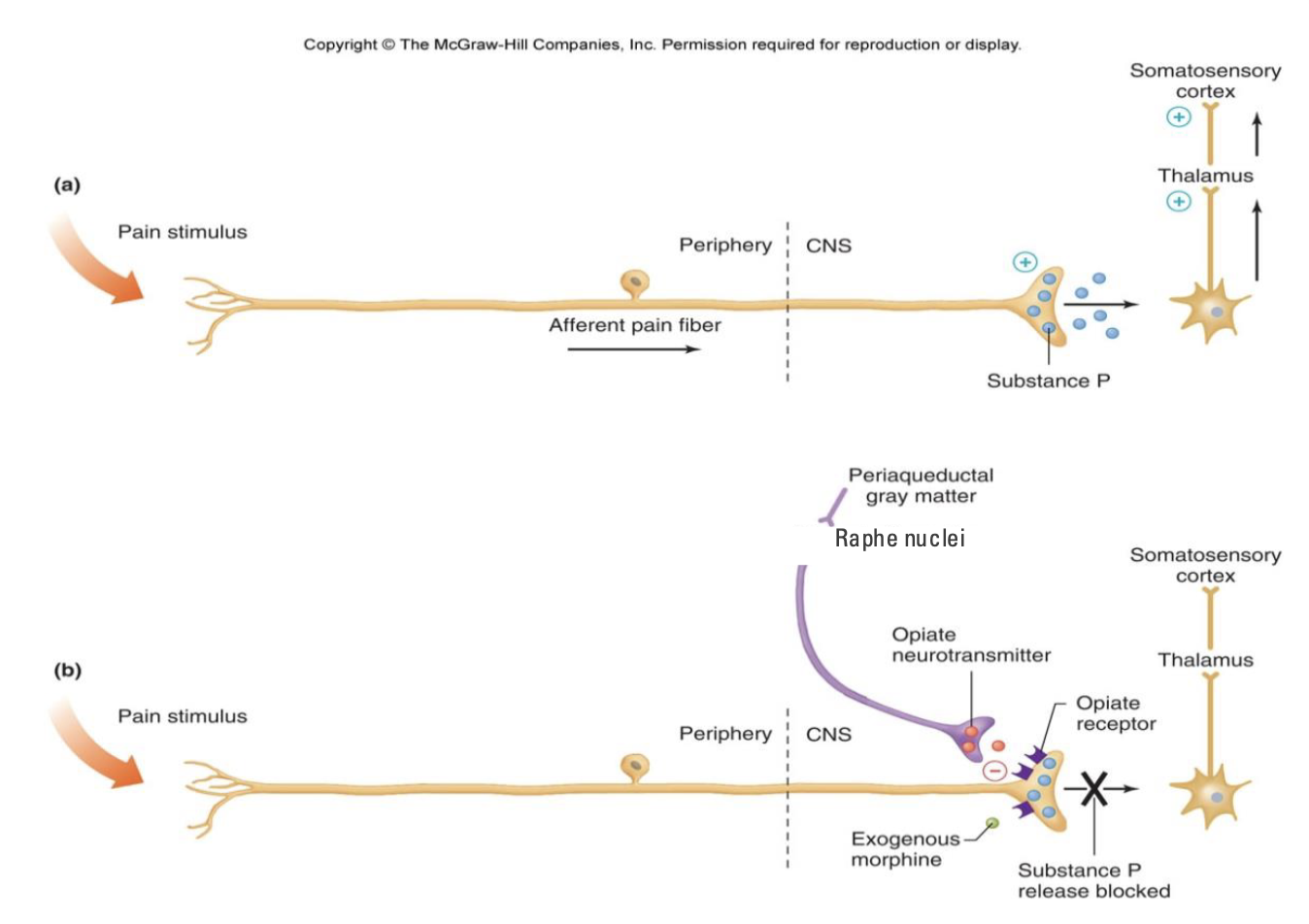
Pain Regulation - Descending Regulation

Brain can do powerful things when it comes to controlling pain!

  • Strong emotion, stress, etc. can suppress pain

Periaqueductal gray matter (PAG) - in medulla

  1. Receives input from many areas in cortex (often emotional)

  2. Neurons descend to medulla (Raphe nuclei)

  3. Neurons descend to spinal cord to depress activity
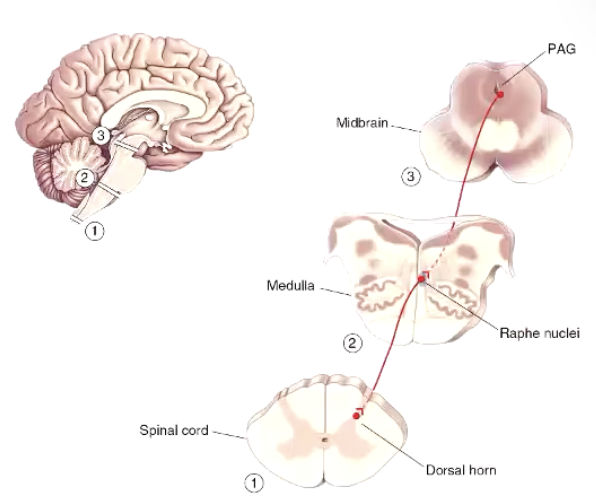
<p>Brain can do powerful things when it comes to controlling pain!</p><ul><li><p>Strong emotion, stress, etc. can suppress pain </p></li></ul><p><strong><u>Periaqueductal gray matter (PAG)</u></strong> - in medulla</p><ol><li><p>Receives input from many areas in cortex (often emotional)</p></li><li><p>Neurons descend to medulla (Raphe nuclei)</p></li><li><p>Neurons descend to spinal cord to depress activity</p></li></ol><img src="https://assets.knowt.com/user-attachments/b27b6064-2cc2-421b-a1a5-5e584fea8504.png" data-width="75%" data-align="center"><p></p>
64
New cards

Hyperalgesia

Reduction in the pain threshold, increased sensitivity, or spontaneous pain

  • Primary Hyperalgesia: super-sensitivity within the damaged area

  • Secondary Hyperalgesia: super-sensitivity in the surrounding area

Primary changes occur peripherally:

  • Inflammation = bodies attempt to eliminate injury and stimulate healing

  • A variety of neurotransmitters, peptides, lipids, etc. are released which can attach to receptors in/around injury to lower their threshold for activation

Hyperalgesia vs. Allodynia:

  • Allodynia is a similar concept, but pain response from stimuli that would normally not cause pain

65
New cards

Central Sensitization

  • Amplification of neural signaling (e.g., nociceptive information) within the CNS that elicits pain hypersensitivity or even normal stimuli (allodynia)

    • Changes in the synapses and potentially the organization of interconnecting neurons may increase excitability/reducing inhibition of pain pathways

    • Contributions are difficult to identify and treatments difficult to target
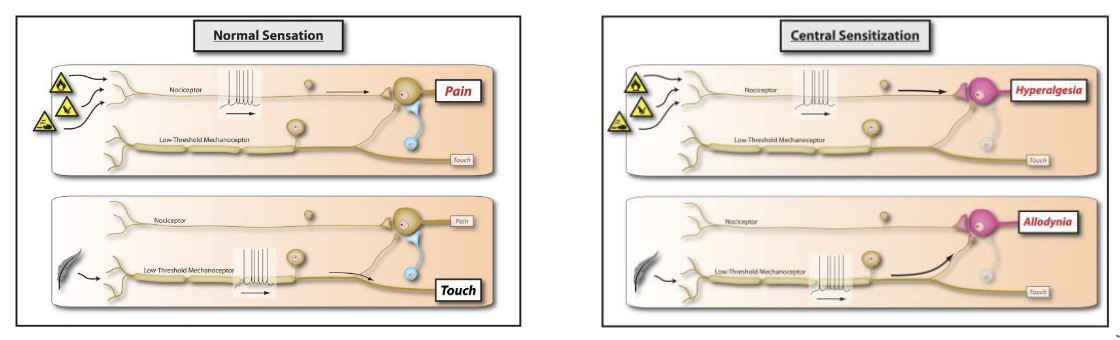
<ul><li><p>Amplification of neural signaling (e.g., nociceptive information) within the CNS that elicits pain hypersensitivity or even normal stimuli (allodynia)</p><ul><li><p>Changes in the synapses and potentially the organization of interconnecting neurons may increase excitability/reducing inhibition of pain pathways</p></li><li><p>Contributions are difficult to identify and treatments difficult to target</p></li></ul></li></ul><p></p>
66
New cards

What is referred pain?

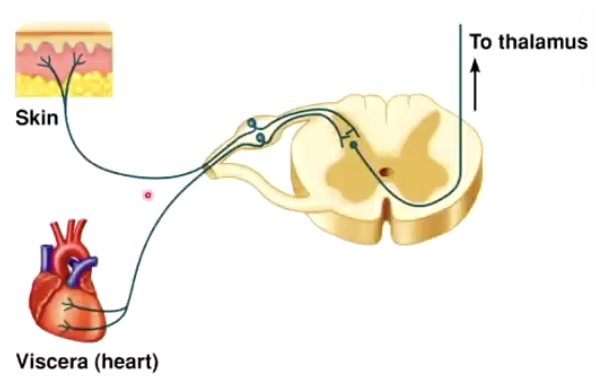
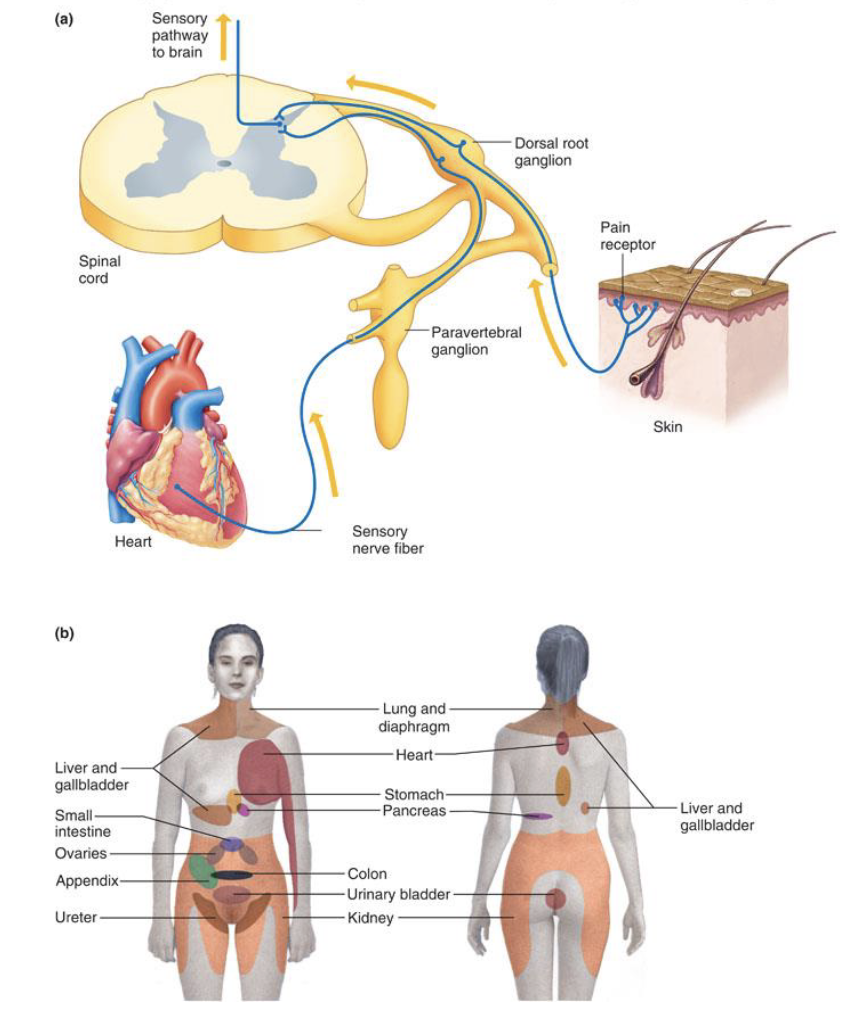
Cross-talk between sensory neurons

  • Convergence of visceral and somatic afferent neurons (in dorsal root ganglion)

  • Ex: Chest and left arm pain before heart-attack

Issue here?

  • In STT, the signal should synapse, then cross over and go up to the brain

  • More accurate diagram:

<p>Cross-talk between sensory neurons</p><ul><li><p>Convergence of visceral and somatic afferent neurons (in dorsal root ganglion)</p></li><li><p>Ex: Chest and left arm pain before heart-attack</p></li></ul><p>Issue here? </p><ul><li><p>In STT, the signal should synapse, then <strong><u>cross over</u></strong> and go up to the brain</p></li><li><p>More accurate diagram: </p></li></ul><img src="https://assets.knowt.com/user-attachments/2d2a0a35-0756-4c1b-8327-d0189804a986.png" data-width="50%" data-align="center"><p></p>
67
New cards

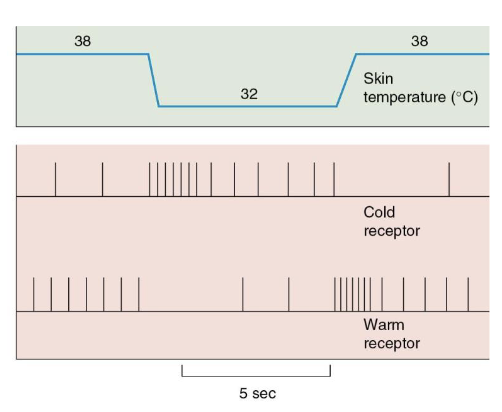
What is temperature?

Thermoreceptors

  • Varying sensitivities to hot and cold temperatures

  • Cold (Aδ & C fibers) and hot (C fibers)

  • Adapt to long durations of stimuli

Follow the same pathway as pain
<p>Thermoreceptors</p><ul><li><p>Varying sensitivities to hot and cold temperatures</p></li><li><p>Cold (Aδ &amp; C fibers) and hot (C fibers)</p></li><li><p>Adapt to long durations of stimuli</p></li></ul><p>Follow the same pathway as pain</p>
68
New cards

What is proprioception?

Our perception of the location and movement of our body

Allows us to control limb and joint position for optimal movement

Group I neurons

Two primary receptors:

  • Muscle spindle – amount of stretch in a muscle

  • Golgi tendon organ – amount of force

<p>Our perception of the location and movement of our body</p><p>Allows us to control limb and joint position for optimal movement</p><p>Group I neurons</p><p>Two primary receptors:</p><ul><li><p><strong><u>Muscle spindle</u></strong> – amount of stretch in a muscle</p></li><li><p><strong><u>Golgi tendon organ</u></strong> – amount of force</p></li></ul><p></p>
69
New cards

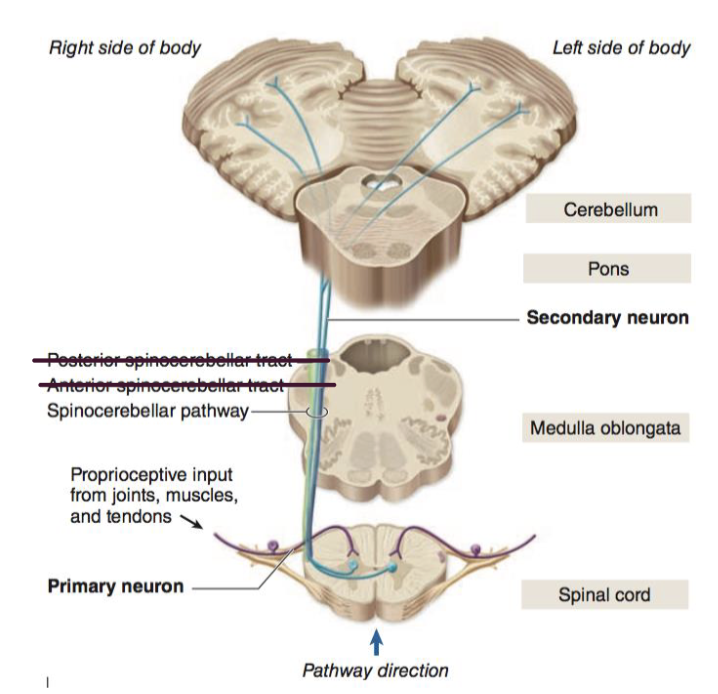
Conscious vs. Unconscious proprioception

Conscious proprioceptive information

  • Dorsal column medial lemniscus pathway

Unconscious proprioceptive information

  • Spinocerebellar tracts – To cerebellum

  • Spinal interneurons – Spinal reflexes

<p>Conscious proprioceptive information</p><ul><li><p>Dorsal column medial lemniscus pathway</p></li></ul><p>Unconscious proprioceptive information</p><ul><li><p><strong>Spinocerebellar tracts</strong> – To cerebellum</p></li><li><p>Spinal interneurons – Spinal reflexes</p></li></ul><p></p>
70
New cards

While holding a dime for a period of time between your fingers, you are able to feel the contours along the edge. The most important receptor for this type of sensory information is the...

A. Messner’s corpuscle

B. Merkel’s disk

C. Pacinian corpuscle

D. Ruffini’s endings

B. Merkel’s disk
<p>B. Merkel’s disk</p>
71
New cards

You stub your right toe on your bedpost and the free nerve endings immediately send nociceptive information to the brain through the spinothalamic tract. What side of the body (spinal cord/brain) will this information be when it: i) is ascending the spinal cord at the level of thecervical spine, ii) reaches the brain.

A. i) left, ii) left

B. i) left, ii) right

C. i) right, ii) right

D. i) right, ii) left

A. i) left, ii) left
<p>A. i) left, ii) left</p>
72
New cards

Which of the following statements is NOT true about the dorsal column medial lemniscal pathway?

A. The body of the second order neuron is found within medulla

B. It contains 3 neurons (first, second, and third order)

C. Decussation occurs immediately after the axon enters the spinal cord

D. The body of the first order neuron is within the dorsal root ganglion

C. Decussation occurs immediately after the axon enters the spinal cord
<p>C. Decussation occurs immediately after the axon enters the spinal cord</p>