Guest Lecture 3: Whale as food in vulernable communities: Safety and nutrition in a changing climate
 Call Kai
 Learn
Learn Practice Test
 Spaced Repetition
 Match
Match Flashcards
 Knowt Play
1/18

There's no tags or description
Looks like no tags are added yet.
Name | Mastery | Learn | Test | Matching | Spaced | Call with Kai |
|---|
No analytics yet
Send a link to your students to track their progress
19 Terms
To which TA does this research belong?
Kiah Lee
What do Norwegian Killer whales eat (from her masters)
Herring
Lumpfish Roe
Harbour Porpoise + Harbour Seal
Lumpfish Muscle
Capelin
Using airgun dart, for biopsies to analyze fatty acids
Marine Mammal Harvesting in the North Atlantic Sites
Greenland
Eastern Arctic and Eastern Canada
St. Vincent and the Grenadines (GVC)
Norway
Faroe Islands
History and Regulations of Marine Mammal Harvesting
Commerical whaling: industrial-scale hunting of whales for profit, to sell meat, oil, blubber, etc.
Aboriginal subsistence whaling (ASW): important for food and economuc security, and contributes to cultural identity, sprititual beliefs, ancestral connections, and social relationships
IWC —> International Whaling Commission
Canada: Commercial hunting banned in 1972, but ASW by inuit people is allowed.
Greenland, St. Vincent and the Grenadines (Caribbean), US (Alaska), and Russia are part of the IWC but still conduct ASW.
Norway: part of IWC but establishes their own catch limits for commercial purposes
Faroe islands: part of IWC but have traditional regulations established for ASW.
How is whaling nutrionally important to these communities
Good sources of
Fatty acids (from the blubber)
Vitamins (A,D, E)
Essential (and non-essential) trace elements
Known that communities that eat less suffer negative effects such as increased cancer, diabetes and obesity
What can these important foods (the whales) be contaminated with?
Per- and Polyfluoroalkyl Substances (PFAS)
Mercury (Hg)
Bioaccumulation and biomagnification of PFAS and Hg
How do we understand diet?
Visual observations + stomach content
Fatty acid analysis
Bulk stable isotopes: variants of an element, depending on the number of neutrons
Compund specific stable isotopes: analysis of individuals compounds (e.g., amino acids)
What does TWI stand for
Tolerable Weekly Intake.
Guidlines for max weekly intake of these contaminants to be tolerable
Climate change and shifting species
Changes in:
Sea surface temperature (SST)
Depth (in terms of habitat preference)
Ice cover
Salinity
Oceanographic restructuring
Stratification
Thermocline deepening
Primary production
Sea surface temperature and depth (bathymetric affinities) were strongest drivers of habitat suitability
Significant range losses in tropical zones
Subtropical and temperate regions will serve as refuge
leads to effects on feeding, life histories and breeding
How do these climate change driven shifts in species range effect the communities?
Range-shifting species = decrease safe intake amount
Climate change causes vulnerabilities in communities that rely, in part, on local, wild-caught foods.
What does all this mean for whale harvesting/objective
Develop an understanding of how vulnerable communities in the North Atlantic are adapting to shifiting marine resources due to climate change by focusing on the nutritional value and food safety of whale meat.
Knowledge gaps hoping to be filled by this research
Climate change, contamination, and nutrition are often studied in isolation —need a holisitic perspective.
Contamination and nutritional value of odonotocetes is rarely considered under the context of community well-being; these foods are important culturally, economically, and in terms of food security.
Lack of contaminant measurements in tissue that people consume (i.e., muscle) as most samples are from biopsies (only skin and blubber).
Lack of research in whaling communities of the tropics.
Methods and stuff
Sample collection from harvest events
Native arctic species
Non-native arctic species
Teeth samples (from SVG and the Faroe Islands)
n= 264
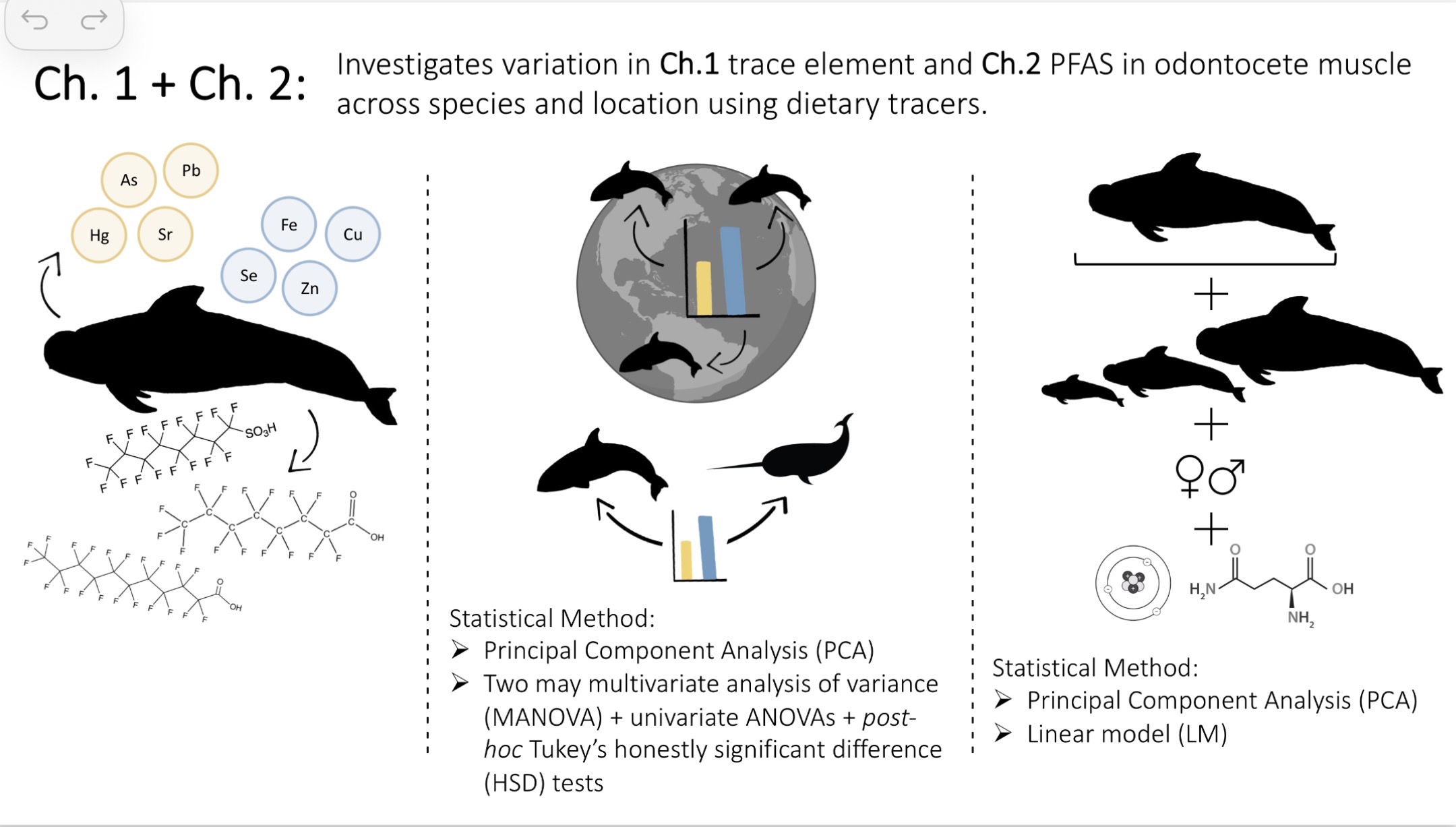
Chapter 1 and Chapter 2
Chapter 1: Investigates variation in trace element in odontocete muscle across species and location using dietary tracers
Chapter 2: Investigates variation in PFAS in odontocete muscle across species and location using dietary tracers
Chapter 3 part 1
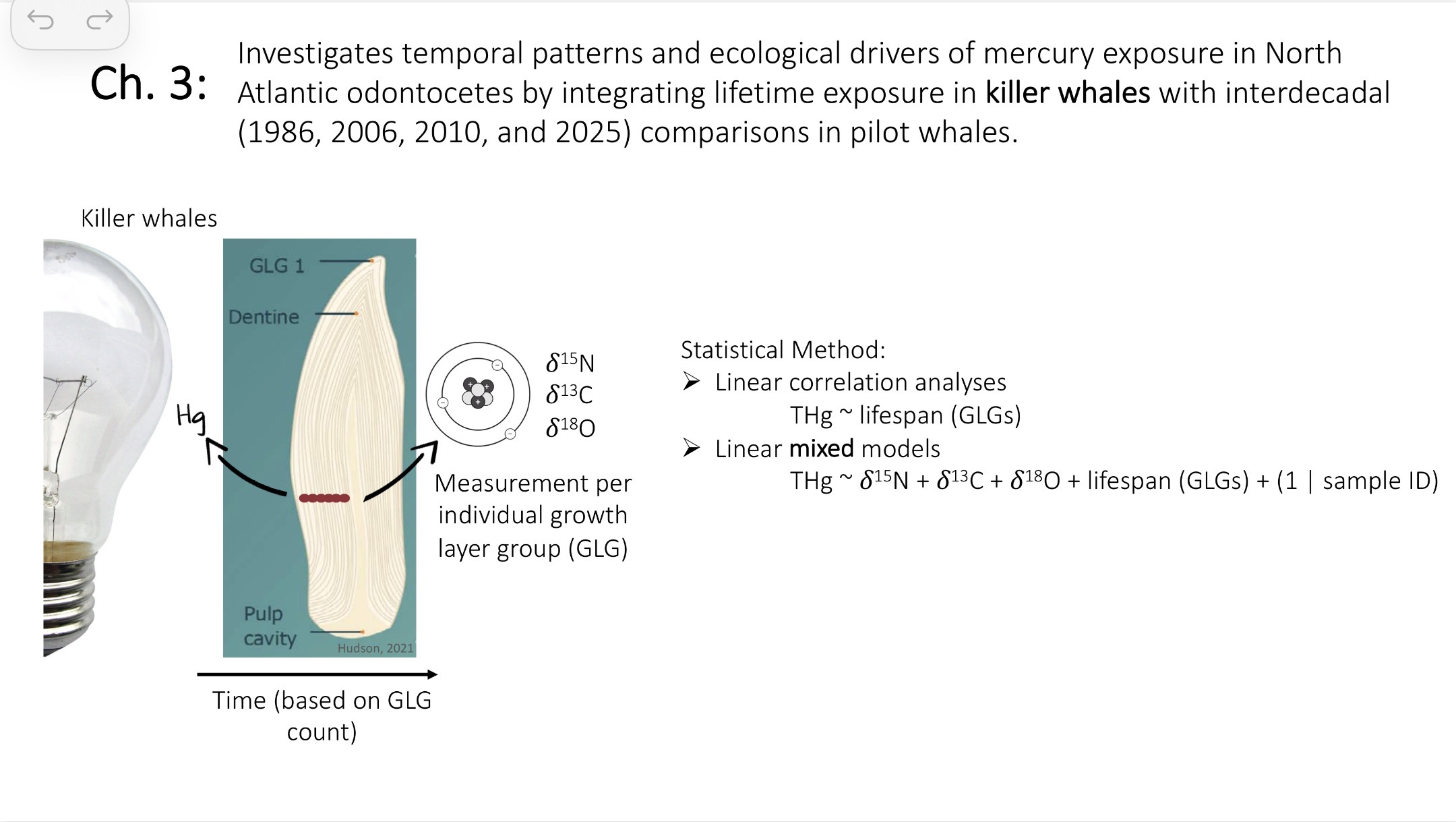
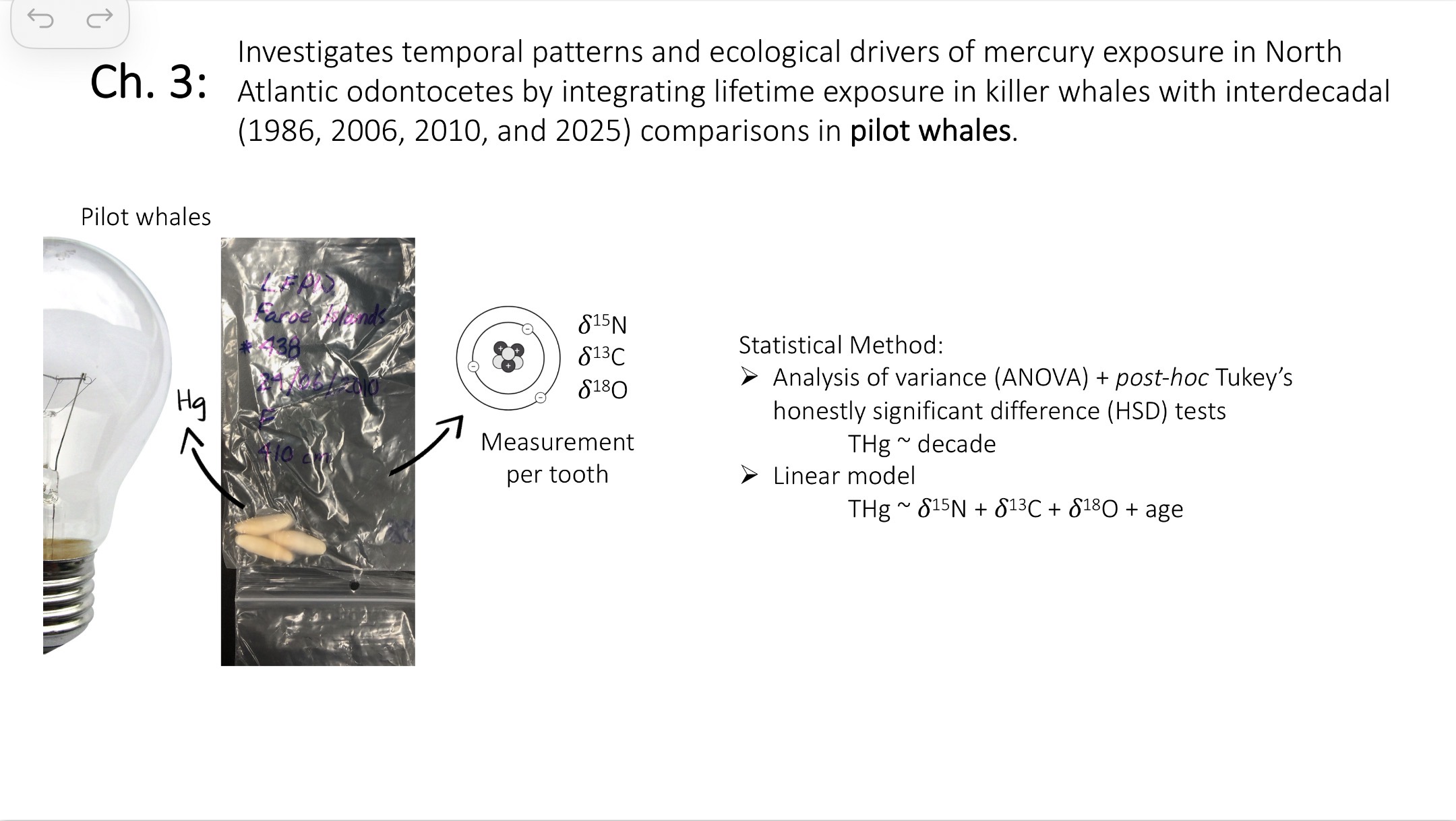
Investigates temporal patterns and ecological drivers of mercury exposure in North Atlantic odontocetes by integrating lifetime exposure in killer whales with interdecadal (1986, 2006, 2010, and 2025) comparisons in pilot whales.
Chapter 3 part 2
Investigates temporal patterns and ecological drivers of mercury exposure in North Atlantic odontocetes by integrating lifetime exposure in killer whales with interdecadal (1986, 2006, 2010, and 2025) comparisons in pilot whales.
Chapter 4 part 1
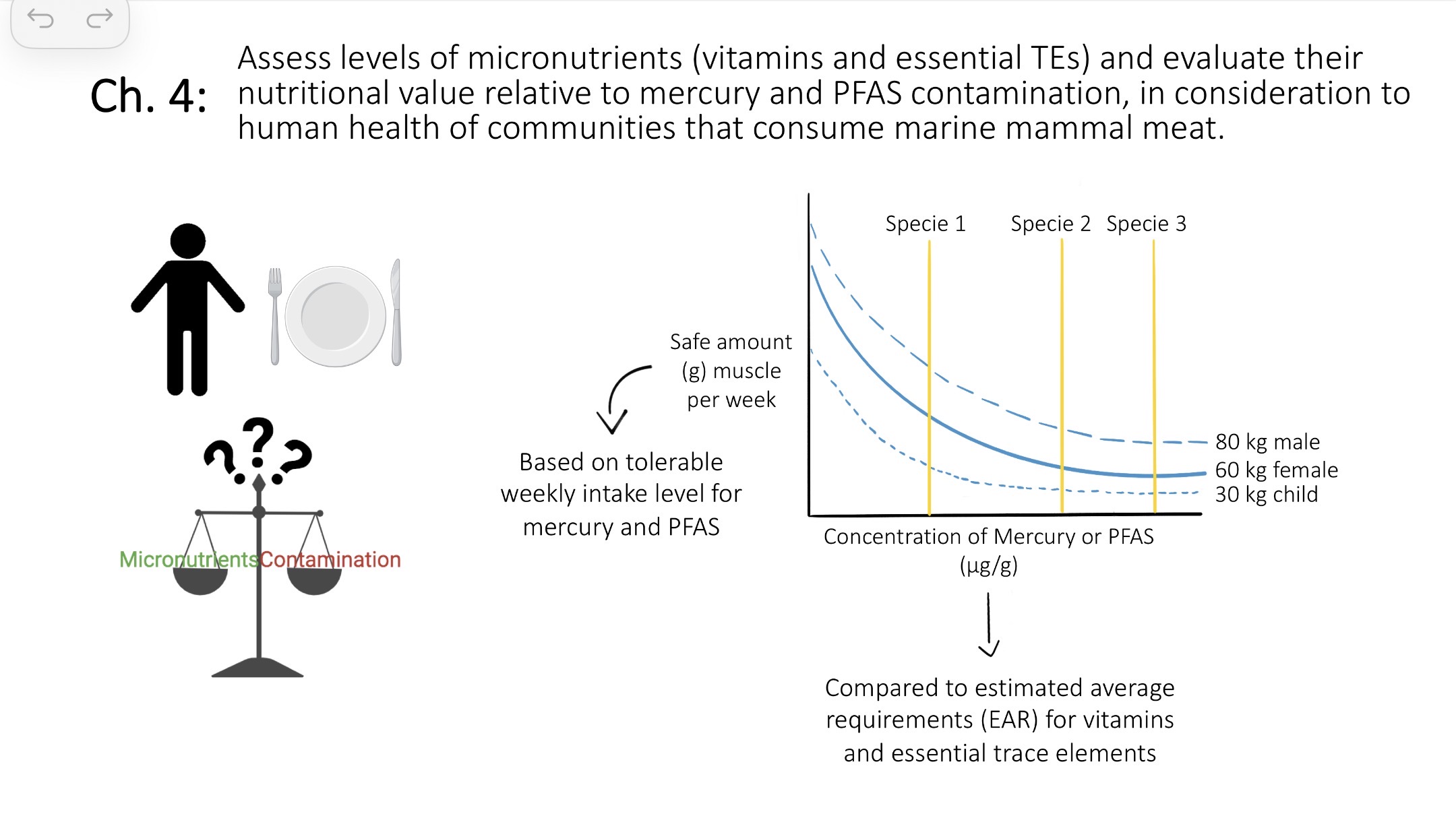
Assess levels of micronutrients (vitamins and essential TEs) and evaluate their nutritional value relative to mercury and PFAS contamination, in consideration to human health of communities that consume marine mammal meat.
Chapter 4 part 2
Why is this work important?
Provides a holistic perspective by measuring contaminant levels and nutrient profiles across many species and locations in the North Atlantic
Generates data in relevant tissue to human consumption (i.e., muscle).
Address gaps in monitoring by considering species from SVG.
Improves understanding of climate change impacts on subsistence hunting.
Provides information (e.g., risk-benefit assessments) to inform communities, policy and conservation.