Non Communicable Diseases
 Call Kai
 Learn
Learn Practice Test
 Spaced Repetition
 Match
Match Flashcards
 Knowt Play
1/195

Earn XP
Description and Tags
Care of Clients with Non-Communicable Diseases
Name | Mastery | Learn | Test | Matching | Spaced | Call with Kai | Chat |
|---|
No analytics yet
Send a link to your students to track their progress
196 Terms
Hypertension
is a chronic condition characterized by a persistent elevation in arterial blood pressure, resulting in increased workload of the heart and blood vessels. It is a major risk factor for cardiovascular, cerebrovascular, and renal diseases.
Renin-Angiotensin-Aldosterone System
What is the meaning of RAAS?
Renin
is a protein enzyme produced by the kidneys when blood pressure is low, blood volume is decreased, or sodium levels are too low to create homeostasis in the body.
ACE or Angiotensin converting enzyme
Angiotensinogen is converted into Angiotensin I via?
Heart
Brain
Kidneys
Eyes
Persistent elevation of blood pressure can damage these 4 target organs.
120/80
Normal Blood Pressure
120–129/<80
Elevated Blood Pressure
130–139/80–89
Stage I Hypertension
≥140/≥90
Stage II Hypertension
≥180/≥120
Hypertensive Crisis
Asymptomatic
Game Changer: Hypertension is commonly _________
Headache (especially occipital)
Dizziness
Blurred vision
Fatigue
Palpitations
Nosebleeds (epistaxis)
Clinical manifestations of Hypertension
Chest pain
Dyspnea
Neurologic deficits
Altered mental status
Clinical manifestations of Severe Hypertension
Captopril, Enalapril, Lisinopril
ACE inhibitors
Losartan, Valsartan
ARBs (Angiotensin Receptor Blockers)
Amlodipine, Nifedipine
CCB (Calcium Channel Blockers)
Hydrochlorothiazide, Chlorthalidone
Thiazide Diuretics
Two
Stage II Hypertension usually requires how many antihypertensive agents from different classes?
Hypertensive Urgency
Severe BP elevation without acute target-organ damage.
Captopril, Clonidine, Labetalol
Oral Antihypertensives for Severe BP elevation without acute target-organ damage.
Hypertensive Emergency
Severe BP elevation with acute organ damage. Examples: Stroke, Myocardial infarction, Acute heart failure, Aortic dissection, and Acute kidney injury
Nicardipine
Medication indicated for Stroke, hypertensive emergency
Labetalol or Hydralazine
Medication indicated for Stroke, pregnancy-induced HTN
Nitroprusside
Medication indicated for severe hypertensive emergencies
Nitroglycerin
Medication indicated for ACS, pulmonary edema
Dietary Approaches to Stop Hypertension
In DASH Diet, DASH means?
Cardiac Output × Systemic Vascular Resistance
Game Changer: Blood Pressure = ___________ x ___________
Most antihypertensive medications lower blood pressure by:
1. Decreasing cardiac output,
2. Reducing blood volume, or
3. Decreasing peripheral vascular resistance.
o Fruits
o Vegetables
o Whole grains
o Fish
o Low-fat dairy products
In DASH diet, there must be an increase in:
o Saturated fats
o Processed foods
o Sugary beverages
In DASH diet, there must be a decrease in:
Coronary Artery Disease (CAD)
_________________ is a condition in which the coronary arteries become narrowed or blocked due to atherosclerosis, resulting in decreased blood flow and oxygen supply to the myocardium.
LDL or Low Density Lipoprotein
Accumulates in Arterial Wall that causes CAD
Myocardial ischemia
Occurs when blood flow to your heart is reduced, preventing the heart muscle from receiving enough oxygen.
Angina (Angina pectoris)
Medical term for chest pain
Occlusion
Blockage or closure that prevents normal flow through a passage in the body
Chest pain (angina)
Chest pressure or heaviness
Dyspnea
Fatigue
Palpitations
Clinical manifestations for CAD
P – Provoked by: exertion, stress, cold exposure
Q – Quality: squeezing, pressure, tightness
R – Radiation: left arm, shoulder, neck, jaw, back
S – Severity: varies
T – Timing: relieved by rest or nitroglycerin
Angina Characteristics (PQRST)
Myocardial Infarction (Heart Attack)
___________ is the irreversible necrosis of myocardial tissue due to
prolonged interruption of coronary blood flow.
Anaerobic Metabolism
Defined as the biochemical process that generates adenosine triphosphate (ATP) without the requirement of oxygen in oxygen limited conditions such as myocardial ischemia.
Lactic Acid or Lactate
Substance that body produces by breaking down glucose in anaerobic metabolism.
STEMI and NSTEMI
Two types of Myocardial Infarction
ST-Elevation Myocardial Infarction
STEMI means?
Non ST-Elevation Myocardial Infarction
NSTEMI means?
STEMI
• Complete coronary artery occlusion
• ST-segment elevation on ECG
• Medical emergency requiring immediate reperfusion
NSTEMI
• Partial coronary artery occlusion
• No ST elevation
• Positive cardiac biomarkers
Chest Pain
• Severe crushing pain
• Lasts >20 minutes
• Not relieved by rest or nitroglycerin
Pain Radiation
• Left arm
• Shoulder
• Jaw
• Neck
• Back
Associated Symptoms
• Shortness of breath
• Diaphoresis (cold clammy skin)
• Nausea and vomiting
• Weakness
• Anxiety
• Palpitations
Classic symptoms of Myocardial Infarction
Troponin
Game Changer: ________ = Gold Standard biomarker for diagnosing MI.
Electrocardiogram (ECG)
Cardiac Biomarkers (Troponin, CK-MB, Myoglobin)
Echocardiography
Coronary Angiography
Diagnostic evaluations needed for Myocardial Infarction.
Coronary Angiography
Gold Standard for identifying coronary artery occlusion/obstruction.

Cardiac Biomarkers (Review Image)
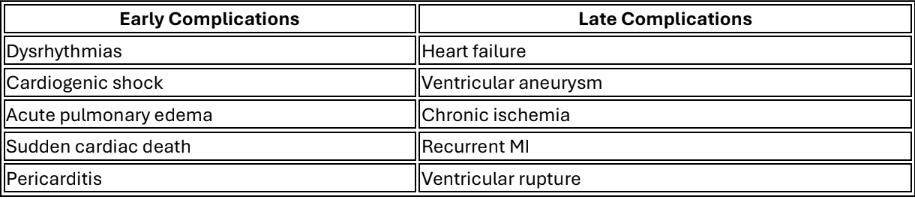
Common Complications of Myocardial Infraction (Review Image)
Stable
Game Changer for CAD
______ Angina
• Triggered by exertion
• Relieved by rest and nitroglycerin
Unstable
Game Changer for CAD
_______ Angina
• Occurs at rest
• Not consistently relieved by nitroglycerin
• Medical emergency
20
Chest pain lasting more than __ minutes and unrelieved by rest or nitroglycerin strongly
suggests MI.
PCI or thrombolytic therapy
Time is Muscle: Rapid reperfusion with ___________ can save myocardium and improve survival.
Percutaneous Coronary Intervention
PCI meaning
Time is Muscle
A quote commonly used which means the longer it takes to get treatment during a heart attack, the more damage the heart muscle sustains.
Heart Failure (HF)
A clinical syndrome in which the heart is unable to pump sufficient blood to meet the body's metabolic demands or can do so only at elevated filling pressures. It results in inadequate tissue perfusion and/or fluid congestion.
Pulmonary Manifestations
o Dyspnea
o Orthopnea
o Paroxysmal nocturnal dyspnea (PND)
o Tachypnea
o Crackles/rales
o Pulmonary edema
Left Sided Heart Failure Signs and Symptoms
Venous Congestion Manifestations
o Peripheral edema
o Jugular vein distention (JVD)
o Hepatomegaly
o Splenomegaly
o Ascites
o Weight gain
o Anorexia
o Nausea
Right Sided Heart Failure Signs and Symptoms
"Left = Lungs"
"Right = Rest of the Body"
Game Changer for Heart Failure
Echocardiography
Gold standard diagnostic test for evaluating heart failure.
Brain Natriuretic Peptide
BNP meaning

BNP interpretation for CHF (Review Image)
ARBs
Used when ACE inhibitors are not tolerated for CHF
Beta Blockers
Examples:
• Metoprolol
• Bisoprolol
• Carvedilol
Action
• Reduce heart rate
• Reduce myocardial oxygen demand
Diuretics
Examples:
• Furosemide
• Bumetanide
• Hydrochlorothiazide
Action
• Remove excess fluid
• Relieve pulmonary congestion and edema
Aldosterone Antagonists
Examples:
• Spironolactone
• Eplerenone
Action
• Reduce sodium and water retention
SGLT2 Inhibitors (Sodium- Glucose Cotransporter 2 Inhibitors)
Examples:
• Dapagliflozin
• Empagliflozin
Benefits
• Reduce HF hospitalization
• Improve cardiovascular outcomes
Cardiac Glycoside
Example:
• Digoxin
Action
• Increases cardiac contractility
• Slows heart rate
Daily weight
Game Changer: _____ is the most reliable indicator of fluid retention.
High Fowler's position or Semi-Fowler's position
Positioning recommended for Heart Failure
Diabetes Mellitus
A chronic metabolic disorder characterized by persistent hyperglycemia resulting from defects in insulin secretion, insulin action, or both.
Type 1 DM
An autoimmune disorder in which the body's immune system destroys the insulin-producing beta cells of the pancreas.
Type 2 DM
Characterized by insulin resistanceand progressive impairment of insulin secretion.
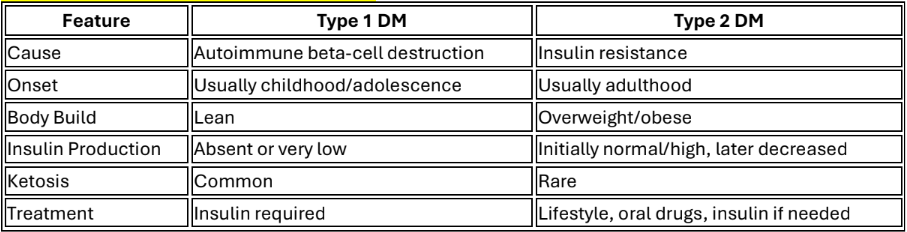
Comparison of Type 1 and Type 2 Diabetes (Review Image)
• Weight loss
• Fatigue
• Blurred vision
• Irritability
• DKA
S/Sx of Type I DM
• Recurrent infections
• Delayed wound healing
• Fatigue
• Numbness and tingling
• Blurred Vision
S/Sx of Type II DM
• Polyuria - Excessive urination
• Polydipsia - Excessive thirst
• Polyphagia - Excessive hunger
Game Changer: Classic Symptoms (3 Ps) of DM
Diabetic Ketoacidosis (DKA)
Common in Type I DM
Manifestations:
• Hyperglycemia
• Ketonuria
• Fruity breath odor
• Kussmaul respirations
• Dehydration
• Abdominal pain
• Altered consciousness
Hyperosmolar Hyperglycemic State (HHS)
Common in Type II DM
Manifestations:
• Severe hyperglycemia
• Extreme dehydration
• Neurologic changes
• Minimal or absent ketosis
Fasting Plasma Glucose
FPG meaning
Diabetes
FPG of ≥126 mg/dL
Random Plasma Glucose
This is a diagnostic test where ≥200 mg/dL with classic symptoms indicates diabetes.
Oral Glucose Tolerance Test
OGTT meaning
≥200 mg/dL
OGTT value which indicates diabetes.
Hemoglobin A1c (HbA1c)
Reflects average blood glucose over the previous 2–3 months.
Insulin
Game Changer: Type 1 DM always requires _____ therapy.
*Neuropathy increases risk for foot ulcers and amputation
Rapid-Acting Insulin
Short-Acting Insulin
Intermediate-Acting Insulin
Long-Acting Insulin
Types of Insulin therapy (Mainstay Streatment)
Rapid-Acting Insulin
Lispro, Aspart, and Glulisine are examples of which type of insulin?
Short-Acting Insulin
Regular insulin is an example of which type of insulin?
Intermediate-Acting Insulin
NPH (Neutral Protamine Hagedorn) or Isophane is an example of which type of insulin?
Long-Acting Insulin
Glargine, Detemir, and Degludec are examples of which type of insulin?
Biguanide and Metformin
First-Line Medication for Type II DM which decreases hepatic glucose production and improves insulin sensitivity.
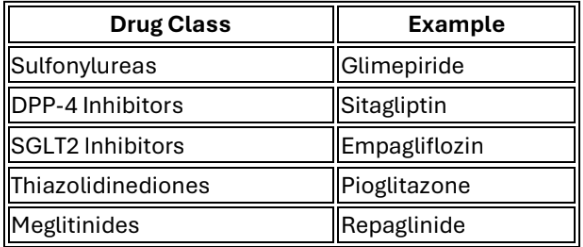
Other oral antidiabetic drugs for Type II DM (Review Image)
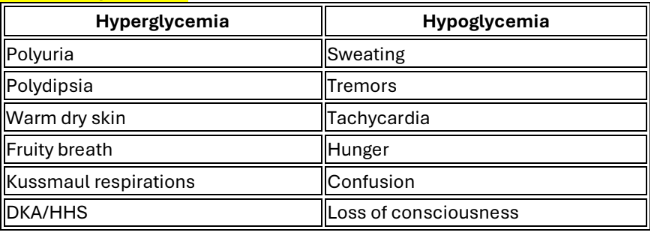
Acute complications for Hyper and hypo glycemia (Review Image)
Conscious Patient
15-15 Rule
• Give 15 g fast-acting carbohydrates
• Recheck glucose after 15 minutes
Examples:
• 4 oz fruit juice
• Glucose tablets
Unconscious Patient
• IV dextrose (D50W)
• Glucagon IM/Subcutaneous
Managements done for Hypoglycemia
Retinopathy
Nephropathy
Neuropathy
Chronic Complications from DM (Microvascular)
Coronary Artery Disease
Stroke
Peripheral Arterial Disease
Chronic Complications from DM (Macrovascular)
Type 1
Game Changer:
Which type of diabetes is this?
Problem: No Insulin
• Autoimmune
• Young onset
• Lean body
• DKA-prone
Type 2
Game Changer
Which type of diabetes is this?
Problem: Insulin Resistance
• Obesity-related
• Adult onset
• HHS-prone
• Metformin first-line treatment.