6.4 Exchange Rates
 Call Kai
 Learn
Learn Practice Test
 Spaced Repetition
 Match
Match Flashcards
 Knowt Play
1/37

There's no tags or description
Looks like no tags are added yet.
Name | Mastery | Learn | Test | Matching | Spaced | Call with Kai |
|---|
No analytics yet
Send a link to your students to track their progress
38 Terms
What is an exchange rate
The price of one currency in terms of another currency, showing how much domestic currency is needed to buy foreign currency.
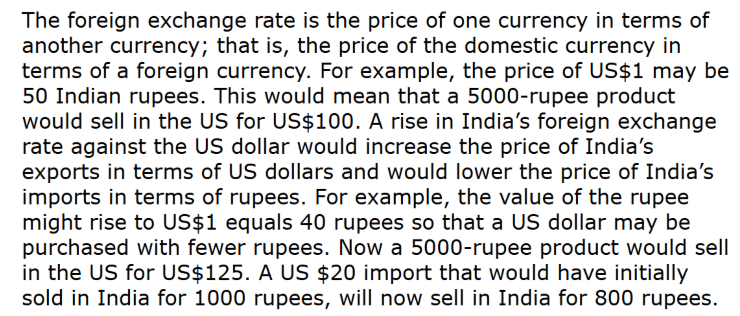
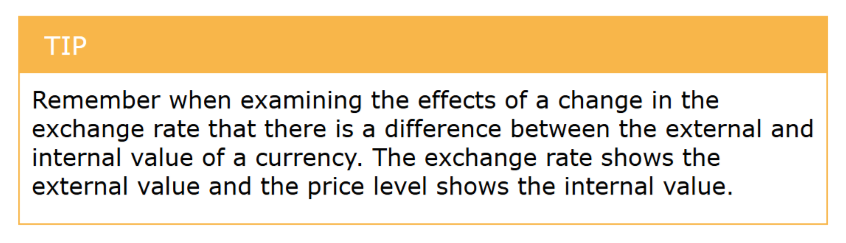
Tip - difference between external and internal value of a currency
What is a fixed exchange rate
A currency value set and maintained by the government or central bank.
What is a floating exchange rate
A currency value determined by supply and demand in the foreign exchange market.
- An exchange rate that is determined by the market forces of demand and supply
- This market does not exist in a single location but is made up of financial institutions that buy and sell foreign currency on behalf of private and business customers
Why do currency traders buy and sell a country’s currency
Traders buy a currency so their clients can purchase that country’s goods and services, invest within the country, or speculate on its value rising in the future.
- They sell the currency when clients buy foreign goods, invest abroad, or expect the currency’s value to fall.
What determines a floating exchange rate
The supply and demand of the domestic currency in the foreign exchange market.
What causes demand for a domestic currency
Foreigners buying domestic exports
2. Foreign investment in domestic assets
3. Speculation expecting currency appreciation
What causes supply of a domestic currency
Domestic residents buying imports
2. Domestic investors buying foreign assets
3. Speculation expecting currency depreciation
What is depreciation
A decrease in the international price of currency caused by market forces
What is currency depreciation
A fall in the value of the domestic currency in a floating exchange rate system.
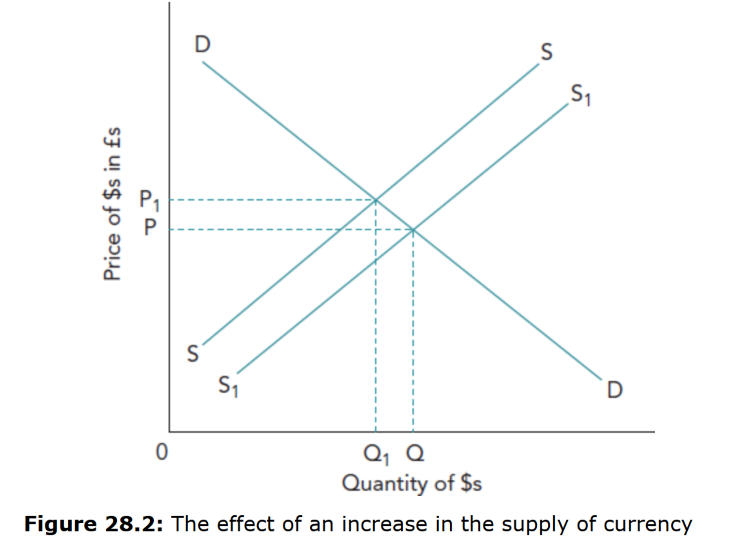
What is the effect of an increase in the supply of a currency (diagram)
An increase in the supply in a currency will result in a fall in its value
What is appreciation
An increase in the international price of a currency caused by market forces (increase in demand/ decrease in supply)
What is currency appreciation
A rise in the value of the domestic currency in a floating exchange rate system.
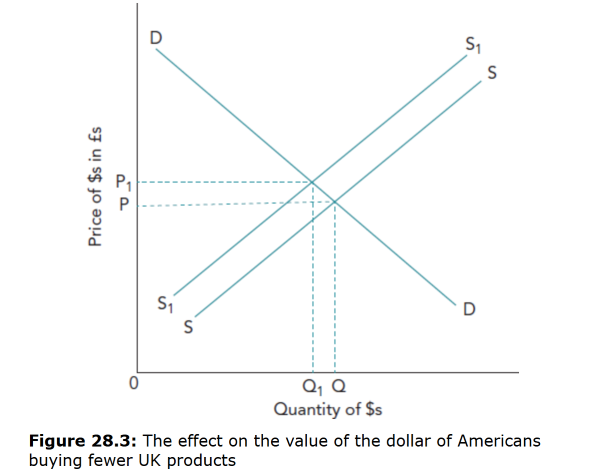
What is the effect on the value of the US dollar if Americans buy less UK imports (diagram)
If Americans buy less UK imports, they will need to sell fewer dollars to purchase pound sterling.
How does depreciation affect exports and imports
Exports become cheaper → demand rises; Imports become more expensive → demand falls.
How does appreciation affect exports and imports
(SPICED)
Exports become more expensive → demand falls; Imports become cheaper → demand rises.
What are the causes of changes in a floating exchange rate (5 + short chains of reasoning)
Changes in demand for domestic currency
→ ↑ demand (e.g. more exports) → currency appreciates
→ ↓ demand → currency depreciates
2. Changes in supply of domestic currency
→ ↑ supply (e.g. more imports/capital outflow) → currency depreciates
→ ↓ supply → currency appreciates
3. Interest rate differentials
→ higher interest rates → attract foreign investment → ↑ demand for currency → appreciation
4. Inflation rate differences
→ higher inflation → exports less competitive → ↓ demand for currency → depreciation
5. Speculation and expectations
→ expectation of appreciation → investors buy currency now → ↑ demand → actual appreciation
What causes an increase in the demand for a currency in a floating exchange rate system (4)
Demand for a currency rises when:
• More exports are sold (e.g., due to lower inflation, higher productivity, better quality, or rising incomes abroad).
• Foreigners want to buy domestic shares because the economy looks strong.
• Foreign investors want to place money in domestic banks offering higher interest rates (hot money flows).
• Foreign firms buy the currency to set up branches in the country.
What are hot money flows and how do they affect exchange rates
Hot money flows are short‑term movements of financial capital between countries as investors chase higher interest rates or expect a currency to rise in value. Increased hot money inflows raise demand for the currency and push up its exchange rate.
What causes an increase in the supply of a currency in foreign exchange markets
Supply of a currency rises when residents sell it to:
• Purchase more imports.
• Travel abroad or invest overseas.
• Buy foreign government bonds.
• Anticipate that the domestic currency will fall in the future or domestic interest rates will decline.
How do changes in demand and supply affect a floating exchange rate
• Higher demand for the currency → its value rises (appreciates).
• Higher supply of the currency → its value falls (depreciates).
Exchange rates adjust automatically based on market forces.
A change in the exchange rate can have a number of effects on an economy. What 4 main things does it influence
It can influence its income, output, price level and employment
How does a depreciation affect exports and imports
A depreciation makes exports cheaper to foreigners and imports more expensive for domestic consumers. This encourages domestic firms to sell more abroad and at home, and some consumers switch from imports to home‑produced goods. Foreigners may also switch toward the country’s now‑cheaper exports.
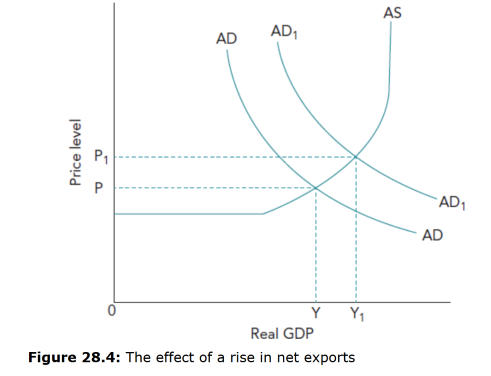
How does a depreciation affect national income and real output (diagram)
Because depreciation increases net exports, aggregate demand rises (AD → AD₁). This leads to an increase in real GDP and national income (Y → Y₁), as shown in the diagram. The overall effect is economic expansion through higher output.
How can a depreciation affect the domestic price level
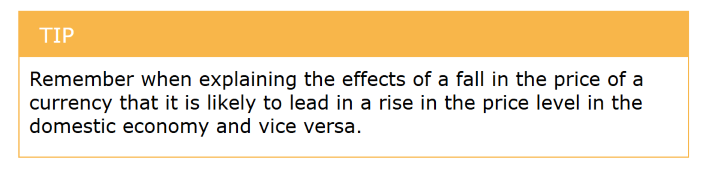
A depreciation can increase the domestic price level because it raises aggregate demand (via higher net exports), which can cause demand‑pull inflation as the economy nears full capacity. Scarce resources become more expensive, pushing prices up.
Why does a depreciation cause cost‑push inflation
A weaker currency makes imported goods and raw materials more expensive, increasing firms’ production costs. These higher costs are passed on to consumers as higher prices. Imported finished goods also become pricier, raising the consumer price index.
How can a depreciation reduce competitive pressure on domestic firms
Because foreign goods become more expensive, domestic firms may feel less pressure to keep costs and prices low, which can further contribute to inflation.
Tip - effects of a fall in price of currency
How does a depreciation affect unemployment in the domestic economy
If depreciation increases aggregate demand, firms selling to both domestic and foreign markets will expand output and hire more workers. This can lead to a reduction in cyclical unemployment.
How does an appreciation affect national income and real output
An appreciation makes exports more expensive and imports cheaper. This reduces demand for domestic goods both at home and abroad, which can slow economic growth and may even cause a recession. With lower output, incomes and employment are likely to fall.
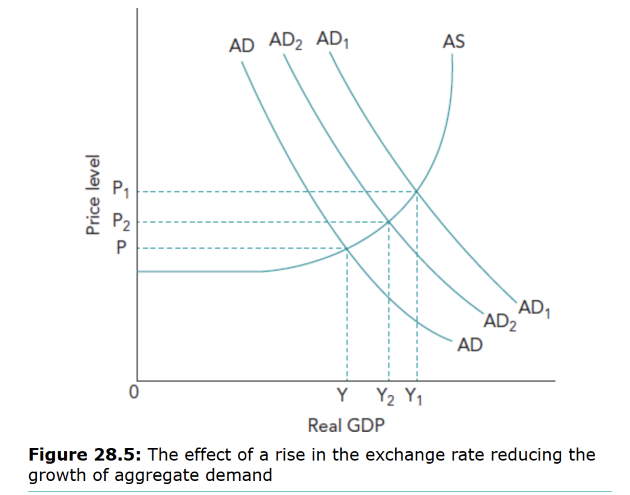
How does an appreciation affect domestic inflation (diagram)
An appreciation can reduce inflationary pressure by:
• Lowering aggregate demand (AD → AD₂), which slows the rise in prices.
• Reducing the cost of imported raw materials, shifting AS to the right.
• Making imported finished goods cheaper, which lowers the domestic price level.
Overall, inflation will be lower than it would have been without the appreciation.
How does an appreciation affect unemployment
An appreciation can increase unemployment because lower aggregate demand reduces output. Firms may cut back production, and some workers may be made redundant.
How does a depreciation affect aggregate demand
Increases net exports → AD shifts right → higher output, employment, and price level.
How does an appreciation affect aggregate demand
Decreases net exports → AD shifts left → lower output, employment, and price level.
What is the impact of depreciation on the domestic economy
Higher output and employment due to increase in exports as they are cheaper
2. Higher AD → price level rises → possible inflation
3. CAB may improve due to increased exports
What is the impact of appreciation on the domestic economy
Lower output and employment due to decrease in exports because they are more expensive
2. Lower AD → price level falls → disinflation
3. CAB may worsen due to reduced exports
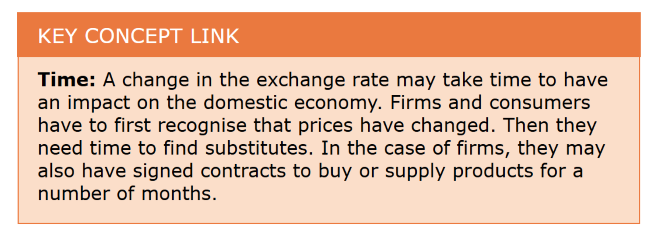
Key concept link - time
Exam tip: How to answer questions on exchange rates.
Identify depreciation or appreciation
2. Explain effect on exports and imports → net exports → AD shift
3. Show effect on output, employment, price level
4. Include evaluation → short-term vs long-term, CAB, inflation, employment