Evaluation Criteria - Class III, IV, V Composite Restorations
 Call Kai
 Learn
Learn Practice Test
 Spaced Repetition
 Match
Match Flashcards
 Knowt Play
1/37

There's no tags or description
Looks like no tags are added yet.
Name | Mastery | Learn | Test | Matching | Spaced | Call with Kai |
|---|
No analytics yet
Send a link to your students to track their progress
38 Terms
Facial evaluation criteria
Symmetry
Transitional ling angles (width)
Embrasure
Contacts
Incisal height
lingual evaluation criteria
Marginal ridges
Lingual anatomy
Embrasures
symmetry
incisal evaluation criteria
Contours
Line angles
Embrasures
Incisal thickness
Arch alignment
Symmetry
lateral evaluation criteria
contours / height of contour
When should you shade match?
BEFORE placing rubber dam while the tooth is hydrated
Can you use prophy paste before shade matching?
no
overall steps for restoration
1. Preparation / restoration sequence
Decay present, outline form, and depth removes decay
2. Final prep (modified/small adhesive) - little internal form
3. Acid etch - note frosty appearance
4. Apply bonding agent (rub gently), air thin and cure
5. Apply composite shape and cure
What is important when using esthetic finishing burs?
Choose the proper shape for the surface
What is the general shape of esthetic finishing burs?
long and thin
which direction do you move carbide burs?
clockwise
if you go counterclockwise, the bur bounces
Enhance polishing point/tips/cups
Contains composite particles
Can finish and/or polish depending on pressure applied
Finishing bur
removes excess composite
Enhance bur - what pressure accomplishes what task?
use light pressure for polishing
hard pressure for removing composite
Coarser grit produces what?
deeper grooves which are more difficult to polish
What does the final restoration look like when dry?
chalky
What do you use polishing paste for?
to finish polish and luster
before doing a class 4, always check ____? Why?
check occlusion.
helps us determine whether the class 4 is there due to fracture or due to misocclusion.
if we do not correct reason for misocclusion our restoration can ultimately fail.
What type of matrix is used on the anterior part of mouth with composite?
Clear matrix strips
When do you place clear matrix strips? Why?
Before etching, so that we do not end up binding to adjacent tooth
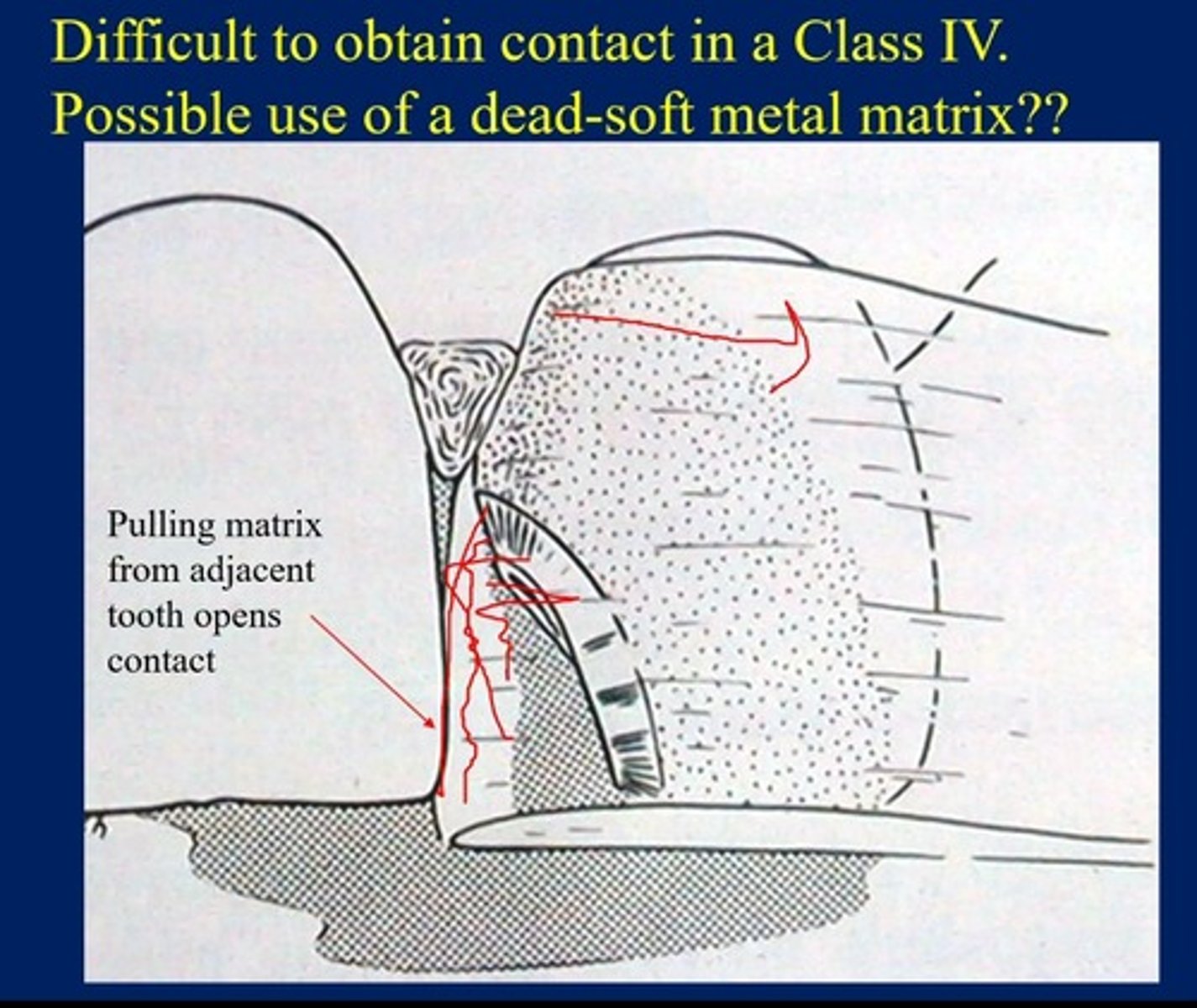
Many practicioners like to pull the matrix band across in order to get a nice contour. What is the potential issue with this technique? How can we avoid this?
We can lose proximal contact.
first build up proximal wall, cure, then add rest of composite and then pull matrix across.
how far should you separate teeth when placing a matrix band?
must be separated atleast to the thickness of the matrix band.
What else can you use to prevent proximal bonding (boberick said we wouldn't really be doing this in clinic though)? when should we use this technique?
teflon tape over the adjacent tooth
good to use with lingual matrix
What is a lingual putty matrix?
impression material for a class IV
What can you use to create/ move line angles?
finishing bur, flexible disks
we can determine this by looking at the tooth from an incisal view
What surface do we tend to use a football finishing bur?
lingual
When moving line angles, do you adjust the lingual or facial first?
we check occlusion to determine if we should adjust the lingual first, then consider adjusting the facial
What bur can damage root surfaces easily?
finishing burs
what are finishing strips good for?
removing overhangs in gingival area
use firm pressure with finger against the surface requiring finishing and pull strip facially.
How can we avoid removing contact point when using a finishing strip?
cut it in half to reduce the length
Polishing tools
Enhance disks/points
Shofu discs - color coded
Finishing strips - cut lengthwise
Polishing paste (prisma gloss)
What do we use flexible disks for?
contour occlusal and proximal embrasure
external outline form is determined by?
your final geometry ( final cavosurface, final extent into sound tooth structure, etc)
should you polish dry or wet?
start dry, then add some water and end polishing wet
how should finishing burs be moved along the cavosurface?
Move parallel to cavosurface
Excess finishing disrupts _____
bonding
shape soft material (before/after) curing?
before
what step should we always take once we think we are done with our restoration?
check occlusion
rules for Class IV contact:
no contact in centric
no contact in protrusive
make the other teeth take up stress!