Physics-yr10 Electricity
 Call Kai
 Learn
Learn Practice Test
 Spaced Repetition
 Match
Match Flashcards
 Knowt Play
1/42

There's no tags or description
Looks like no tags are added yet.
Name | Mastery | Learn | Test | Matching | Spaced | Call with Kai |
|---|
No analytics yet
Send a link to your students to track their progress
43 Terms
What can insulators be charged by?
Friction
What particles does friction transfer?
Negative electrons
What is an electric field?
The area around a charged object in which it can affect other charged objects
What do arrows show on an electric field?
The direction a positively charged object would be pulled by the field
How does a Van Der Graff generator work?
Friction between the rubber band and the roller causes negative electrons to transfer to the dome. The negative electrons repel each other because like charges repel. They spread onto the person and their hair. Causing it to repel each other and stand up.
How do you discharge a Van Der Graaf generator and how does it work?
When a large charge builds up it causes a large potential difference (or voltage) which can provide a large enough force to make electrons jump through the air to Earth, creating a spark and it discharges.
What is current?
The rate of flow of charge
What is current measured in and by?
Amps by an ammeter
What is the current in a series circuit?
Same at every point
What is current like in a parallel circuit?
Splits between branches with lower resistance receiving more current
What is voltage?
The energy per unit charge
What is voltage measure in and by?
In volts using a voltmeter
What is voltage in a series circuit?
Splits with higher resistance components receiving more voltage than lower resistance components
What is voltage in a parallel circuit?
Each branch receives the full voltage
What is resistance?
Opposition to the flow of current
What is resistance measured in?
Ohms
___ resistance means ___ current (less/more)
More resistance means less current
What is resistance in a series circuit?
Total resistance is found by adding the values of individual resisters?
What is resistance in a parallel circuit?
Adding the resistors lowers the total resistance of the circuit
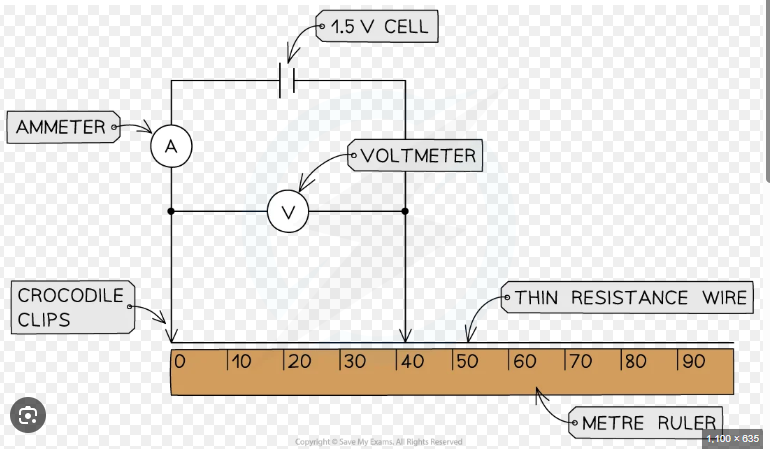
Describe the required practical of resistance and length of wire
Build the circuit as shown
Turn on the power supply and adjust to 0.1A
Record the voltage when 0.1m of wire is between the clips
Adjust the clips to 0.2m set to 0.1A and record the voltage
Repeat for 0.3m 0.4m 0.5m
Repeat and calculate a mean
Use V=IR to calculate resistance
Plot a graph of R against length
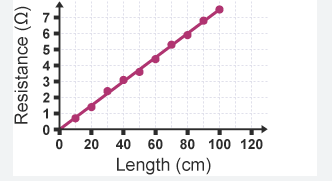
What is the outcome of the resistance and length of wire practical?
Resistance is directly proportional to length
What is Ohms law?
Potential difference is directly proportional to current for an ohmic conductor (resistance) at constant temperature
What is a fixed resistor in exam language?
An ohmic conductor at constant temperature
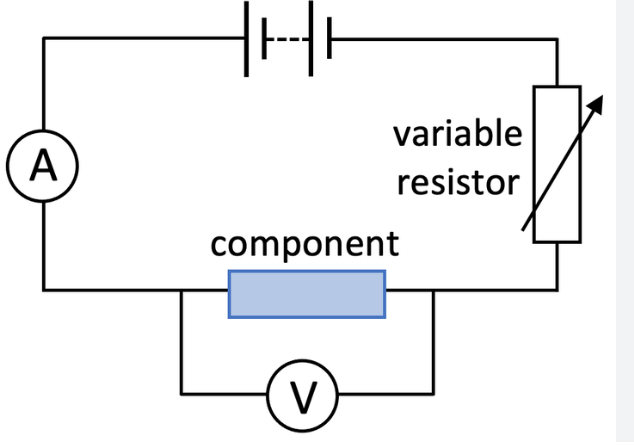
What is the method for the required practical for IV graph for ohmic conductor?
Build the diagram as shown
Use the variable resistor to set the voltage to 1V and read the current
Repeat at 1V intervals up to 5V
Reverse the battery connections and repeat for negative voltages
Repeat and calculate a mean
Plot a graph of I against V
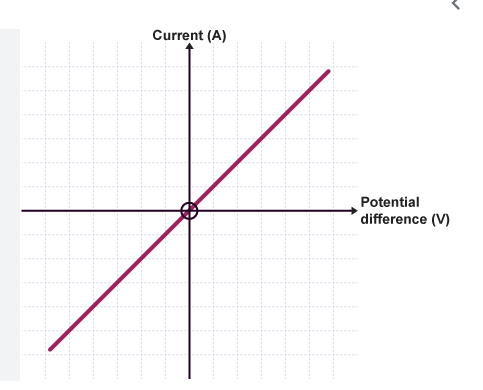
What is the outcome of the ohmic conductor practical?
The line is a straight line through the origin and current is directly proportional to voltage.
What is the method for the required practical IV graph for a filament lamp?
Build the circuit as shown
Use the variable resistor to set the voltage to 1V read the current
Repeat at 1V intervals to 5V
Reverse the battery connections and repeat for negative voltages
Repeat and calculate a mean
Plot a graph of I against V
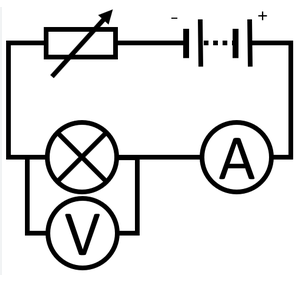
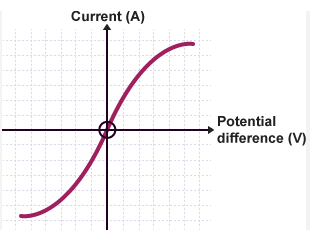
What is the outcome of the filament lamp practical?
As voltage increases current increases at a decreasing rate. This is because as a voltage increases the filament gets hotter. As temperature increases the lattice ions (metal atoms) vibrate more vigorously and collide with the electrons in the current. This increases resistance
What is the method for the required practical IV graph for a diode?
Build the circuit as shown
Use the variable resistor to set the voltage to -1V read the current
Repeat at 0.1V intervals to 0V
Reverse the battery connections and repeat at 0.1V intervals up to 1.2V
Repeat and calculate a mean
Plot a graph of I against V
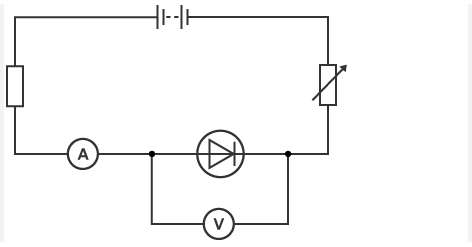
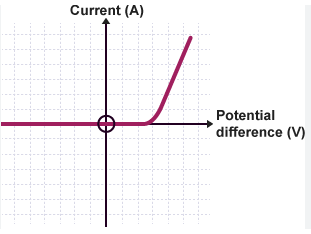
What is the outcome of the diode practical?
When the voltage is negative the current is 0.1A this is because diodes only permit current to flow in one direction
For voltages up to 0.7V the current remains at 0A this is because at low voltages the resistance of a diode is infinite
Above 0.7V as voltage increases at an increasing rate. This is because above 0.7V the resistance of a diode decreases as voltage increases
What is a thermistor?
Resistor that has a resistance dependant on its temperature
What is an LDR?
Resistor that has a resistance dependant on the light shining on it
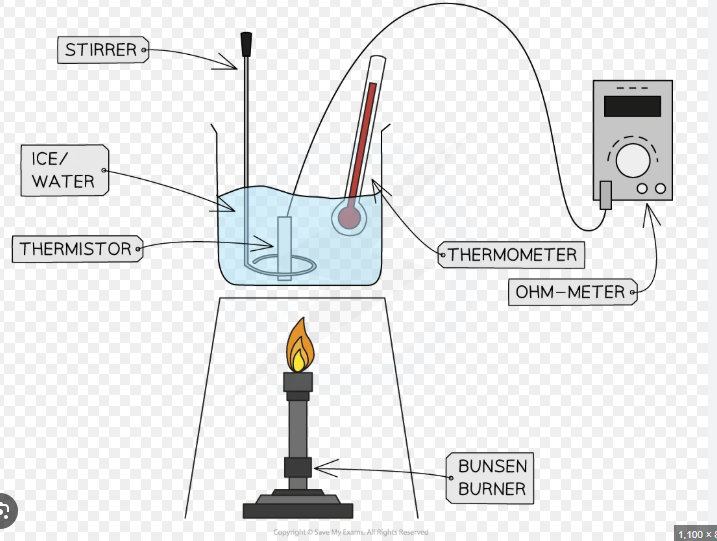
What is the method for the required practical for thermistors?
Pour boiling water into the beaker and place in the thermistor and the thermometer as shown
Wait for the thermometer to stop increasing and when it reaches 90 record the resistance
Repeat at 10 intervals until 20 is reached
Repeat and calculate a mean
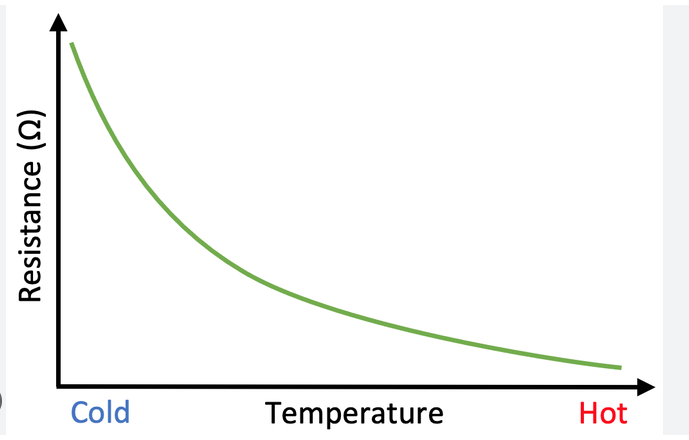
Plot a graph of resistance against temperature
What is the outcome of the thermistor required practical?
The greater the temperature the lower the resistance
What is mains electricity?
Electricity we get from our plug sockets
What is the volts of mains electricity?
230V
What type of current is in batteries and what is different about it?
Direct current which means the current only flows in one direction
What type of current is mains electricity and what’s different about it?
Alternating current which means the current constantly changes direction at 50Hz
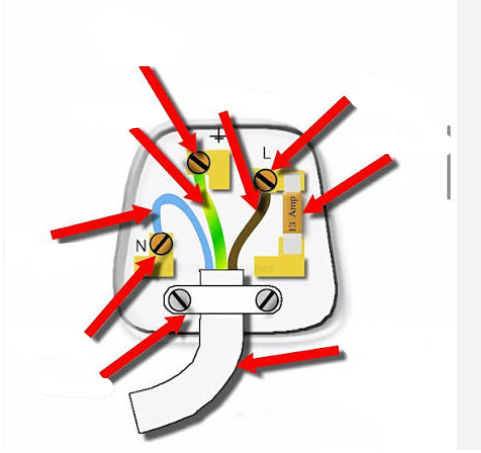
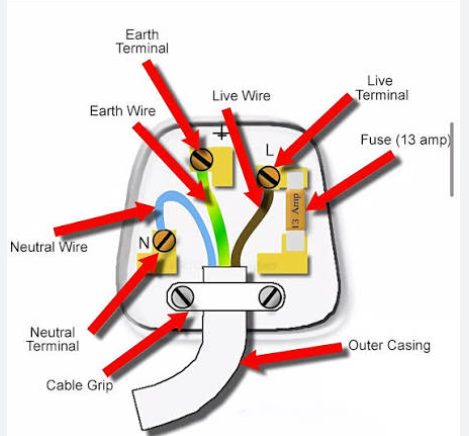
Label the 3 pin plug
What makes the casing live?
If the applicants are damaged the live wire can touch the metal casing and make it live at 230V
What happens if a person touches the live casing?
They could get electrocuted
What does the earth wire provide?
An alternate low resistance route preventing electrocution, this causes the current to increase melting the fuse and breaking the circuit
If some applicants are double insulated what does this mean?
There is a complete layer of insulation between the live wire and any exposed metal and double insulated devices do not need a earth wire
What is the national grid?
Massive system of cables and transformers that join buildings to the system of power stations that supply the electricity