Biological Explanations for OCD
 Call Kai
 Learn
Learn Practice Test
 Spaced Repetition
 Match
Match Flashcards
 Knowt Play
1/62

There's no tags or description
Looks like no tags are added yet.
Name | Mastery | Learn | Test | Matching | Spaced | Call with Kai |
|---|
No analytics yet
Send a link to your students to track their progress
63 Terms
Assumptions: what should psychology be seen as?
a science - to be studied in a scientific manner
Assumptions: what can behaviour be largely explained in terms of?
biology (e.g. genes/hormones)
Assumptions: what have humans genes evolved over millions of years to adapt?
behaviour to the environment - therefore, most behaviour will have an adaptive or evolutionary purpose
Why use the Biological Approach: what does the biological approach offer surrounding OCD
OCD has been explained in a number of ways but the biological approach offers particularly useful suggestions as to how it is caused
Why use the Biological Approach: what of component to OCD has been proposed?
It has been proposed that there is a genetic component to OCD which predisposes some individuals to the illness
Why use the Biological Approach: what does the genetic explanation suggest?
whether a person develops OCD is at least partly due to their genes
Why use the Biological Approach: what does the genetic explanation suggesting that whether a person develops OCD is at least partly due to their genes explain?
explains why patients often have other family members with OCD
Why use the Biological Approach: what does Bellodi et al claim?
that genetic factors play a role in OCD
Why use the Biological Approach: when did Bellodi et al carry out their research?
2001
Why use the Biological Approach: Bellodi et al (2001) what did they show from using evidence from twin studies and family studies?
that close relatives are more likely to have the disorder than more distant relatives
Why use the Biological Approach: what did Mckeon and Murray find?
that close relatives are more likely to have the disorder than more distant relatives
Why use the Biological Approach: what did Pauls et al find?
that there is a much higher percentage of OCD sufferers in relatives of patients with OCD than in the control group without OCD
Genetic explanations: Candidate genes?
Genes which are implicated in OCD
Genetic explanations: What are the two candidate genes?
SERT and COMT
Genetic explanations: What does the SERT gene do?
The SERT gene lowers the amount of serotonin that is created in the body
Genetic explanations: What have lower levels of serotonin been linked to?
obsessive thoughts
Genetic explanations: What does the COMT gene produce?
catechol-O-methyltransferase (COMT)
Genetic explanations: What does COMT regulate the production of?
dopamine (also a neurotransmitter)
Genetic explanations: What can too much dopamine trigger?
the compulsions
Genetic explanations: What is dopamine associated with?
motivation and drive
Genetic explanations: what does OCD being polygenic mean?
this means that its development is not determined by a single gene but a few
Genetic explanations: How many genes did Taylor (2013) identify to be associated with OCD?
Genetic explanations: How does OCD being polygenic weaken the genetic explanation?
It means that there is little predictive power from this explanation
Genetic explanations: Why must their be additional factors?
not everyone in a given family gets OCD
Genetic explanations: Diathesis–stress model?
Suggests that people gain a vulnerability towards OCD through genes but an environmental stressor is also required
Genetic explanations: How does the Diathesis–stress model weaken the genetic explanation towards OCD?
Argues that the genetic explanation is not a full explanation of OCD
Neural explanations?
The genes associated with OCD are likely to affect the levels of key neurotransmitters as well as structures of the brain
Neural explanations: the two main ones?
Abnormal levels of certain neurotransmitters and Certain brain circuits may be abnormal
Neural explanations: What have Neuroimaging (brain scans) techniques enabled researchers to study?
study the brain in detail and to identify normal brain patterns
Neural explanations: What does identifying normal brain patterns allow?
allows for comparisons with abnormal brain patterns
Neural explanations: 4 neuroscience techniques?
fMRI, Post-mortem, PET scan and EEG
Neural explanations: The 3 implicated areas of the brain?
Basal Ganglia, Orbitofrontal Cortex and Thalamus
Neural explanations: What is the Basal Ganglia area responsible for?
innate psychomotor functions
Neural explanations: What was the hypersensitivity of the Basal Ganglia proposed to give a rise to?
gives a rise to the repetitive motor behaviours seen in OCD, for example, repetitive washing/cleaning/checking, i.e. the compulsions
Neural explanations: Who proposed that the hypersensitivity of the basal ganglia gives a rise to the repetitive motor behaviours seen in OCD?
Rapport and Wise
Neural explanations: Orbitofrontal cortex (OFC) function?
decision making and worry about social and other behaviour
Neural explanations: Thalamus function?
cleaning, checking and other safety behaviours
Neural explanations: What are the OFC and the thalamus are believed to be for OCD suffers?
overactive
Neural explanations: What would an overactive OFC result in?
increased anxiety and increased planning to avoid anxiety
Neural explanations: What would an overactive thalamus result in?
an increased motivation to clean or check for safety
Neural explanations: If the thalamus was overactive what would the OFC also become as a result?
overactive
Neural explanations: image of normal brain activity compared to OCD brain activity?
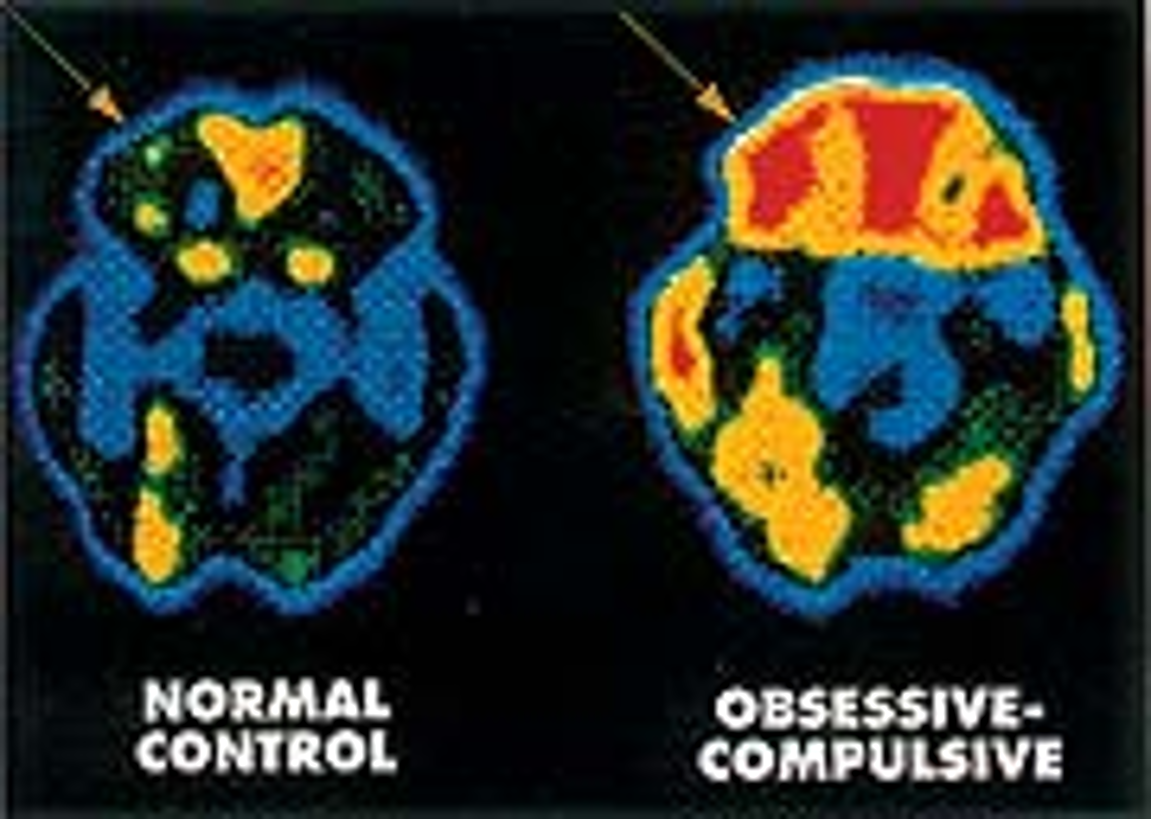
Strength - P: what is there supportive evidence from?
twin studies
Strength - Ev1: who reviewed various twin studies?
Nestadt et al
Strength - Ev2: when did Nestadt et al carry out their research?
2010
Strength - Ev3: Nestadt et al (2010) found that if one twin had OCD there was a ? percentage chance that an identical twin would as well?
68% chance
Strength - Ev4: Nestadt et al (2010) found that if one twin had OCD there was a ? percentage chance that a non-identical twin would as well?
31% chance
Strength - Ex: how does this show the likelihood of genetics causing OCD?
identical twins share 100% of their genetics, and non-identical twins share only 50% of their genetics
Strength - L: as this was a meta-analysis, what is good about this research?
it has a good generalisability
Weakness - P: what may there also be an effect from?
the environment
Weakness - Ev: for example, what did Cromer et al find?
that over half of the OCD patients in their sample had a traumatic past, and that OCD was more severe in those with multiple trauma
Weakness - Ev: when did Cromer et al’s research take place?
2007
Weakness - Ex: what can this be better explained by?
by the diathesis-stress model - which suggests that both a genetic predisposition and a stressful event are needed for OCD to develop
Weakness - L1: therefore, what can’t OCD be entirely?
OCD cannot be entirely genetic - environmental causes too
Weakness - L2: why may it be more productive to focus on environmental causes?
as we are more able to do something about these
Strength - what has this explanation led to?
treatments for OCD being developed
Strength - Ev: what has the role of serotonin being understood meant?
that medication affecting the functioning of serotonin has been developed, such as SSRIs
Strength - Ex: how do SSRIs work?
They work by blocking the process of reuptake, so the serotonin can continue to work in the synapse
Strength - L: therefore, what does the explanation have?
real world applications
Weakness - P: what is unclear?
Weakness - Ev1: despite what evidence suggests, what does it not mean?
evidence suggests that those with OCD are likely to have an overactive basal ganglia, thalamus and orbito-frontal cortex - however this doesn’t mean they are causing the disorder
Weakness - Ex: what could cause these areas to be overactive?
having OCD
Weakness - L: therefore, what can’t we establish?
cause and effect between overactive brain areas and the development of OCD