Chapter 12: Establishing a Pay Structure
 Call Kai
 Learn
Learn Practice Test
 Spaced Repetition
 Match
Match Flashcards
 Knowt Play
1/19

There's no tags or description
Looks like no tags are added yet.
Name | Mastery | Learn | Test | Matching | Spaced | Call with Kai |
|---|
No analytics yet
Send a link to your students to track their progress
20 Terms
Decisions about pay
Organizations must plan what they will pay employees in each job through two sets of policies to form their pay structure:
Job structure — the relative pay for different jobs within the organization, among different functions and different levels of responsibility
Entry-level accountant vs entry-level assembler
Entry-level accountant vs accounting department manager vs comptroller
Pay level — the average amount (including wages, salaries, and bonuses) the organization pays for a particular job
Pay structure simplifies the process of making decisions about individual employees’ pay by grouping together employees with similar jobs
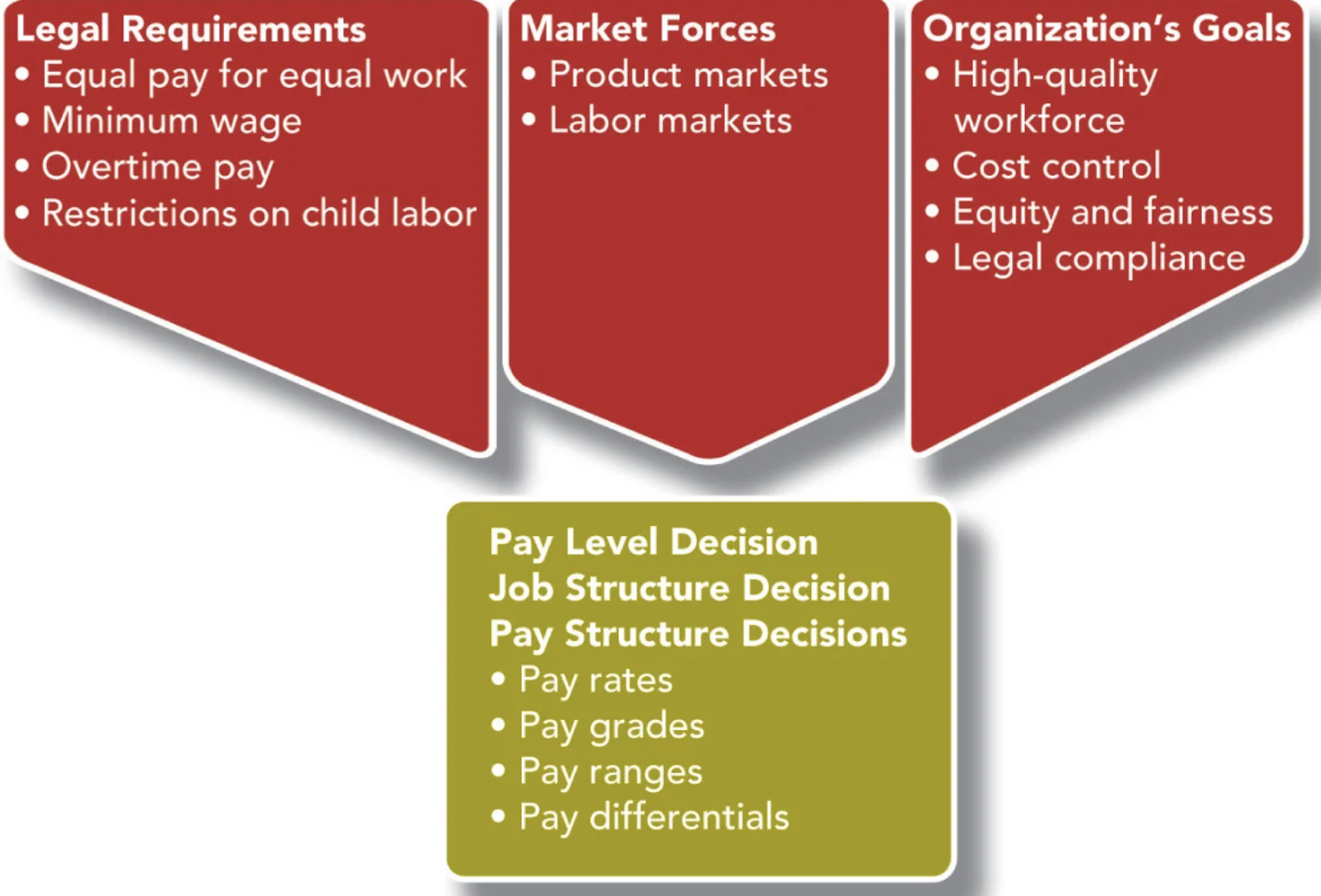
Equal Employment Opportunity (EEO) laws
Employers may not base differences in pay on protected status. Differences in pay must be tied to business-related decisions as job responsibilities and performance
Equal pay for equal work
Comparable work — Establishes the worth of an organization’s job in terms of criteria like their difficulty and importance using evaluation points. Equal evaluation points should mean equal pay
Minimum wage FLSA laws
Employers must pay at least minimum wage established by the FLSA at $7.25/hr
Training wage — May pay workers under 20 approximately 85% of minimum wage for a period of up to 90 days
Living wage — A minimum wage based on the cost of living in a particular region
Overtime pay FLSA laws
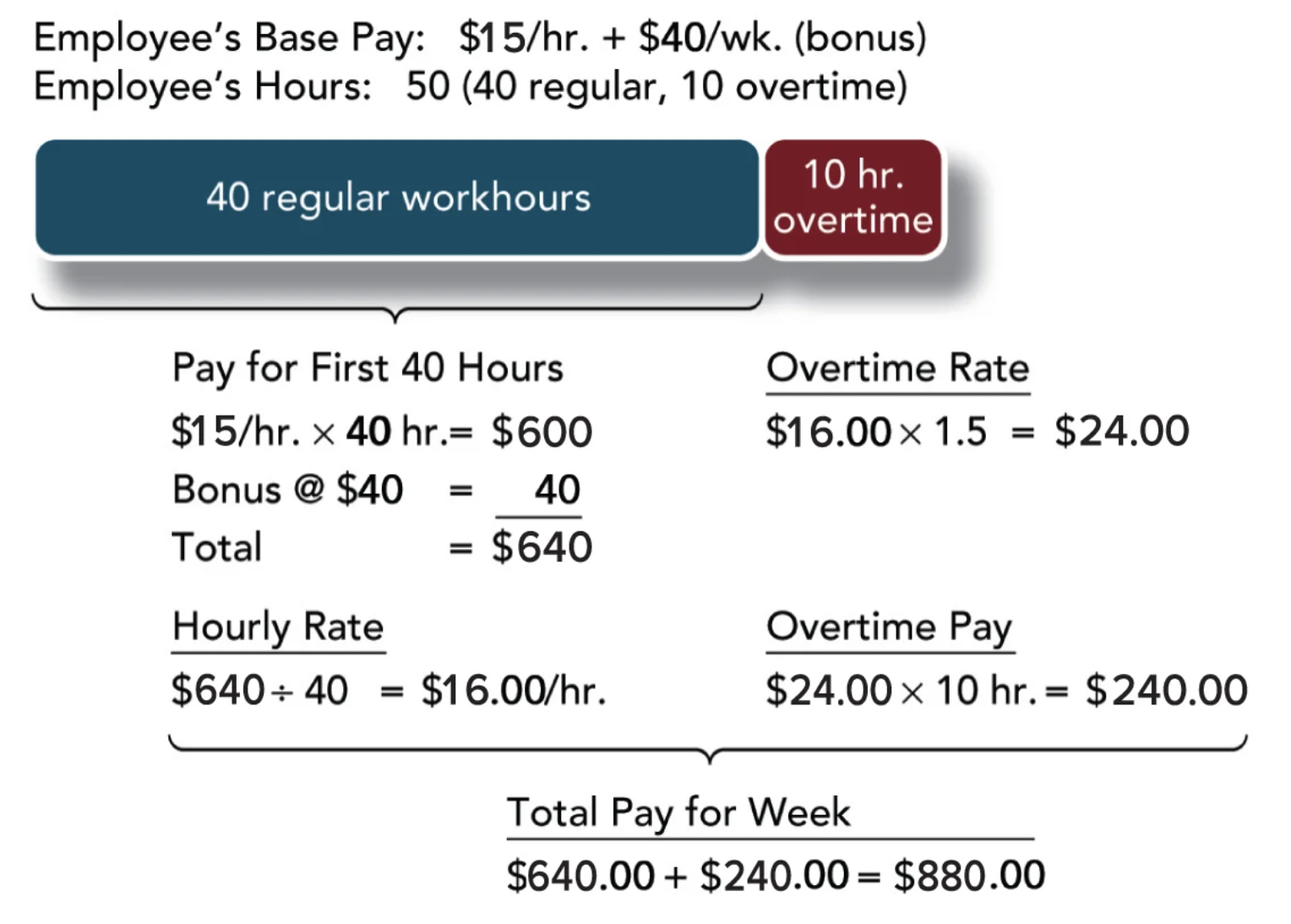
Requirement of the FLSA that employers must pay nonexempt employees higher wages for overtime (hours worked beyond 40 hours per week)
Overtime rate is 1.5x the regular hourly rate, including any bonuses and piece-rate payments
Example: Base pay of $600 + Bonus of $40 = $16.00, so overtime pay is $24.00/hr
Exempt employees include executive, professional, administrative, outside sales, and highly compensated white-collar employees
Child labor FLSA laws
The FLSA places restrictions to protect health, safety, and education
Children aged 16 and 17 may not be employed in hazardous occupations, such as mining, meatpacking, and manufacturing with heavy machinery
Children aged 14 and 15 may only work outside school hours in jobs defined as nonhazardous and for limited time periods
Children <14 cannot be employed in interstate commerce except for nonhazardous jobs in parent-owned businesses
Exemptions include acting, babysitting, and newspaper delivery
Prevailing wages laws
Federal contractors must pay their employees at rates at least equal to to the prevailing wages in the area
Prevailing rates must be based on 30% of the local labor force, typically based on relevant union contracts
Davis-Bacon Act covers construction contractors that receive >$2,000 in federal money
Wash-Healy Act covers all government contractors receiving $10,000 or more in federal funds
Pay ratio reporting laws
Dodd-Frank Act requires communicating the ratio of CEO pay to the pay of a typical worker in their annual financial statements
Compares CEO compensation to that of a median employee’s (excludes contract workers and includes international employees)
Influence on pay: Product markets
An organization’s product market includes organizations that offer similar or competing goods & services
An important influence on price is the cost to produce — the cost of labor is a significant part of the organization’s costs
Product markets place an upper limit on the pay an organization will offer
Influence on pay: Labor markets
Labor markets comprise of an organizations that offer similar or competing goods/services and/or hire similar employees
Organizations must compete to obtain human resources (employees)
Competition for labor and the cost of living place a minimum on the pay an organization can pay to hire an employee
Deciding on pay level
If many workers are competing for a few jobs, employers have more flexibility in pay levels
Organizations compare their pay with other organization’s pay (Market rate)
Benchmarking — Procedure in which an organization compares its own practices against those of successful competitors; involves the use of pay surveys
Judging fairness: Equity theory
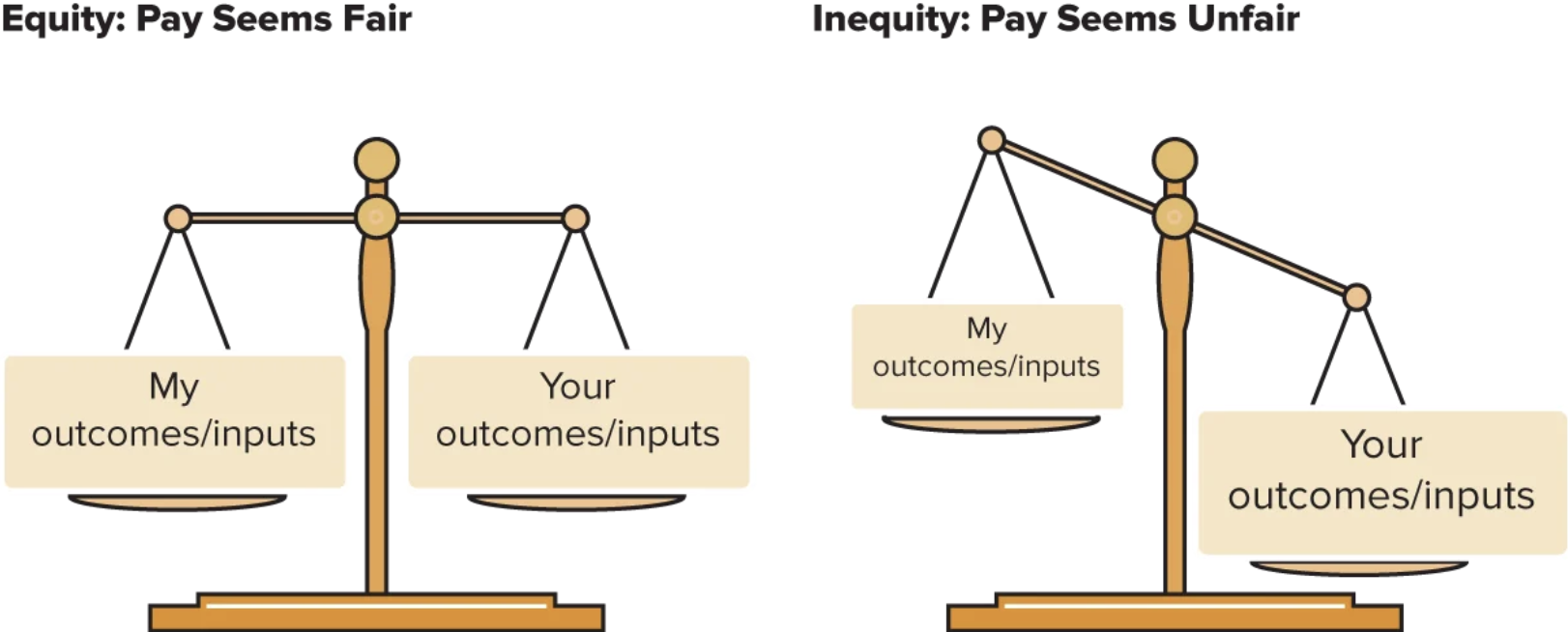
Individuals care about and compare their outcome and inputs to others’ outcomes and inputs and decide whether their pay is equitable — my outcome/input ratio vs my peers’
External equity — fairness of one’s pay relative to what employees in other organizations earn for doing the same job
Internal equity — fairness of one’s pay relative to other employees in the same organization (co-workers and higher and lower level employees)
Underpayment
My outcome/input ratio is less than your ratio: My O/I < Your O/I
If I am under-rewarded, I will make up the difference in one of three ways
Reduced inputs by putting forth less effort
Increased outcomes like stealing
Withdrawal from the organization
Overpayment
My outcome/input ratio is more than your ratio: My O/I > Your O/I
If I am over-rewarded, I will see it as equitable
Pay transparency
The practice of openly communicating information about wages or salary to employees and job candidates
Paycheck — Details about the individual employee’s pay
Market data — Description of the data used for decision making
Pay planning — Data about pay ranges and potential for future earnings
Pay strategy — Explanation of how pay decisions relate to the organization’s objectives
Open salary — Full disclosure of the organization’s pay ranges and salaries paid
Job structure
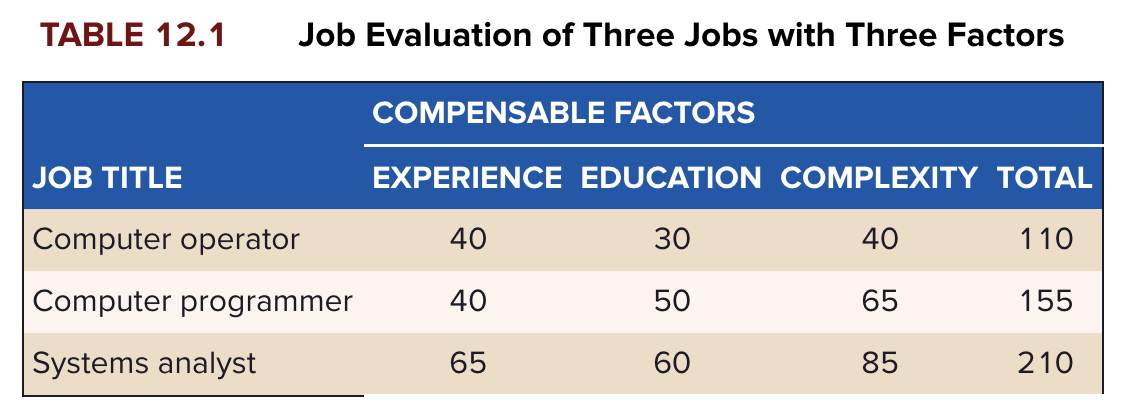
Job evaluation — An administration procedure for measuring the relative worth of the organization’s jobs
Assembling and training a job evaluation committee familiar with the jobs being assessed
Job evaluations identifies each job’s compensable factors (the characteristics of a job the organization values and chooses to pay for) and their weights
Pay structure
Reflects decisions about how much to pay (pay level) and the relative value of each job (job structure)
Establishes a combination of pay rates, pay grades, and pay ranges
Pay may be stated in (1) hourly wage, (2) piecework rate; pay for each unit produced, or (3) salary; rate of pay per month or year
Pay rates
Organization can base pay directly on market research on many of its key jobs through survey data
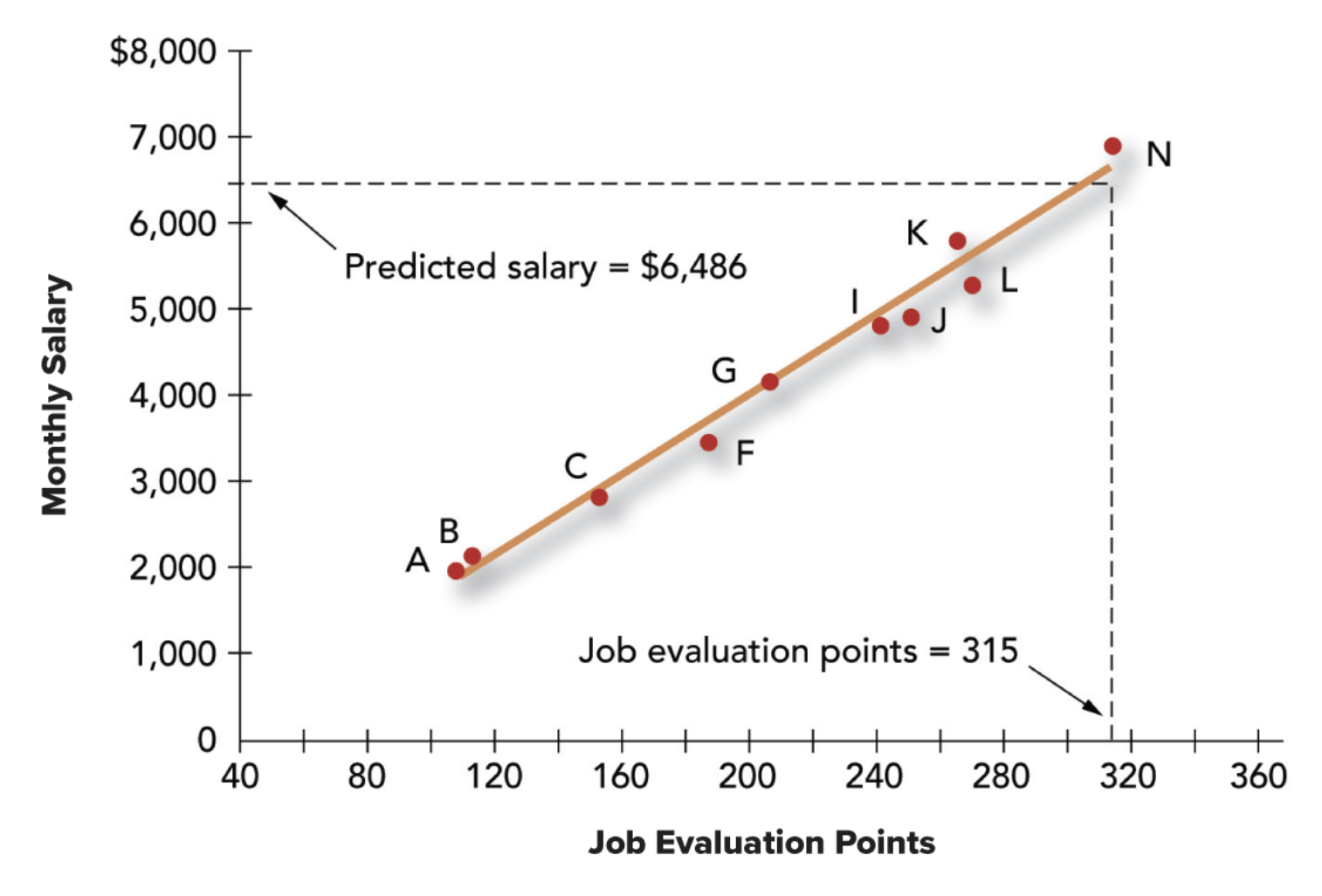
For non-key jobs, they can create a graph with the vertical axis showing a range of possible pay rates and the horizontal axis showing job evaluation points
Pay policy line — Positive line showing the relationship between job evaluation points and pay rate, reflecting the pay structure in the market
Pay grades
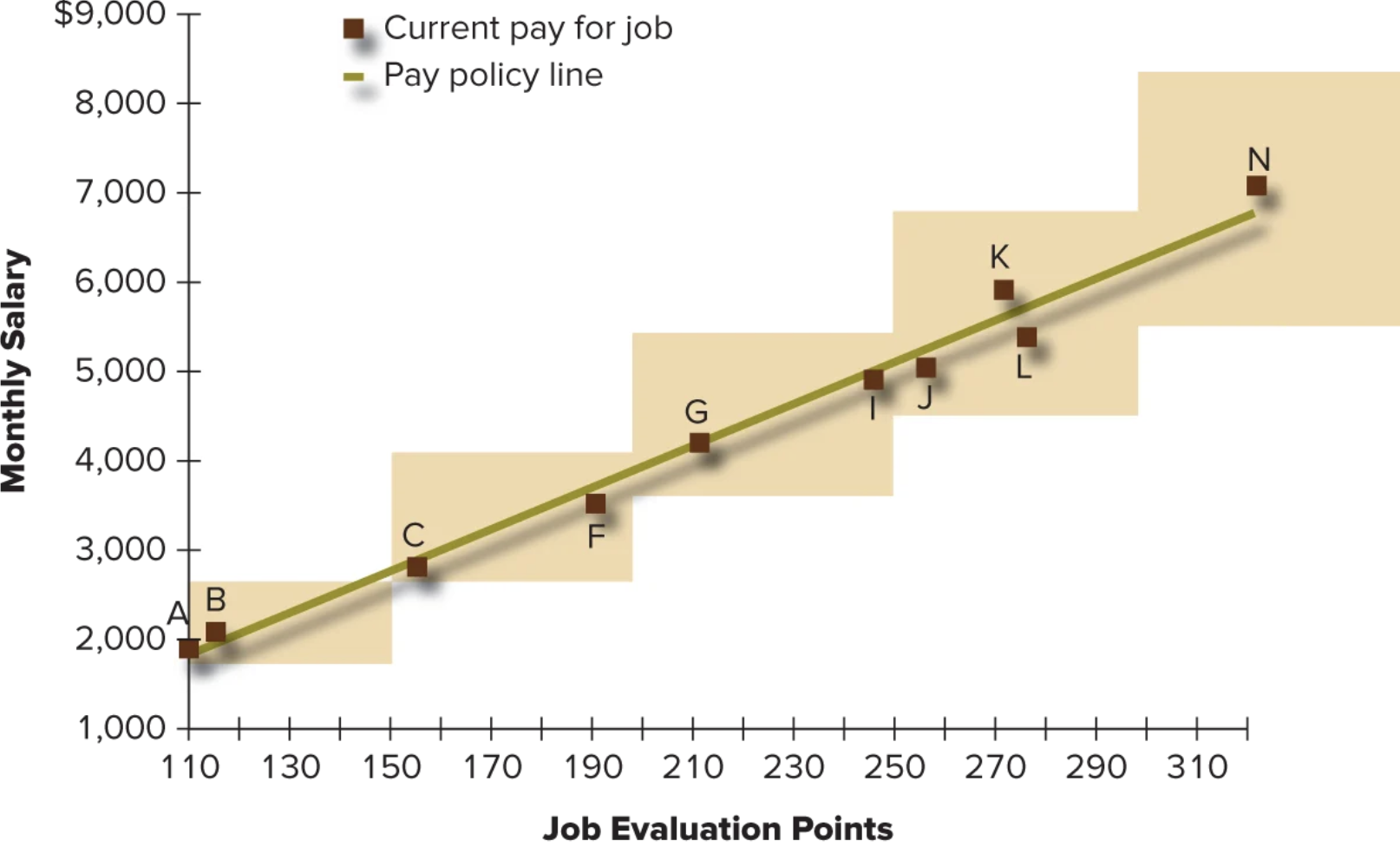
Sets of jobs having similar worth or content, grouped together to establish rates of pay
Setting a pay rate for each job would be extremely complex, so many organizations group jobs into pay grades
Drawbacks are that grouping will result in rates of pay for individual jobs that aren’t precisely matched to the market and the organization’s job structure
Pay ranges
A set of possible pay rates defined by a minimum, maximum, and midpoint of pay for employees holding a particular job or a job within a pay grade
Gives the organization flexibility to balance conflicting information from market surveys and job evaluations
Organizations want to pay their most valuable employees the highest amount
Ranges may be widest for employees in higher job evaluation point levels
Pay ranges overlap somewhat which gives more flexibility but may detract from motivation for promotions
Pay differentials
Organizations may adjust pay rates to reflect differences in working conditions or labor markets
Examples: paying extra to employees working the night shifts as those hours are less desirable, and paying extra for employees whose living expenses are higher
Alternatives to job-based pay
Delayering — Reducing the number of levels in the organization’s job structure
Creates broad bands rather than several pay grades
Combining more assignments into a single layer gives managers more flexibility in making assignments and awarding pay increases
Reduces the opportunities for promoting employees
Skill-based pay systems — Pay structures that set according to the employees’ level of skill or knowledge and what they are capable of doing
Supports efforts to empower employees and enrich jobs
Practical for organizations where technology or machinery are constantly evolving
Drawbacks: It rewards employees for acquiring skills but does not guarantee that they can use them
Current issues involving pay structure
Pay during military duty — Uniformed Services Employment and Reemployment Rights Act requires employers to make jobs available to employees when they return after up to 5 years of military duty
Military pay often falls short of job’s pay
Some employers will pay the difference between military and civilian earnings
Pay for executives — Perceptions of high CEO and executive pay is related to equity theory
Ratio of CEO pay relative to the average annual pay is 399:1
If executives do not contribute 399 times more, employees will see the compensation as unfair