Life History Strategies
 Call Kai
 Learn
Learn Practice Test
 Spaced Repetition
 Match
Match Flashcards
 Knowt Play
1/26

There's no tags or description
Looks like no tags are added yet.
Name | Mastery | Learn | Test | Matching | Spaced | Call with Kai |
|---|
No analytics yet
Send a link to your students to track their progress
27 Terms
What are the advantages of having seeds
Genetic recombination, robust package provisioned with nutrients
Theoretical tradeoff of seed mass versus seed number
A fixed amount of resources can be divided into many small units or few large units
When are many small seeds advantageous
When suitable sited or conditions for seedling establishment are unpredictable or patchy
When are large seeds advantageous
Where suitable sired for seedling establishment are predictable but subject to competition
Why would ecosystem factors force seeds to be larger
Trees in mature successional ecosystems may need to produce large seeds with high nutrient stores because seedlings will need provisioned nutrients to survive living in the shaded understory. This then means that the seeds are too large to be transported by things like wind and must be transported by animals
Correlation between seed mass and growth form
Grasses rushes, and sedges, often have small seeds that are not animal dispersed, while woody plants and climbers are more likely to have larger seeds
Important constraint of seed mass and dispersal by animals
Seed mass and size is limited by the largest animal that can eat and disperse it
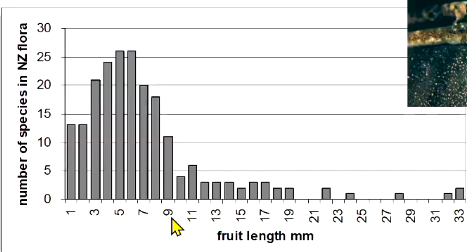
Comparison of bird sizes in NZ and Australia and how it relates to seed dispersal and mass
Birds in NZ are generally smaller and have smaller gape sizes which leads to smaller seeds and fruits in NZ compared to Australia
Speciation and extinction occur in higher instances among what kind of seeds
Smaller seeds (often have faster lifecycles making for faster speciation and also higher rates of extinction compared to large seeds)
Seedbank definition
Seeds are present in environment but are not above ground as a reproducing plant
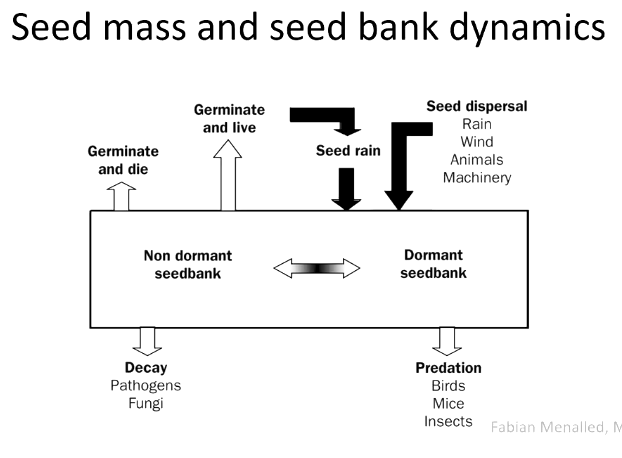
What are the dynamics/outcomes within a seed bank
Seeds are dispersed, some are eaten, some decay, some germinate right away and live, others germinate and then die, the rest may stay dormant for long periods of time
Are small or large seeded species more likely to form seed banks
Small seeded species (because they produce more seeds compared to large seeded species. Large seeds are also more likely to be predated)
What traits are associated with being able to form seed banks
Small and round, tough seed coat, starchy endosperm, seed dormancy
Describe the species with seedbanks in New Zealand
It is rare for species to form seed banks in NZ but there is little research on the topic
Examples of species that potentially form seedbanks in NZ
Pikao (seedlings known to appear after disturbance), South Island Kowhai (Canopy seed bank & seeds may persist in the soil), and canopy seed bank in Manuka
2 main different kinds of seed dormancy
Morphological dormancy & physiological dormancy
Morphological dormancy traits
Tough seed coat that requires abrasion or fungal penetration to germinate (legumes)
Physiological dormancy traits
When seed is released from plant it is not mature and requires after ripening, or could have a requirement for light levels or chilling in order to germinate
Orthodox seeds versus recalcitrant seeds
Orthodox seeds are seeds that can be stored for more than 20 years and tolerate drying, Recalcitrant seeds do not tolerate drying (typically large seeds and tropical species)
What kind of seed traits do New Zealand trees exhibit
a lot are desiccation sensitive (18%) and many are also orthodox (23%)
What are monocarpic plants
Plants that only reproduce once (annuals, bamboos)
What are polycarpic plants
Plants that reproduce repeatedly (trees that have mast seeding)
Definition of mast seeding
Synchronous highly variable seed production among years by a population of plants
Benefit of masting in regard to seed predation
Predators are starved in “off” years and satiated in mast years which means that a greater proportion of seeds escape
Benefit of animal dispersal/pollination in regard to mast seeding
Attracts a larger number of animals from further away which means a greater proportion of flowers/pollinated crops are dispersed