Visual perception Pyschophysical Methodoly
 Call Kai
 Learn
Learn Practice Test
 Spaced Repetition
 Match
Match Flashcards
 Knowt Play
1/63

There's no tags or description
Looks like no tags are added yet.
Name | Mastery | Learn | Test | Matching | Spaced | Call with Kai | Chat |
|---|
No analytics yet
Send a link to your students to track their progress
64 Terms
what is psychophysics and its importance?
A scientific study that investigates the relationship between physical stimuli and the sensations & perceptions they affect many of the routine procedures used in EYE CARE are psychophysical in
nature.
what is the role of Psychophysics in the Clinical examination of the Visual System (aka what can it be used in the determination of)
VA
refractic status
visual fields threshold (most common psychophysical measurement)
color vision status
what does the knowledge of psychophysical theory and methodolgy enable you to do?
enables u to properly perform these procedures
interpret their results in meaningful manner
use in research, analytical purposes and to follow the course of treatment
when considering the relation between the physical world and our perception of
it, what are the fundamental aspects of perception must be investigated?
incluedes but not limited too:
detection: what properties must a stimulus posses for us to be aware of its presence?
identification: how do we know what the stimulus is
discrimintion: how different do stimuli need to be for us to distinguish b/w them
scaling: how do we judge the magnitude of a given stimulus parameter? How do we
judge degree of similarity or difference for discriminable stimuli?
what do psychophysical experiments (clinical procedures) frequently involve?
determination of a threshold
define threshold
minimum quantity of stimulus that can be detected or in psychophysics its’s the lowest minimum intensity at which a stimulus can be detected 50% of the time aka absolute threshold
In VA testing, what is the threshold?
MAR (minimum angle of resolution)
in VF testing, what is the threshold?
minimum light intensity that can be detected
What are 2 examples of a colour vision test and what is its threshold?
2 examples: FM 100 Hue Test, Dichotomous D-15 test
Threshold: just noticable hue (colour) that can be discriminated
why is the determination of a threshold complicated?
cuz humasn are not perfect observers
what answers would a perfect observer give when measuring threshold?
would give the same threshold each time its measuresd
In practice, the threshold varies on repetition of its measurement

Example of results of a psychophyicsal experiment conducted with a hypothetical (1) ideal perfect observer vs (2) real observer for the following task:
Task: observer required to detect a light (stimulus)
It’s flashed on the surrounding background (increment threshold)
The task is repeated for a range of stimulus intensities, from dim to intense
What would the ideal perfect observer see?
Ideal Perfect Observer:
manifests as an unambiguous threshold
below threshold intensity: never sees the stimulus
above threshold intensity: always sees the stimulus
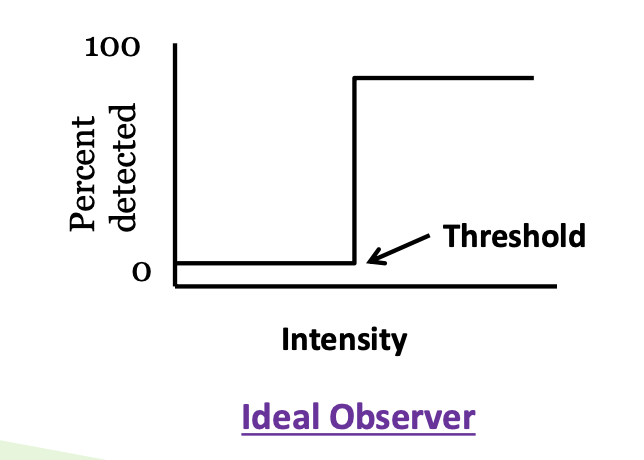
Example of results of a psychophyicsal experiment conducted with a hypothetical (1) ideal perfect observer vs (2) real observer for the following task:
Task: observer required to detect a light (stimulus)
It’s flashed on the surrounding background (increment threshold)
The task is repeated for a range of stimulus intensities, from dim to intense
What would the real observer see and how does it differ from the ideal observer?
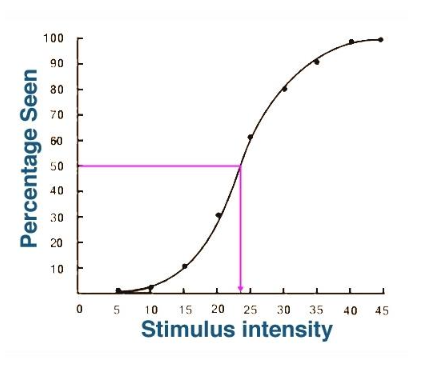
as intensity of the stimulus ↑, the probability of seeing the stimulus ↑
Unlike an ideal observer:
There is NO clearly defined intensity
below which a stimulus is never seen
above which it is always seen
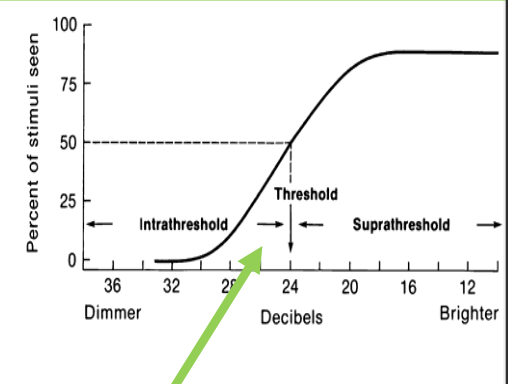
What do you see on the x and y-axis of the frequency of seeing (FOS) curve, and what is this curve also referred to as?
percentage of stimuli detected (y-axis) is plotted as a function of stimulus intensity (x-axis) to produce an FOS curve
also referred to as psychometric function
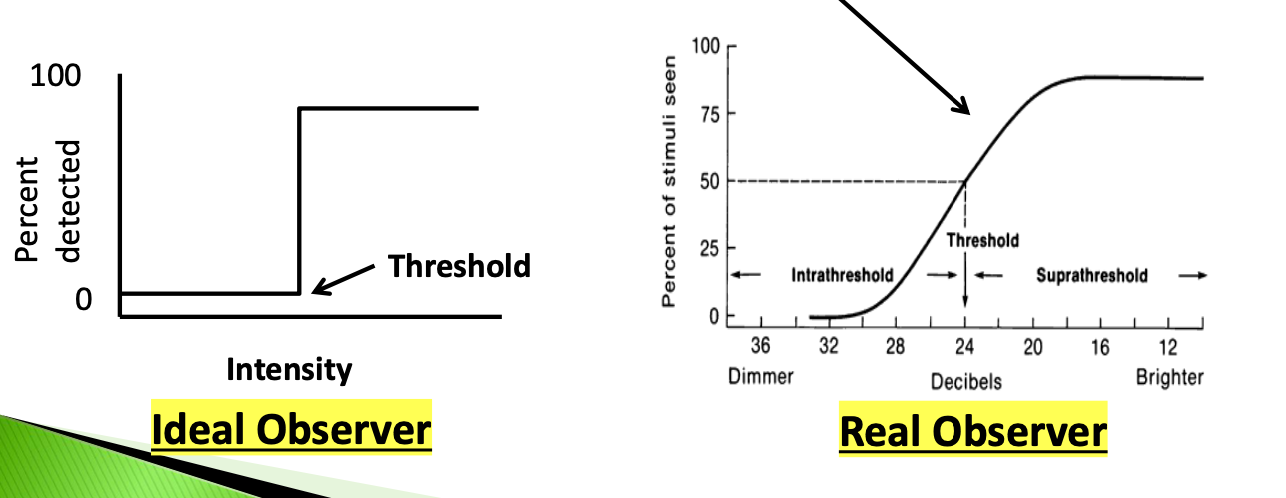
since there are no perfect observers what is threshold based on?
on theoretical considerations
What is a threshold usually defined as? Where does this value come from?
defined as the intensity that results in the detection of the stimulus on one-half of the presentations
The value is read off the FOS curve
why are humans not perfect observers?
cuz they are complex biological systems, not simple mechanical devices
what are the factors affecting threshold?
Random neural noise
Fluctuations of the Stimulus
Attention
Motivation
Fatigue
Psychological bias
Diseased Visual System (more neural noise)
how is random neural noise and how does it affect threshold?
A stimulus results in neural activity, and if this neural activity is sufficiently strong (strong enough) = stimulus is seen
Random neural noise is inherent within the visual system; therefore, the signal produced by the stimulus must be perceived as different than this neural noise
neural noise can vary over time
At any time, the amount of noise is unpredictable; therefore, the threshold is variable
What is the difference between a diseased visual system and a healthy one, and how does the FOS curve change and what happens as a result?
The diseased vis sys is noisier than a healthy one
makes the FOS curve flatter (less steep)
more difficult to accurately ascertain a threshold for a FLAT CURVE (because there is a broader range of values that could correspond to 50% detection)
since there is a broader range of values corresponding to 50% detection (when FOS curve is flat), it complicated measurement of visual fields in diseased eyes
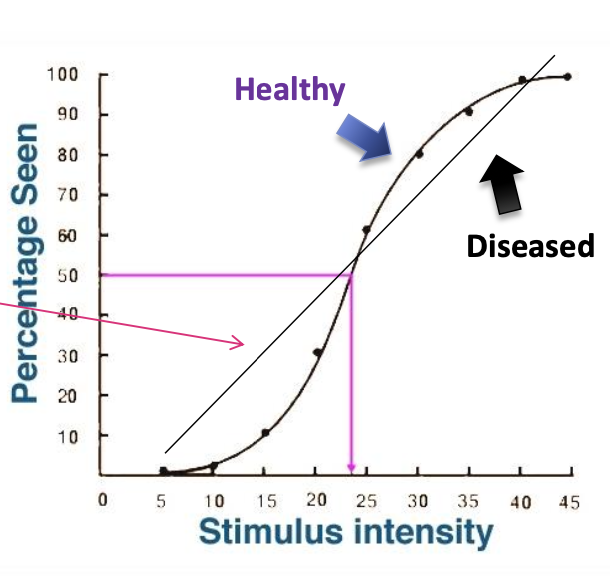
the visual system is noiser ___________ than ________. This makes the assessment of peripheral VF in diseased eyes more ________.
noiser peripherally than centrally
makes assessment of peripheral VF is diseased eyes more challenging
define absolute threshold
minimum quantity of stimulus that can be detected (same as threshold)
what is differential threshold and what is it also known as? Give an example.
as JND (just noticeable difference)
minimum difference in stimulation for detecting that the two stimuli differ in some characteristics (such as intensity) when the stimuli are physically separated in space
ex. sub refraction: lens 1 is better, or lens 2 is better (JCC)
what is increment threshold and give an example?
minimum difference in stimulation for detecting that the two stimuli differ in some characteristics (such as intensity) when the stimuli are immediately adjacent or superimposed
Ex: Subjective Refraction, Detecting letters in CS Chart, Colour Vision
Arrangement Tests (D15, FM100 etc.,)
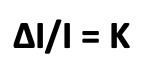
what law expresses the constant relationship of increment threshold? What is the equation and what does each variable stand for?
Weber’s Law:
ΔI is the JND
I is the reference stimulus
K is a constant, the Weber fraction
what is intensity discrimination and what is it important for? What is it measured in?
process of distinguishing one stimulus intensity
from another
important for seeing and is the basis for many tests, like spatial VA, for detecting boundaries of objects
for the basis of VF testing
Isopters define points in the visual field w/ similar increment thresholds and provide a topographic map of retinal sensitivity
what affects intensity discrimination?
glare- by reducing contrast
Glare can be introduced by adding a constant amount of light to both background and test stimulus, or by scattering of light by ocular media (such as occurs in cataracts)
Descibe intensity discrimination at low background luminance levels and what law applies to them at this level:
At low background levels, background luminance increased from 0 to a small range of scotopic luminance levels
The human visual system acts like an ideal detector
as background luminance level ↑- threshold change in luminance (ΔL) needed to detect that the test stimulus differs from background luminance, increases as √background luminance
follows the deVries–Rose law
Descibe intensity discrimination at higher background luminance levels and what law applies to them at this level:
The visual system does not behave like an ideal detector because of neural interactions
Result: threshold ΔL of the test spot ↑ in direct proportion to ↑in the background luminance
Weber’s law applies
Descibe intensity discrimination at very high intensities background luminance levels and what law applies to them at this level:
neither relationship holds because the rod and cone systems saturate
Result: the test spot luminance must differ greatly from the background luminance to be seen as differing in brightness.
DeVries-Rose law and Weber’s law are useful in predicting visual performance
what does the most suitable method to measure threshold depend on? What is it also deteremined by?
most suitable method depends on advantage and disadvantages
determined by the nature of the experiment or clinical procedure
In order to determine the threshold, there are 3 classical psychophysical methods. What are they, and what is one method that is not part of the classical psychophysical method?
3 Classical Psychophysical Methods:
methods of limits (ascending and descending)
method of constant stimuli
method of adjustments
Forced choice procedure
what is a method that is often thought to be ineffficient and why? Give 2 examples of this?
Adaptive psychophysical methods are often argued to be inefficient
Adaptive procedures differ from the classical ones mainly in that they are designed to concentrate stimulus presentations at or near the presumed value of the threshold
ex. Staircase method and magnitude estimation
what are the 2 types of methods of limits
Ascending Method of Limit
Descending Method of Limit
Describe the method of ascending limits
stimulus is initially below threshold (it is not visible)
During a trial, the stimulus intensity is increased systematically until the observer reports that it is VISIBLE
Several trials are performed (Non-seeing to Seeing) and the results are averaged to obtain a threshold
what are the advantages and distadvantages of the method of ascending limits?
Advantage
▪ advantageous in Dark Adaptometry (where it’s important that the state of retinal adaptation be minimally affected by the stimulus)
Disadvantage
▪ disadvantage is observer anticipation (may lead to an inaccurate results)
*Beginning each trial at a different intensity can mitigate this disadvantage
Descibe the method of descedning limits
The reverse of the method of ascending limits.
trial starts with a clearly visible stimulus
i.e., the stimulus is above threshold and the visibility is decreased systematically until it can no longer be seen
clinical relevance of the method of descending limits
used to determine VA commonly
pt asked to read down the Snellen eye chart, and ptotypes that become progressively smaller from top to bottom (and more difficult to resolve)
The threshold MAR is determined when the optotypes are too small to be resolved.
what are the disadvantages of descending limits
observer anticipation
▪ May lead to an inaccurate result
▪ Solution: Beginning each trial at a different intensity can mitigate this disadvantage
The manner in which a clinical psychophysical test is performed can influence the result
Suppose you determine the Visual Acuity of a patient who is worried he may be losing his vision & who wishes to be sure that you take his symptoms seriously, what would happen when asked to read down eye chart?
If asked to read down an eye chart (method of descending limits)
▪ It is possible that the patient may stop reading letters when he notices blur and has uncertainty regarding what he is seeing.
How would the result be different if YOU set the criterion by instructing the patient to continue to read down the chart even if he says he cannot clearly see the letters (in method of descending limits)?
You encourage the patient to guess at what he sees
tell pt not to worry about being wrong.
Using this forced choice methodology, it would not be surprising to find
the acuity to be 20/20 rather than 20/30 (acuity better than measured)
how should VA be measured and who sets the threshold criterion?
Visual acuity should be measured in a standardized manner
ensures that the practitioner, not the patient, sets the threshold criterion
what are some things to keep in mind when performing method of descending limits?
Not only will different patients have different criteria
▪ Some will be adventurous guessers
▪ Others will be cautious nonguessers
▪ The criterion that a given patient uses may vary from visit to visit (depending on his mood or other factors)
How are treatment desicions made and what is important to know?
Since treatment decisions are often made based on Visual Acuity and/or changes in visual acuity over time,
▪ It is important to know that
▪ Our measurements are reliable and
▪ Not unnecessarily confounded by issues of threshold criteria.
in method of descending limits, what termination rules should be employed when measuring Visual acuity?
Asking the patient to continue to guess at optotypes once it is obvious that they are not visible
▪ Can be frustrating for the patient and time-consuming.
what does the study by carkeet (2001) suggest regarding bailey lovie chart?
t when using Bailey-Lovie chart, the test be terminated after the patient makes four or more mistakes on a line.
what is one way u can improperly administer a psychophysical test?
by allowing the patient to set the threshold criteria
during stereopsis testing, if the pt says i cant tell, what must practioner do
ask the patient to “guess which image is elevated”
what is the method of constant stimuli?
In this method, Stimulus is varied every presentation
stimulus visibility is varied randomly from presentation to presentation, and the FOS curve is plotted based on the subject’s responses
since subject is often asked whether or not a stimulus is seen this method is sometimes referred as “Yes–No” procedure
what are blank/catch trials?
blank trials- in which no stimulus is presented
catch trials- stimulus well below or above threshold are presented
In the method of constant stimuli, what response is recorded?
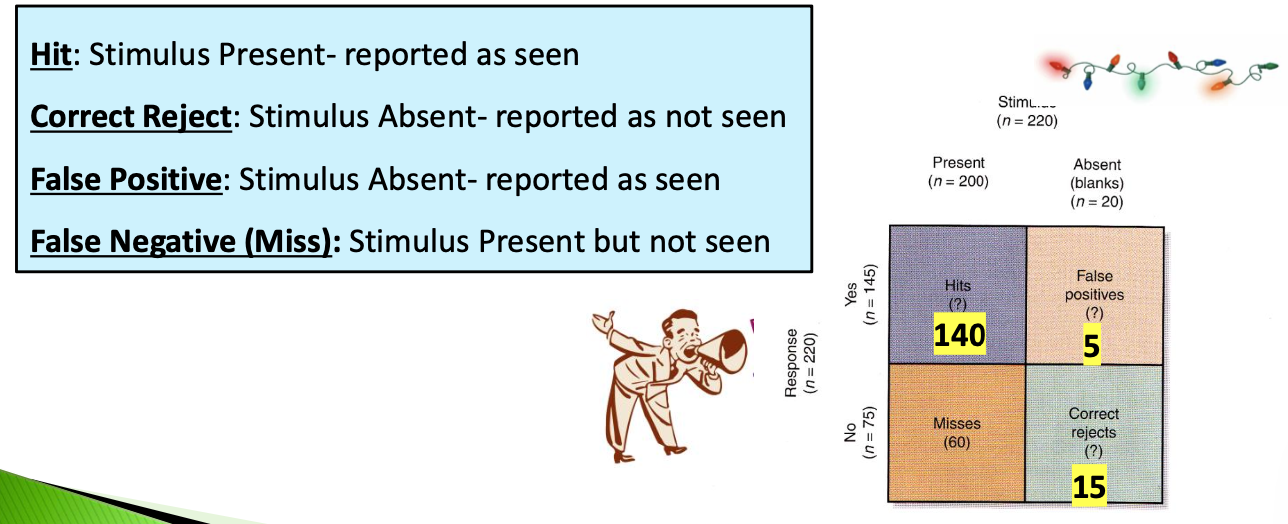
number of times that the observer reports seeing the stimulus during a blank trial (FALSE POSITIVE or FALSE ALARM responses) is recorded
Example 1: YES-NO EXPERIMENT
▪ Total: 220 Trials, 20 Blanks
▪ Stimulus seen by subject 145 Trials; Stimulus present but not seen= 60 trials
▪ We can now calculate Hits, False Positives, and Correct Rejects
stopped at pg 51
starting pg 59
what is the forced choice method
procedure is essentially a modified version of method of limits/constant stimuli, where subjects are forced to response
in forced choiced emethodoly, what happens to the effects of the subjects criteria
the effects of the subjects criteria (anticipation) are minimized (among all psychophysical methods) by forcing them to choose b/w several alternative choices, one of which contains the stimullus
The threshold value is typically taken as the point midway between _____________- and ______________ performances.
b/w chance performance and perfect performance
what is the threshold for a 2AFC(alternative forced choice)experiment?
75% (b/w 50 and 100%)
what is the threshold for a 4AFC experiment?
62.5% (b/w 25 and 100%)