11.6 Price Discrimination
 Call Kai
 Learn
Learn Practice Test
 Spaced Repetition
 Match
Match Flashcards
 Knowt Play
1/20

There's no tags or description
Looks like no tags are added yet.
Name | Mastery | Learn | Test | Matching | Spaced | Call with Kai |
|---|
No analytics yet
Send a link to your students to track their progress
21 Terms
What is price discrimination?
Selling the same product at more than one price not justified by cost differences.
Why does a monopolist use price discrimination?
To increase total profit by charging different buyers different prices based on willingness to pay.
What is first‑degree (perfect) price discrimination?
Charging each customer the maximum price they are willing to pay.
What is second‑degree price discrimination?
Charging one price for the first units purchased and a lower price for additional units.
What is third‑degree price discrimination?
Charging different groups different prices (students, seniors, businesses, etc.).
Why is monopoly power required for price discrimination?
The seller must have control over price; competitive firms cannot price discriminate.
What is market segregation?
The ability to separate buyers into groups with different elasticities or willingness to pay.
Examples:
Students vs businesses
Seniors vs adults
Business travelers vs vacation travelers
Why must resale be impossible?
Low‑price buyers must not be able to resell to high‑price buyers; otherwise discrimination collapses.
This is why price discrimination is common in services (airlines, movies, software licenses).
How do airlines use price discrimination?
Business travelers (inelastic demand) pay high fares; vacationers (elastic demand) get cheaper fares.
How do theaters and golf courses price discriminate?
Different prices by time (weekend vs weekday) and age (children, seniors).
How do railroads price discriminate?
Charge more per ton‑mile for high‑value goods (TVs) than low‑value goods (gravel).
Why are coupons a form of price discrimination?
Only price‑sensitive customers use them; others pay full price.
How does price discrimination appear in international markets?
Firms charge lower prices in countries with elastic demand and higher prices where demand is inelastic.
Why does the monopolist use two separate graphs in Figure 11.7?
It sells the same product in two segregated markets with different elasticities (businesses vs students).
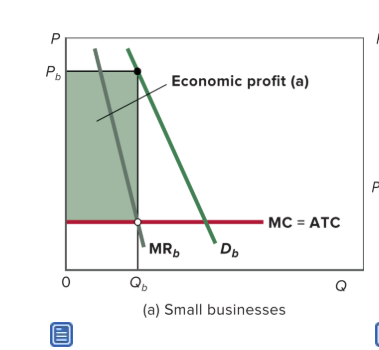
Why do small businesses pay a higher price?
Their demand is inelastic, so the monopolist charges a higher price (Pb).
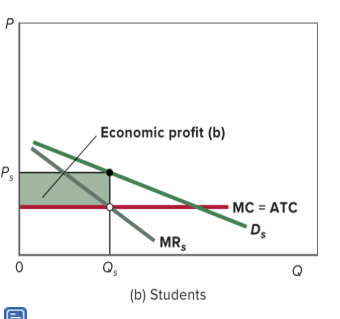
Why do students pay a lower price?
Their demand is elastic, so the monopolist charges a lower price (Ps).
How does the monopolist choose output in each market?
Uses MR = MC separately in each market to find Qb and Qs.
Why does price discrimination increase profit?
The sum of the two profit rectangles (business + student markets) is greater than the profit from a single uniform price.
If the monopolist charged one single price, it would have to pick:
A price too high for students
OR a price too low for businesses
Either way, it loses money.
How does price discrimination affect consumers?
Students benefit (lower price),
Businesses pay more
Total output increases —> more people get the product
When is price discrimination illegal?
Only when used to lessen or eliminate competition (antitrust issues).
What makes price discrimination profitable?
Different groups have different elasticities of demand, so charging different prices extracts more consumer surplus.