Amebae & Balantidium (Lecture 6)
 Call Kai
 Learn
Learn Practice Test
 Spaced Repetition
 Match
Match Flashcards
 Knowt Play
1/136

There's no tags or description
Looks like no tags are added yet.
Name | Mastery | Learn | Test | Matching | Spaced | Call with Kai |
|---|
No analytics yet
Send a link to your students to track their progress
137 Terms
what are the two main categories of diarrhea?
acute and chronic
wat are some things to consider when someone has diarrhea? (5)
blood, weight loss, immune status, fatty stools, onset relative to exposure
what are the two main approaches to diarrhea?
presumptive diagnosis and treatment or laboratory-based diagnosis
Presume diagnosing and treatment is often made for _____, _____, and _____
returning travelers; known outbreaks; acute food poisoning
what are the 4 main things that are used for laboratory based diagnosis of diarrhea?
stool culture, O&P, PCR, Fecal fat analysis
what does O&P stand for?
ovum and parasite
PCR panels are not ideal because they are very _____
expensive
what are the 5 main tests used for a Stool O&P?
wet mount, concentration smear, permanent stain, antigen testing, PCR panel
a stool wet mount is _____ but not the most _____
fast; specific
what is the “gold standard” of permanent Stool O&P stains?
trichrome
PCR is typically reserved for _____ patients
advanced
Ova, aka _____, are she by _____ in the GI tract or elsewhere
egs; adult worms
what are the two main life stages in the typical fecal-oral life cycle?
cyst and trophozoite
the trophozoite stage is the _____ form
active
the cyst stage is the _____ form
dormant
which stage of the fecal oral life cycle is feeding, motile, and doing replication?
trophozoite
what stage of the fecal-oral life cycle is passed in the feces?
cyst
what stage of the fecal oral life cycle is resistant and infectious?
cyst
what is the process of turning from a cyst to a trophozoite?
excystation
what is the process of turning from a trophozoite to a cyst?
encystation
Amebiasis is in the USA is often associated with _____ infection, and a majority of the fatal cases occurred in _____ and _____
HIV; CA; TX
amebiasis in the UDA is mostly in US-born persons, but all fatalities are in the _____ and _____ populations (of which 60% were _____-born)
asian/Pacific Islander; hispanic; foreign
what does histolytic mean?
dissolves tissue
what is the geographic distribution of E. histolytica?
worldwide
E. histolytica is a major cause of death in _____ worldwide
children
true or false: all species of entamoeba are pathogenic
FALSE: some colonize humans with no disease (ex. E. dispar)
E. histolytic is _____ and is associated with both _____ and _____ infections
pathogenic; intestinal; extraintestinal
E. dispar is morphologically _____ from E. histolytica and is generally _____ considered pathogenic
indistinguishable; not
what is the primary feature that is used to differentiate E. histolytica from E. dispar?
erythrophagocytosis
_____ are the primary reservoir for E. histolytica?
humans
how does the infection of E. histolytica occur?
mature cysts ingested
trophozoites are _____ while cysts are _____
labile; hardy
excystation of the E. histolytica occurs in the _____ which leads to the _____ form
small intestine; trophozoites
E. histolytica trophozoites colonize the _____ where they undergo _____ to form more _____ or _____
large intestine; multiplication; trophozoites; cysts
how are E. histolytica cysts released into the environment?
shed in stool
_____% of E. histolytica cases will get infection of the liver, lung, or brain
10
asymptomatic infection of amebiasis is also known as _____, and is caused by commensals like _____
luminal amebiasis; E. dispar
invasive intestinal amebiasis is when the parasite invades the _____ but is still localized to the _____
intestinal epithelial cells; intestine
what are the 4 main symptoms of invasive intestinal amebiasis?
dysentery/UC, appendicitis, toxic mega colon, amebomas
what are the 4 main symptoms of invasive extra intestinal amebiasis?
liver abscess, cutaneous/genital amebic lesions, brain hemorrhage; pleuropulmonary abscess
when looking at intestinal histology of E. histolytica, it is common to see _____ and _____ where the parasite has invaded the _____
flask-shaped ulcers; granulomas; epithelial cells
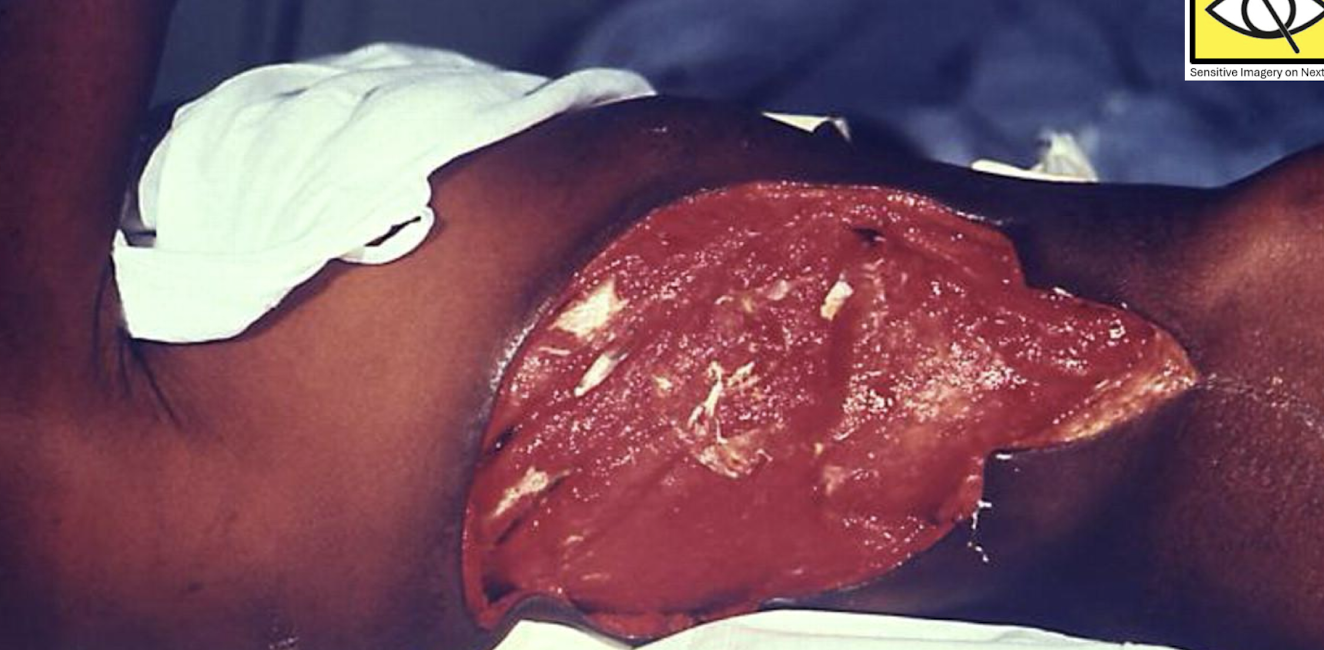
what is this called?
invasive extra intestinal amebiasis (w/ advanced cutaneous disease)
E. histolytica amebic brain abscess show _____ of the brain tissue
deterioration
the first step of diagnosing amebiasis is _____
trying to see the parasite
how is amebiasis ruled out?
3x stool exam
why do 3 stool exams when ruling out amebiasis?
increases sensitivity
stool exam can be done with either a _____ or a _____
wet mount; permanent stain
_____ techniques are used when diagnosing amebiasis, especially for visualizing cysts
concentration
concentration techniques CANNOT be used for _____ tests due to _____
EIA/antigen-based; antigen loss (false NEGATIVES!)
biopsies primarily show the _____ stage
trophozoite
aside from laboratory diagnosis, _____, _____ and _____, are done when diagnosing Amebiasis
liver scan, CT, ultrasound
trophozoites are usually found in _____ stool, while cysts are in _____ stool
diarrheal; formed
how big are E. histo/dispar trophozoites?
15-20um
what is erythrophagocytosis? What amebae is this a clue for?
ingestion of RBCs; E. histo
what are 3 main main features of E. histo/dispar trophozoites?
central karyosome, peripheral chromatin, ground class cytoplasm
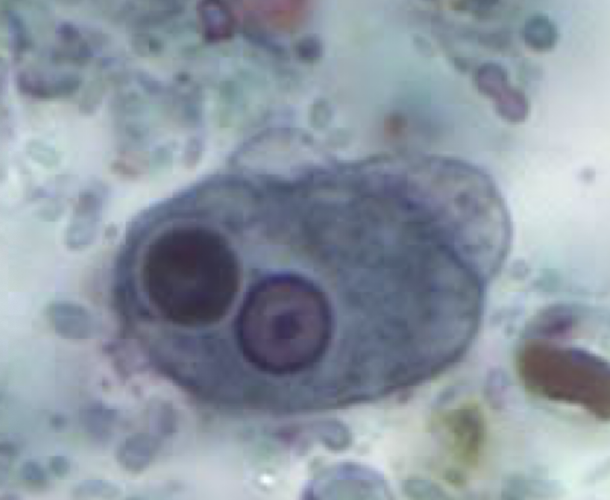
what is this an example of?
erythrophagocytosis
if you do NOT see erythrophagocytosis, can you rule out E. histo?
NO!
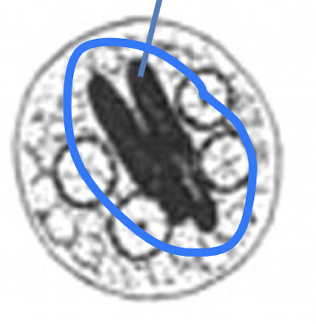
what is this called?
chromatid body
E. histo has a chromatid body with _____, _____ ends
blunt; rounded
what type of stain is ideal for showing the chromatid body?
trichrome stain
If you CANT see the parasite, use _____ or _____ assays
immuno; molecular
fecal _____ can serve as an additive to microscopy
antigen EIA
what are the 3 main immune or molecular assays used to diagnose amebiasis If you cannot visualize the parasite?
fecal antigen EIA, multiplex PCR, serology
serology is primarily useful in _____ disease
extraintestinal
why isn’t serology useful for intestinal disease?
not as sensitive (intestines gen. have a low antibody response)
serology for extra intestinal disease is highly _____ but it cannot differentiate _____
specific; new vs. past infection
E. dispar is _____ more frequent than E. histo; and they can be distinguished by _____ or _____ assays
10x; immunologic; molecular
E. histo must be differentiated from other _____, which are for the most part _____
intestinal protozoa; asymptomatic
what are the 5 other intestinal amebae that H. histo must be differentiated from?
E. hartmanni, E. coli, E. polecki, E. nana, I. beutschlii
E. coli cysts have _____ nuclei, an _____ karyosome, and is typically between _____um
8+; eccentric; 10-35
E. coli trophozoite has _____ nucleus/ei with a _____ cytoplasm and is typically between _____ um
ONE; dirty/vacuolated; 10-50
E. hartmanni is very similar to _____ but _____
E. histo; smaller
E hartmanni cysts are typically _____ um and have a _____, similar to E. histo, but _____
5-10; chromatid body, smaller
E. hartmanni trophozoites has a _____/_____ karyosome and is typically _____ um
small; compact; 5-15
what is the primary distinguishing feature of Endolimax nana cysts?
lack peripheral chromatin (only see karyosome)
how big are Endolimax nana cysts?
5-10um
what is the primary distinguishing feature of Endolimax nana trophozoites?
irregular blot-like karyosome
how big are E. nana trophozoites?
6-12 um
what is the primary distinguishing feature of I. beutschlii cysts?
one LARGE glycogen vacuole
what is the primary distinguishing feature of I. beutschlii trophozoites?
large central karyosome
how big are I. buetschlii cysts?
5-20um
how big are I. beutschlii trophozoites?
8-20um
what is the primary distinguishing feature if E. polecki?
many small chromatid bodies (w/ pointed ends)
E. polecki rarely causes _____ symptoms in humans
mild
Dientamoeba fragilis is a _____ NOT an _____
flagellate; ameba
how does D. fragilis differ from the rest of the amebas (other than it being a flagellate)?
only has trophozoite stage, no cysts
D. fragilis causes both _____ and _____ infections
symptomatic; asymptomatic
what is the primary distinguishing features of D. fragilis trophozoites?
2 nuclei (inclusion possible)
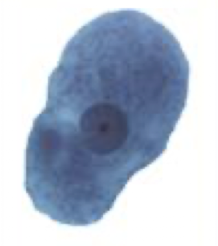
What Amebae is this? Is this the trophozoite or cyst form?
E. histo/dispar; trophozoite
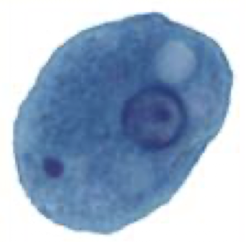
What Amebae is this? Is this the trophozoite or cyst form?
E. coli; trophozoite
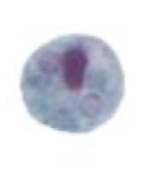
What Amebae is this? Is this the trophozoite or cyst form?
E. hartmanni; cyst
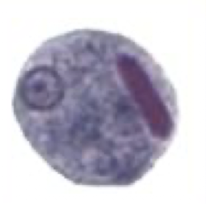
What Amebae is this? Is this the trophozoite or cyst form?
E. histo/dispar; cyst
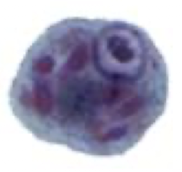
What Amebae is this? Is this the trophozoite or cyst form?
E. polecki; cyst
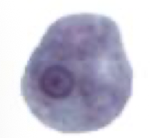
What Amebae is this? Is this the trophozoite or cyst form?
E. hartmanni; trophozoite
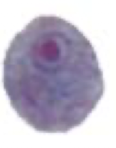
What Amebae is this? Is this the trophozoite or cyst form?
E. nana; trophozoite
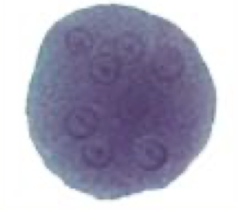
What Amebae is this? Is this the trophozoite or cyst form?
E. coli; cyst
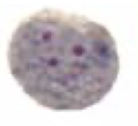
What Amebae is this? Is this the trophozoite or cyst form?
E. nana; cyst
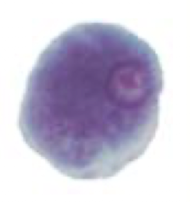
What Amebae is this? Is this the trophozoite or cyst form?
E. polecki; trophozoite
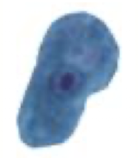
What Amebae is this? Is this the trophozoite or cyst form?
I. beutschlii; trophozoite
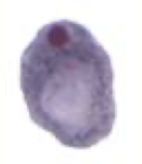
What Amebae is this? Is this the trophozoite or cyst form?
I. beutschlii, cyst