topic 4: terrestrialization (org. bio)
 Call Kai
 Learn
Learn Practice Test
 Spaced Repetition
 Match
Match Flashcards
 Knowt Play
1/31

There's no tags or description
Looks like no tags are added yet.
Name | Mastery | Learn | Test | Matching | Spaced | Call with Kai |
|---|
No analytics yet
Send a link to your students to track their progress
32 Terms
Lichen
composite organism resulting from a symbiotic relationship between a fungus and an algae or cyanobacteria. They are pioneers, often growing on bare rock
Pioneer species
Make soil by both physical and chemical weathering
Photobiont / Mycobiont
The two parts of a lichen
photobiont is the photosynthetic partner (algae/cyanobacteria) that provides food
mycobiont is the fungal partner that provides structure and protection.
Soredia
mall clusters of algal cells wrapped in fungal hyphae used for asexual reproduction. They break off and are carried by wind to start a new lichen
“Seed-free” plants
A broad category of plants that reproduce via spores rather than seeds. This includes bryophytes, lycophytes, and monilophyte (ferns)
Bryophyte
Non-vascular land plants, including liverworts, mosses, and hornworts, whose life cycles are dominated by the gametophyte generation
Desiccation
The state of extreme dryness or the process of drying out
Early land plants had to evolve traits to prevent this
Phyllids
Leaf-like structures found on bryophytes
Unlike true leaves, they lack complex vascular tissue (veins)
Rhizoids
Thin, root-like filaments that anchor bryophytes and some fungi to the ground but do not play a primary role in water absorption
Gametangia
Multicellular organs where gametes are produced
Archegonia
Gametangia that produce and protect the egg
Antheridia
Gametangia that produce and release sperm
Embryo
A young sporophyte that is retained within the tissues of the female gametophyte for protection and nourishment
Cuticle
A waxy, water-repellent covering on the surface of stems and leaves that prevents desiccation
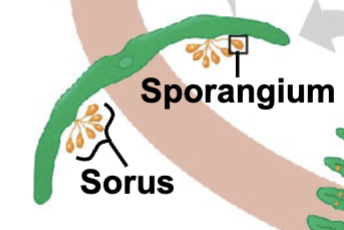
Sporangia
Multicellular organs where meiosis occurs and spores are produced
Sporopollenin
A durable, chemically inert polymer that coats spores and pollen, protecting them from dehydration and UV damage
Peat
Partly decayed organic material often found in huge, acidic, and anoxic wetlands called peatlands
Example: Sphagnum peat, used as fuel or garden soil condition
Lycophyte
A group of seedless vascular plants that includes club mosses, spikemosses, and quillworts
Monilophyte
A group of seedless vascular plants that includes ferns, horsetails, and whisk ferns
Microphyll
Small leaf with a single vein (found in Lycophytes)
Megaphyll
Large leaf with a branched vascular system (found in Ferns)
Sporophyll
Specialized leaves that form sporangia
Sorus
A cluster of sporangia on the underside of a fern frond
Example: The orange or brown dots on the back of a Boston Fern leaf
Carboniferous Period
A historical period characterized by a dramatic drawdown of atmospheric carbon dioxide by plants, leading to Earth's cooling and the formation of modern geological carbon stores
Azolla
genus of floating water fern
The Azolla Event
The "Azolla Event" refers to a massive bloom of these ferns in the Arctic Ocean ~49 million years ago that pulled so much $CO_2$ from the atmosphere it cooled the entire planet
What is the role of sporopollenin in land plants?
It is a durable polymer that makes spores resistant to harsh environments, allowing them to be dispersed through the air without drying out
Which generation is dominant in the bryophyte life cycle
The gametophyte (1n) generation is dominant; the sporophyte is attached to and dependent on it
What is a major limitation of bryophyte anatomy?
They lack a vascular system and cannot transport water long distances, which generally keeps them small and restricted to moist environments
What structural innovation allows vascular plants to grow tall?
Lignification of the stem vascular tissue increases functional strength, providing the support needed for vertical growth
Why are peatlands considered a "massive carbon sink"?
hough they cover only 3% of Earth's surface, they store 25% of all soil carbon—double the amount stored in all global forests combined
Why is the warming and drying of peatlands a climate risk?
It makes them susceptible to fires, which can release centuries of stored carbon "in a relative instant," turning a long-term sink into a major carbon source