Motion of Particles in Fluids
 Call Kai
 Learn
Learn Practice Test
 Spaced Repetition
 Match
Match Flashcards
 Knowt Play
1/37

Earn XP
Description and Tags
Particle Technology
Name | Mastery | Learn | Test | Matching | Spaced | Call with Kai |
|---|
No analytics yet
Send a link to your students to track their progress
38 Terms
Motion of Particles in Fluids
Study of how solid particles move through fluids. Separation processes depend on particle behavior in moving fluids.
Drag Force
The resistance force exerted by a fluid on a moving particle
Drag in Non-Viscous Fluid
No drag occurs; velocity gradients are infinite at the surface. Occurs due to pressure differences around the particle; no shear stress contribution.
Pressure Distribution Around Cylinder
Pressure is highest at stagnation points (A, D) and lowest at maximum velocity points (B, C).
Drag in Viscous Fluid
Includes shear stress effects; thickness depends on pressure gradient, boundary layer formation and flow separation influence drag.
Boundary Layer
The thin fluid region near a solid surface where velocity is retarded due to viscosity, gradually increasing from zero at the surface to free-stream velocity away from it.
Flow Separation
Occurs when boundary layer detaches due to rising pressure.
Reynolds Number (Re)
Dimensionless ratio of inertial to viscous forces: 𝑅𝑒 = 𝜌𝑢𝑑/𝜇
Stokes’ Law
Drag force for creeping flow (Re < 1): 𝐹𝑑 = 3𝜋𝜇𝑢𝑑
Surface Friction Drag
Drag due to viscous shear at particle surface; contributes ~2/3 of total drag at low Re.
Form Drag
Drag due to pressure differences around the particle; contributes ~1/3 of total drag at low Re.
Region A: Stokes’ law applies, Region B: slope changes progressively, Region C: Newton’s law applies, Region D: Turbulent boundary separation.
Drag Coefficient Regions
Region A
Re < 0.2
Region B
0.2 < Re < 1000
Region C
500–1000 < Re < 2×10⁵
Region D
Re > 2×10⁵
Terminal Falling Velocity
Constant velocity reached when gravitational force equals drag force.
Equal Settling Velocity
Condition where particles of different sizes/densities settle at the same velocity.
Free Settling
Occurs in dilute suspensions (<0.1% solids); particles fall independently without interference.
Hindered Settling
Occurs in concentrated suspensions; particle interactions increase drag and slow settling.
Motion of Bubbles/Drops
Internal circulation reduces drag and increases velocity.
Correction Factor (Q)
Accounts for internal circulation effects in bubbles/drops; depends on viscosity ratio μi/μ.
Viscosity Ratio is Large
μi /μ is _____ ⟶ Q ≈ 1: behaves like a rigid particle (low circulation)
Viscosity Ratio is Small
μi /μ is _____⟶ Q ≈ 1.5:strong internal circulation, higher velocity.
Surface Tension
Small droplets remain spherical; large droplets deform, increasing resistance.
Internal Circulation Effect
Can increase falling velocity by up to 50% compared to rigid spheres.
Terminal Velocity in Shear-Thinning Fluids
Settling is slow compared to Newtonian Fluids.
Non-Newtonian Fluids
Fluids with non-linear stress-strain relationships; particle motion differs from Newtonian fluids.
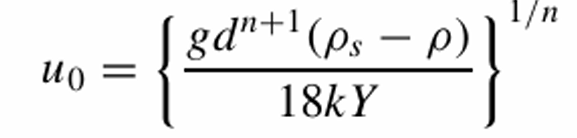
Modified Stokes’ Law
Drag force depends on correction factor Y, which increases as the fluid becomes more shear-thinning (lower n). Adapted drag law for particles in non-Newtonian fluids.
Power-Law Fluids
Shear-thinning fluids where viscosity decreases with shear rate; particles may remain suspended depending on fluid consistency.
Yield-Stress Fluids
Fluids that require a minimum stress to initiate flow; while drag coefficient is solved iteratively.
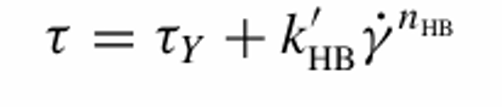
Herschel–Bulkley Model
Describes yield-stress fluids combining yield stress and shear-thinning behavior.
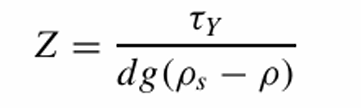
Static Equilibrium Condition
In Herschel–Bulkley fluids, particles remain suspended if dimensionless parameter Z lies between 0.04–0.2.
Static Equilibrium Condition
Shear Stress Relation
Drag Coefficient (Creeping Flow)

Modified Stokesʼ Law

Terminal Settling Velocity for Shear-Thinning Fluids