Bio Exam 3
 Call Kai
 Learn
Learn Practice Test
 Spaced Repetition
 Match
Match Flashcards
 Knowt Play
1/45

There's no tags or description
Looks like no tags are added yet.
Name | Mastery | Learn | Test | Matching | Spaced | Call with Kai |
|---|
No analytics yet
Send a link to your students to track their progress
46 Terms
Describe the defining characteristics of animals
eukaryotes
multicellular heterotrophs
have cells that lack cell walls
Describe the animal life cycle
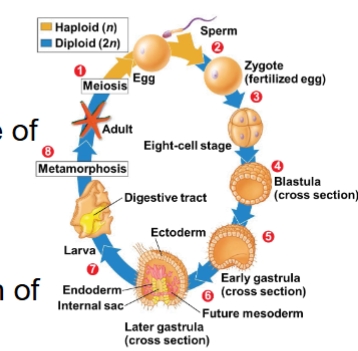
Most animals reproduce sexually
• Dominant diploid stage
• Cleavage = 1st major phase of embryonic development
• rapid cell division after fertilization
• Cleavage leads to formation of a blastula
• The blastula undergoes gastrulation (2nd major phase)
• Formation of layers of embryonic tissues
Describe the basic animal body plan
• symmetry
• presence of true tissues (organized groups of cells that work together to perform specific functions)
• number of embryonic layers
• other details of embryonic development
• presence of a body cavity
Define “body plan”
the sum of the general features of an animal’s form.
Describe the animal phyla poriphera
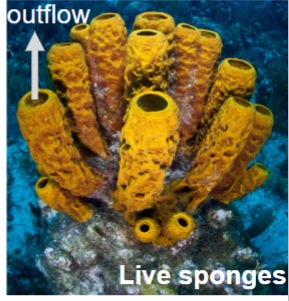
Sponges
• are simple animals with porous body, usually lack body symmetry, are usually marine, do not have true tissues
• Two cell types
• Flagellated choanocytes filter food from water, Amoebocytes digest & carry food
• Sponges represent the earliest branch of the animal kingdom
Describe the animal phyla cnidaria
Cnidarians have
• diploblastic (two true tissue layers), radial symmetry, feeding through gastrovascular (single) opening, tentacles with stinging cells
• Two body forms:
1. polyp (such as hydras) adheres to a substrate, extends tentacles
2. medusa (such as jellies) swim freely with tentacles dangling downward
Describe the animal phyla platyhelminthes
• All three phyla of worms are triploblastic protostomes
with bilateral symmetry, but
• flatworms (Platyhelminthes) are acoelomates
• roundworms (Nematoda) are pseudocoelomates
• annelids (Annelida) are coelomates
• Flatworms have a gastrovascular opening & a simple nervous system and are species that live in marine, freshwater, damp land habitats. Some are animal parasites (i.e., tapeworms).
• Roundworms (= nematodes) have a periodically-shed, protective cuticle, a complete digestive tract with a mouth & anus, Some are free-living decomposers, while others are
plant or animal parasites.
Describe the animal phyla nematoda
characterized by their elongated, cylindrical bodies, that are tapered at both ends
possess a complete digestive system (Mouth and Anus)
covered by a tough, flexible cuticle that is periodically molted
describe the animal phyla mollusca
Mollusks are triploblastic protostomes, coelomates, bilaterally symmetrical
• A mollusk body divided into
three main parts:
• a muscular foot, which functions in locomotion, a visceral mass containing most of the internal organs, a mantle, which may secrete a shell, most mollusks have open circulatory system (i.e., no blood vessels)
describe the animal phyla annelida
• species that include land & marine worms as well as some animal parasites
• a nervous system & a complete digestive tract
• a closed circulatory system in which blood remains enclosed in vessels.
describe the animal phyla arthropoda
Arthropods are bilaterally symmetrical, triploblastic protostomes & coelomates
• This phylum has over a million species including myriapods (subphylum), crustaceans (subphylum), arachnids (class), & insects (class).
• Their diversity & success are due to their segmentation, hard exoskeleton, & jointed appendages.
• As an arthropod grows, it must periodically molt.
• Molting is shedding of an old exoskeleton & secretion of a larger one.
describe the animal phyla echinodermata
• triploblastic deuterostomes & coelomates (along with phylum Chordata)
• all marine including sea stars & sea urchins
• slow-moving or sessile
• radially symmetrical as adults
• Echinoderms have
• a water vascular system (canals & tube feet), a unique hydraulic system for movement
• an endoskeleton of hard calcium-containing plates
• the ability to regenerate lost arms
Define segmentation, explain its functions, and note the
animal phyla where it occurs.
the subdivision of the body along its length into a series of repeated parts
used for movement and flexibility, specialization, regeneration, growth
occurs in arthropoda, and annelida
Describe the common characteristics of insects
Insects are the most successful group of animals
• a life cycle with short generations & large numbers of offspring
• Insect life cycles often include metamorphosis (body form changes from larva to adult).
• The body of many insects includes
• a head, thorax (middle section), abdomen, three sets of legs, and wings (in most)
List several representative species within the eight
invertebrate animal phyla
Sponges (Porifera), Jellyfish (Cnidaria), Earthworm (Annelids), tapeworms (platyhelminthes), roundworms (nematoda) Land Snail (Mollusca), millipede (arthropoda)
List four features of chordates
dorsal hollow nerve cord, notochord, pharyngeal slits, and a post anal tail
Describe the key derived traits of the chordates
Vertebral column (Spine/Backbone)
Hinged Jaws
Lungs or Lung derivatives
lobed fins
legs
Describe the key derived traits of the chordate subgroups
a notochord, dorsal hollow nerve cord, pharyngeal slits, endostyle/thyroid gland, and a post-anal tail
Hagfishes
deep-sea scavengers that produce slime as an antipredator defense
have a rudimentary vertebrae
lack hinged jaws
Lampreys
parasites that penetrate the sides of fishes with their rasping tongues
• have rudimentary vertebrae
• have a notochord for the body’s main
support
• lack hinged jaws & paired fins
Sharks/Rays
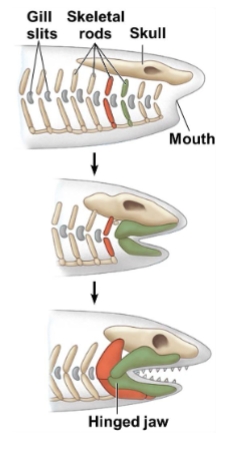
have a flexible skeleton made primarily of cartilage
have gill slits and skeletal rods, paired fins
Ray-Finned Fishes
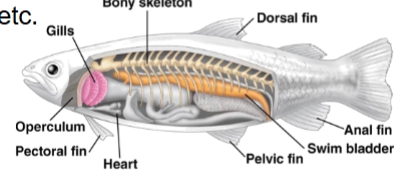
have a skeleton made of bone & fins supported by thin, flexible bony rays
gill slits, paired fins, skeletal rods
Lobe-finned fishes
have a skeleton made of bone & a series of rod-shaped bones in their muscular pectoral & pelvic fins.
coelacanths, lungfishes, tiktaalik
Define tetrapods
jawed vertebrates with limbs & feet that can support weight on land.
Amphibians
tetrapods, vertebrates with 2 pairs of limbs
include salamanders, frogs, &
caecilians
• use their moist skins to supplement their lungs for gas exchange
• usually lay their eggs in water
• were the first tetrapods to colonize land
Reptiles
amniotes (tetrapods with terrestrially-adapted egg).
include lizards, snakes, turtles, crocodilians, & dinosaurs
• have a skin covered with scales & waterproofed with keratin
• obtain most of their oxygen using lungs
• are ectothermic, absorbing external heat rather than
generating much of their own.
Birds
feathered reptiles
• Most can fly & their bodies reflects adaptations for flight.
• Birds are endothermic, using heat generated by metabolism
to maintain a warm, steady body temperature.
also dinosaurs
Mammals
endothermic amniotes with
• hair, which insulates their bodies
• mammary glands, which produce milk
have efficient respiratory and circulatory
systems that support their high rate of metabolism.
teeth are
differentiated for many
kinds of diets.
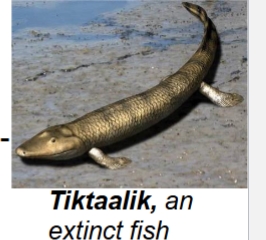
Describe the transitional species Tiktaalik
lobe-finned fish with lungs & structures resembling both fins & limbs
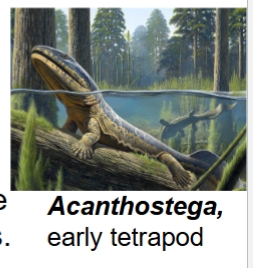
Describe the transitional species Acanthostega
had fish-like features (gills & a tail fin) & tetrapod traits (limbs with digits)
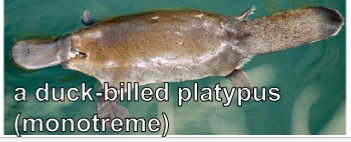
describe monotremes
egg laying mammals- platypus
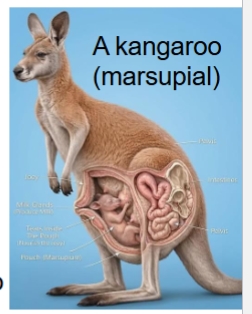
describe marsupials
gestate briefly & give birth to tiny, embryonic offspring that develop while attached to the mother’s nipples.- Kangaroo
Describe Eutharians
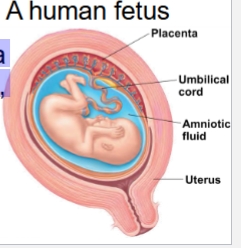
have fully developed placenta & give birth to fully developed young (e.g., humans).
What are the 3 main groups of living primates?
Lemurs, lorises, and bush babies
tarsiers
monkeys and apes
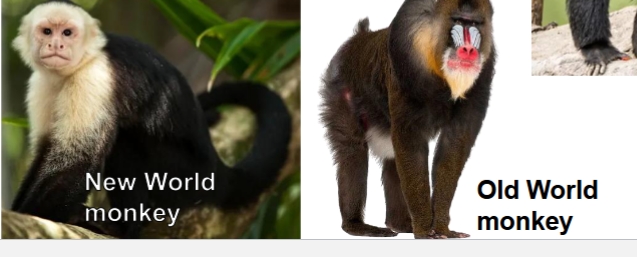
what are the defining characteristics of monkeys
walk on all 4s
found in both old world and new world (Central and south America
smaller than apes
have tails
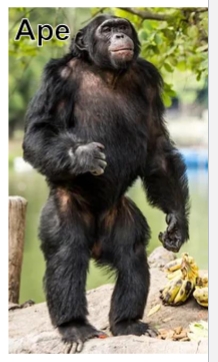
what are the defining characteristics of apes
Only found in old world (Africa and Asia)
can be bipedal (two rear legs)
larger than monkeys
larger brains than monkeys
more flexible behavior
no tail
Describe the evidence that suggests when upright posture and large brains first evolved in hominins.
Bipedalism arose millions of years before larger brain size.
• A clue to bipedalism is the location of the opening in the base of the skull through which the spinal cord exits.
Describe the relationships between Neanderthals and modern humans.
• Neanderthals & humans overlapped in Europe & western Asia for thousands of years.
• most non-Africans today have around 1–2% Neanderthal DNA