ap calc bc stuff to remember
 Call Kai
 Learn
Learn Practice Test
 Spaced Repetition
 Match
Match Flashcards
 Knowt Play
1/78

Earn XP
Description and Tags
trig derivatives, exponential derivatives, log derivatives
Name | Mastery | Learn | Test | Matching | Spaced | Call with Kai |
|---|
No analytics yet
Send a link to your students to track their progress
79 Terms
d/dx sin x
cos x
d/dx cos x
-sin x
d/dx tan x
sec²x
d/dx cot x
-csc²x
d/dx sec x
sec x × tan x
d/dx csc x
-csc x × cot x
d/dx ax
ln a × ax
d/dx ex
ex
d/dx logax
1 / (ln a × x)
d/dx ln x
1 / x
d/dx xn
nxn-1
derivative of inverse function g(x)
1 / g’ (g-1(x))
d/dx sin-1(g)
g’ / √ 1-g²
d/dx cos-1(g)
-g’ / √1-g2
d/dx sec-1(g)
g’ / |g| √g²-1
d/dx csc-1(g)
-g’ / |g| √g²-1
d/dx tan-1(g)
g’ / 1+g²
d/dx cot-1(g)
-g’ / 1+g²
y = f(g(x)) (chain rule)
f’(g(x))g’(x)
y= f(x)g(x) (product rule)
f’(x)g(x) + f(x)g’(x)
y= f(x) / g(x) (quotient rule)
f’(x)g(x) - f(x)g’(x) / g(x)²
y= f(g(h(x))) (chain inside of a chain)
𝑓′(𝑔(ℎ(𝑥))⋅𝑔′(ℎ(𝑥))⋅ℎ′(𝑥)
d/dx eg(x)
eg(x) x g’(x)
d/dx ag(x)
ln a x ag(x) x g’(x)
d/dx ln (g(x))
1/ g(x) x g’(x)
d/dx loga(g(x))
1 / (ln a x g(x)) x g’(x)
g’(x) when f(g(x)) = x
1 / f’ (g(x))
integral of xn
xn-1/n+1 +c
integral of ax
ax / ln a +c
integral of tan x
-ln |cos x| +c
integral of cot x
ln |sin x| +c
integral of sec x
ln |sec x + tan x| + c
integral of csc x
-ln |csc x + cot x| + c
integral of logax
x ln x - x / ln a +c
intermediate value theorem
if a function f is continuous on the interval [a,b] and k is a number between f(a) and f(b), then there is at least one x-value c between a and b such that f(c ) = k (a root exists)
mean value theorem
if a function is continuous and differentiable on [a,b], then for some value c in between the interval, the instantaneous rate of change at x=c will be equal to the average rate of change on [a,b]
rolle’s theorem
if a function f is continuous and differentiable on the interval [a,b] and f(a) = f(b), then there is at least one number c in (a,b) such that f’(c ) = 0.
extreme value theorem
if a function f is continuous on the closed interval [a,b], then f is guaranteed to attain an absolute minimum and absolute maximum value on [a,b]
local maximums and minimums (first derivative test)
when f’(c ) = 0 or is undefined, then it is a local maximum if it changes from positive to negative around the point, or a local minimum if it changes from negative to positive around the point.
relative maximums and minimums (second derivative test)
if f’’(c ) < 0 , f(c ) is a relative maximum. if f’’(c ) is > 0, f(c ) is a relative minimum. if f’’ (c ) = 0, the test is inconclusive.
midpoint riemann sum
adding all the rectangles where the area of the rectangle is the base times the height from the midpoint of the base.
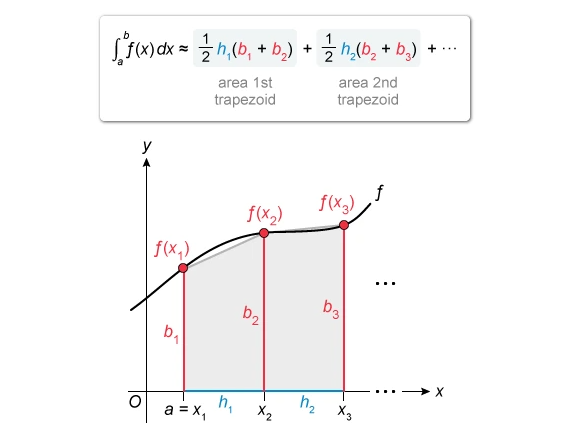
trapezoidal riemann sum
adding all the trapezoids where the area of the trapezoid is ½h(b1 + b2).
fundamental theorem of calculus
∫ab f(x)dx = F(b) - F(a)…. (shows differentiation and integration are inverse operations)
second fundamental theorem of calculus
if f is a continuous function on an interval [a, b], then the derivative of its accumulation function, F(x) = d/dx (∫ax f(t)dt) is f(x).
an integrals with bounds of the same point are equal to
0
∫abf(x)dx =
-∫baf(x)dx
∫a∞ f(x)dx =
lim t → ∞ ∫at f(x)dx
integration by parts formula
∫(u)(dv) = (u)(v) - ∫ v(du)
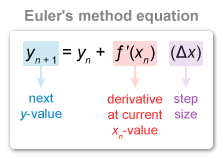
euler’s method equation
yn+1= yn + f’(Xn) (Δx)
logistic differential equations
dP/dt = kP(1-P/a) OR dP/dt = kP(a-P)
average value of an integral
1/b-a ∫ab f(x)dx
total distance traveled
∫t1t2 |v(t)| dt
area between curves in terms of x (can be switched with y)
A = ∫x1x2 (top - bottom) dx
disc method for horizontal rotation (switch for r(y) if vertical rotation)
V = ∫ab 𝝅[r(x)]2 dx
![<p>V = ∫<sub>a</sub><sup>b</sup> <span>𝝅</span>[r(x)]<sup>2</sup> dx</p>](https://assets.knowt.com/user-attachments/e314b9e0-5469-40d9-82fe-937efc7b9efb.jpg)
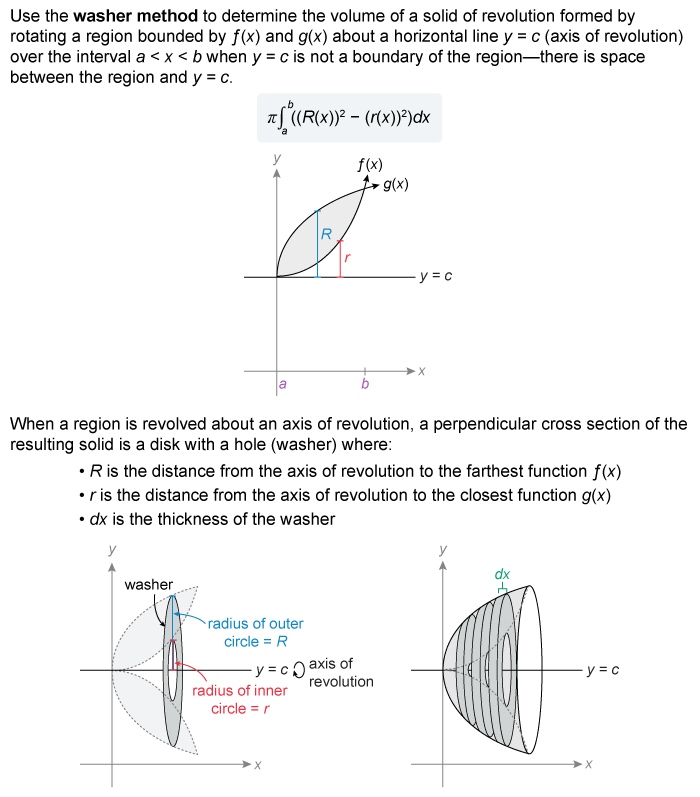
washer method for horizontal rotation (switch for r(y) if vertical rotation)
𝝅∫ab ((R(x)2-(r(x))2) dx, where R is the midpoint height of the top curve and r is the midpoint height of the bottom curve
arc length of a curve
∫ab (sqrt1+(f(x))²)dx
derivative (slope) of parametric curve
dy/dx = y’(t)/x’(t)
parametric speed
s(t) = (sqrt(x’(t))² + (y’(t))²)
length of parametric curve
∫t1t2 (sqrt(x’(t))² + (y’(t))²)dt
derivatives of vector-valued functions
f(t) = <x(t) , y(t)>
f’(t) = <x’(t), y’(t)>
f’’(t) = <x’’(t), y’’(t)>
total distance of vectors
∫t1t2 (sqrt(x’(t))² + (y’(t))²) dt
polar to rectangular coordinates
x = rcosθ
y= rsinθ
slope of a polar curve
dy/dx = (d/dθ[y]) / (d/dθ[x])
sum of geometric series
S = a1 / (1-r)
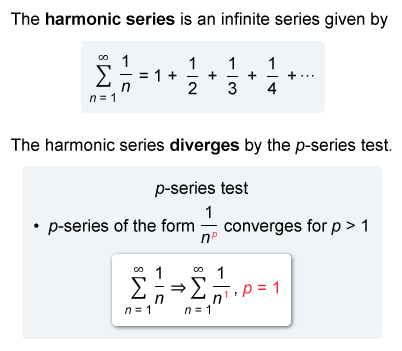
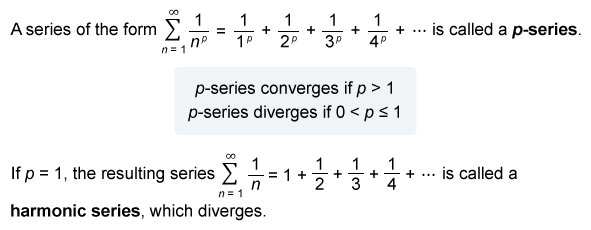
harmonic series divergence
by p-series test
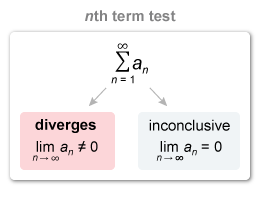
nth term test
diverges if lim does not equal 0
p-series series
converges if p>1 and diverges if 0<p<1
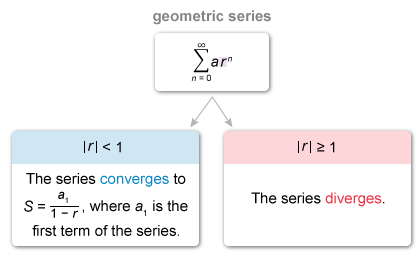
geometric series
when |r| < 1, the series converges to the sum of geometric series formula, when |r|>1, the series diverges
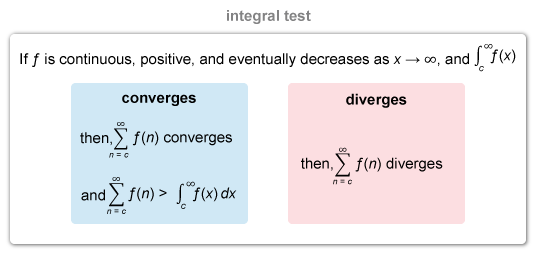
integral test
the integral stays convergent or divergent in its sum if it is continuous, positive, and eventually decreases as x → infinity
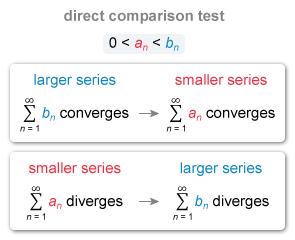
direct comparison test
when 0<an<bn, if bn converges, an converges. if an diverges, bn diverges (an is the smaller series, bn is the bigger series)
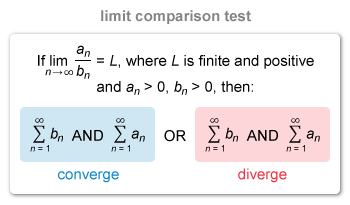
limit comparison test
if lim n→ inf an/bn = L, where L is finite and positive, then both an and bn either converge or diverge equally.
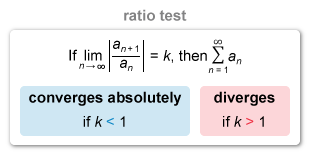
ratio test
if lim n→ inf |an+1/an| = k, then an’s sum converges absolutely if k <1 and diverges if k>1
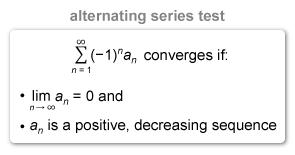
alternating series test
the sum of (-1)nan converges if lim n→ inf an=0 and an is a positive, decreasing sequence
nth degree taylor polynomial of f about x=c
Pn(x) = f(c ) + f’(c )(x-c) + (f’’(c ) / 2!)(x-c)² +…+ (f(n)(c ) / n!) (x-c)n
maclaurin polynomial
Pn(x) = f(0) + f’(0)x + (f’’(0)/2!)x² + (f’’’(0)/3!)x³ +… (f(n)(0)/n!)xn
1/1-x power series
1 + x + x² + x³ + … + xn +…
ex power series
1 + x + (x²/2!) + (x³/3!) +…+ (xn/n!)+…
sin x power series
x - (x³/3!) + (x5/5!) - (x7/7!) + … + (-1)n(x2n+1/(2n+1)!)+…
cos x power series
1 - (x2/2!) + (x4/4!) -(x6/6!) + …. + (-1)n(x2n/2n!)+…