C.5 Doppler Effect
 Call Kai
 Learn
Learn Practice Test
 Spaced Repetition
 Match
Match Flashcards
 Knowt Play
1/10

There's no tags or description
Looks like no tags are added yet.
Name | Mastery | Learn | Test | Matching | Spaced | Call with Kai |
|---|
No analytics yet
Send a link to your students to track their progress
11 Terms
What is the Doppler effect?
The Doppler effect is the change in observed frequency of a wave when there is relative motion between the source of the wave and the observer.
How is the Doppler effect represented using wavefront diagrams for a moving source?
Wavefronts become bunched together in front of the moving source (higher frequency) and spread out behind it (lower frequency).
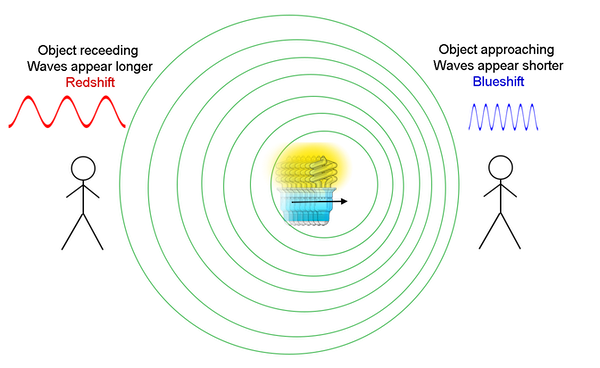
How do you calculate the fractional change in frequency for a light wave (where source speed is much less than light speed)?
The change in frequency divided by the original frequency is approximately equal to the relative velocity divided by the speed of light.
What information do shifts in spectral lines provide about stars and galaxies?
A redshift indicates the body is moving away from Earth, while a blueshift indicates it is moving toward Earth.
What is the formula for the observed frequency when the source is moving toward a stationary observer?
Observed frequency equals source frequency times the quantity wave speed divided by the quantity wave speed minus source velocity.
What is the formula for the observed frequency when the source is moving away from a stationary observer?
Observed frequency equals source frequency times the quantity wave speed divided by the quantity wave speed plus source velocity.
What is the formula for the observed frequency when the observer is moving toward a stationary source?
Observed frequency equals source frequency times the quantity wave speed plus observer velocity divided by the wave speed.
What is the formula for the observed frequency when the observer is moving away from a stationary source?
Observed frequency equals source frequency times the quantity wave speed minus observer velocity divided by the wave speed.
What are two practical applications of the Doppler effect mentioned in the syllabus?
The Doppler effect is used in medical physics (such as blood flow measurement) and in radar systems to determine the speed of objects.
Why does the observed frequency increase when a source of sound moves toward you?
The moving source "catches up" to the waves it just emitted, resulting in a shorter observed wavelength and a higher frequency.
In sound wave problems, what does the variable "v" usually represent?
The variable "v" represents the speed of sound in the medium (typically 340 meters per second unless stated otherwise).