Inorganic Materials and Nanomaterials
 Call Kai
 Learn
Learn Practice Test
 Spaced Repetition
 Match
Match Flashcards
 Knowt Play
1/130

There's no tags or description
Looks like no tags are added yet.
Name | Mastery | Learn | Test | Matching | Spaced | Call with Kai |
|---|
No analytics yet
Send a link to your students to track their progress
131 Terms
What is materials (solid state) chemistry?
The synthesis, structure, properties and applications of organic, inorganic and their composite materials.
Investigates the relations between structure and properties.
What are crystalline structures?
Structures that maintain a long range order.
E.g. SiO2 quartz
What are amorphous structures?
Structures that have short range order.
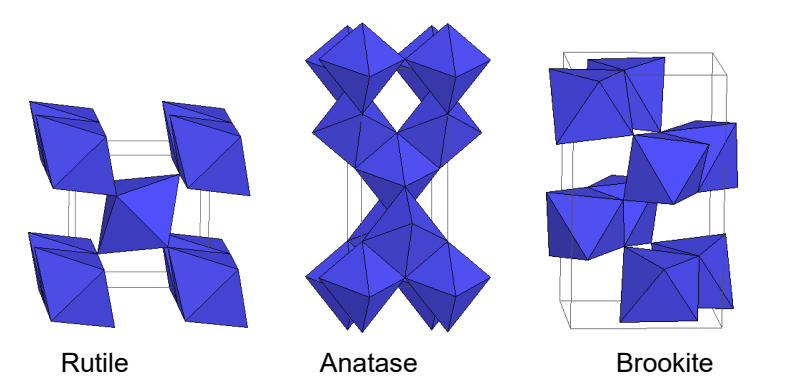
What is polymorphism?
When a substance can exist in more than one kind of structural form for the same composition, depending on conditions such as pressure and temperature.
Each polymorph will be thermodynamically stable under a unique range of conditions.
E.g. TiO2
What are allotropes?
When an element is able to form different structural forms in the same physical state.
Why is dimensionality important?
It is important in understanding the properties of solids.
The different structures give different properties, e.g. graphite is conducting, whereas diamond is an insulator.
How are anions and cations distributed in ionic solids?
The anions are much bigger than cations, therefore anions are close packed and cations are able to fit into the interstitial sites (the spaces between anions).
Cations are therefore more mobile.
The structures are mostly ionic and the overall charge of the bulk solid is zero.
When does an ionic crystal have a perfectly ordered structure?
Only at 0K, the crystal will have perfectly ordered atoms where every atomic lattice point contains an atom.
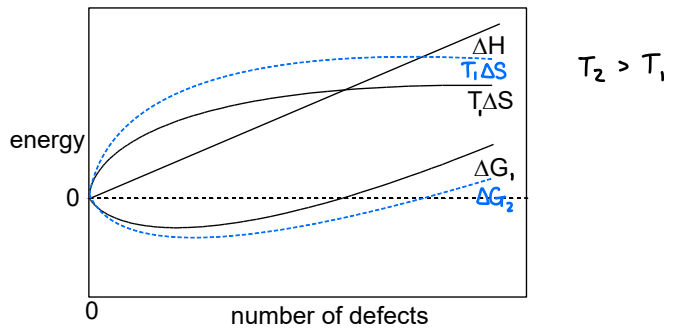
Why are defects present?
Above 0K, the defect form endothermically, driven by the increase in entropy.
At equilibrium, ΔG=0, therefore the number of defects is dependent on the ΔH for the formation and the temperature.
What are intrinsic defects?
Defects that occur due to the removal of an atom. There are no impurities.
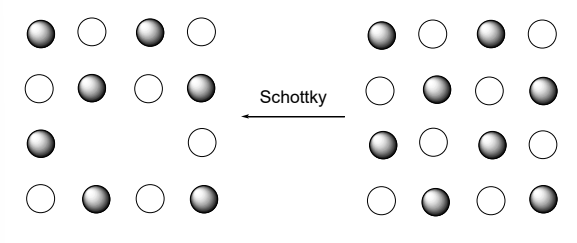
What are Schottky defects?
A pair of anion and cation vacancies are present in the lattice.
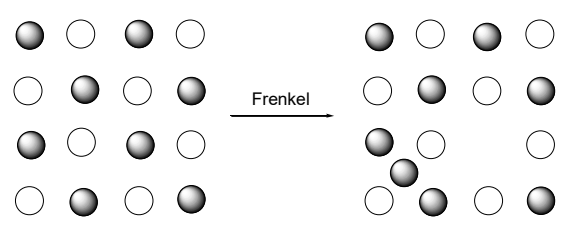
What are Frenkel defects?
An ion (usually the cation) moves into an interstitial site in the lattice.
What happens at the site of vacancy?
The lattice distort to minimise the loss in lattice energy.
The vacancies do not have to be adjacent and can be mobile.
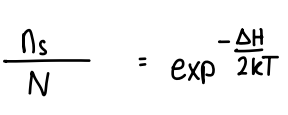
How do you find the proportion of defects?
Where ns = Schottky defects (can also be nf as Frenkel defects), and N = number of cation and anion sites per unit volume. ΔHs is the Schottky enthalpy of formation.
What is the trend in defect formation as covalency increases?
More defects form as covalency increases.
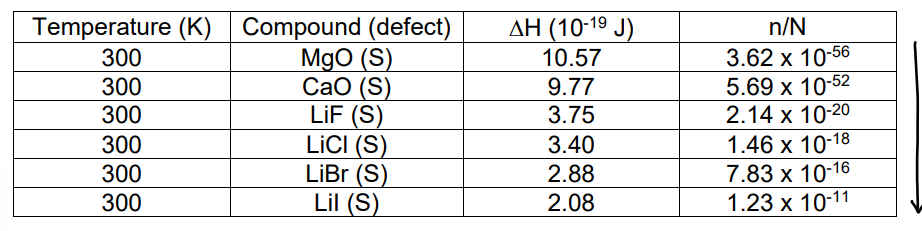
What is the trend in defect formation as temperature increases?
The number of defects increases as temperature increases.

How do intrinsic point defects affect ionic compound properties?
Even if the % of intrinsic point defects is small, they can have a significant effect on magnetic, mechanical and other properties. This is increased if defects cluster.
What are extrinsic point defects?
Defects caused by the introduction of different ions into the structure, also known as doping.
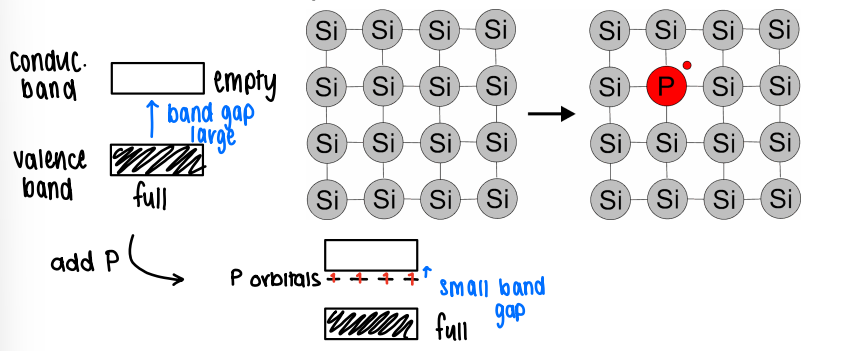
How does doping with P increase conductivity?
Upon addition of an impurity, such as phosphorus, there is an electron on the P which is left over following bonding. This electron is able to conduct and moves through the lattice.
Without the doping, the full valence band is full therefore the band gap is large. After doping, the phosphorus orbitals lie just below the conductivity band, therefore there is a small band gap.
What are non stoichiometric solids?
Following defects and doping, non stoichiometric solids form which gives the ratio of elements as not a simple whole number ratio.
They are distinct from other compositions as they have a common structure.
What is the rock salt structure?
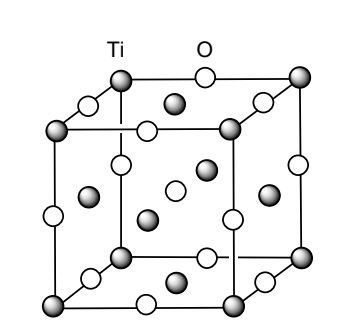
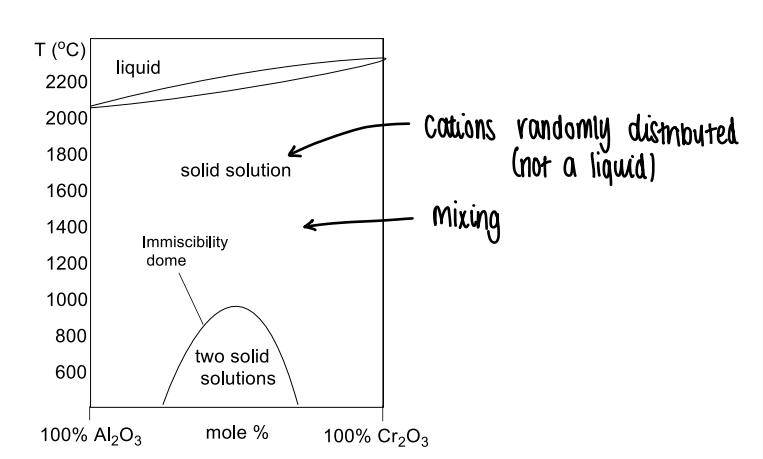
What are solid solutions?
A crystalline solid that can have continual variable composition for a given structure type.
The cations are randomly distributed within the structure.
What are substitutional solid solutions?
Where a new atom/ion replaces an existing atom (e.g. by doping).
The cations are similar in size and form a solid solution over a range of ratios.
E.g. Al2O3 and Cr2O3, the Al3+ and Cr3+ are randomly distributed.
What are interstitial solid solutions?
Other atoms are added into a structure.
E.g. carbon is added into Fe, giving FeCx (where 0 < x < 0.09).
How are solids dynamic?
Above 0K, the atoms/ions in compounds can move and respond to external stimuli, e.g. magnetic or electric field, pressure or temperature).
How do batteries allow long range movement of ions?
Batteries comprise of two electrodes and an electrolyte. The Li+ (in lithium ion batteries) must be mobile in all the electrodes and electrolyte material to allow current to pass.
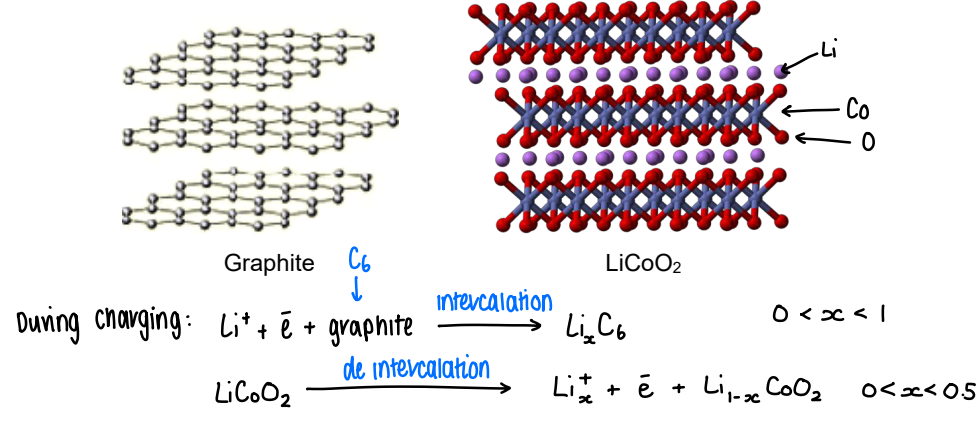
What is intercalation/deintercalation?
Species can be added/removed from host structures, this is needed for charge/discharge cycles.
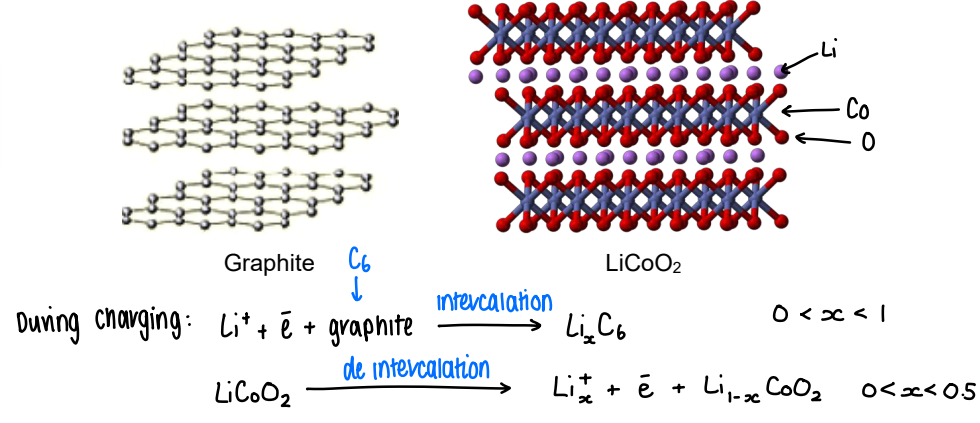
How is intercalation/deintercalation used to aid ion mobility?
Layers/channels/porosity is required to provide space for the ions to move freely.
This can allow movement of charge in batteries.
How is energy calculated?
Energy (Wh) = power (W) x time (h)
How do you calculate power?
Power (W) = voltage (V) x current (A)
How do you calculate Ecell?
Ecell = Ecathode - Eanode
What is energy density?
The energy per volume (units in WhL-1)
What is specific energy?
The energy per mass (units in Whkg-1)
What are the equations for lithium battery during discharge?

Why is a low specific energy of batteries achieved experimentally?
Only about 30% is achieved due to resistivity losses and the extra weight of terminals, case, separators, etc.
What are the goals of battery engineering?
To maximise energy density and have a long life, be cheap to manufacture and be recyclable.
What are the challenges with lithium batteries?
Intercalation/deintercalation: big structural changes could lead to mechanical stress, fracture and performance loss.
Uncontrolled Li metal growth (forming dendrites): leads to shorting and ignition of flammable electrolytes.
What is the SEI in batteries and why is it used?
SEI is the solid electrode interface. The growth of a secondary later on the electrode.
Helps to prevent degradation of electrolyte on contact with strongly reducing/oxidising electrodes and growth of Li dendrites.
What are piezoelectric materials?
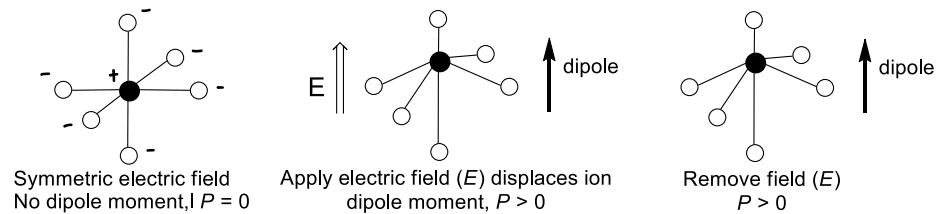
When a pressure/mechanical stress is applied to the material, there is a change in electric field in the crystal. Conversely, when an electric field is places across crystal faces, this changes the dimension of the crystal by causing expansion/contraction.
Converts kinetic energy to electrical potential energy.
How does a material obtain a bulk polarisation?
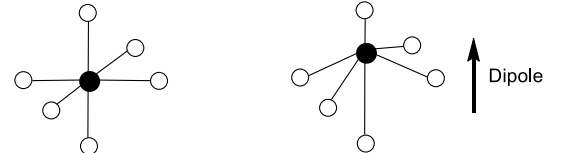
The material must have a non-centrosymmetric crystal structure to ensure dipoles do not cancel out.
To form a local dipole moment, the ion must be in an asymmetric site.
What are ferroelectric materials?
The dipoles within the molecule respond to an electric field (the energy is stored as electrical potential) and retain the polarisation after removal of the field.
What is dielectric permittivity?
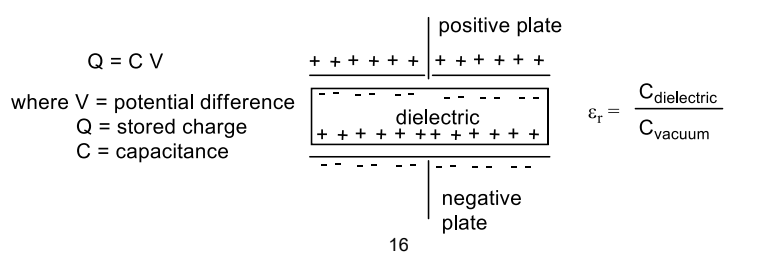
A measure of the amount of stored polarisation.
What are pyroelectric materials?
The dipoles respond to heat (e.g. from a photon) and convert heat to electrical potential.
They exhibit a net spontaneous polarisation that is temperature dependent, the thermal expansion and contraction of the lattice changes the size of the dipole and polarisation.
What are the properties of good dielectric materials?
They should have high dielectric strength (they do not break down at high voltages and become electron or ion conducting).
They have low dielectric loss (they do not lose electrical energy as heat in an alternating electric field).
How do you measure the stored charge of a dielectric material?
The stored charge is measured in a parallel plate capacitor and the dielectric permittivity is determined from this.
When is BaTiO3 ferroelectric?
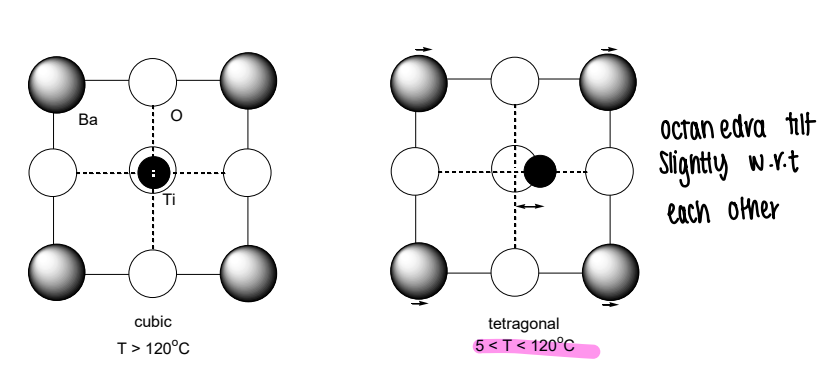
At temperatures above 120 degrees, the Ti atoms are symmetrically distributed in the TiO6 octahedra. This gives a cubic structure with no dipole.
Between 5-120 degrees, the Ti atoms are displaced along one of the octahedral axis by 10pm, resulting in polarisation. This gives a tetragonal structure which is ferroelectric.
Why do dielectric material structures distort?
The structure of the compound is dependent on the size, charge and preferred coordination number/geometry of the constituent ions.
For compounds with several elements, the ideal preferences for each ion may not be accommodated, therefore strain occurs. Significant strain results in distortion.
What is the perovskite structure?
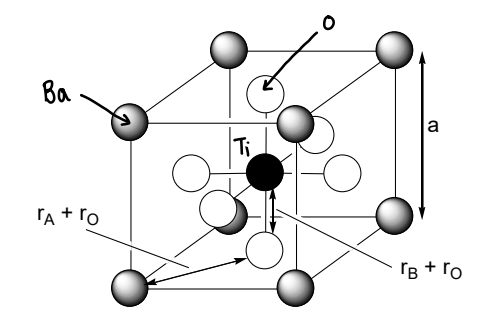
Has the ABO3 structure.
What is the tolerance factor?
The deviation from the ideal structure that is allowed.
For an ideal structure, the tolerance factor (t) = 1, as t deviates from this value strain is introduced due to one or both of the cations not fitting properly.
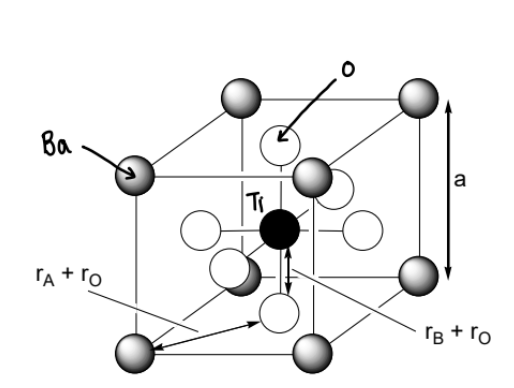
How do you calculate the lengths for a perovskite?
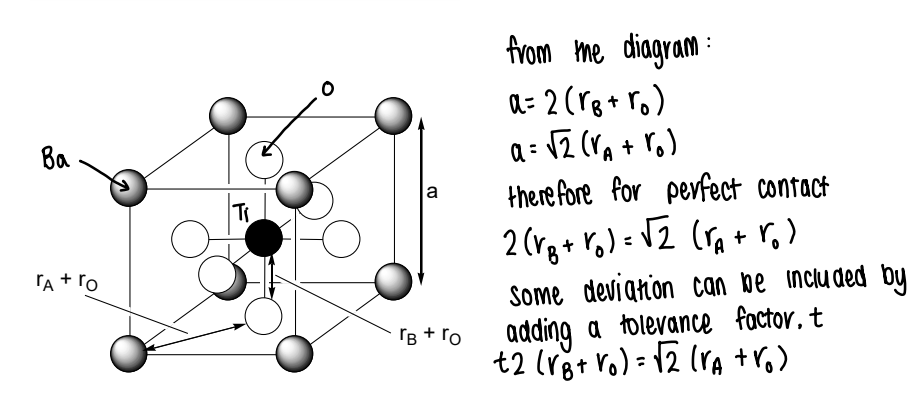
What is the ideal tolerance factor for perovskite?
Between 0.85 < t < 1.06 a distorted perovskite forms.
Outside of this range a non-perovskite structure is adopted.
What does SrTiO3 have a t value closer to ideal than BaTiO3?
In the Sr compound, there is a good fit of the atoms, which is almost ideal.
In the Ba compound, the Ti ion is slightly too small for the O6 octahedra.
How is the BaTiO3 retain the perovskite structure over 120 degrees?
Over this temperature, the thermal motion of the Ti atoms creates enough chemical pressure to retain the ideal cubic perovskite structure.
Under this temperature, the thermal motion no longer compensates for the strain and so the structure distorts.
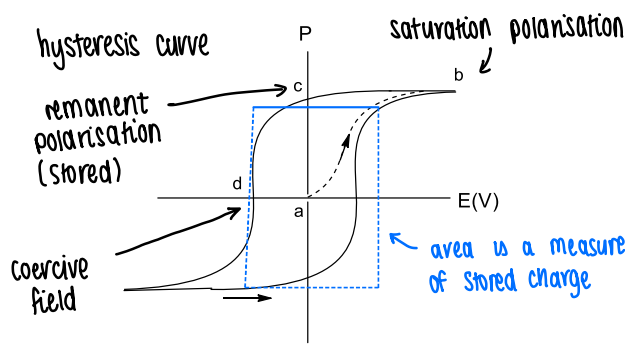
What is remanent polarisation?
Polarisation remaining when the electric field returns to 0.
What is the coercive field?
The reverse field required to depolarise the material.
Why do ferroelectric exhibit a hysteresis curve?
Ferroelectrics exhibit hysteresis because their dipole domains retain alignment after the external electric field is removed. An opposite electric field is required to reverse the polarization, so polarization lags behind the applied field, producing a hysteresis loop
Hysteresis allows charge to be stored, therefore allowing ferroelectrics to be used as capacitors.
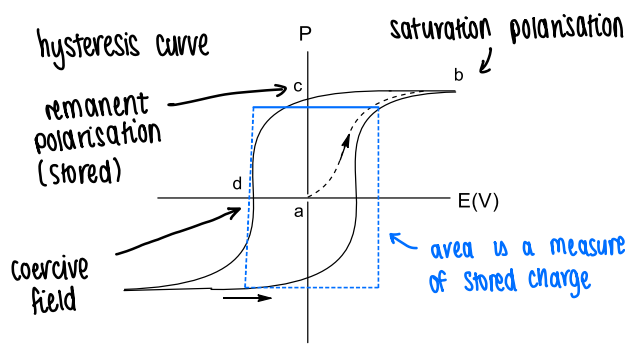
What does the hysteresis curve show?
From a to b, the electric field is applied and individual dipoles are aligned.
At b, the sample reaches saturation polarisation.
From b to c, the electric field is returned to 0 but the sample remains polarised (remanent polarisation).
From c to d, a coercive field in the opposite direction is applied to depolarise the sample.
Why are many piezoelectric compounds composed of tetrahedral groups?
Tetrahedral groups distort under stress, the tetrahedra also do not have a centre of symmetry leading to non-centrosymmetric structures.
What are piezoelectrics used for?
Used to convert between mechanical energy and electricity. Often used for transducers for earphones, inkjet printers, etc.
Can be used for crystal oscillators (watches), applying the alternating electric field causes the crystal to vibrate.
What is is ZnO and how is it an example of a pyroelectric material?
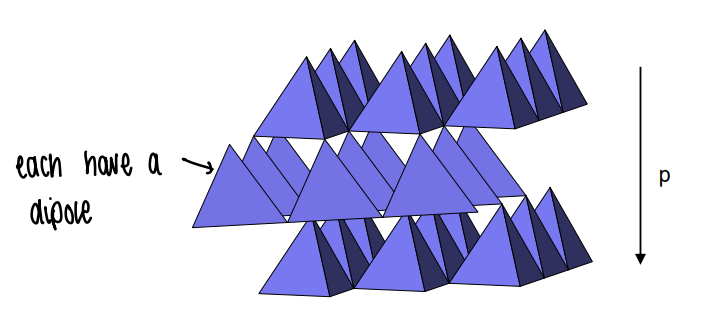
It has a wurtzite structure consisting of ZnO tetrahedra which have dipoles that all point in the same direction giving rise to bulk polarisation.
The polarisation cannot be reversed.
Changing the temperature changes the extent of polarisation.
What are pyroelectrics used for?
Used in systems where an electrical response to temperature is useful, e.g. infrared radiation detectors.
Why are transition metals and lanthanides used for magnetic materials?
They can have partially filled valence orbitals that result in unpaired electrons and magnetism.
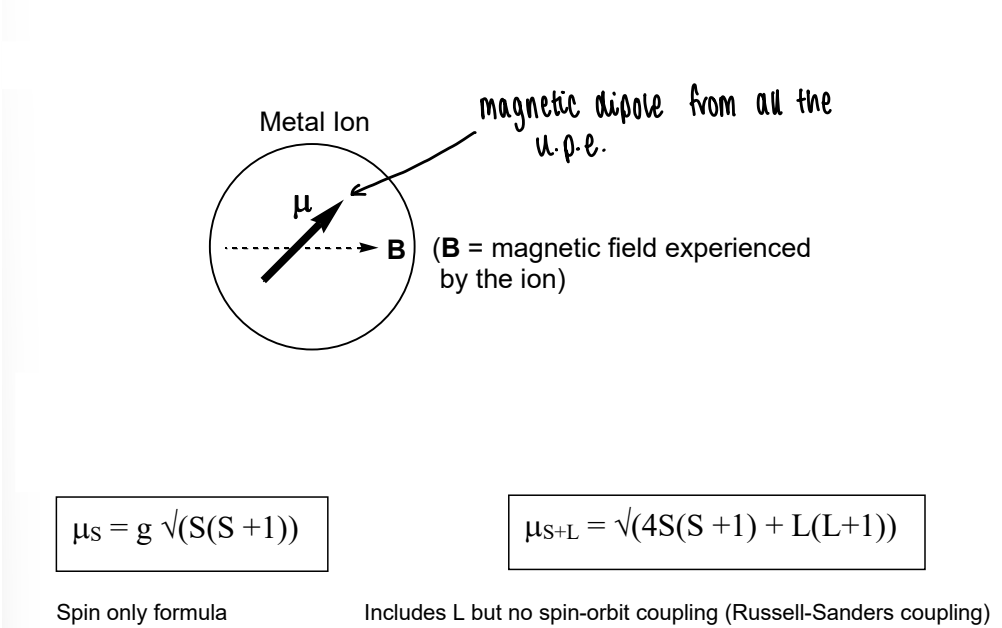
The angular momentum (J) of the u.p.e. gives rise to magnetic behaviour.
How do you determine the magnetism of individual ions?
Individual ions with u.p.e. have a magnetic dipole moment, the size of this dipole moment depends on the spin and orbital angular moments.
Where S = total spin angular momentum
L = total orbital angular momentum
g = g factor.
What causes orbital angular momentum?
Due to the motion of the electron about the nucleus.
In 1st row TMs, the orbital momentum can be quenched as d-orbitals are no longer degenerate and electrons are localised in chemical bonds.
Why are heavier TMs and actinides strongly magnetic?
They are heavier, therefore spin-orbit coupling is large and Russell-Sanders coupling is used.
Large spin orbit coupling gives rise to large moments.
What is magnetic susceptibility?
A measure of how magnetic a material is, it varies with temperature and applied magnetic fields.
What is paramagnetism?
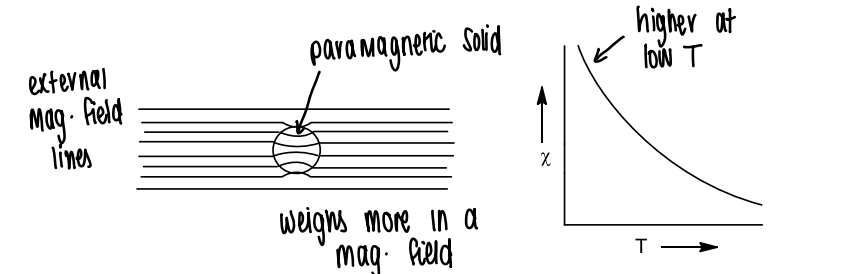
Magnetism observed in compounds containing ions with u.p.e, however these ions do not strongly interact with each other. The dipoles align weakly with an external magnetic field.
As temperature increases, the magnetic susceptibility decreases.
Why do paramagnetic materials have a strong temperature dependence?
As temperature decreases, the dipoles of the ions begin to align parallel (the lowest energy configuration) to an external field.
Paramagnetism stronger at lower T.

What is antiferromagnetism?
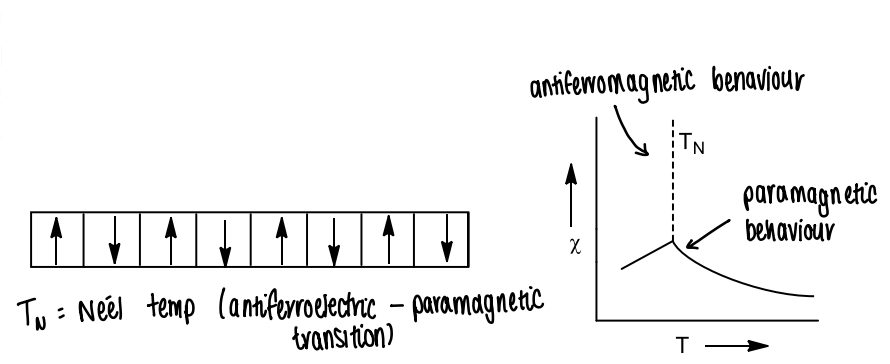
A cooperative magnetism, no external applied magnetic field is required to align the ions antiparallel.
This antiferromagnetic behaviour occurs at a specific temperature, the Neel temp.
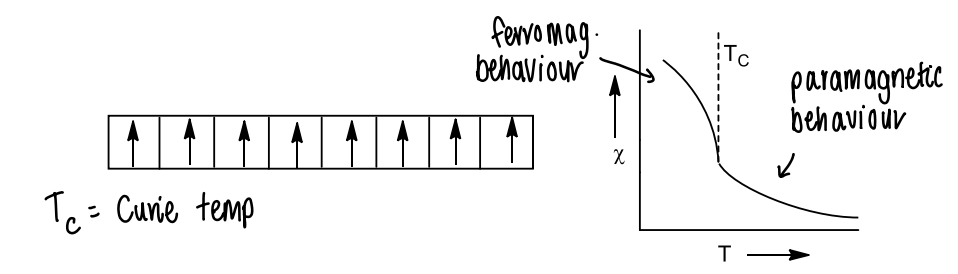
What is ferromagnetism?
A cooperative magnetism, no applied field is needed to align the ions parallel.
Occurs at a specific temp, the Curie temp.
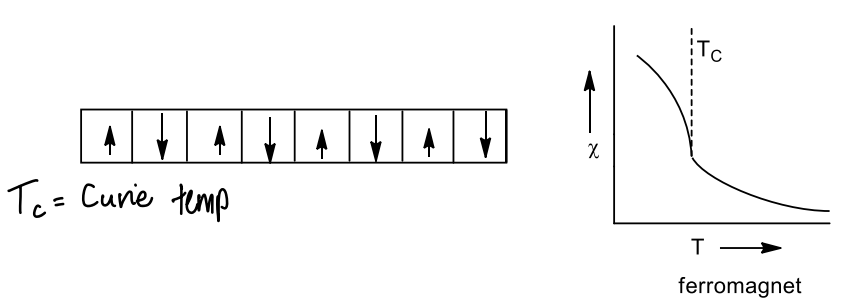
What is ferrimagnetism?
A cooperative magnetism, there is partial cancellation of ions with different magnetic moments.
Occurs at a specific temp (the Curie temp).
What elements is ferromagnetism associated with?
Associated with metals that have an electronic band structure.
E.g. Fe, Co, Ni, Gd, Tb
What is superexchange?
Where anions mediate the exchange of magnetism between metal ions.
Occurs via the overlap of atomic orbitals on the anion (p orbitals) and the metal (d orbitals).
How does superexchange lead to antiferromagnetism?
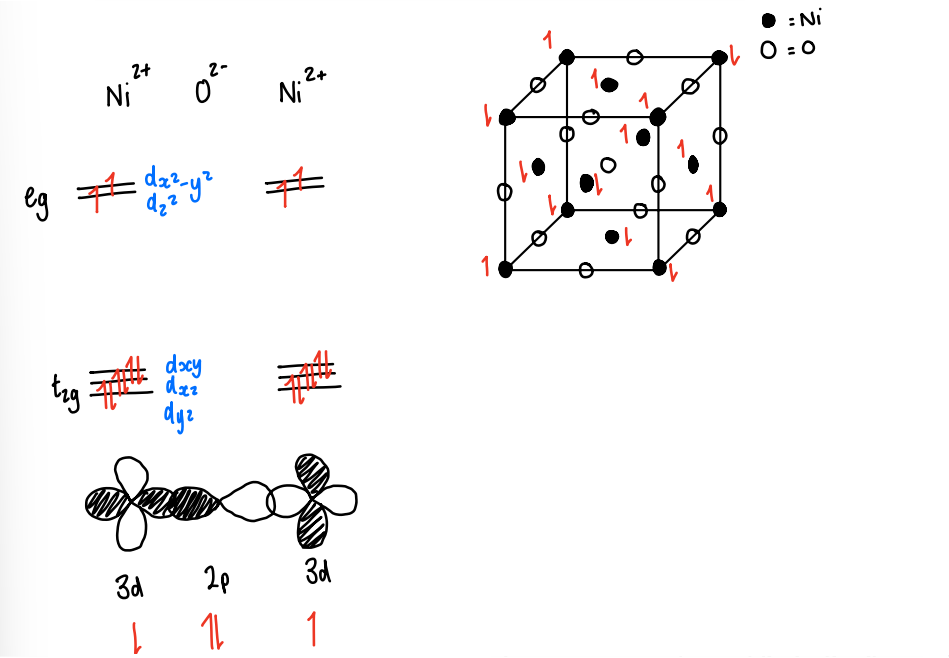
In first row TM monoxides, the rock salt structure is adopted with the metal and oxygen in octahedral sites.
The two eg orbitals contain an u.p.e, these orbitals overlap with the filled oxygen 2p orbital. The electrons align antiparallel, giving an overall antiferromagnetic coupling.
This effectively forms two Ni lattices with Ni spins ‘up’ and ‘down’, forming a sublattice.
What happens above the Neel temperature (TN)?
The thermal energy is greater than the superexchange interaction, therefore the material becomes paramagnetic.
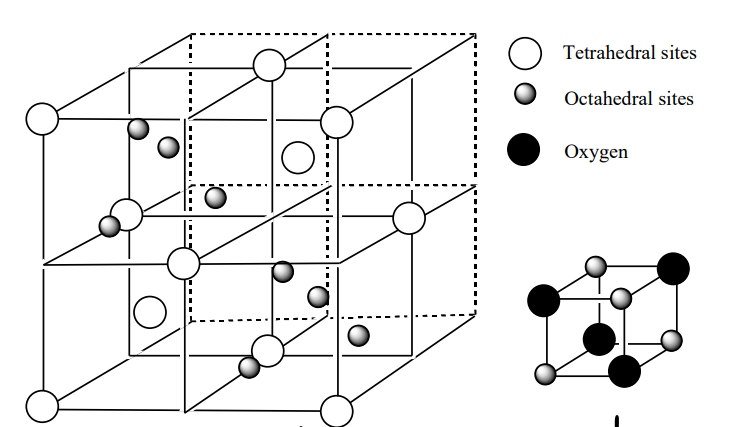
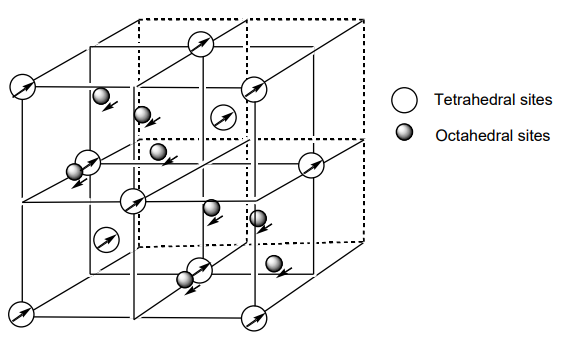
What is the spinel structure?
Has the formula AB2X4.
Based on a cubic close packed array of anions.
Formed by filling 1/8 of the tetrahedral sites and ½ of the octahedral sites.
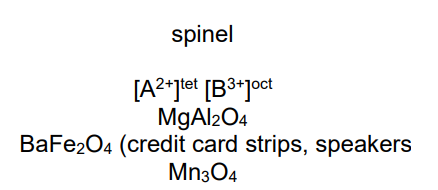
When do normal spinels form?
A2+ is tetrahedral, B3+ is octahedral.
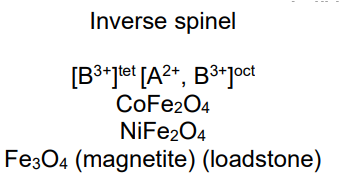
When do inverse spinels form?
B3+ is tetrahedral, A2+ and B3+ are octahedral.
What causes the preference for normal or inverse spinels?
Electrostatics: the M3+ prefers the octahedral site and the M2+ prefers the tetrahedral site.
Size: the smaller metal cation prefers the smaller tetrahedral site.
Crystal field stabilisation energy: the ion with the larger CFSE goes into the octahedral site.
How do you estimate the magnetic moment of ferrimagnets?
μ = gS gives a rough estimate for the magnetic moment for each ion.
The saturation magnetic moment is then a vector sum of the individual ion moments.
What are the magnetic properties of coupling between octahedral and tetrahedral sites?
Coupling between oct-oct and tet-tet sites is weak, therefore it is weakly ferromagnetic.
Coupling between oct-tet sites is strong and antiferromagnetic.
What happens to magnetic materials below TC?
The magnet materials are divided into domains, in each domain the ions are aligned through strong exchange. The domains are not aligned with respect to each other.
Entropy drives the domain formation.
On application of an external magnetic field the domains align in the same direction as the field. This causes saturation magnetisation.
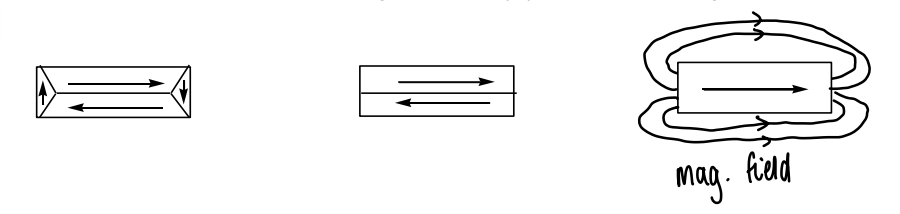
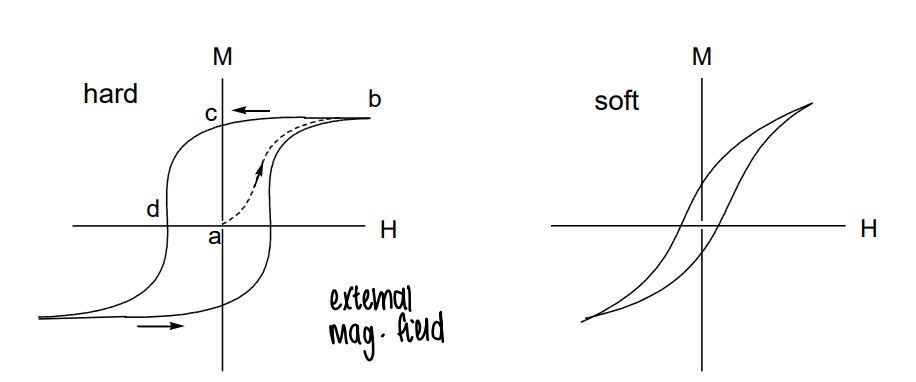
What are hard and soft magnets?
The hard magnet is useful for magnetic memory as the domains retain the magnetisation much better.
The soft magnet is useful for power transformers.
What are superconductors used for?
Used for the generation of large magnetic fields (such as NMR) as they can support very large currents without resistive heating.
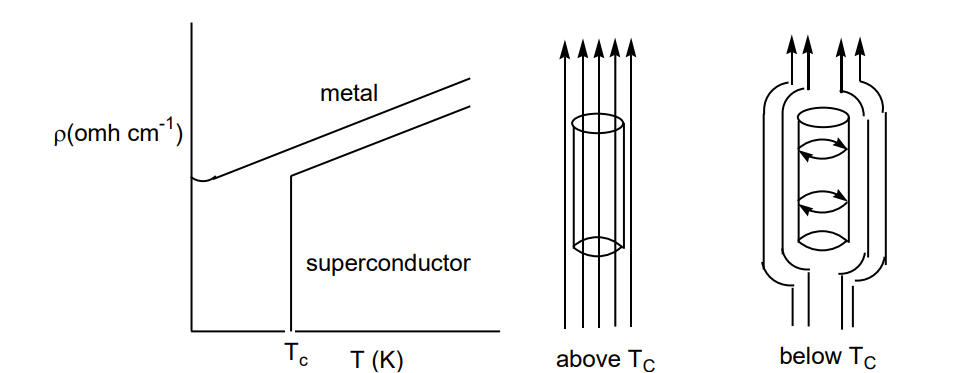
What is a superconductor?
A material that conducts electricity with zero resistance after certain temperature.
Below a critical temp (TC) there is 0 electrical resistance, the magnetic flux is expelled and B=0.
Why are cuprates good superconductors?
They have high TC values.
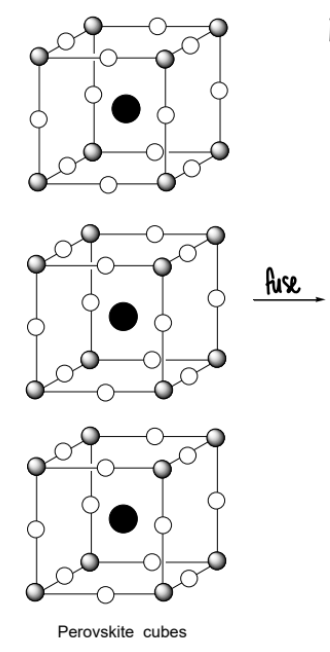
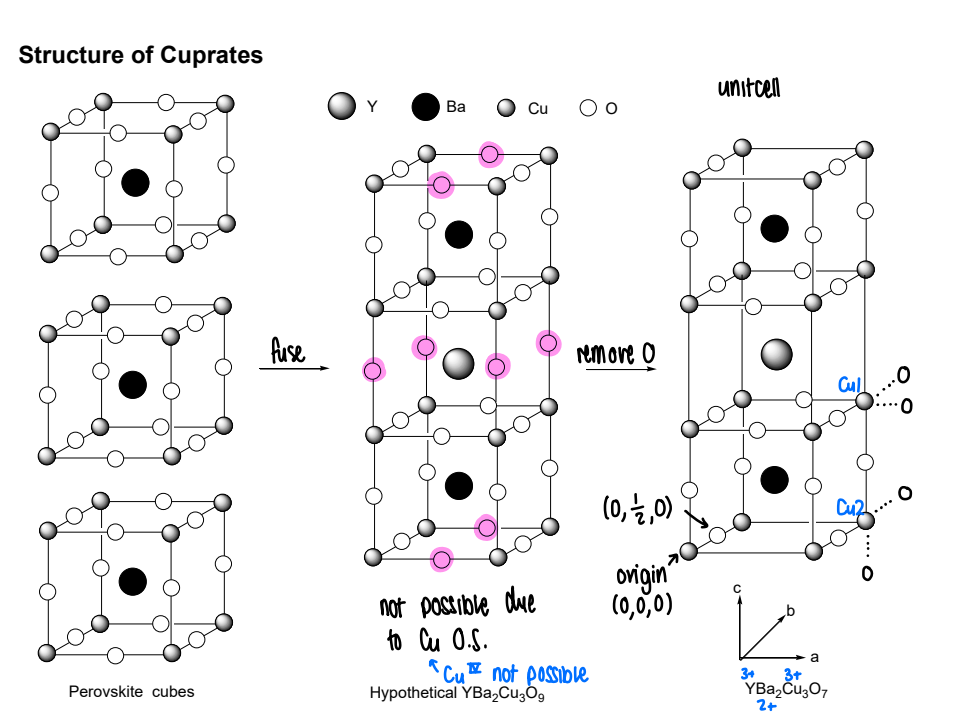
What is the structure of cuprates?
There are two copper sites, a distorted square pyramid of Jahn-Teller distorted Cu2+, and a square planar geometry.
Oxygen is removed from the basal planes leading to linear geometry for the Cu atoms linking the CuO2 layers.
The structure is orthorhombic.
In cuprates, what determines the TC value?
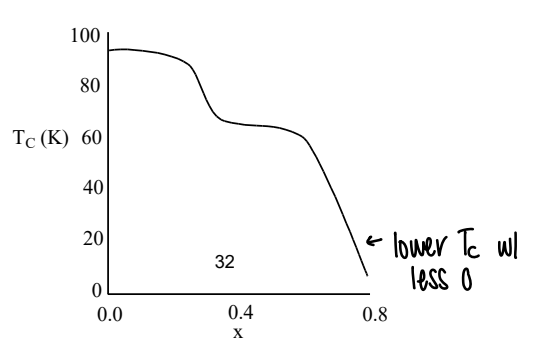
The TC is very dependent on the oxygen content.
The TC increases with oxygen content.
Where x is the number of oxygens in YBa2Cu3O7-x
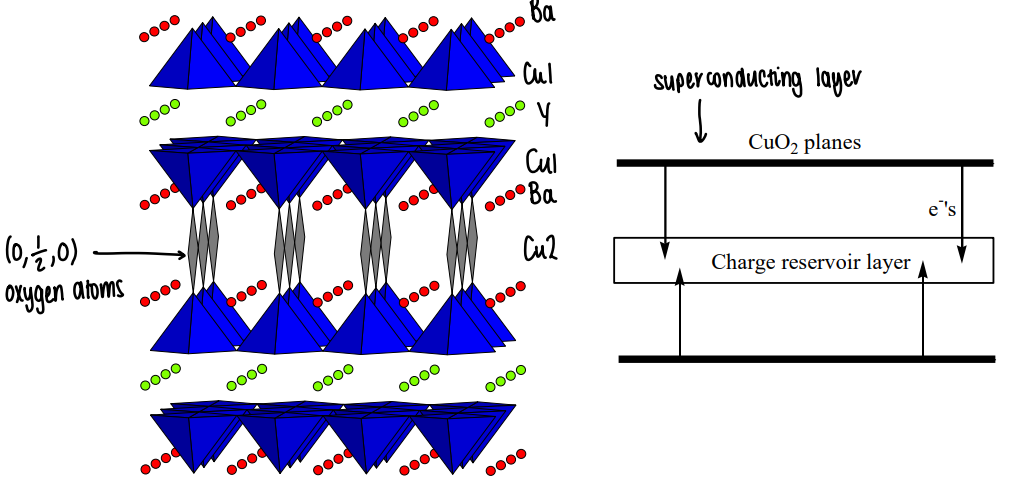
What are the important structural features of the CuO2 layers in cuprates?
The square planar layers are separated by ‘charge reservoir layers’ that control the average Cu oxidation state in the layers. The CuO2 planes form the superconducting layers that allow electrons to move into the charge reservoir.
The average O.S. should be > 2+.
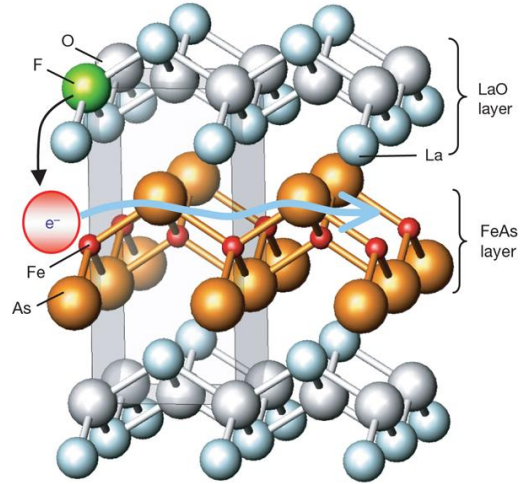
What is the structure of FeAs superconductors?
FeAs layers separated by LaO layers, similar to the structure of cuprates.
What are fullerides and how do electrons move within the structure?
They are synthesised by intercalation of electropositive metals into a C60 lattice.
There is electron transfer from an electropositive metal to the C60 to give the fulleride (C60n-). The neighbouring orbitals of the C60 molecules can interact forming bands, therefore the electrons can move throughout the structure (similar to metals).
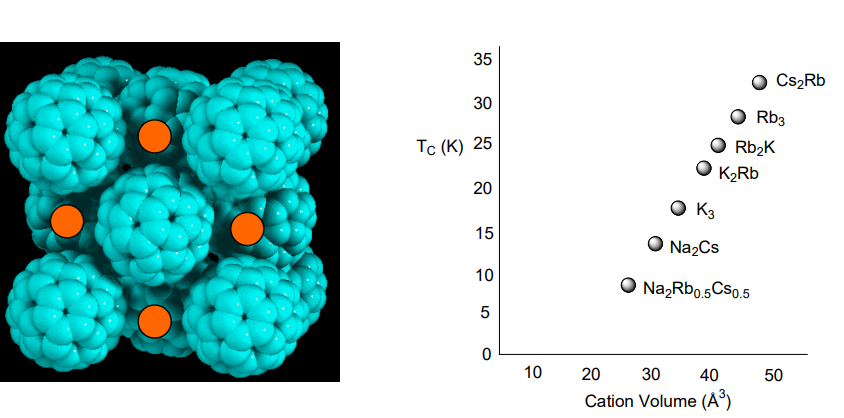
What is the structure of A3C60?
They have a cubic structure in which the tetrahedral and octahedral interstitial sites are filled.
The TC is proportional to the average cation volume.
What is the theory of superconductivity?
The mutual attraction of two conduction electrons mediated by lattice vibrations.
We can quantise vibrational waves of atoms in a solid as phonons, the electron-phonon coupling is the mechanism by which electrons can be attracted to each other (a Cooper pair).
These two electrons do not have to be close together.
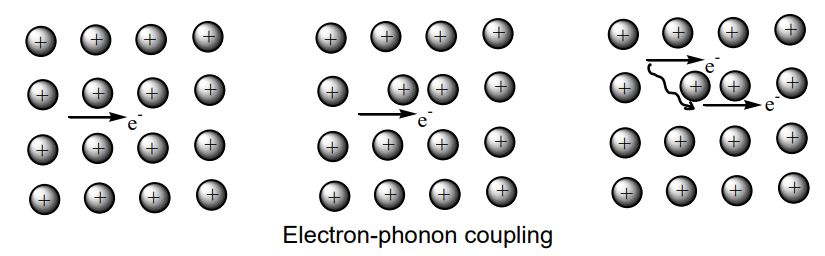
What are Cooper pairs?
Two electrons weakly attracted through phonon-mediated coupling.
How is TC related to the mass of a lattice ion.
The TC is inversely proportional to √M.
Why are metals more resistant than superconductors?
The resistance of metals is due to scattering of electrons by phonons. This causes resistance to increase with temperature as more phonons exist at higher T.
For superconductors, Cooper pairs are not scattered and so have no resistance.
Why is TC low in superconductors?
Because the binding of Cooper pairs is usually weak. This is because there is repulsive electrostatic interaction between two electrons, the electron-phonon coupling must be strong for the Cooper pair to remain intact and so must be stronger than electron-electron repulsion.
What are nanomaterials?
Materials which have at least one dimension in the nm range (10-100nm), bridging the properties between molecules and solid state materials.
Many properties are size dependent (e.g. optical, magnetic, electronic, catalytic, mechanical)
How do you calculate the number of atoms in a nanoparticle?
Assume it is a sphere, therefore calculate the volume of the atoms.
Then calculate the volume of the nanoparticle.
Divide the volume of the nanoparticle by the volume of the atom.
Assume a ~74% packing density.

How do you calculate the number of atoms on the surface of a nanoparticle?
Calculate the surface area of the atom, then the surface area of the nanoparticle.
Divide the SA of the nanoparticle by the SA of the atom.
Assume a 90% packing density.
