ALL FELINE QUIZ
 Call Kai
 Learn
Learn Practice Test
 Spaced Repetition
 Match
Match Flashcards
 Knowt Play
1/31

There's no tags or description
Looks like no tags are added yet.
Name | Mastery | Learn | Test | Matching | Spaced | Call with Kai |
|---|
No analytics yet
Send a link to your students to track their progress
32 Terms
FeLV and FIV are both retroviruses. What makes these different to other virsues?
Insert their DNA into the invaded cells dna - lifelong infection.
gag-pro-pol-env sequence
pol = reverse transcriptase (DNA polymerase + intergrase)
What type of contact transmits FeLV? give examples.
close and freindly contact
eg saliva, urine, faeces milk
There are three possible disease status outcomes after an infection with FeLV. what are these and describehow they occur.
Persistent viraemia (clinical disease). poor immune system / strogn infection, leads to death
virus elimination (clinically normal) virus eliminated by strogn immune response
Persistent latent infection (clinically normal) rare viraemia, shedding after stress. Strong immune responnse but virus not eliminated.
What are the symtoms of FeLV?
RAIN
reproductive failure
anaemia
immunodeficiency
neoplasia
What disease is most common cause if anaemia in cats?
FeLV
An owner comes to you with 5 kittens all with anaemia, some with tumours and some with secondary infections, you diagnose FeLV primry stage infection. What is your plan for restesting?
You test all cats - they are all +.
after 12 weeks, test again
those who are + should be removed - persistant viraemia
those who are - should be retested every 6-12 months for life.
test any new cats entering colony
How is FIV transmited? Give exmaples.
UNFRIENDLY CONTACT
saliva - bitimg
(also transplacental / milk?)
Describe testing methods for FIV vs FeLV
PCR tests for the provirus IN the cells DNA
RT-PCR tests for th viral RNA genome
For both : use in-house lateral flow tests
LFT for FIV tests for the ant I body. antibodies remain high for all infection, cannot clear virus.
LFT for FeLV tests for the antig E n. As cats can recover / be latently infected, so antibodies fluctuate.
Describe how cats develop feline infectious peritonitis and the types of virus involved.
Must forst be infected with FCoV (feline enteric coronavirus), which CAN but will not always develop into FIP. It occurs due to a common but sporradic mutation of FCoV.
infection with FCoV often occurs via faecal oral transmission in kittens.
What makes the difference in recovery, dry and wet FIP - and what are these?
Will recover - no disease, if there is a good CMI response.
Partial CMI leads to dry FIP - invariably fatal, fluctuating fever, anorexia, depresion, lethargy, jaundice
Poor CMI leads to wet FIP - invariably fatal, accumulation of lfuid in body cavities, depression inaopetentce, jaundice
How does FIV effect the immune system?
It is an immune comlex disease - deposit in walls of small blood vessels causing vasculitis.
ehances macrophage uptake of complexes
more antibodies = acceleration of disease.
A cat is bought in to your practice with a mild fever and enteritis. The owner thinks it may have eaten something, so you send it away as it seems well. A week later the cat returns, it seems depressed and lethargic. The owner states it hassn’t been eating but its abdomen is swollen and dull upon percussion. Its mucous membranes are yellow tinted. It also has a large fever, which is nto responding to medication.
What disease is this?
You take a sample of fluid from the abdomen. If your dianosis is correct, what do you expect to see?
What is the prognosis?
FCoV = enteritis. Devloped in wet FIP.
Viscus straw coloured fluid that froths upon shaking, and clots on standing. - FIP lfuid.
No treatment. poor outcome.
What two viruses can cause feline panleucopenia?
Is this preventable?
feline infectious peritonitis
parvovirus
YES vaccination is sucessful
List the symptoms of feline panleucopenia. WHY do these happen?
the virus targets rapidly dividing cells.
villus crypt epithelium - enteritis
bone marrow / lymphoid tissue - panleucopenia
late gestation (cerebellum) - cerebellar hypoplasia
early gestation - foetal death, abortion.
Clinical signs include - sudden death. diarrrhoea, pyrexia, depression, panleocpenia
Name two feline enteric viruses
feline panelucopenia
feline enteric coronavirus
How can cats catch cow pox?
From rodents!
A barn cat comes in with some mild lesions on its face / ears. It is later summer. What culd this be - what is the prognosis?
Cow pox! should self-resolve as long as cat healthy. warn owner as it is zoonotic
Why are cats at risk of ctaching H5N1? What are the symptoms and prognosis for this? Is it preventable?
scavangers / hunters- catch weakened / sick bords that coud be infected with influenza.
severe - fatal disease. fever, lethargy, conjunctivits, laboured breathing. can sread to other cats.
There is a vaccine ! prevents severe clinical disease
List the core vaccines for cats in the UK
Feline parvovirus
felive calcivirus
feline herpesvirus - 1
Name three types of bacteria that cause infections in cats
Mycobacteria
Mycoplasma
Bartonella
What are the signs of a mycobacterial infection in a cat?
cutaneous nodules, drainig sinuses, pannicultis (inflammation of skin fat layer)
What pathogen causes feline infectious anaemia? How?
mycoplasma haemoelis
adheres to and damages erythrocytes
An owners child was scrated by her cat. Initially it was justa small lesion, but now the child has developed lymphadenopathy (swollen lymph nodes). What could this be?
Cat scratch disease - bartonella heneslae
What are the two main feline RT infections causing ‘cat flu’?
Feline herpesvirus
Feline calcivirus
A cat comes in with sneeing, nasal discharge, conjunctivits and occuar discharge. It also hs a fever. what disease can casue this?
Feline herpes virus
main diagnositc symptom is the conjunctivits
Can also lead to chronic rhinitis
A cat comes in with conjunctivits, oral ulceration, nasal discharge, a fever and lamness. What coud this be?
Feline calcivirus
lameness, ulcers and conjunctivitis are gieawasy
What is meant by chronic stomatitis /
server ersistant mouth ulcers. thi is associated with FCV.
A cat comes in with conjunctivits, oral ulceration, nasal discharge, a fever and lamness. What coud this be?
After a few days, the symptoms change - facial and paw oedema, necrosis and ulceration. there is also some jaundic, resp disease and fever. What is this?
Initiall typical FCV.
Develops into virulet strain - haemorrhagic syndrom, viral systemic disease.
Describe the differencees in symptomsof FCV / FHV
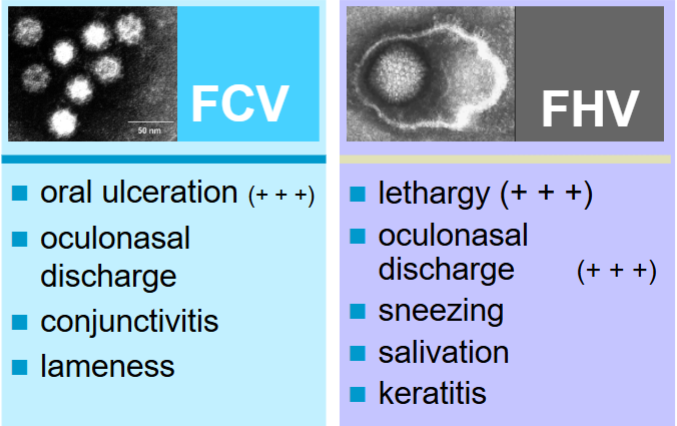
Describe the differences in FHV / FCV virus carrires
FCV - persistent infection, no clinical disease, shed always, recovery.
FHV - latency +- reactivation, life long.
A cat comes in with
Pyrexia
Sneezing
Nasal discharge
Sub-mandibular lymphadenopathy
Coughing
Dyspnoea/cyanosis -
bronchopneumonia
What do you suspect?
Bordertella bromnchiseptica
causes cilliary stasis.
What disease causes unilateral → bilateral conjunctivits and chemosis?
chlamydophila felis
gram negative parasite