3.4.3 Monopolistic competition
 Call Kai
 Learn
Learn Practice Test
 Spaced Repetition
 Match
Match Flashcards
 Knowt Play
1/5

There's no tags or description
Looks like no tags are added yet.
Name | Mastery | Learn | Test | Matching | Spaced | Call with Kai |
|---|
No analytics yet
Send a link to your students to track their progress
6 Terms
What is monopolistic competition?
A form of imperfect competition, so demand curve is downward sloping - lies between two extremes of perfect competition and monopoly
Examples include hairdressers, restaurants, estate agents (more likely to exist in real life)
Characteristics of monopolistic competition
Large number of buyers and sellers
All act mostly independently and are relatively small - so no one buyer or seller has large market power or price setting power
No/low barriers to entry and exit
Allows new firms to enter market easily when supernormal profits are being made, but also incumbent firms can leave easily during losses - therefore, only normal profits in the long run
Perfect knowledge/information
Consumers know all prices and all information about the products - firms know all costs and all producing methods available
Slight product differentiation
Firms produce somewhat non-homogeneous goods or services - therefore, some firms have little price setting power, so curve is downward sloping, but still quite elastic as good are still similar
Profit maximisation
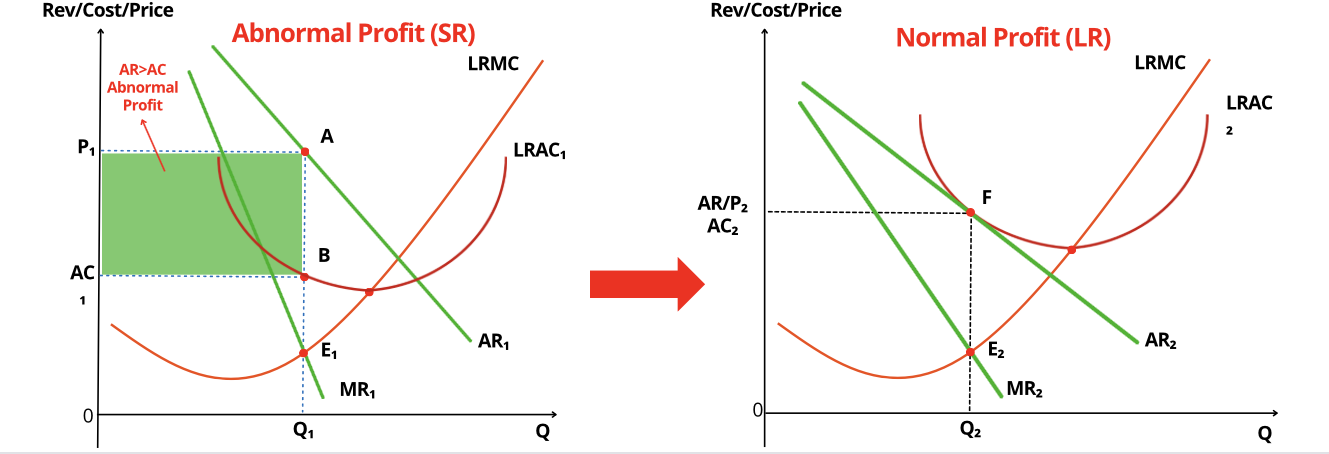
Short run supernormal profits to long run normal profits
In the short run, firms can make supernormal profits (AR>AC) - however, in the long run, due to low barriers to entry and perfect knowledge, new firms will be attracted by abnormal profits and will join the market, competing away the profits leading to normal profits only (AR=AC)
However, realistically, information is likely to be imperfect and so firms will not enter market as they are unaware of abnormal profits - firms are also likely to differ in size and costs, as well as products (e.g. Starbucks), which may allow them to retain supernormal profits in the long run
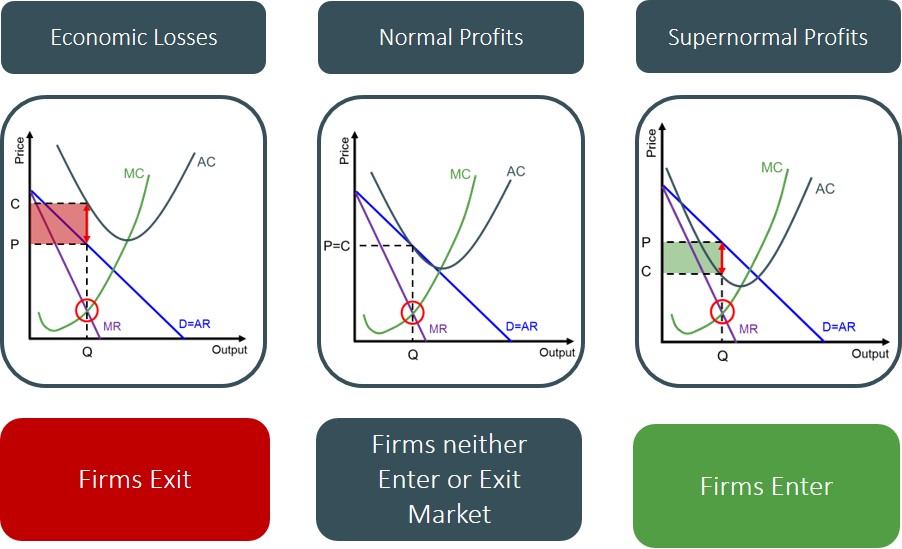
Short run economic loss to long run normal profits
In the short run, firms can also make a loss (AC>AR) - however, these incumbent firms will just leave the market due to low barriers to exit, which increases demand for firms that are still in the market, therefore those firms are earning normal profits (AR=AC)
Efficiencies in monopolistic competition
In the long run, firms can only make normal profits, therefore are not allocatively or productively efficient at the profit maximising point (MC=MR) - since demand curve is downward sloping, P>MC and MC never equals AC
In the short run, firms could have dynamic efficiency due to supernormal profits, which could be used to further differentiate and innovate products (e.g Starbucks branding) - however, in the long run, most likely no dynamic efficiency and only normal profits
Firms are also very small so struggle to receive finance or have enough retained profits to reinvest (No EoS)
Large number of buyers and sellers, perfect knowledge, and low barriers to entry means there is X-efficiency - firms delivering too high prices or low quality are just forced out of business
Main difference to perfect competition
Goods are slightly differentiated, therefore, firms may have some price setting power, hence less is sold at a higher price and firms may not necessarily be producing at the lowest cost
However, consumers may enjoy greater choice and firms may also benefit from some EoS