Criminal procedure - Arrest and charge
 Call Kai
 Learn
Learn Practice Test
 Spaced Repetition
 Match
Match Flashcards
 Knowt Play
1/19

There's no tags or description
Looks like no tags are added yet.
Name | Mastery | Learn | Test | Matching | Spaced | Call with Kai | Chat |
|---|
No analytics yet
Send a link to your students to track their progress
20 Terms
NZBORA s 22
‘Everyone has the right not ot be arbitrarily arrested or detained’
Arrest =
restraint or apprehension (typically by a police office - physical or not) for principal purpose of bringing person before Court. Person is no longer free to go as they please and must remain in the presence of or subject to direction by the arrester.
Crimes Act 1961, s 39
Arrester able to use force necessary to overcome resistance (police + citizens)
Most common statutory power for arrest without warrant is s 315 Crimes Act 1961
finds someone disturbing the peace or committing an offence punishable by imprisonment.
Good cause to suspect of having committed a breach of the peace or an offence punishable by imprisonment.
(NOTE: suspect = more than mere speculation. Good cause = objective test
Rights upon arrest ss 21-27 NZBORA + what other place are these laid out
21- right to be free from unreasonable search and seizure
22 - Not to be arbitrarily arrested
23 - lays out rights at arrest e.g. informed for the reason, can get a lawyer without delay, be treated with humanity, charged promptly etc.
24 - rights of those charged - may be released on bail unless there is a good reason not to, lawyer, told what charge and it’s details, adequate time to form a defence
s25 - minimum standards of procedure - fair hearing, presumed innocent until proven guilty etc.
s 26 - no retroactive penalties (if it wasn’t an offence when you did it then you can’t be charged) - can’t be repunished for an offence you’ve already been acquitted or sentenced for.
s 27 - natural justice rights
Practice Note on Police questioning
what rationales do there rights upon arrest engage
supportive of burden of proof, presumption of innocence, other procedural rights, and generally the fair treatment of the defendant by the state.
Promotes reliability of admissions (miscarriages caused by past improper police questioning e.g. Teina Pora)
Practice note on police questioning in relation to questioning and charging people
1. A member of the police investigating an offence may ask questions of any person from whom it is thought that useful information may be obtained, whether or not that person is a suspect, but must not suggest that it is compulsory for the person questioned to answer.
2. Whenever a member of the police has sufficient
evidence to charge a person with an offence or
whenever a member of the police seeks to question a
person in custody, the person must be cautioned
before being invited to make a statement or answer
questions.
What caution should be given during questioning or on arrest?
The caution to be given is:
(a) that the person has the right to refrain from making any statement and to remain silent
(b) that the person has the right to consult and instruct a lawyer without delay and in private before deciding whether to answer questions and that such right may be exercised without charge under the Police Detention Legal Assistance Scheme. (so that people don’t say no because they can’t pay for it)
(c) that anything said by the person will be recorded and may be given in evidence
issues surround/with rights upon arrest (4)
Criminal procedural rights have faced challenge in NZ and overseas in relation to the investigation and prevention of terrorism (in particular, rights such as continued detention without charge)
Targeting of particular groups (gang member, sex
offenders etc
The admissibility of confession evidence where improper questioning occurred dealt with under three different headings in Evidence Act 2006.
Section 28 (reliability), s 29 (oppression) and s 30 (improperly obtained evidence)
Charging procedure
Initial decision to charge made by Police
Then reviewed by prosecutor (see test on other FC)
P’s should only commence a prosecution if BOTH tests are met
Test for prosecution
1) Evidential test - is there enough evidence to prove the charge beyond reasonable doubt
2) Public interest test - does the public interest require a prosecution to be brough
(MUST meet BOTH )
Why such a detailed test for deciding when to prosecute?
Because there's significant prosecution discretion which then has risks;
May be used unfairly, don’t want the ones in Invercargill for driving whilst suspended but people in south Auckland to not charge that. Make more equality before the law.
The onerous nature of the criminal process ‘process is the punishment’ and therefore the importance that only those cases where it is really appropriate be engaged in the criminal justice process.
Evidential test:
Sufficient evidence to prove the charge “beyond reasonable doubt”. Includes consideration of both “elements of offence” but also likely “defences”.When considering whether evidence meets that test need to
consider:
Availability
Admissibility
Credibility
Reliability
• Not for prosecutor to usurp the function of the fact-finder (Judge or jury)
Prosecutor should not attempt to predict the outcome of a trial. In particular, prosecutors should not allow the prospect of illegitimate reasoning by the fact-finder to factor into their assessment of evidential sufficiency. This is particularly likely to be an issue in cases involving sexual violence or family violence, where a victim may be perceived to have behaved in a counter-intuitive way.
Public interest test - key factors,
not all offences satisfying the evidential test must be prosecuted.
should be satisfied that public interest requires a prosecution to be brought
broader considerations of justice, fairness, and consideration beyond the case at hand/
Key factors include:
Nature of the offence (seriousness, level of culpability of suspect, likely sentence if convicted).
The suspect (age, disability, prior history, risk posed, other background factors, existing consequences eg employment, remorse and making amends, assistance to authorities)
The victim (ongoing safety concerns, impact of prosecution on them, or of decision not to prosecute, impact on ability to claim reparation)
Types of charge
Most cases evidence will support charges for more than one offence (some that have various levels of seriousness eg assault, assault with intent to injure etc - or a combined one assault and kidnapping)
P should proceed with the charge that accurately and adequately reflects the seriousness and extent of the offending (to give leeway for an appropriate sentence)
Provides the court with an appropriate basis for sentencing in light of the facts
Plea arrangement/Plea bargaining
Most common form of plea arrangement is that a prosecutor will agree to reduce a charge to a lesser offence or withdraw some charges if the defendant agrees to plead guilty to an offence.
• Benefits include avoiding a trial and time and
cost savings.
• However, arrangement must be justified in
interests of justice and resulting guilty plea must
still adequately reflect the criminality of the
conduct.
• Guidelines are clear that prosecutor should
never inflate the number or seriousness of
charges to use as a bargaining tool.
and P should not agree to support a particular sentence because sentencing = judges decision . But should give advance notice of their likely sentence but not apart of plea arrangement
P should engage with defence-counsel not typically with defendants themselves
not where it will distort facts or create an artificial basis for sentencing
seek victims views on the proposed plea arrangement before it is agreed (ultimately P’s decision)
should be as consistent as possible in plea discussions with all defendants
should follow arrangement unless Crown solicitor or senior manager personally approves the repudation of a plea deal in the interests of justice
p shouldnt mislead the court
• Impact of mandatory sentences? Shift of power
from Judge to prosecutor? ( Problems have arisen where there are severe mandatory punishments
May feel forced to plea guilty.
When should prosecution decide what charge to charge?
Before test for Prosecution because:
needs to know for evidential test
seriousness = public interest
benefits of plea arrangements
provides a level of certainty of an outcome without the need for a trial
time (quicker)
savings.
Time can be used on other cases
victims that may have had to give evidence that is traumatic may not have to now
Decisions to take no action
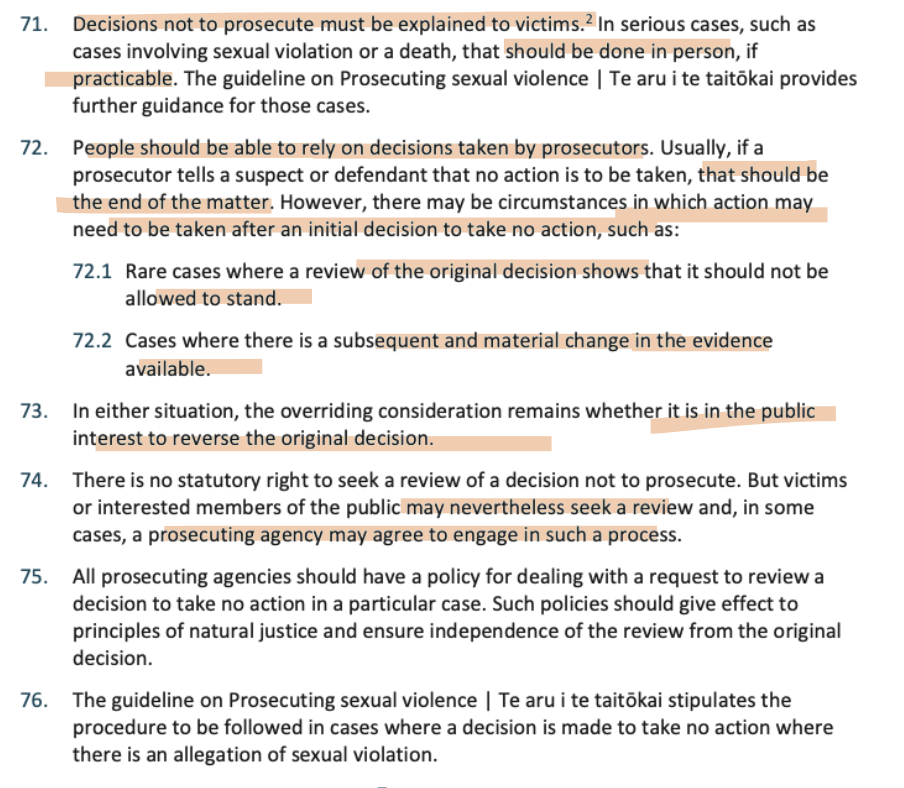
Warnings and diversion
principle of proportionality = stress of trial shouldn’t be inflicted on those charged with minor offences
see photo