CNR W7 - Learning and Memory
 Call Kai
 Learn
Learn Practice Test
 Spaced Repetition
 Match
Match Flashcards
 Knowt Play
1/26

There's no tags or description
Looks like no tags are added yet.
Name | Mastery | Learn | Test | Matching | Spaced | Call with Kai |
|---|
No analytics yet
Send a link to your students to track their progress
27 Terms
most common neurodegenerative disease
alzheimer’s
Memory + Learning
Memory =
encoding, storage and retrieval of learned information
Forgetting of transiently (short time) useful information is important
Learning =
new information is acquired + integrated by the nervous system
Learning is observable by changes in behaviour
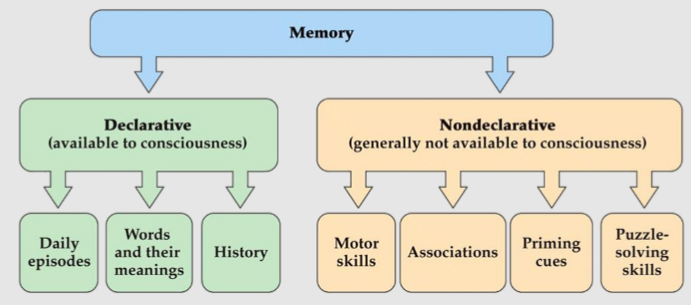
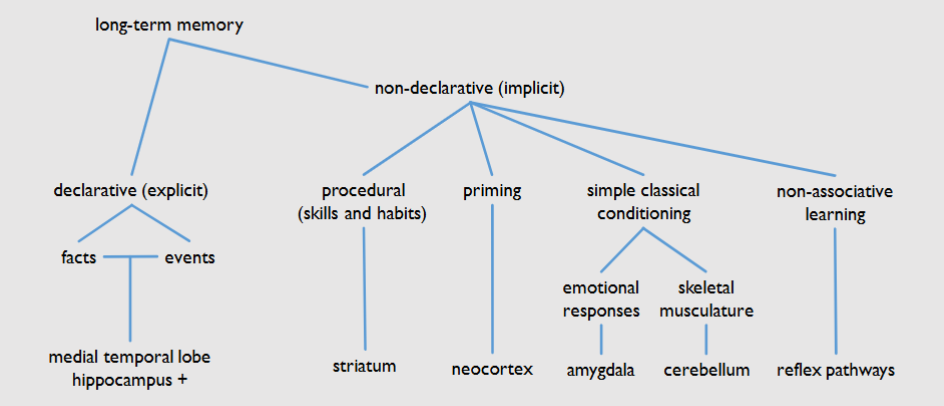
Declarative (explicit) memory
Episodic (event based) memory (‘I remember’)
Semantic (fast based) memory
These memories are consciously available + are usually easy to verbalise or declare
Nondeclarative (implicit) memory
Involve skills + associations
BUT
Not available to consciousness
Not easy to verbalise
‘Knowing how’
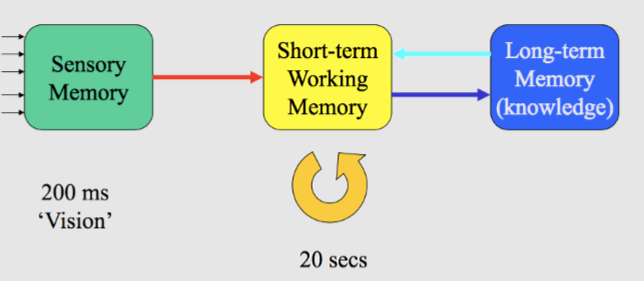
Working memory
Works in the range of seconds to minutes
Short-term memory buffer = allows for manipulation of stored information
Working memory = has to be actively maintained
Is fragile + easily disrupted
Has a limited capacity
Long term memory
LTM can store larger quantities of information (potentially unlimited duration)
Does not have to be actively maintained
Very stable - once memories are made long-term = hard to disrupt
E.g. working memory digit span of 7/8 numbers - but can remember phone number from childhood
Categories of human memory
Association can improve memory
Our capacity for remembering arbitrary info is poor (e.g. 7-9 number string) - practice can improve
Over months a student developed the ability to remember 80 element digit strings
Did this by associating subsets of the numbers to dates / times at track meetings (he was a runner)
Professional ‘mnemonists’ use the same technique of associating meaningless data with meaningful + memorisable elements (e.g. using a tune)
ability to remember is related to how much the info means to you
fun fact: world record for Pi is 67 thousand decimal places
motivation will increase association
Asked if stimuli included food or not
If they were hungry = identified food items more accurately
Conditioned learning
Another form of associative learning
Conditioned learning is a form of non-declarative learning
a response becomes more frequent / predictable in a given environment as a result of reinforcement (stimulus or reward for desired response)
Classical conditioning vs Operant conditioning
Classical conditioning | Operant conditioning |
|
|
Pavlov’s dogs
unconditioned stimulus (food) elicits an unconditional response (salivating)
with repeated association of a neutral stimulus (bell) with the unconditional stimulus (food), the neutral stimulus becomes a conditioned stimulus that elicits the unconditioned response
operant conditioning
Behaviour is altered (by increasing or decreasing its probability of occurring) by associating the behaviour with a reward or punishment
Unlike classical conditioning the behaviour that is being altered is not reflexive
Forms the training regimes for pets and animals
HM
Henry Molaison (1926 - 2008)
Suffered from grand mal seizures following a bike accident
Unconscious
Tongue biting
Incontinent
experimental surgery (1953) for epilepsy
Bilateral surgery to remove the source of the seizures
Medial temporal lobe including:
Amygdala
Uncus
Hippocampal gyrus
⅔ anterior hippocampus
Destruction of hippocampus causes anterograde amnesia
No longer form episodic memories - e.g. HM had no idea he underwent surgery
Memories of events before the surgery remained intact
Perceptual ability, reasoning, abstract thinking all remained normal
The part of the brain that encodes new memories + part that stores + retrieves memories are different
He could never recognise Brenda Milner (studies him for 50 years)
other cases
RB - Hippocampus damage following ischemia surgery = normal IQ + amnesia
KC - motorbike accident = HC damage = amnesiac
Morris water maze
Crucial part of episodic memory = place
The mouse has to find a platform under water surface
With practice, the place is remembered and mouse swims directly to the platform
But in mice with hippocampal lesions = unable to remember + each trial is like the first
place cells
hippocampus contains place cells
place cell = neuron withing HC that becomes active in certain place / environment
fun fact:
London taxi drivers have been shown to have larger hippocampi than age matched controls
The volume of the hippocampi is correlation with the amount of time spent as a taxi driver
declarative vs non-declarative
Mirror drawing task - HM couldn’t remember it but improved on the task
Shows that he can learn non-declarative = diff types = this not in HC
HM could learn Gollin figures with practice + still claimed to never seen the figures before
Memory flowchart (image)
Diseases that affect memory
Dementia | Amnesia |
= syndrome in which there is deterioration in memory, thinking, behaviour and the ability to perform everyday activities
| = syndrome that involves substantial difficulty learning and retaining new information
|
Alzheimer’s
Hippocampus is affected early
Memory loss is often one of the first symptoms reported
Hippocampal volume i=lost rapidly
Loss of hippocampal volume is associated with decreasing memory deficits
Fronto-temporal dementia
most common form in under 60s
memory less is NOT often one of the first symptoms
in both variants memory loss occurs later, when it involved the hippocampus
Behavioural variant FTD | Primary progressive aphasia |
|
|
Korsikoff’s
chronic alcoholism
thiamine isn’t absorbed
thiamine deficiency causes damage to several parts or the brain including the mamillary bodies
chronic amnesia – though implicit learning is relatively preserved
Temporal lobe epilepsy - acute
Most common form of epilepsy (60%)
Focal seizures in the temporal lobe (1-2mins) can spread to rest of the brain
Acute effect on memory - sufferers often do not remember the seizure of the events leading up to the seizure
Temporal lobe epilepsy - chronic
Loss of cells in HC can lead to long-term memory deficits
These mechanisms of cell loss are not clear though they are related to the seizures
Cannabis
The HC has cannabinoid receptors that are stimulated by the psychoactive ingredient of cannabis THC
= the known effect of cannabis on memory
This has been demonstrated in animal models such as the Morris water maze