3.3.5 Alcohols
 Call Kai
 Learn
Learn Practice Test
 Spaced Repetition
 Match
Match Flashcards
 Knowt Play
1/25

There's no tags or description
Looks like no tags are added yet.
Name | Mastery | Learn | Test | Matching | Spaced | Call with Kai |
|---|
No analytics yet
Send a link to your students to track their progress
26 Terms
Alcohols and production:
1.What is 1st ionisation energy?
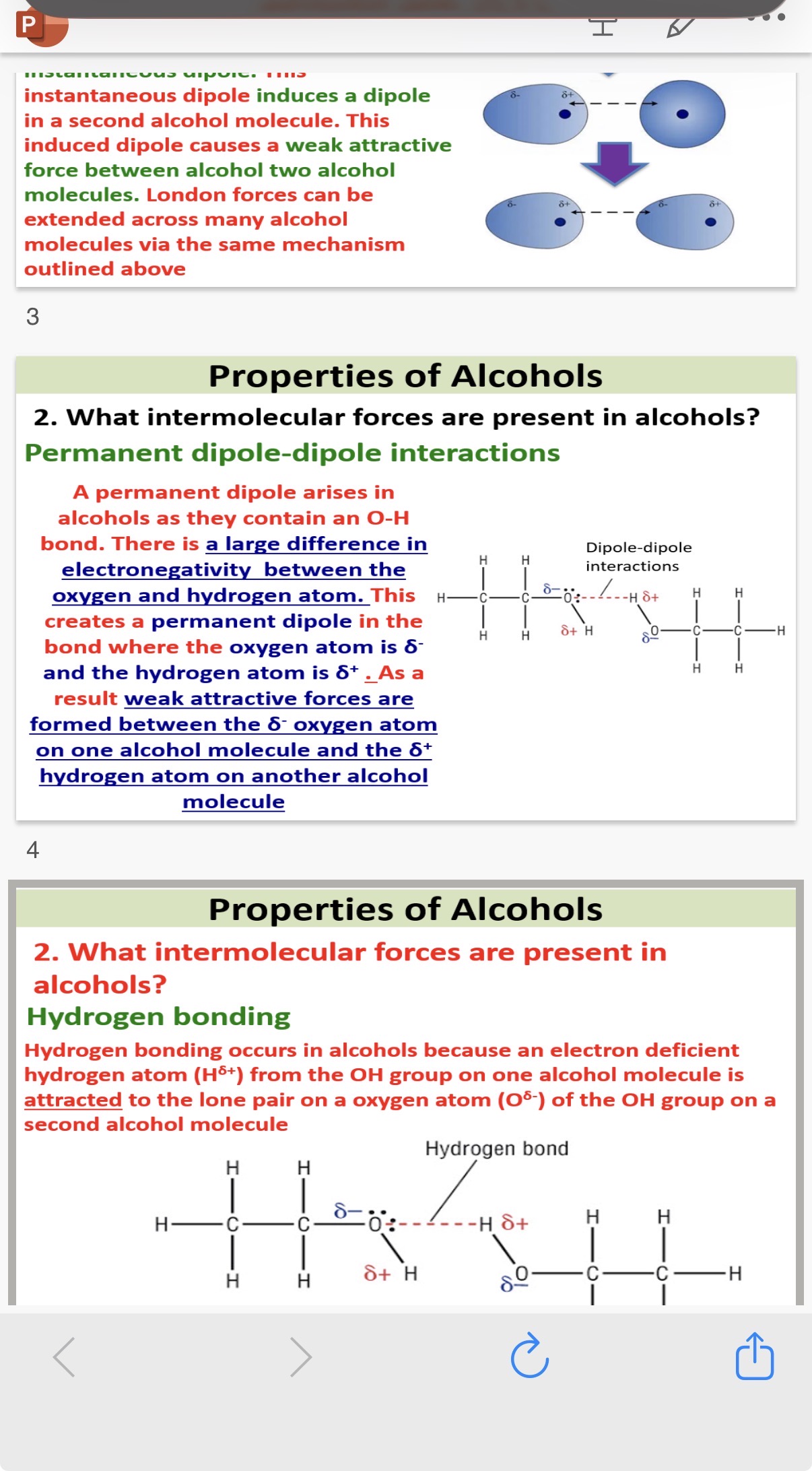
2.All 3 types of intermolecular forces are present in alcohols(Van der waals,Permanent dipole-dipole interactions,Hydrogen bonding).Explain all 3 in alcohols?
Note-Hydrogen bonding is the strongest
Solubility of alcohols:
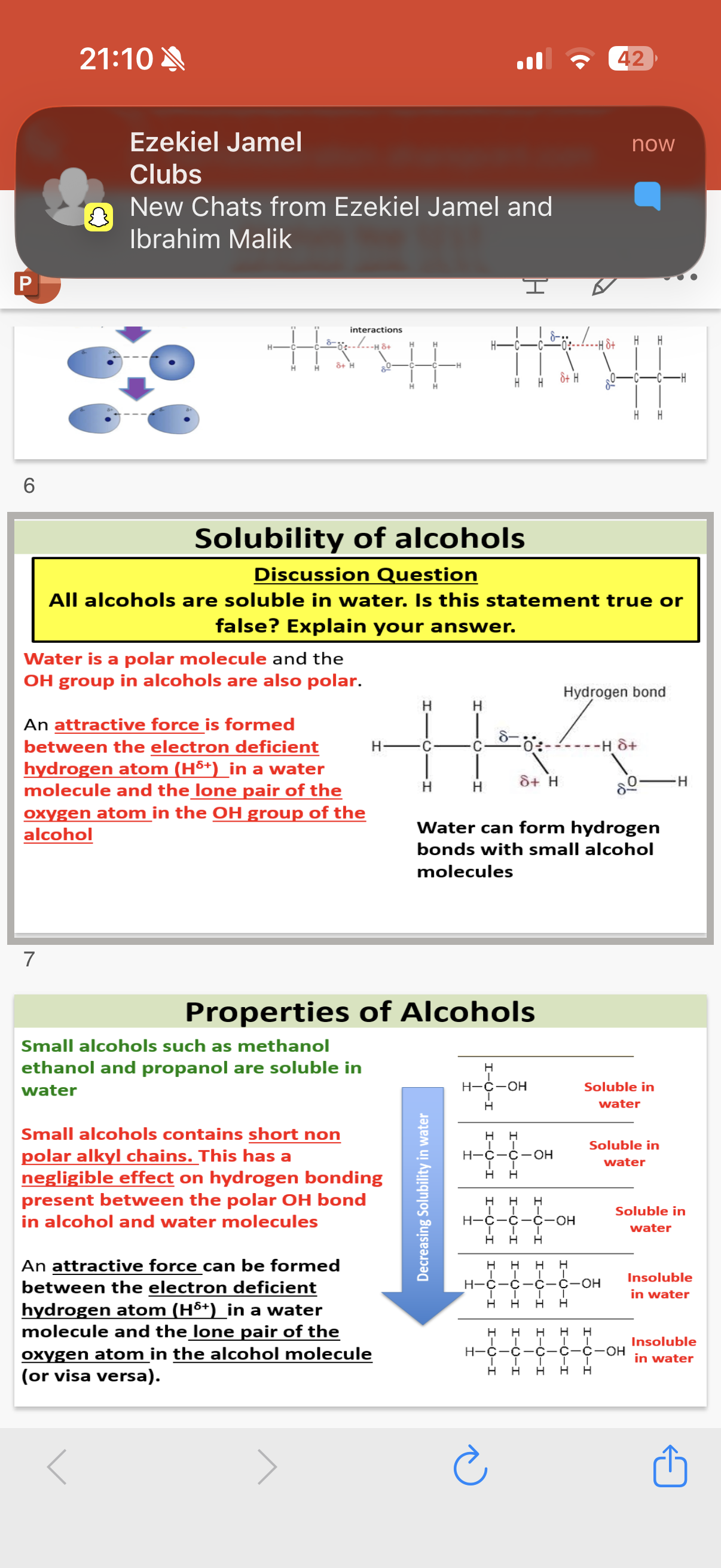
•Water is a …3? molecule and the OH group in alcohols are also polar.
•An attractive force is formed between the electron deficient hydrogen atom (H°+) in a water molecule and the lone pair of the oxygen atom in the OH group of the alcohol.
4.Small alcohols such as methanol,ethanol and propanol are soluble in water. Explain why these are soluble in water and longer chain alcohols are not soluble in water?
As alcohols get larger, they become…
1.Enthalpy change when 1 mole of gaseous 1+ ions are formed from 1 mole of gaseous atoms.
2.Vdws:London forces arise in alcohols due to fluctuations in electron density. An unbalanced distribution of charge within the electron shells of one alcohol molecule This creates an instantaneous dipole induces a dipole in a second alcohol molecule. This induced dipole causes a weak attractive force between two alcohol molecules. London forces can be extended across many alcohol molecules via the same mechanism.
Permanent dipole-dipole interactions:
A permanent dipole arises in alcohols as they contain an O-H bond. There is a large difference in electronegativity between the oxygen and hydrogen atom. This creates a permanent dipole in the bond where the oxygen atom is delta- and the hydrogen atom is delta+. As a result weak attractive forces are formed between the delta- oxygen atom on one alcohol molecule and the delta+ hydrogen atom on another alcohol molecule.
Hydrogen bonding:
Hydrogen bonding occurs in alcohols because an electron deficient hydrogen atom (H delta+) from the OH group on one alcohol molecule is attracted to the lone pair on a oxygen atom (O delta-) of the OH group on a second alcohol molecule
3.polar
Larger alcohols have long non-polar alkyl chains (that can’t form hydrogen bonds with water molecules)which become a large part of the alcohol molecule and since the OH group is the only polar part of an alcohol, the alcohol becomes less polar and more insoluble as the alkyl chain increases. Despite Small alcohols containing short non-polar alkyl(e.g.CH3) chains. This has a negligible effect on hydrogen bonding present between the polar OH bond in alcohol and water molecules since the alkyl chain is smaller.
5.more insoluble/less soluble
Volatility of alcohols:
1.What does volatility mean?
Do you think alcohols are more or less volatile than alkanes. Explain your answer?
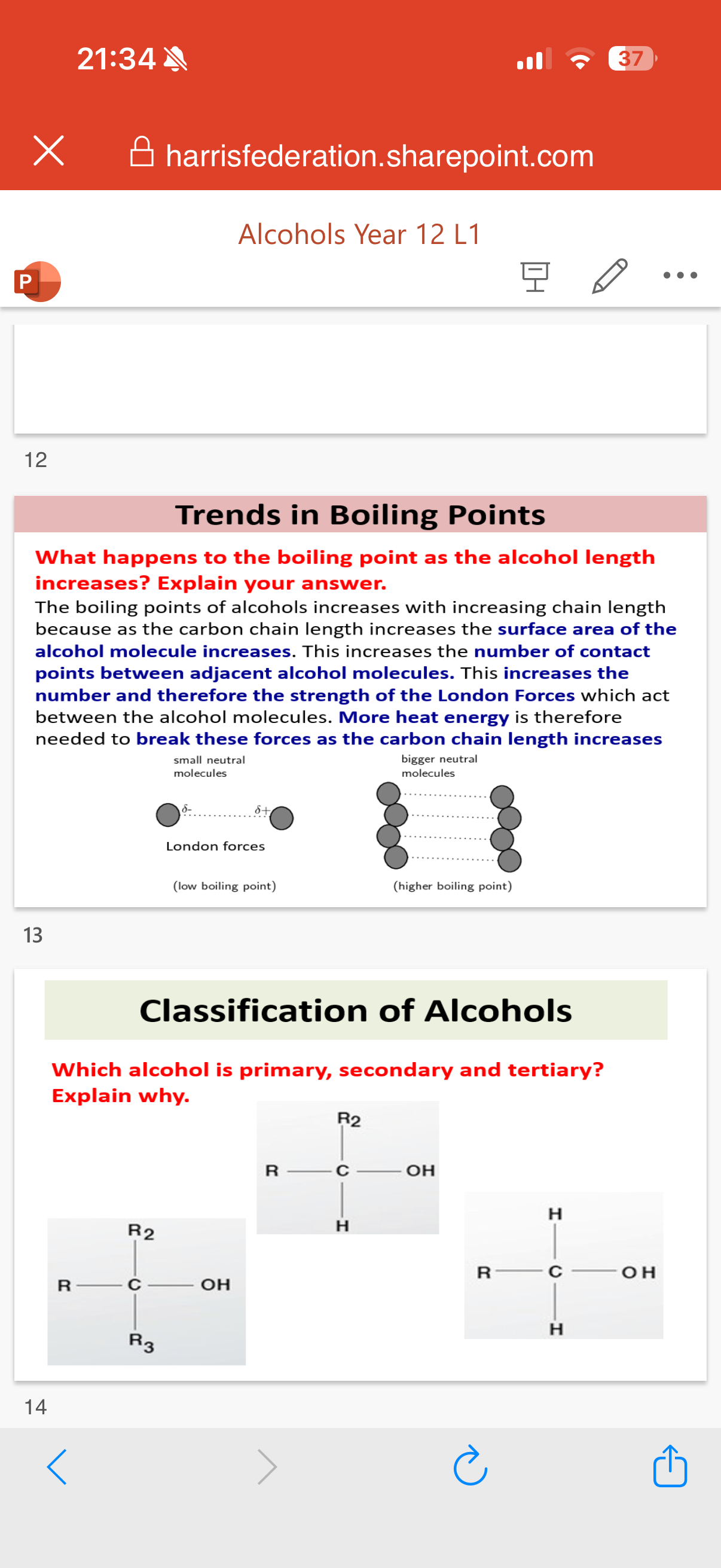
3.What happens to the boiling point as the alcohol length increases?Explain your answer.
4.Answer the question in the image and explain why?
1.A measure of how easy it is for a substance to evaporate
2.The boiling points of alcohols are higher than the corresponding alkanes.
This is because hydrogen bonds exist between alcohol molecules which is the strongest type of intermolecular force. However in alkanes, only Van der waals forces exist between alkane molecules which is the weakest type of intermolecular force. More heat energy is therefore needed to break the strong hydrogen bonds between alcohol molecules in order for them to boil.
3.The boiling points of alcohols increases with increasing chain length because as the carbon chain length increases the surface area of the alcohol molecule increases.
This increases the number of contact points between adjacent alcohol molecules. This increases the number and therefore the strength of the London Forces which act between the alcohol molecules. More heat energy is thereforeneeded to break these forces as the carbon chain length increases
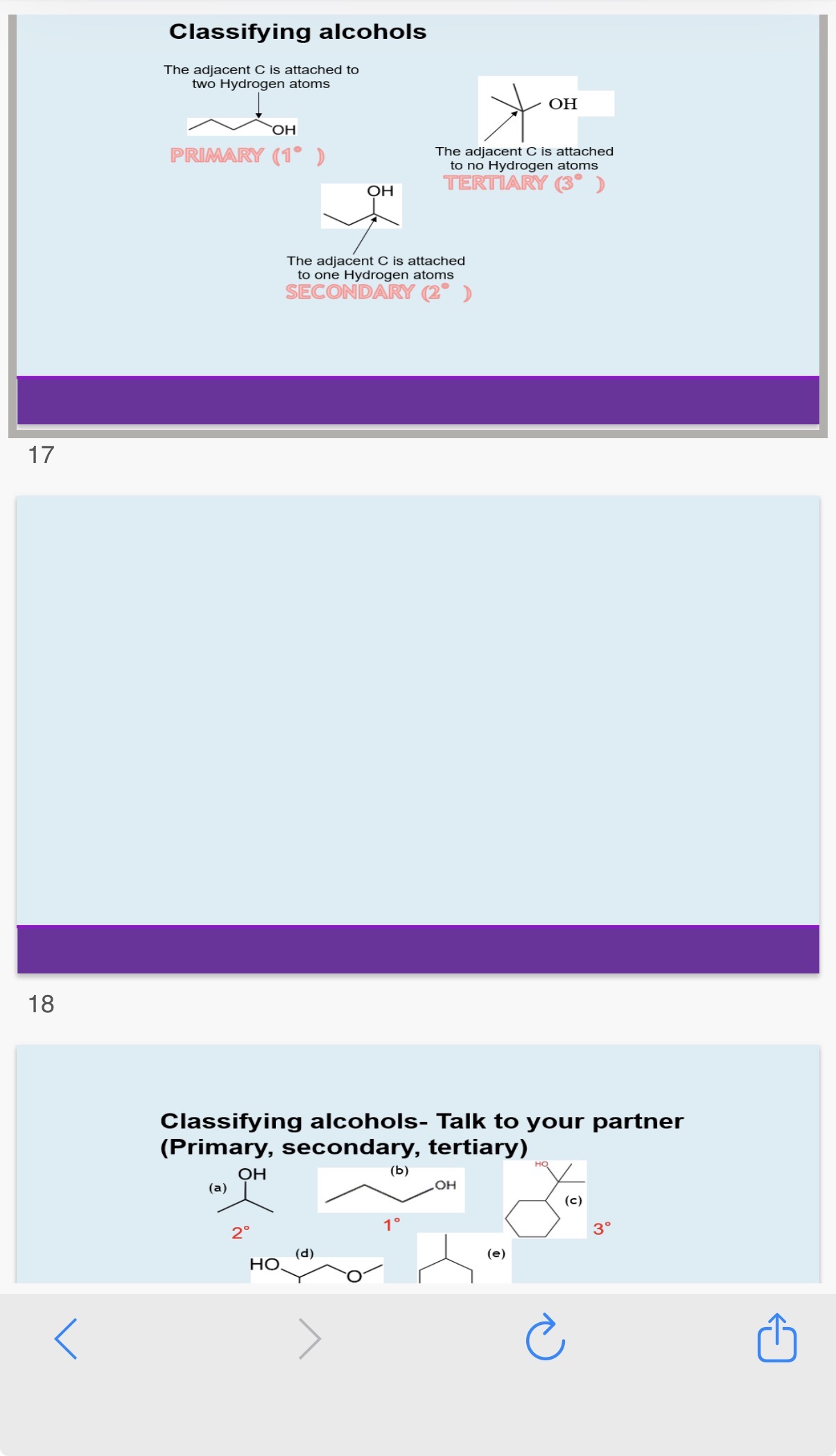
Right:Primary alcohol-The carbon that’s attached to the OH group is bonded to 2(or more) hydrogens
Middle:Secondary alcohol-The carbon that’s attached to the OH group is bonded to 1 hydrogen
Left:Tertiary alcohol-The carbon that’s attached to the OH group is bonded to no hydrogens.
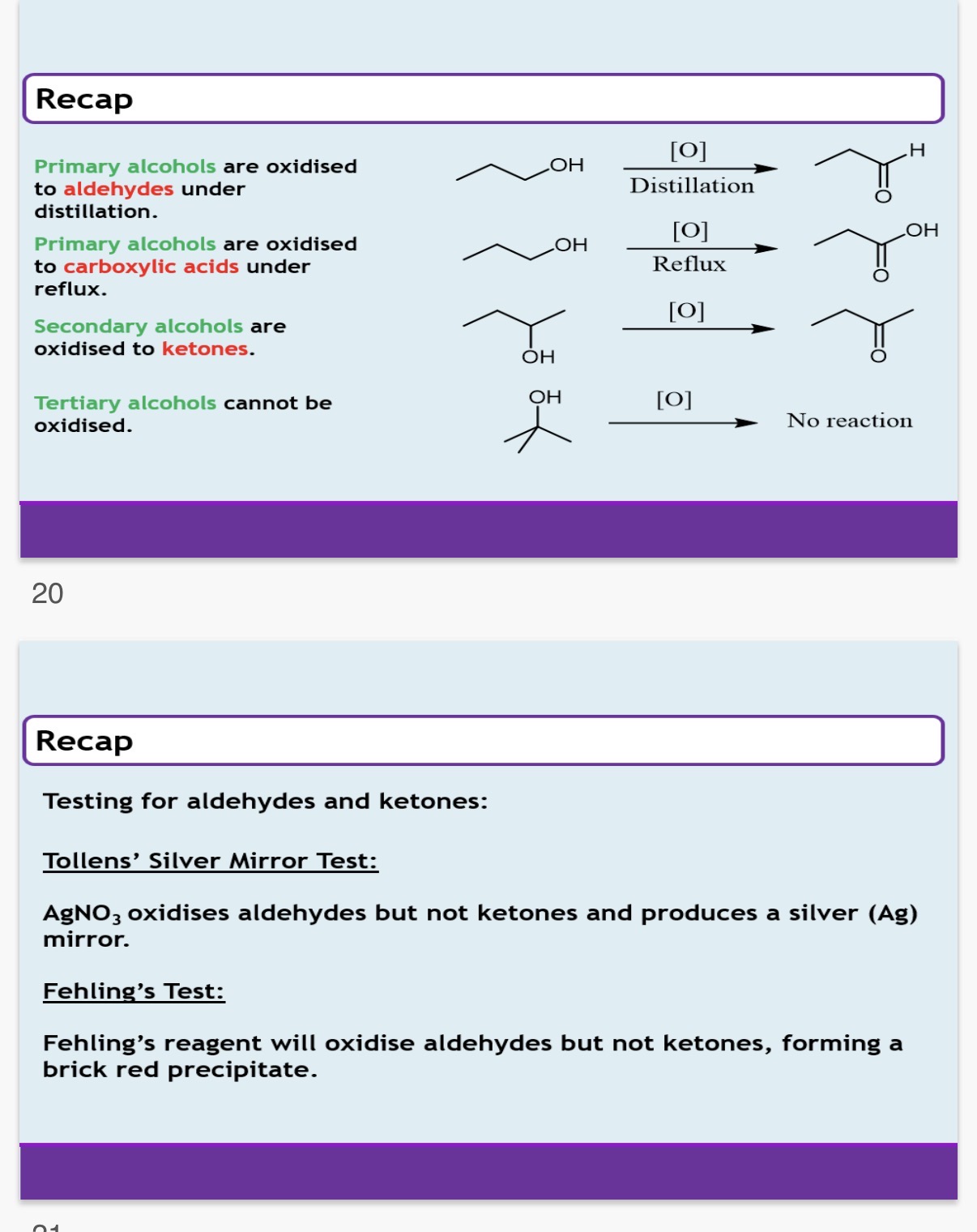
Primary alcohols are oxidised to aldehydes Under …1.?
Primary alcohols can be oxidised to …2? Under …3?.
Secondary alcohols are oxidised to …4?.
Tertiary alcohols cannot be …5?
Testing for Carbonyl compounds (aldehydes and ketones):
Tollens' Silver Mirror Test:
[(AgNO3)2]*+ (The Ag+ ions) oxidises aldehydes but not ketones and produces a 6…
Fehling's Test(Note that Fehling’s reagent contains some Benedict’s reagent):
Fehling's reagent(The Cu2+ ions) will oxidise aldehydes but not ketones, forming a …7? precipitate
8.What does a negative test result look like for Tollens and Fehlings test?
9.Name and classify these alcohols
а) СНзОН
b) СНзСН (ОH)CH3
с) СНзC(CH3)(OH)СH3
10.Arrange these alcohols in order of increasing boiling point: ethanol, methanol and 1-propanol. Explain your answer?
11.Arrange these alcohols in order of increasing solubility in water: butan-1-ol, methanol and octan-1-ol. Explain your answer?
What types of molecules does Tollen’s reagent and Fehling’s reagent work on?
1. distillation. 2.carboxylic acids. 3.reflux
4.ketones. 5.oxidised. 6.silver mirror(thin mettalic coating of silver) (the Ag+ ions are reduced to metallic Ag which forms the coating)
Brick red
Tollens:Tollens reagent remains colourless.
Fehling’s: Fehlings reagent remains blue
Methanol: Primary
Propan-2-ol: Secondary
2-methylpropan-2-ol: Tertiary
10.Methanol<ethanol<propan-1-ol
From methanol to propan-1-ol increase in carbon chain length increases surface area and an Increase in number of contact points between adjacent alcohol molecules.Leads to an Increase in number and strength of London forces so more heat energy is needed to break these forces
11.Octan-1-ol< butan-1-ol< methanol
Octan-1-ol, butan-1-ol and methanol all contain polar OH groups that form hydrogen bonds with water molecules.
The carbon chain is non-polar Alcohol molecules become more non-polar as the carbon chain length increases from methanol to octan-1-ol.
Non-polar chain cannot form hydrogen bonds with water So solubility in water decreases with increasing chain length.
•Tollen’s: Cyclical + straight chain molecules
•Fehling’s:straight chain molecules
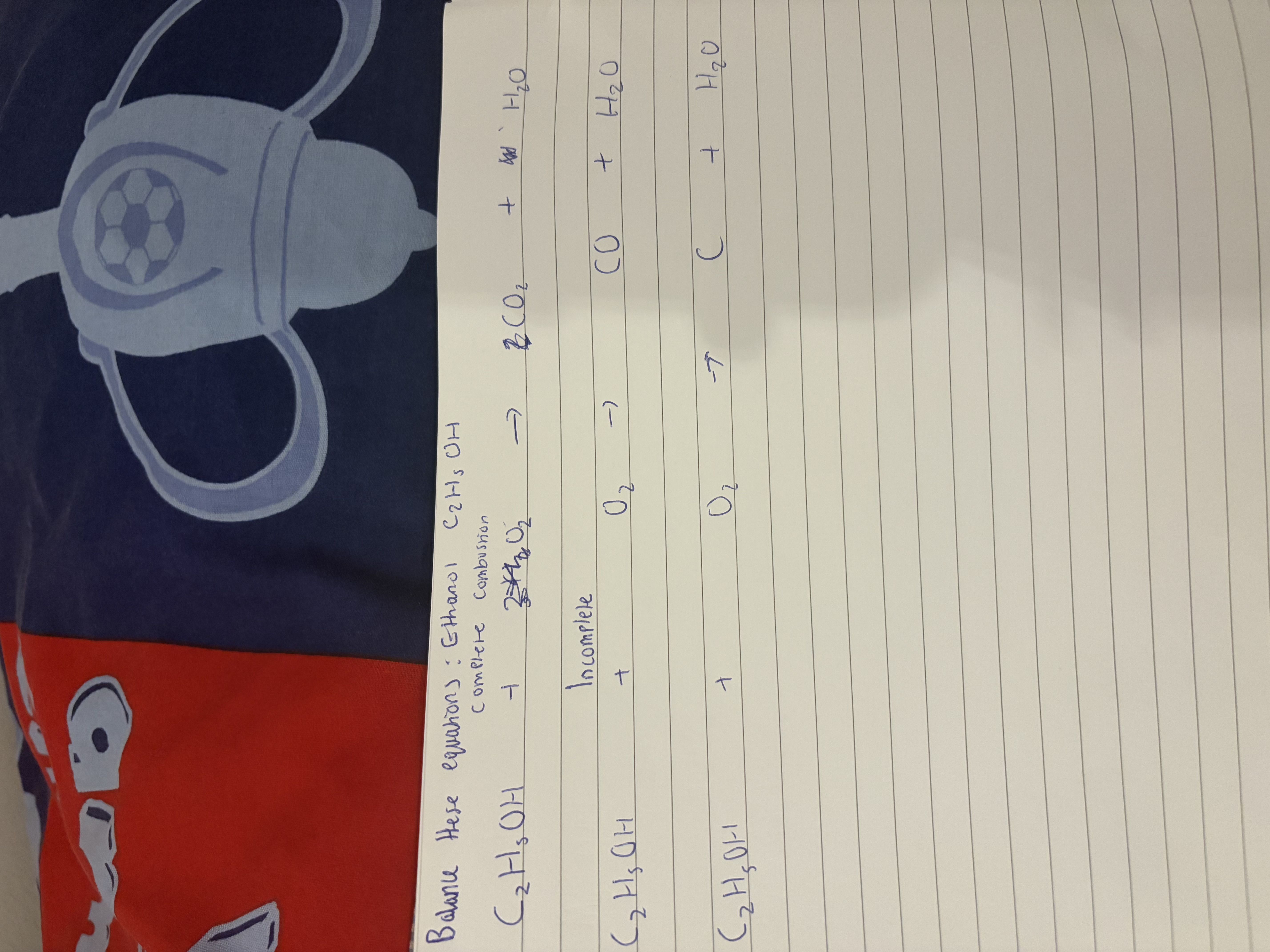
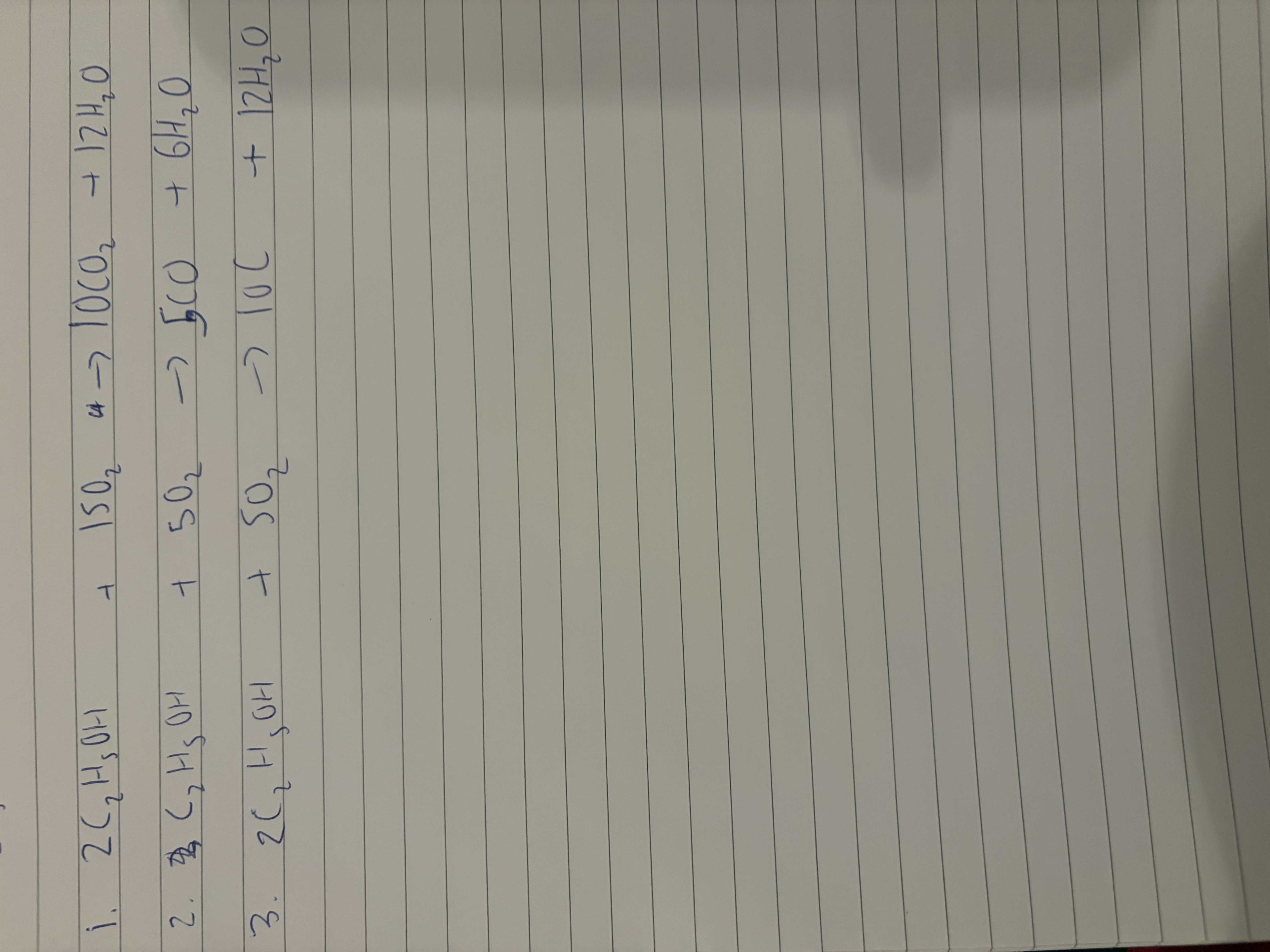
Combustion:
Note-Alcohols and hydrocarbons are very similar as they both behave like fuels.
Formula: Organic compound+ O2→ CO2 + water
Incomplete combustion(little oxygen)
Formula: Organic compound + O2→ CO + water
Incomplete combustion(very little oxygen)
Formula: Organic compound + O2→ C (soot) + water
1.Answer the questions in the image?
(Tip-Use decimals(.5s) to balance then double everything)
Alcohols:
Alcohols are important chemicals that are used as …1? and …2? as well as materials to make other important organic molecules such as medicines.
Ethanol is the alcohol present in alcoholic ...3?. Ethanol can be produce via the fermentation of glucose or via the hydration of ethene
1.solvents. 2.fuels. 3.drinks
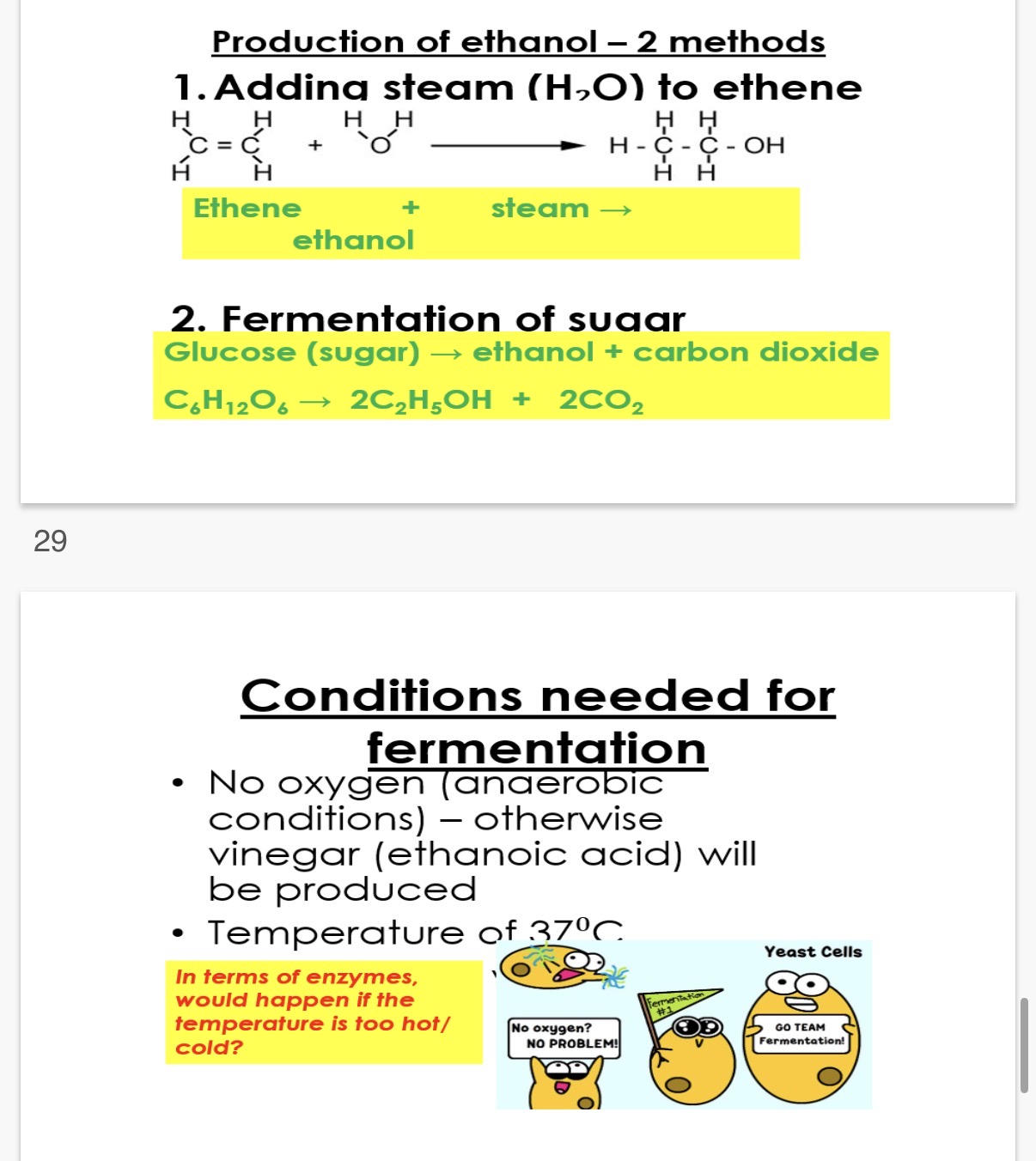
1.What is the formula for adding steam to ethene?
2.What is the formula for fermentation of sugar?
3.what is a biofuel?
4.Explain the steps of fermentation?
5.Why is the fermentation of glucose considered carbon neutral?
6.Why is no oxygen necessary for the fermentation of glucose?
1.Ethene + H2O(g) → ethanol
2.Glucose(sugar) → ethanol + carbon dioxide
3.A fuel derived from a living thing.(i.e. plants)
4.Glucose from plant materials forms a solution and is kept in warm conditions (37 degrees optimal) with a yeast catalyst under anaerobic conditions.
This produces impure ethanol (max 15% by volume normally).
C6H12O6→2CH5OH+2CO2.
5.The CO2 absorbed from growing plant material by photosynthesis = the amount of CO2 released when the ethanol is made and then burned.
6CO2 + 6H20 → C6H12O6 +6O2
C6H12O6→ 2C2H5OH + 2CO2 2CH5OH+8O2 → 4CO2+ 6H2O
6.Otherwise vinegar(ethanoic acid) will be produced
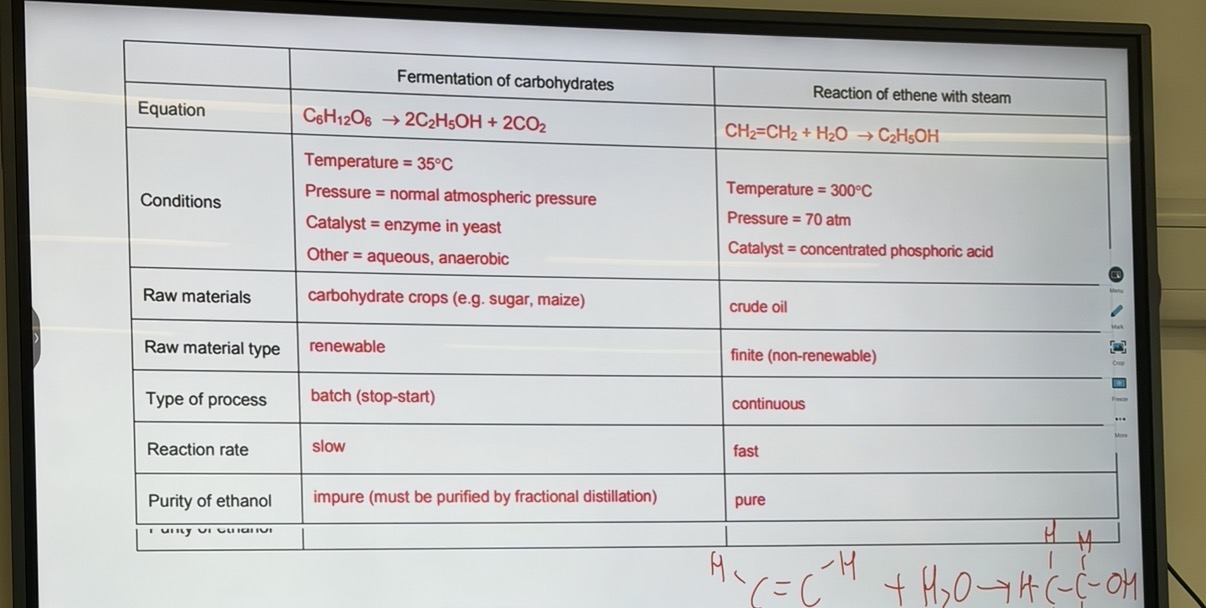
State 2 pros+ 3 cons of fermentation and 3pros+ 2cons of reaction with steam?
note-Fermentation is a metabolic process that converts sugar to acids, gases, or alcohol. It occurs in yeast and bacteria, and also in oxygen-starved muscle cells, as in the case of lactic acid fermentation.
Fermentation of Carbohydrates
* Pros:
* Renewable raw materials: Uses crops, which can be regrown.
* Lower temperature: The reaction happens at a lower temperature, which can save energy.
* Cons:
* Impure ethanol: Requires further purification, increasing cost and complexity.
* Slow reaction rate: Takes more time to produce ethanol.
* Batch process: Less efficient than continuous processes because each batch needs to be started and stopped.
Reaction of Ethene with Steam
* Pros:
* Pure ethanol: Requires no further purification, making it more efficient.(high percentage yield)
* Fast reaction rate: Produces ethanol quickly.
* Continuous process: Allows for constant production, increasing efficiency.
* Cons:
* Non-renewable raw material: Relies on crude oil, a finite resource.
* High temperature and pressure: Requires a lot of energy and specialized equipment.
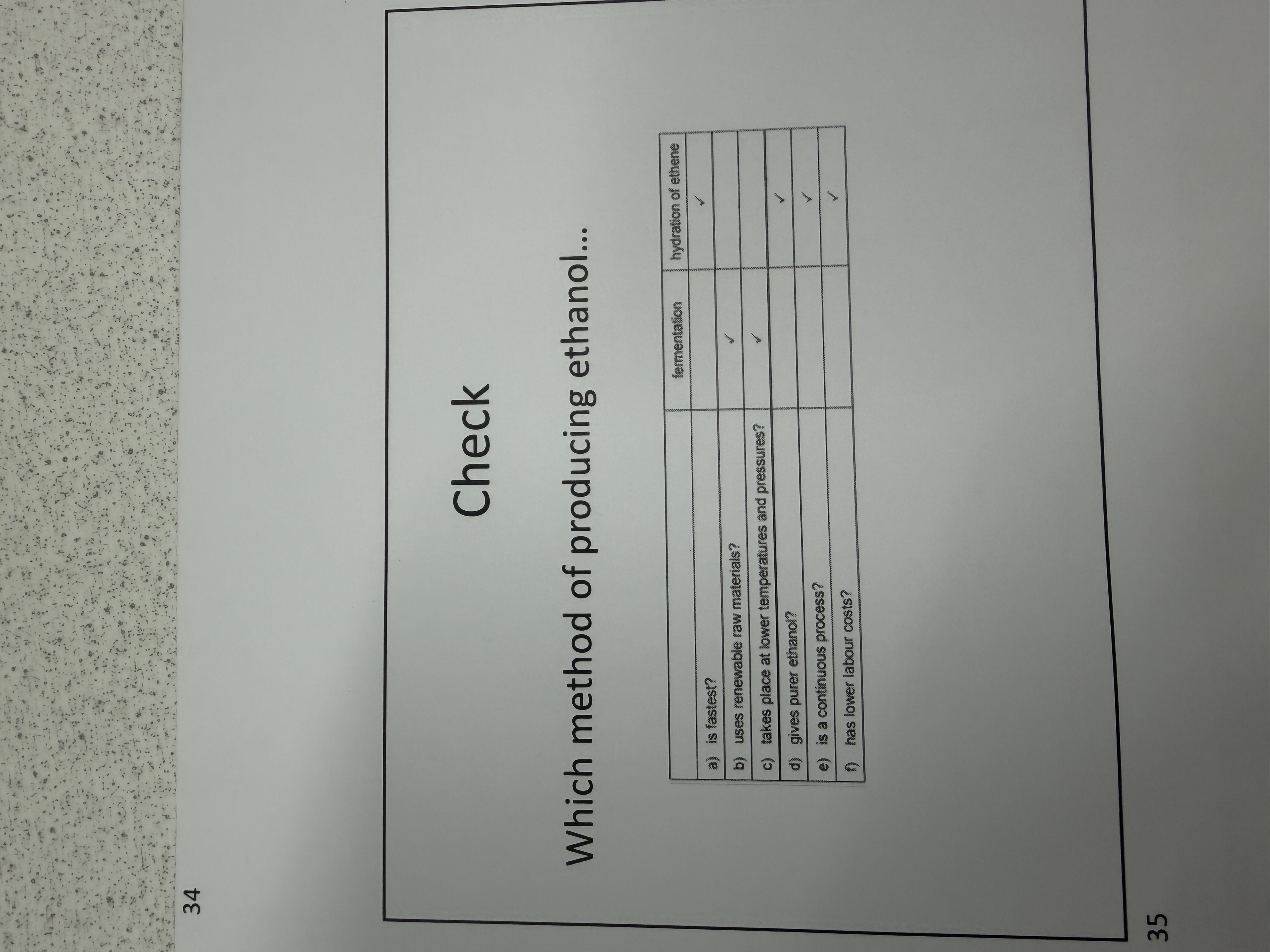
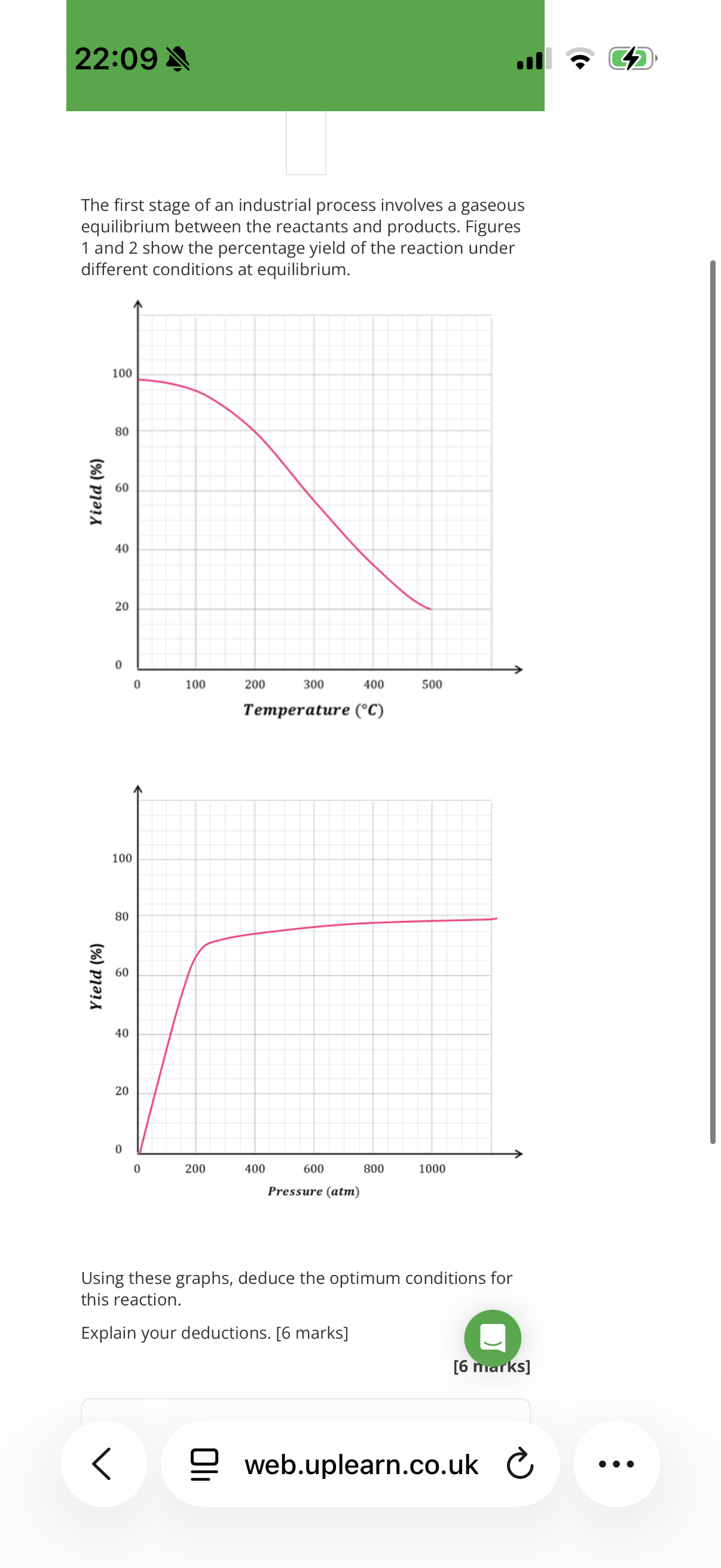
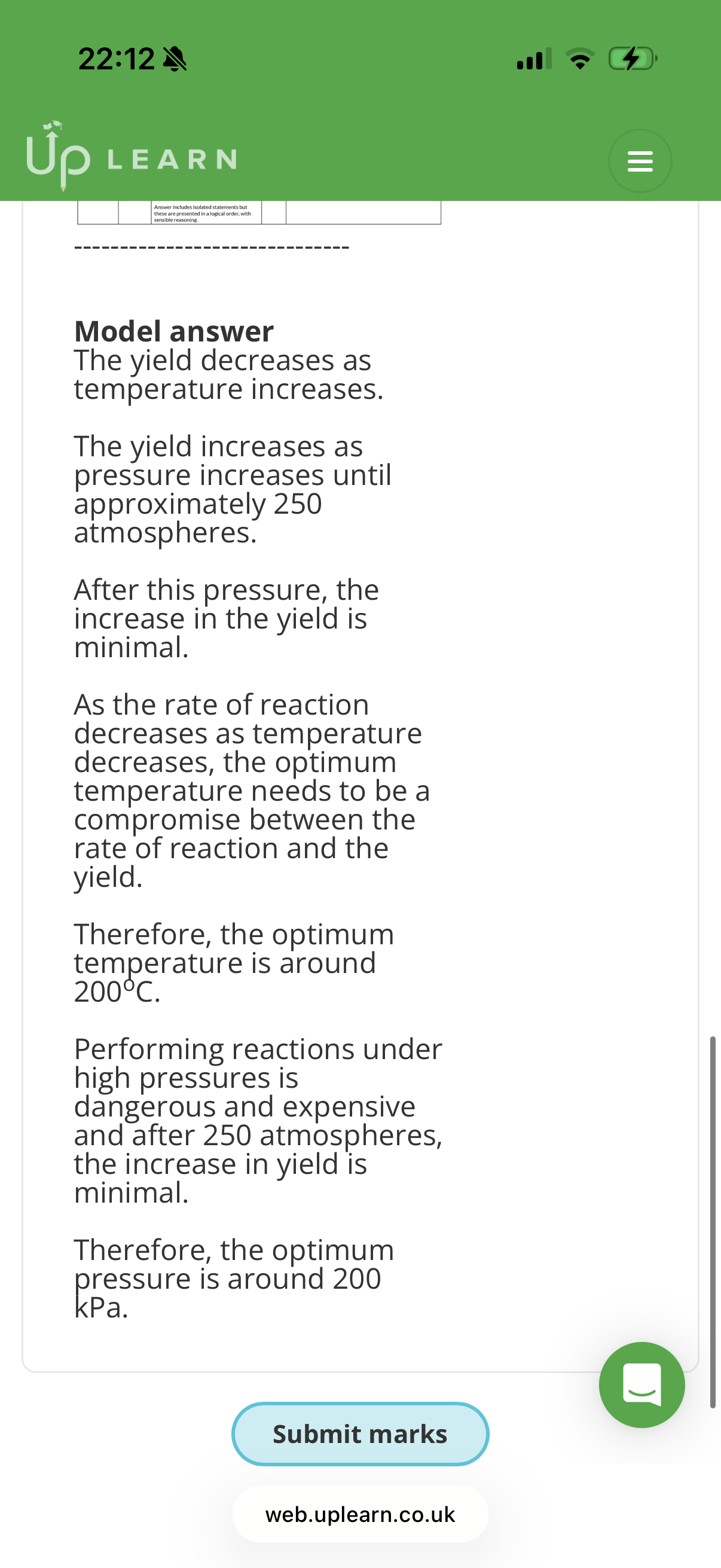
Note: Optimal conditions in industry prioritise maximizing product formed but also want the rate of reaction to be fast so product is formed quick. So there needs to be a compromise because it’s not possible to have supper high temperatures and pressures in all reactions.
Note: high pressure is expensive and dangerous, low temp means rate of reaction is slow but too high is expensive.
Note: 1st deductions from graph, 2nd suggest optimum temperature, 3rd suggest optimum pressure.
What are the conditions to react an alcohol to form an aldehyde?
What are the conditions to react an alcohol to form a carboxylic acid
What are the conditions to react an alcohol to form a ketone
Acidified potassium dichromate (VI) under distillation
Acidified potassium dichromate (VI) under reflux
Acidified potassium dichromate (VI) under reflux

Oxidation of alcohols:
Oxidation of alcohols is not only a combustion reaction to form carbon dioxide and water. Oxygen can also be …1? onto alcohols in other …2? reactions to form new products
3.What oxidising agent can be used to oxidise alcohols?( or acidified potassium manganate (VII)
4.Can you determine the oxidation state of chromium in potassium dichromate (K2Cr2O7)?
1.added 2.oxidation. 3. Acidified potassium dichromate (VI) solution(K2Cr2O7(aq)/H2SO4(aq) or K2Cr2O7(aq)/H+(aq)
+6 ( 2X=+12→ X=+6)
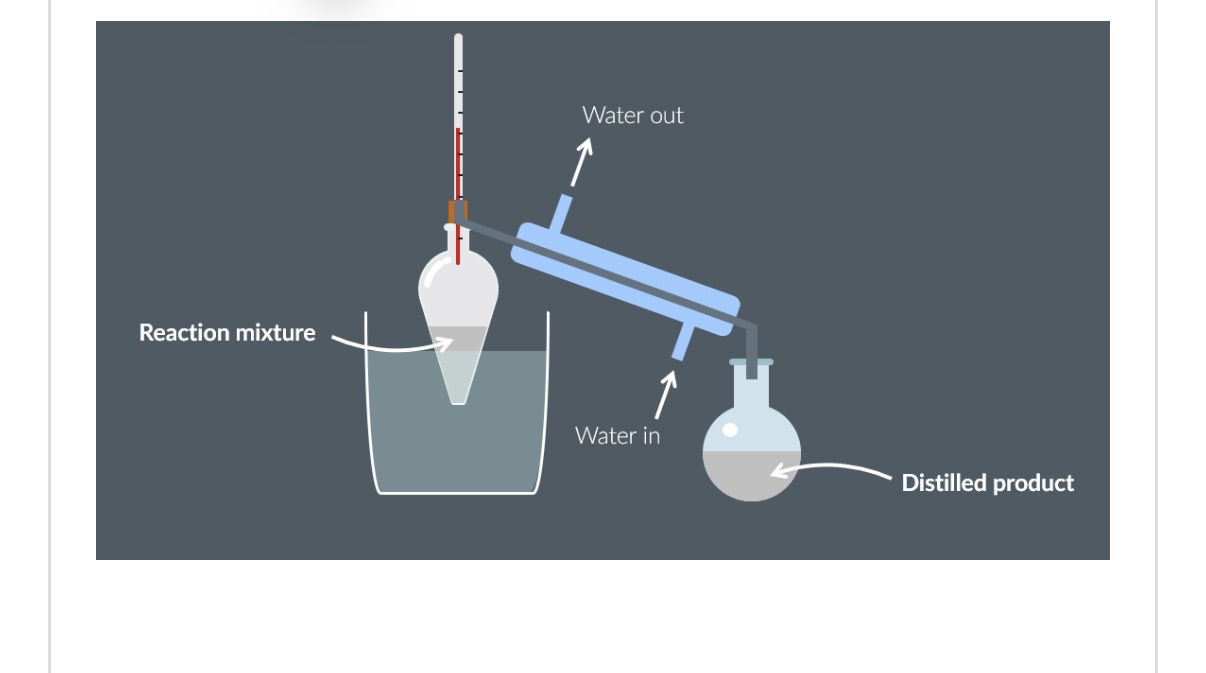
Distillation practical( This practical is unrelated/seperate to the oxidation practical. This is to form an alkene via an elimination reaction)
Whenever any alcohol undergoes an elimination reaction, we get the following products…
And, because a water molecule is eliminated from the alcohol, we also call these reactions…?
(1•Now, suppose an alcohol undergoes a dehydration reaction in just a simple flask, which is heated with a bunsen burner.
(2•After the reaction is done, we’d be left with a weird mixture of products, reactants, and anti-bumping granules in our flask.
Explain why this wouldn’t be useful to us? (This is why we’re actually going to carry out the elimination reaction... whilst also carrying out a method called distillation)
During distillation, we heat the reaction mixture. Explain why?
•The vapour passes through a …5?, where it condenses into a …6? and then drops down into a different flask.
This allows us to separate or distill the …7? from the reactants.
•After we’ve distilled the alkene, we need to run a test to confirm that it is in fact an alkene.
For this, we add …8?(VII) solution to the distillate.
And, if the solution turns from …9? to …10?, we’ve proven that the solution contains an alkene.
What are the 2 conditions to react an alcohol to form an alkene?(green line)
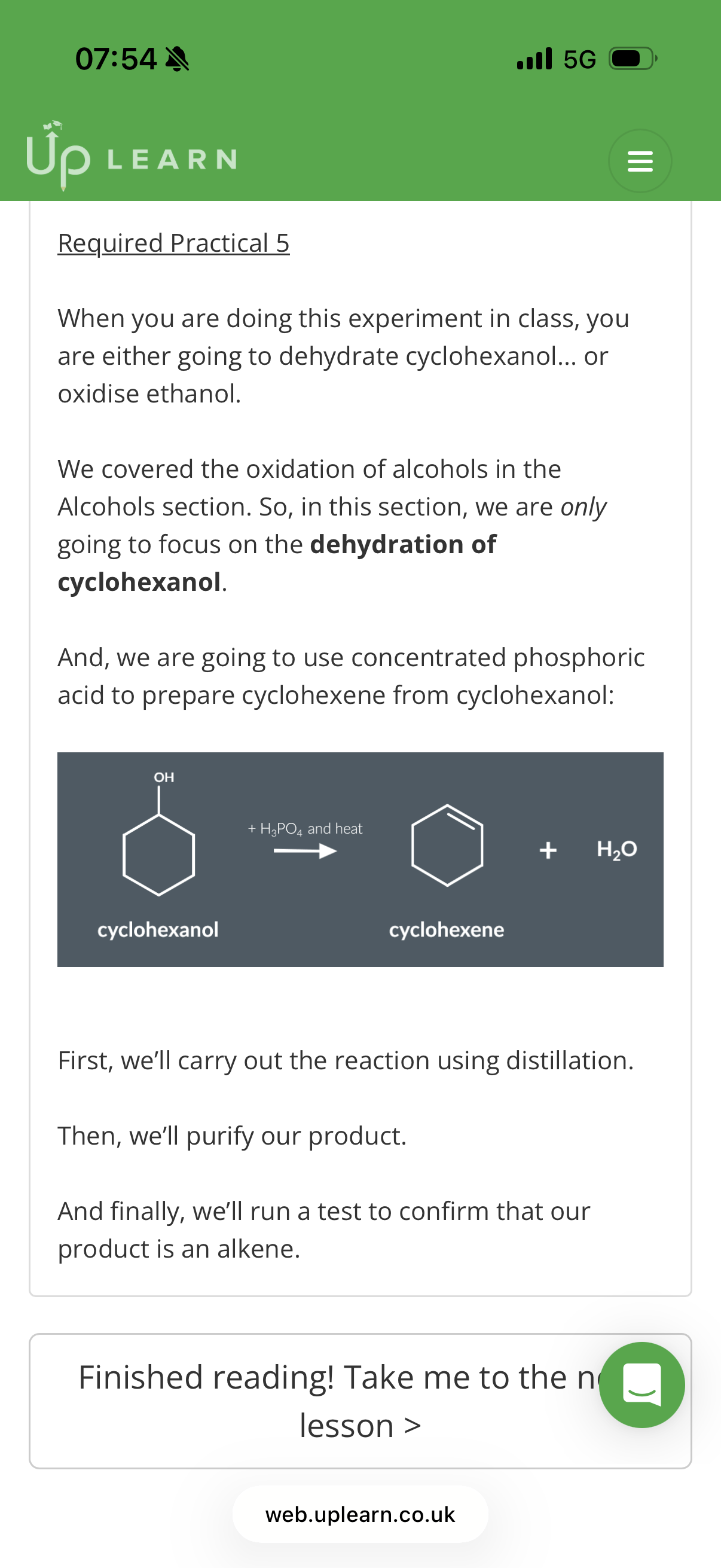
Required Practical 5
When you are doing this experiment in class, you are either going to dehydrate cyclohexanol... or oxidise ethanol.
We covered the oxidation of alcohols in the Alcohols section. So, in this section, we are only going to focus on the dehydration of cyclohexanol.
And, we are going to use concentrated phosphoric acid to prepare cyclohexene from cyclohexanol:
•First, we’ll carry out the reaction using distillation.
Then, we’ll purify our product.
And finally, we’ll run a test to confirm that our product is an alkene.
Alcohol → Alkene + Water
2. Dehydration reactions
because we want to separate our newly gained product - the alkene - from everything else in the reaction mixture.
This increases the rate of the reaction and it produces a vapour containing our desired alkene.
Condenser. 6. Liquid 7.alkene
Acidified potassium manganate(Cant use acidified potassium dichromate (VI) solution for dehydration)
9.purple. 10. Colourless
1)Concentrated phosphoric acid(H3PO4) or
2) Sulfuric acid(H2SO4) under reflux
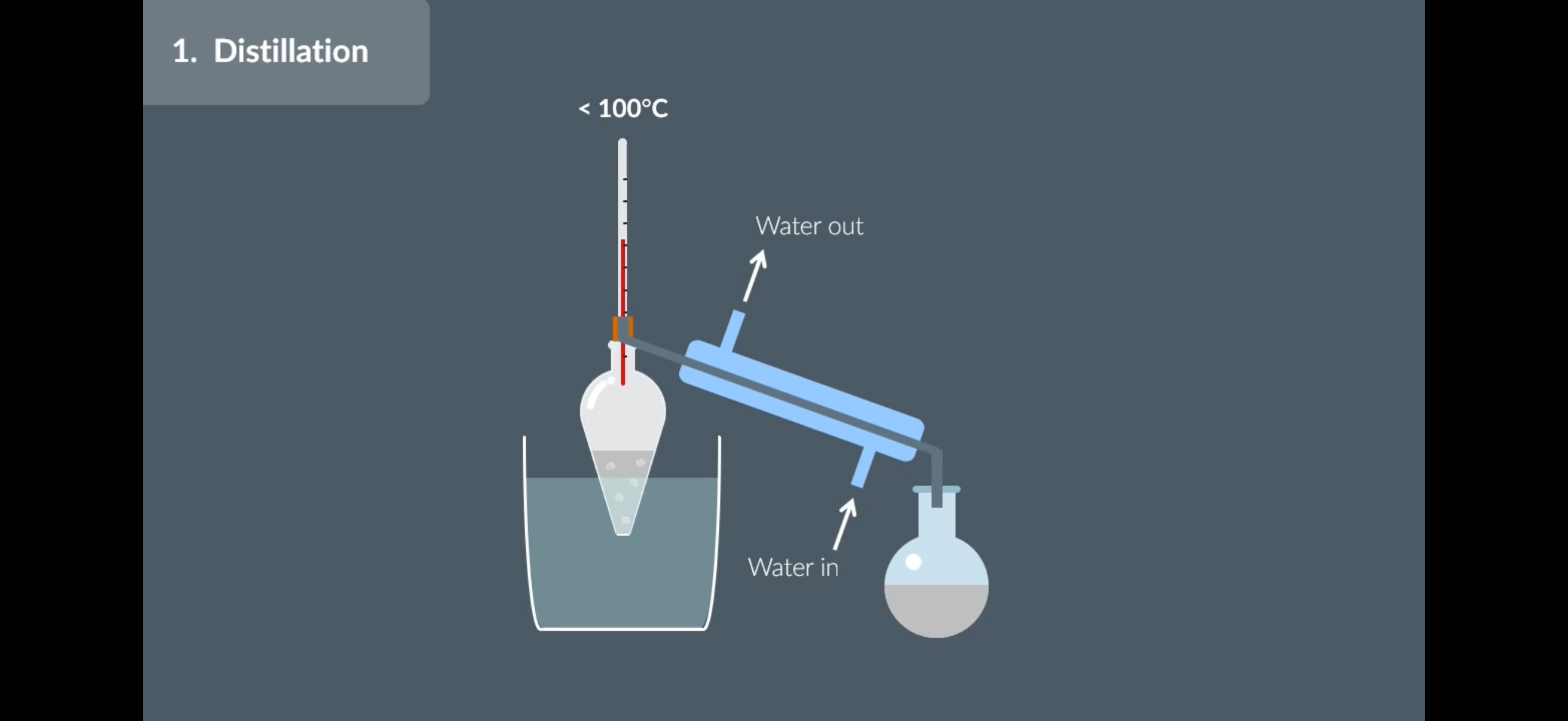
Distillation practical
Step 1-distillation: (1). Pour some cyclohexanol in a pear-shaped …1? (2). Next add a few drops of concentrated …2? into the flask using a …3? (3).Then add some …4? To the flask. (4). Then connect the flask to the distillation apparatus and heat the reaction mixture in a …5? Below …6? •C. (6). So the cyclohexene evaporates from the …7? and collects as a distillate in the..8?
Step-2: Purifying: (1). Pour the liquid into a …9?.
(2)Next you carry out 2 solvent extractions. The first you use Na2CO3 which will react with any molecules of our acid catalyst that made it into our distillate. 2. Explain how to do the 1st solvent extraction ? 3. Now explain how to carry out the 2nd solvent extraction?
Step-3: Drying
Explain the process?
Step-4: Seperating
Explain the process?
Why do we consider the seperated cyclohexen liquid as dry distillate even though it’s still a liquid ?
Step-5: Testing
Explain the process
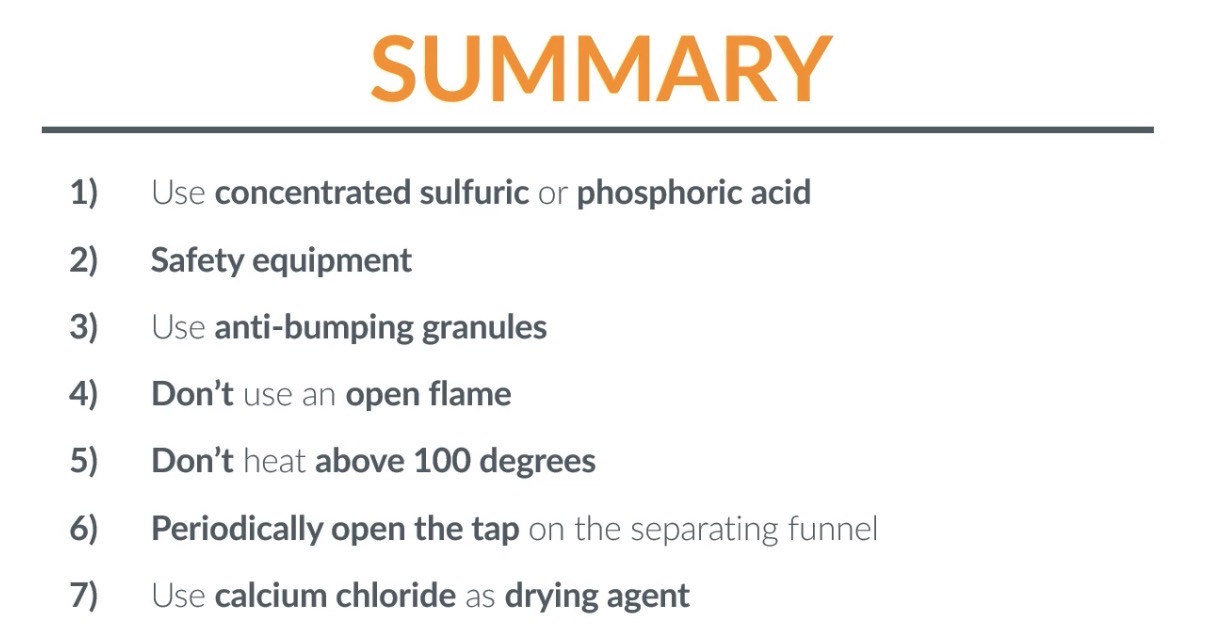
Note(image on other side contains practical considerations→ (we go over that in flashcard 12)
Step-1
Flask. 2. phophoric acid 3.pipette. 4. Anti-bumping granules. 5. Water bath. 6. 100•C. 7. Flask
Receiving flask
Step-2
Seperating funnel
add the sodium carbonate(using a spatula) into the seperating funnel then shake the mixture. Now the top layer will contain cyclohexene, so remove the bottom layer.(which leaves you with just the alkene)
Add drops of saturated HCl into the funnel using a pipette. Then shake the mixture and the top layer will be cyclohexene so we remove the bottom layer.
Step-3
Once you poured the cyclohexene into a flask, add some anhydrous CaCl2(calcium chloride) using a spatula as a drying agent, then shake the mixture.
Step-4:
Pour the liquid in a seperate flask(so the CaCl2 is no longer in the same apparatus as the liquid). Note- We call the seperated liquid the dry distillate
Because H2O has been removed by CaCl2 from Cyclohexene
Step-5:
Pour the dry distillate into a test tube and add an equal amount of acidified potassium manganate (VII) solution into the test tube using a pipette.
(2) Then shake the mixture and if the solution turns from purple to colourless, you confirmed that the dry distillate is cyclohexene
Distillation practical
Percentage yield of dry cyclohexene
In your exam, you might get a question asking you to calculate the percentage yield of dry cyclohexene produced.
Before we have a look at the calculations, let’s briefly look where during the dehydration of cyclohexanol you can collect the necessary data:
1. At the beginning of the experiment, …1? the pear-shaped flask which you will pour the cyclohexanol in.
…2? your scale, pour some cyclohexanol into the same pear-flask, weigh it again and record the mass of …3?.
2. At the end of the experiment, weigh the …4? in which you will pour your dry distillate in. The dry distillate is …5?.
Reset your scale, pour the dry distillate into the flask, weigh it again and record the mass of …6?.
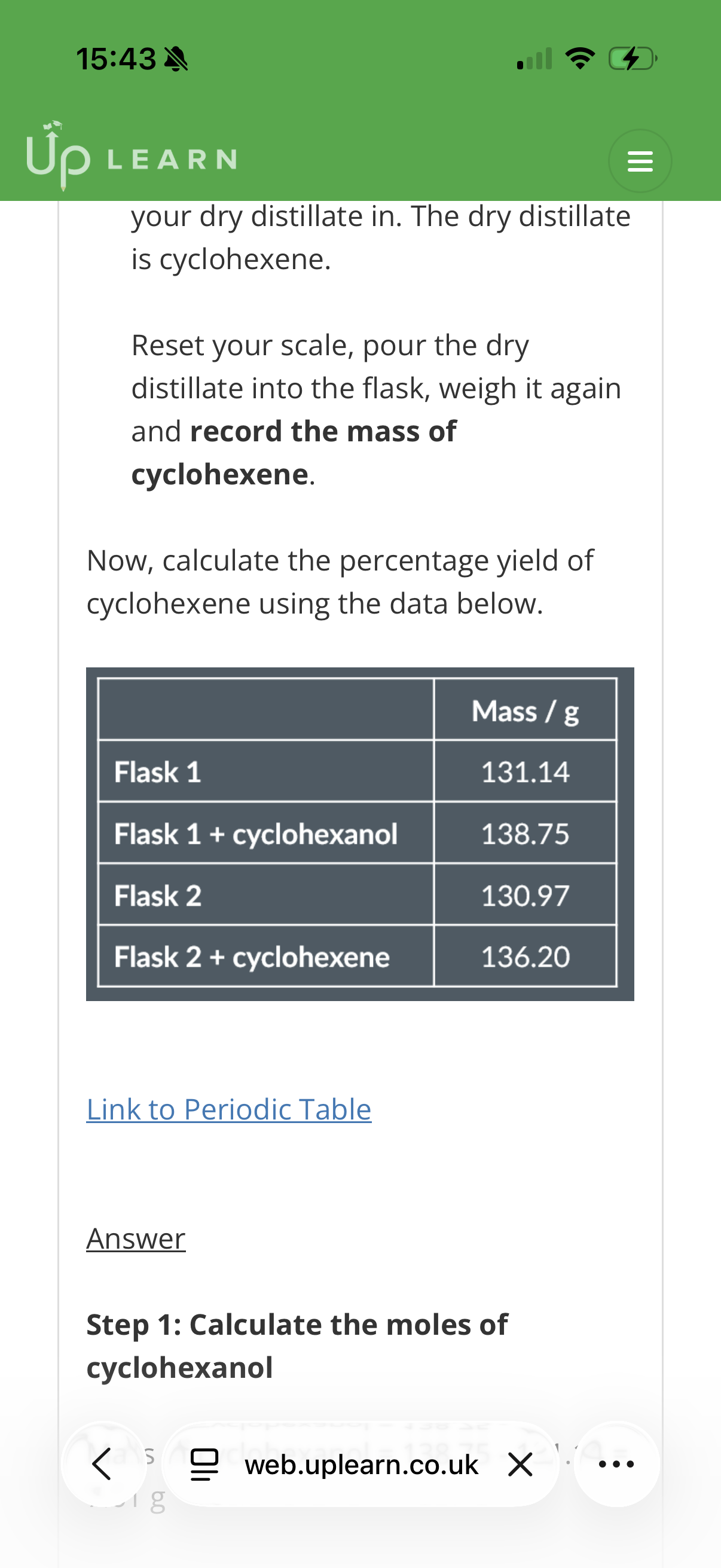
Now, calculate the percentage yield of cyclohexene using the data in the image?
C=12. H=1. O=16
Weigh. 2. Reset. 3.cyclohexanol. 4. Flask 5.cyclohexene. 6.cyclohexene
Step 1: Calculate the moles of cyclohexanol
Mass of cyclohexanol = 138.75 - 131.14 = 7.61 g
Molar mass(Mr) of cyclohexanol = 100 g mol-1 (16)+(6×12)+(12X1)
Moles of cyclohexanol = 0.0761 mol (7.61/100). (Mol=mass/Mr)
Step 2: Calculate the theoretical yield of cyclohexene
C₆H₁₂O → C₆H₁₀ + H₂O
The ratio of cyclohexanol to cyclohexene is 1 : 1
•So, moles of cyclohexene = 0.0761 mol
•Molar mass of cyclohexene = 82 g mol-1 ( 12×6)+(10×1)
mass = moles × molar mass
mass = 0.0761 × 82
Theoretical yield of cyclohexene = 6.24 g (3 s.f.)
Step 3: Calculate the percentage yield
Actual yield of cyclohexene = 136.20 - 130.97 = 5.23 g
•Percentage yield= (Actual yield/ Theoretical yield) X100
• (5.23/6.24)=0.838 0.838X100=83.8%
Percentage yield of cyclohexene = 83.8% (3 s.f.)

Distillation practical considerations
For the dehydration of Cyclohexanol we can either use Concentrated sulfuric acid and concentrated phosphoric acid…
Select all that apply
A: …are acid catalysts.
B: … are base catalysts.
C: …catalyse the dehydration reaction of an alcohol.
D: …catalyse the elimination reaction of an alcohol.
Concentrated H2SO4 and H3PO4(toxic substances) are harmful to the skin,eyes and inner organs. To protect ourselves from toxic substances such as concentrated sulfuric acid and concentrated phosphoric acid, we need to…
A: wear plastic gloves.
B: wear goggles.
C: wear a lab coat.
D: work in below-room temperature conditions.
E: work in a fume cupboard.
Why do we always add anti-bumping granules to the reaction meixture before we heat it?
The reactants and products in the pear shaped flask(reaction mixture) are flammable. When heating these flammable substances, we...
Select all that apply
A: need to avoid the buildup of toxic vapours.
B: don’t use an open flame.
C: use a fire extinguisher.
D: use a water bath.
When producing cyclohexene(only van der waals) from cyclohexanol(has hydrogen bonding+ van der waals), we keep the reaction mixture below 100 degrees celsius because…
When we carry out the 1st solvent extraction, why do we add Na2CO3 to the distillate?
Why do we add saturated sodium chloride solution (NaCl2) to the distillate in the separating funnel?
Sodium carbonate and any remaining acidic impurities in a mixture react like this:
HCO3−(aq)+ H+(aq)⇌H2O (l)+CO2(g)
So, it’s important to open the tap on the separating funnel periodically to…Select all that apply
A: enhance pressure
B: release pressure
C: release CO2
D: release H2O
E: prevent the stopper from blowing out
F: allow O2 into the separating funnel
Anhydrous calcium chloride(CaCl2), anhydrous sodium sulfate(NaSO4) and anhydrous magnesium sulfate(MgSO4) can be used as drying agents in this experiment.
That’s because none of these substances…
Why can cyclohexene be separated from the mixture using a separating funnel?
A: Cyclohexene is insoluble in aqueous solution.
B: The impurities are soluble in the organic phase.
C: Cyclohexene has a different colour to the impurities.
D: Sodium carbonate solution reacts with cyclohexene.
E: The aqueous and organic solutions are immiscible.
•Info-Immiscible means that two or more liquids don't mix to form a homogeneous solution. Instead, they form separate layers. A common example is oil and water.
After drying your product with anhydrous calcium chloride, how could you test that all water has been removed?
•When we set up our distillation apparatus, we need to make sure that water flows in at the
…12?
of the condenser, and then flows out at the
…13?
. This is to make sure that the condenser is always full of
…14?
water so the vapour can condense back into a
…15?
.
A,C,D
A,BC,E (You were right not to select D.As long as we’re using the other protective measures mentioned here we don’t need to do this.)
They prevent the reaction mixture from uneven boiling
B,D
cyclohexanol has a higher boiling point than cyclohexene
And we want to separate cyclohexene from cyclohexanol.
(if we heat the reaction mixture above 100•C then both the cyclohexanol and cyclohexene will vaporize and collect in our flask so they won’t be separated→ therefore we want the temp above cyclohexenes boiling point but below cyclohexanols)
sodium carbonate removes any remaining acidic impurities.
[Sodium carbonate will react with any acid impurities (conc phosphoric acid catalyst) and neutralise it → producing water and CO2]
Saturated sodium chloride removes water from the mixture incase water still remains from the dehydration reaction.
(Explanation
•Sodium chloride dissociates into sodium and chloride ions in water.
•Due to opposite charges attracting each other, this results in water molecules surrounding both ions, effectively removing water from the mixture.)
B,C,E
react with or dissolve in alkenes (cyclohexene)
A and E (Cyclohexene forms an organic phase. The impurities, such as residual acid catalyst, are soluble in the aqueous phase. As these phases are immiscible, cyclohexene can be isolated with a separating funnel)
Add anhydrous copper sulfate to the liquid. If the white salt dissolves to form a blue solution, it tells us that water is present, because the ions in the copper sulfate lattice have been hydrated. If copper sulfate remains as a white solid, the liquid is dry.
Bottom. 13. Top. 14. Cool. 15.liquid
![<ol><li><p>A,C,D</p></li><li><p>A,BC,E (<span>You were right not to select D.As long as we’re using the other protective measures mentioned here we don’t need to do this.)</span></p></li><li><p><span>They prevent the reaction mixture from uneven boiling</span></p></li><li><p><span>B,D</span></p></li><li><p><span>cyclohexanol has a higher boiling point than cyclohexene</span></p><p class="sc-ggWZvA iOhPCm"><span>And we want to separate cyclohexene from cyclohexanol.</span></p><p class="sc-ggWZvA iOhPCm">(if we heat the reaction mixture above 100•C then both the cyclohexanol and cyclohexene will vaporize and collect in our flask so they won’t be separated→ therefore we want the temp above cyclohexenes boiling point but below cyclohexanols)</p></li></ol><p class="sc-ggWZvA iOhPCm"></p><ol start="6"><li><p class="sc-ggWZvA iOhPCm"><span>sodium carbonate removes any remaining </span><strong>acidic impurities</strong><span>.</span></p><p class="sc-ggWZvA iOhPCm">[Sodium carbonate will react with any acid impurities (conc phosphoric acid catalyst) and neutralise it → producing water and CO2]</p></li></ol><p></p><ol start="7"><li><p><span>Saturated sodium chloride removes water from the mixture incase water still remains from the dehydration reaction.</span></p></li></ol><p>(Explanation</p><p class="sc-ggWZvA iOhPCm"><span>•Sodium chloride dissociates into sodium and chloride ions in water. </span><span><br></span><span>•Due to opposite charges attracting each other, this results in water molecules surrounding both ions, effectively removing water from the mixture.)</span></p><ol start="8"><li><p class="sc-ggWZvA iOhPCm">B,C,E</p></li><li><p class="sc-ggWZvA iOhPCm"><strong>react with</strong> or <strong>dissolve in alkenes (cyclohexene)</strong></p></li><li><p class="sc-ggWZvA iOhPCm"><strong>A and E (</strong><span>Cyclohexene forms an organic phase. The impurities, such as residual acid catalyst, are soluble in the aqueous phase. As these phases are immiscible, cyclohexene can be isolated with a separating funnel)</span></p></li><li><p><span>Add anhydrous copper sulfate to the liquid. If the white salt dissolves to form a blue solution, it tells us that water is present, because the ions in the copper sulfate lattice have been hydrated. If copper sulfate remains as a white solid, the liquid is dry.</span></p></li><li><p><span>Bottom. 13. Top. 14. Cool. 15.liquid</span></p></li></ol><p></p>](https://assets.knowt.com/user-attachments/82d728ba-1267-45ed-914a-f29f7ee7da60.png)
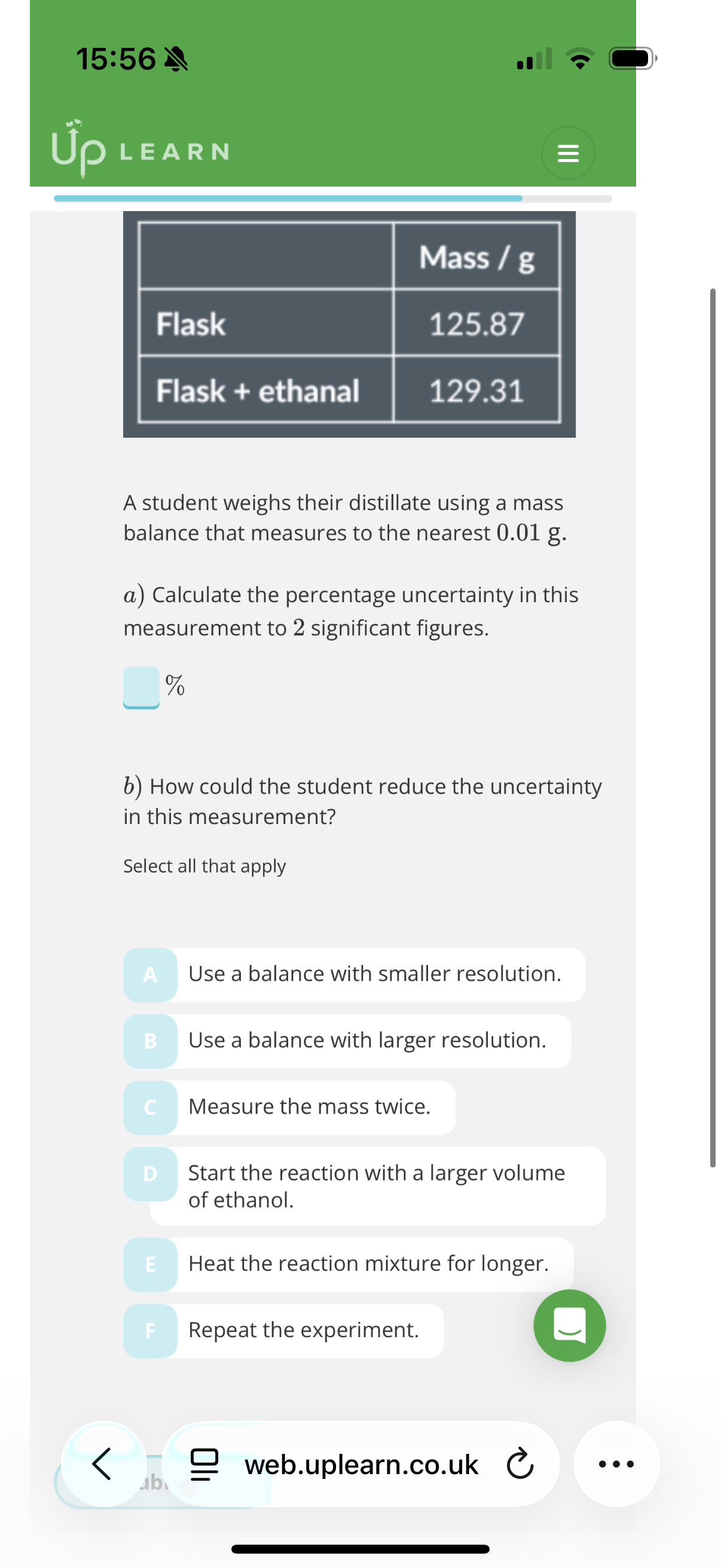
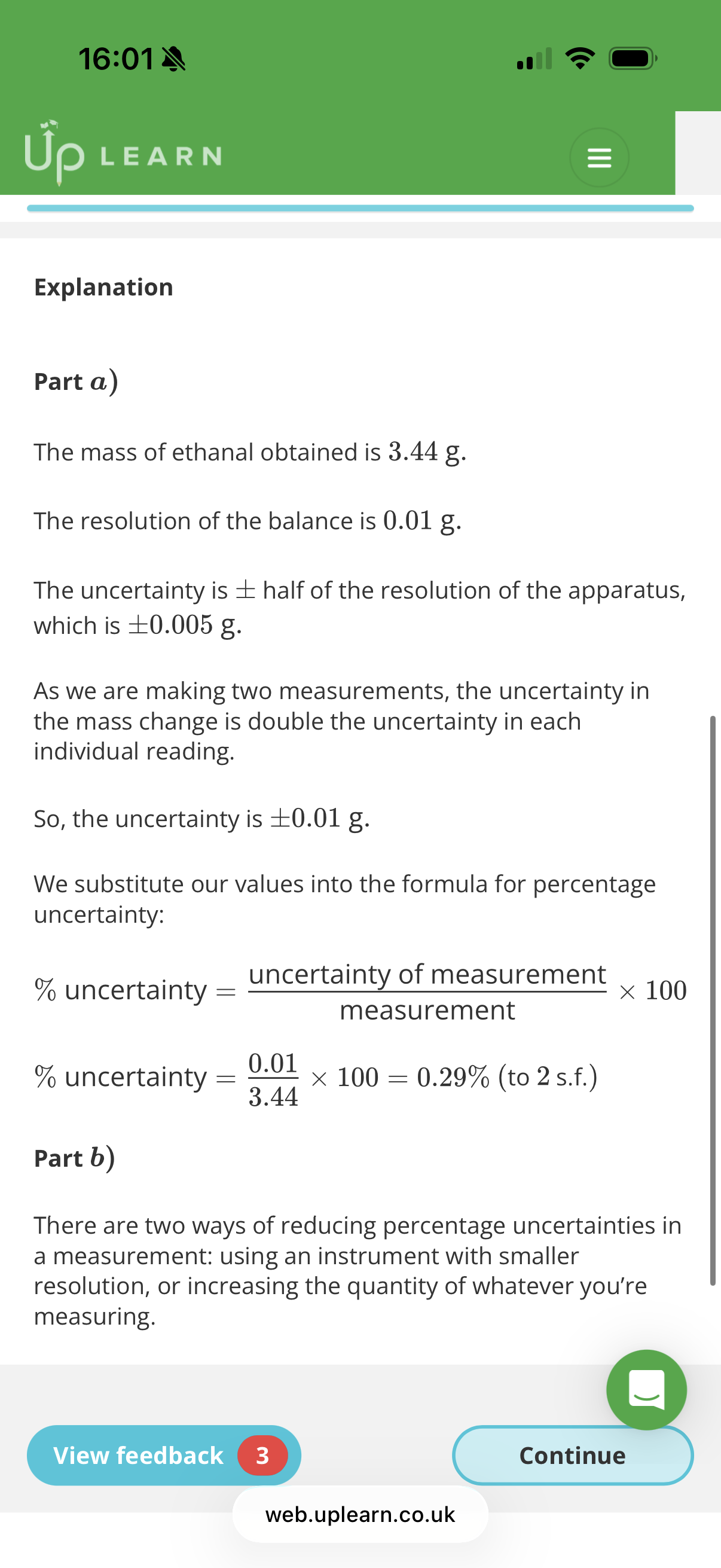
Ethanal is produced by heating ethanol with acidified potassium dichromate solution while distilling. Suggest why the temperature of the distillation apparatus must be kept below 78°C.
Answer image question?
As ethanal does not experience hydrogen bonding, it has a lower boiling point than ethanol. Below 78°C,ethanal will evaporate and collect as a distillate in the second flask, but ethanol will remain in the reaction mixture. If the temperature exceeds 78°C, ethanol will also evaporate, meaning that the distillate will contain both ethanol and ethanal.
0.29%(for first question)
A:Use a balance with smaller resolution.
D: Start the reaction with a larger volume of ethanol.
![<p>Partial oxidation of primary alcohols to aldehydes:</p><p>Primary alcohols can be partially oxidised by …1? Into aldehydes</p><p>2.What is the general reaction? [O] represents oxidation</p><ol start="3"><li><p>How do we prevent complete oxidation into a carboxylic acid?</p></li></ol><p>4.Using the image, explain briefly the practical steps?</p>](https://knowt-user-attachments.s3.amazonaws.com/0ff169e3-23b4-4db4-9563-a9c7a9ee6ad8.jpg)
Partial oxidation of primary alcohols to aldehydes:
Primary alcohols can be partially oxidised by …1? Into aldehydes
2.What is the general reaction? [O] represents oxidation
How do we prevent complete oxidation into a carboxylic acid?
4.Using the image, explain briefly the practical steps?
Acidified potassium dichromate (VI) solution
RCH2OH + [O] → RCHO + H2O
Alcohol Aldehyde + Water
The primary alcohol should be in excess and the aldehyde should be distilled off immediately and collected.
4.
1. Set up the apparatus: Assemble the distillation apparatus, including a round-bottomed or pear-shaped flask, a thermometer placed through an adapter, a condenser, and a receiving flask (often kept in an ice bath).
2. Add the reactants: Place the primary alcohol, dilute sulfuric acid, and potassium dichromate solution into the flask. The alcohol should be in excess.
3. Gently Heat the mixture: Gently heat the flask using a heat source (e.g., a heating mantle or water bath). The thermometer is used to monitor the temperature.
4. Distill the aldehyde: As the alcohol oxidizes, the aldehyde produced will have a lower boiling point than the alcohol and any remaining reactants. The aldehyde vaporizes and moves through the adapter and condenser.
5. Cool and collect: The condenser cools the aldehyde vapor, causing it to condense back into a liquid. The liquid aldehyde is collected in the receiving flask.
6. Prevent further oxidation: The aldehyde is distilled off immediately to prevent it from being further oxidized to a carboxylic acid. The receiving flask is often kept in an ice bath to help cool the aldehyde and prevent unwanted reactions.
![<ol><li><p>Acidified potassium dichromate (VI) solution</p></li><li><p>RCH2<u>OH</u> + [O] → R<u>CHO</u> + H2O</p><p>Alcohol Aldehyde + Water</p></li><li><p>The primary alcohol should be in excess and the aldehyde should be distilled off immediately and collected.</p></li></ol><p>4.</p><p>1. Set up the apparatus: Assemble the distillation apparatus, including a round-bottomed or pear-shaped flask, a thermometer placed through an adapter, a condenser, and a receiving flask (often kept in an ice bath).</p><p>2. Add the reactants: Place the primary alcohol, dilute sulfuric acid, and potassium dichromate solution into the flask. The alcohol should be in excess.</p><p>3. Gently Heat the mixture: Gently heat the flask using a heat source (e.g., a heating mantle or water bath). The thermometer is used to monitor the temperature.</p><p>4. Distill the aldehyde: As the alcohol oxidizes, the aldehyde produced will have a lower boiling point than the alcohol and any remaining reactants. The aldehyde vaporizes and moves through the adapter and condenser.</p><p>5. Cool and collect: The condenser cools the aldehyde vapor, causing it to condense back into a liquid. The liquid aldehyde is collected in the receiving flask.</p><p>6. Prevent further oxidation: The aldehyde is distilled off immediately to prevent it from being further oxidized to a carboxylic acid. The receiving flask is often kept in an ice bath to help cool the aldehyde and prevent unwanted reactions.</p>](https://knowt-user-attachments.s3.amazonaws.com/8ff5fe85-19cb-49b5-a58e-b06e6b41fcd8.jpg)
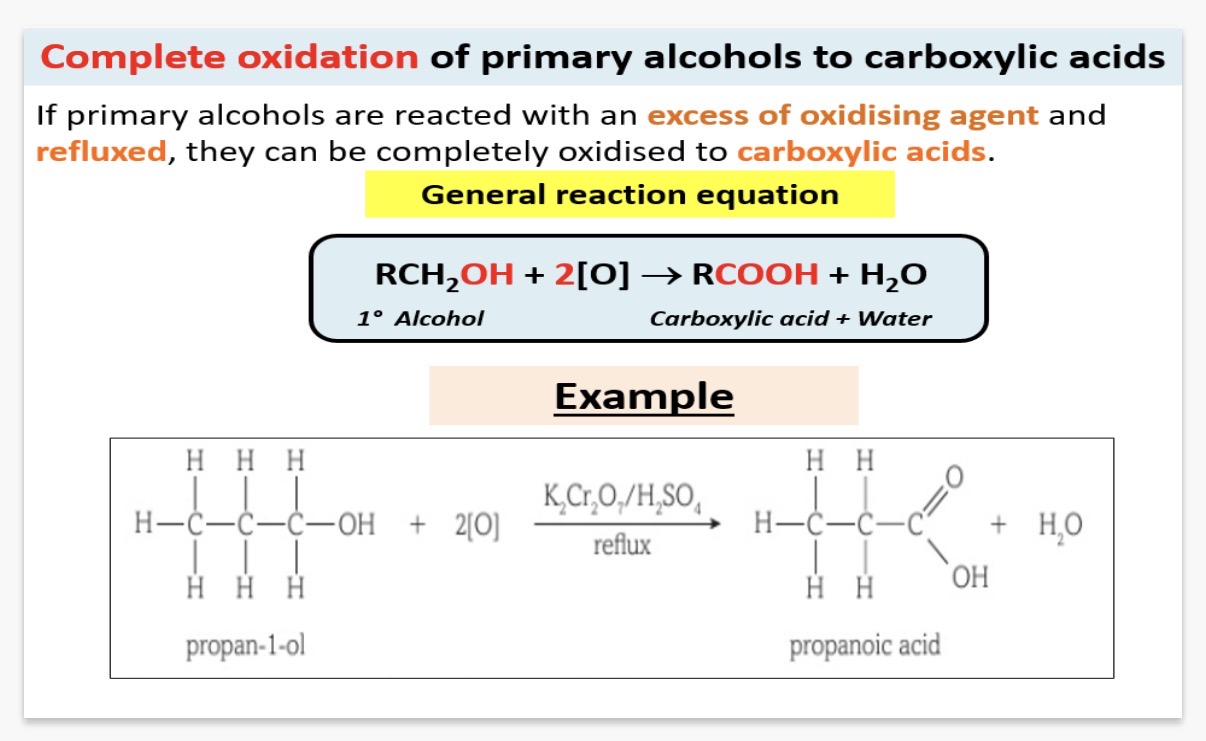
Complete oxidation of primary alcohols to carboxylic acids:
primary alcohols are reacted with an …1? of oxidizing agent and …2?, they can be completely oxidised to carboxylic acids.
3.What is the general equation for this process?
How do we ensure complete oxidation of the primary alcohol?
What is “reflux”?
Heating under reflux refers to heating a reaction mixture without losing any of the volatile solvents or reactants.
What is the importance of heating under reflux?(refer to the practical)
1.excess. 2.refluxed
RCH2OH + 2[0] → RCOOH + H2O 1º Alcohol Carboxylic acid + Water
Make sure the oxidising agent is in excess and the reaction mixture is heated under reflux which is achieved by the condenser being connected directly to the round bottom flask.
The constant boiling and condensing of a reaction mixture
6.Heating with a condenser connected to the flask is essential because it ensures that the alcohol is completely oxidised without any loss of reactants or products as vapour to the air.
This is because any reactant or partially oxidised product that vaporises and rises up the condenser is able to condense back into the reaction flask where it can be oxidised completely into the final product
![<p>1.excess. 2.refluxed</p><ol start="3"><li><p>RCH2<u>OH</u> + <u>2</u>[0] → R<u>COOH</u> + H2O 1º Alcohol Carboxylic acid + Water</p></li><li><p>Make sure the oxidising agent is in excess and the reaction mixture is heated under reflux which is achieved by the condenser being connected directly to the round bottom flask.</p></li><li><p>The constant boiling and condensing of a reaction mixture</p></li></ol><p>6.Heating with a condenser connected to the flask is essential because it ensures that the alcohol is completely oxidised without any loss of reactants or products as vapour to the air.</p><p>This is because any reactant or partially oxidised product that vaporises and rises up the condenser is able to condense back into the reaction flask where it can be oxidised completely into the final product</p>](https://knowt-user-attachments.s3.amazonaws.com/304e6475-88cb-4eb1-8bf7-5f7f46932546.png)
![<p>Oxidation of secondary alcohols:</p><p>Secondary alcohols can be oxidised to …1? by an oxidising agent [O].</p><p>2.What is the general reaction equation for the oxidation of secondary alcohols?</p><ol start="3"><li><p>Explain why the only condition for this reaction is that the reaction mixture is heated under reflex?</p></li></ol><p></p><p>Oxidation of tertiary alcohols:</p><ol start="4"><li><p>Explain why tertiary alcohols are resistant to oxidation?</p></li></ol><p>Observations:</p><p>What colour changes do you see during an experiment when alcohols (primary or secondary) become oxidised?Explain why?</p>](https://knowt-user-attachments.s3.amazonaws.com/beb85273-0301-43c7-8872-083da254680f.jpg)
Oxidation of secondary alcohols:
Secondary alcohols can be oxidised to …1? by an oxidising agent [O].
2.What is the general reaction equation for the oxidation of secondary alcohols?
Explain why the only condition for this reaction is that the reaction mixture is heated under reflex?
Oxidation of tertiary alcohols:
Explain why tertiary alcohols are resistant to oxidation?
Observations:
What colour changes do you see during an experiment when alcohols (primary or secondary) become oxidised?Explain why?
Ketones
R1CH(OH)R2 + [O] → R1COR2 + H2O
2° Alcohol + oxidising agent → Ketone + Water
There is no risk of further oxidation of a ketone product unlike if an aldehyde was produced.
due to the lack of hydrogen atoms on the carbon atom to which the hydroxyl group is attached.
5.•The dichromate ion (Cr207 (2-) within potassium dichromate is orange in colour
• When the dichromate ion oxidises an alcohol, the dichromate ion becomes reduced to a 2Cr3+ ion which is green in colour.
Therefore the colour change observed during an oxidation reaction with acidified potassium dichromate is orange→ green
![<ol><li><p>Ketones</p></li><li><p>R1CH(<u>OH</u>)R2 + [O] → R1<u>CO</u>R2 + H2O</p><p>2° Alcohol + oxidising agent → Ketone + Water</p></li><li><p>There is no risk of further oxidation of a ketone product unlike if an aldehyde was produced.</p></li><li><p>due to the lack of hydrogen atoms on the carbon atom to which the hydroxyl group is attached.</p></li></ol><p>5.•The dichromate ion (Cr207 (2-) within potassium dichromate is orange in colour</p><p>• When the dichromate ion oxidises an alcohol, the dichromate ion becomes reduced to a 2Cr3+ ion which is green in colour.</p><p>Therefore the colour change observed during an oxidation reaction with acidified potassium dichromate is orange→ green</p>](https://knowt-user-attachments.s3.amazonaws.com/df1d726c-3781-46f1-abfd-4fea1ea6f311.undefined)
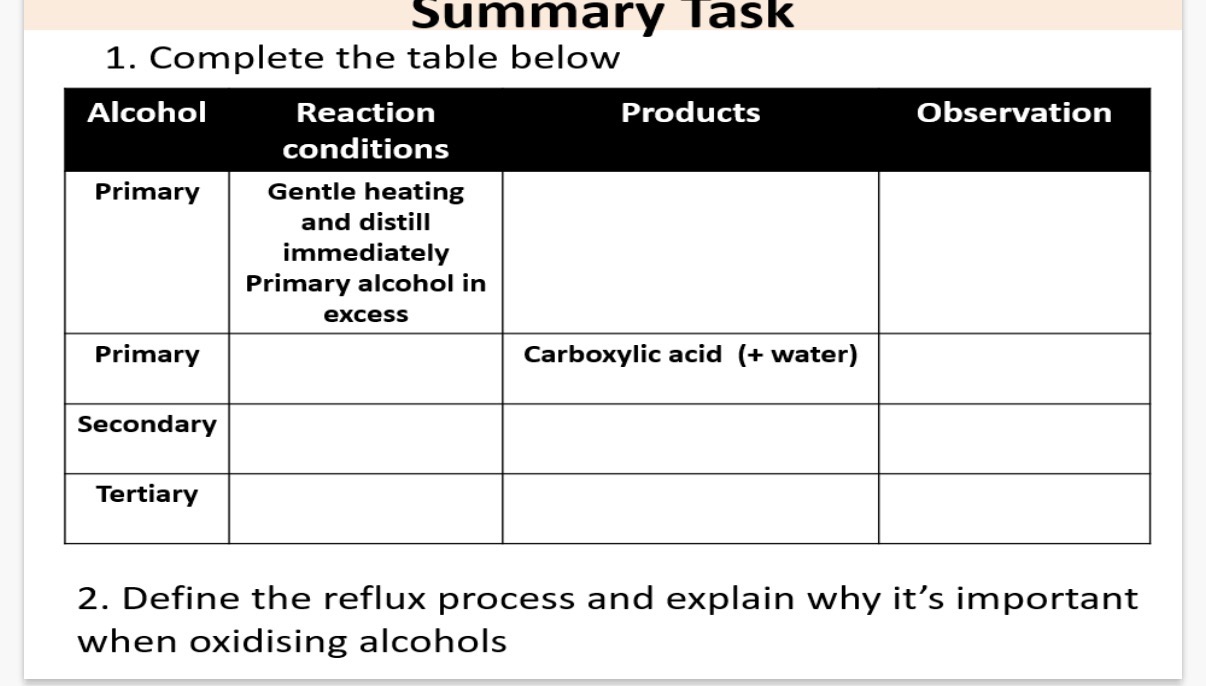
Answer image q?
What is the carboxylic acid test?
note:Effervescence is when a liquid fizzes because gas is escaping from it
What is the alkene test?
You use the reagent sodium carbonate(Na2CO3) and a positive result shows effervescence of CO2 gas.
We use the reagent bromine water and a positive result is a colour change of the water from orange to colourless.
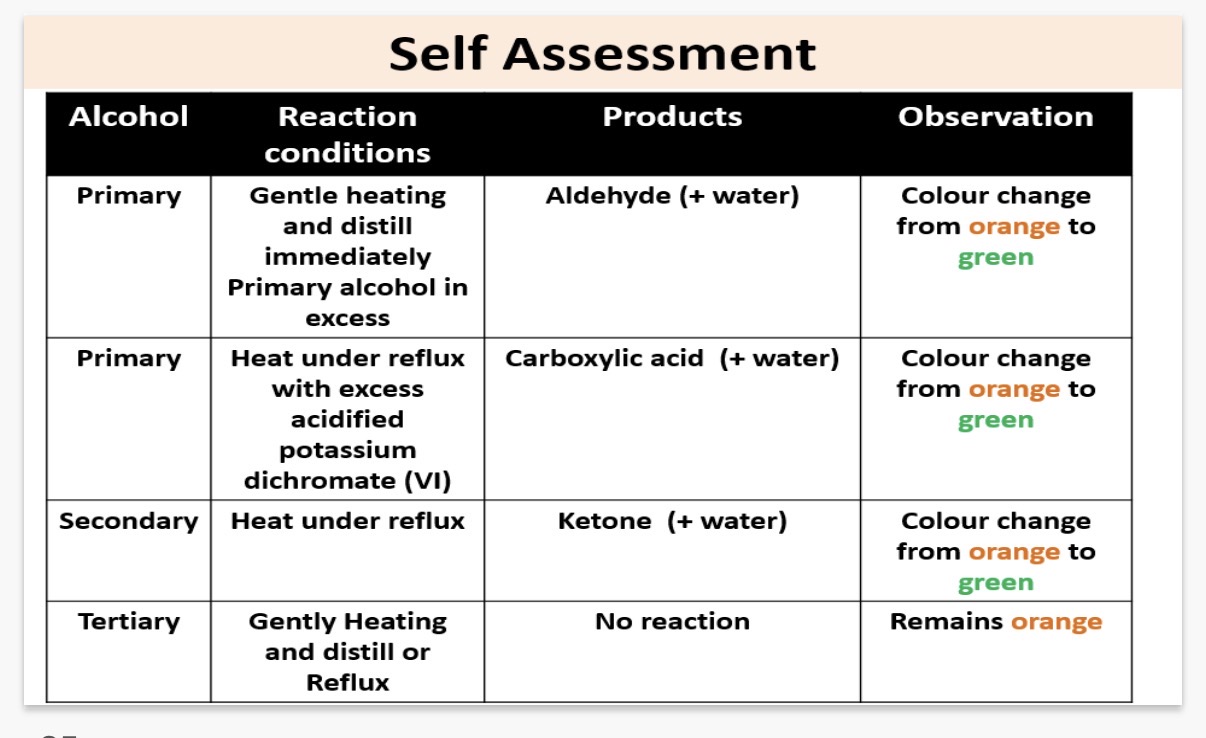
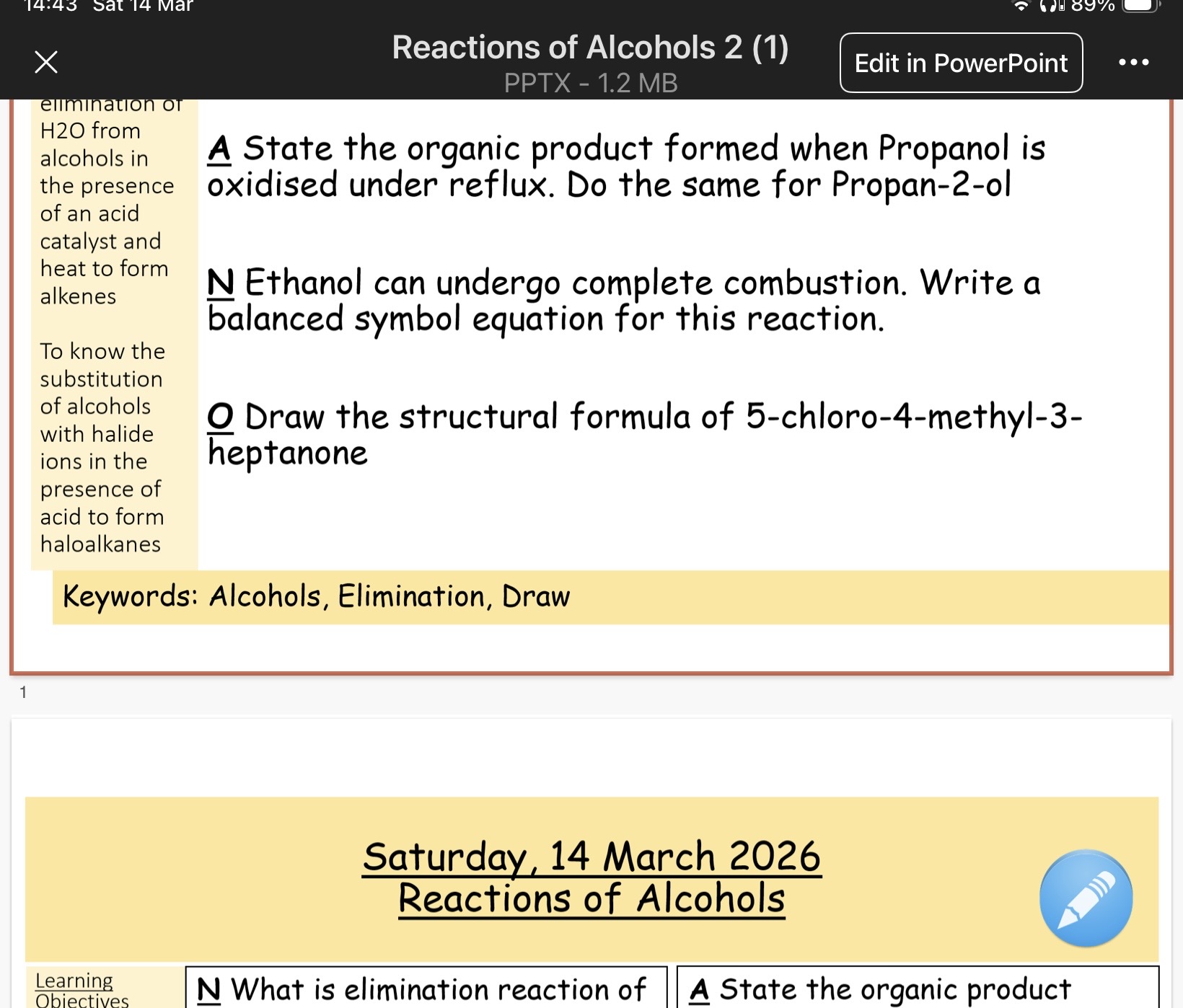
Answer image questions
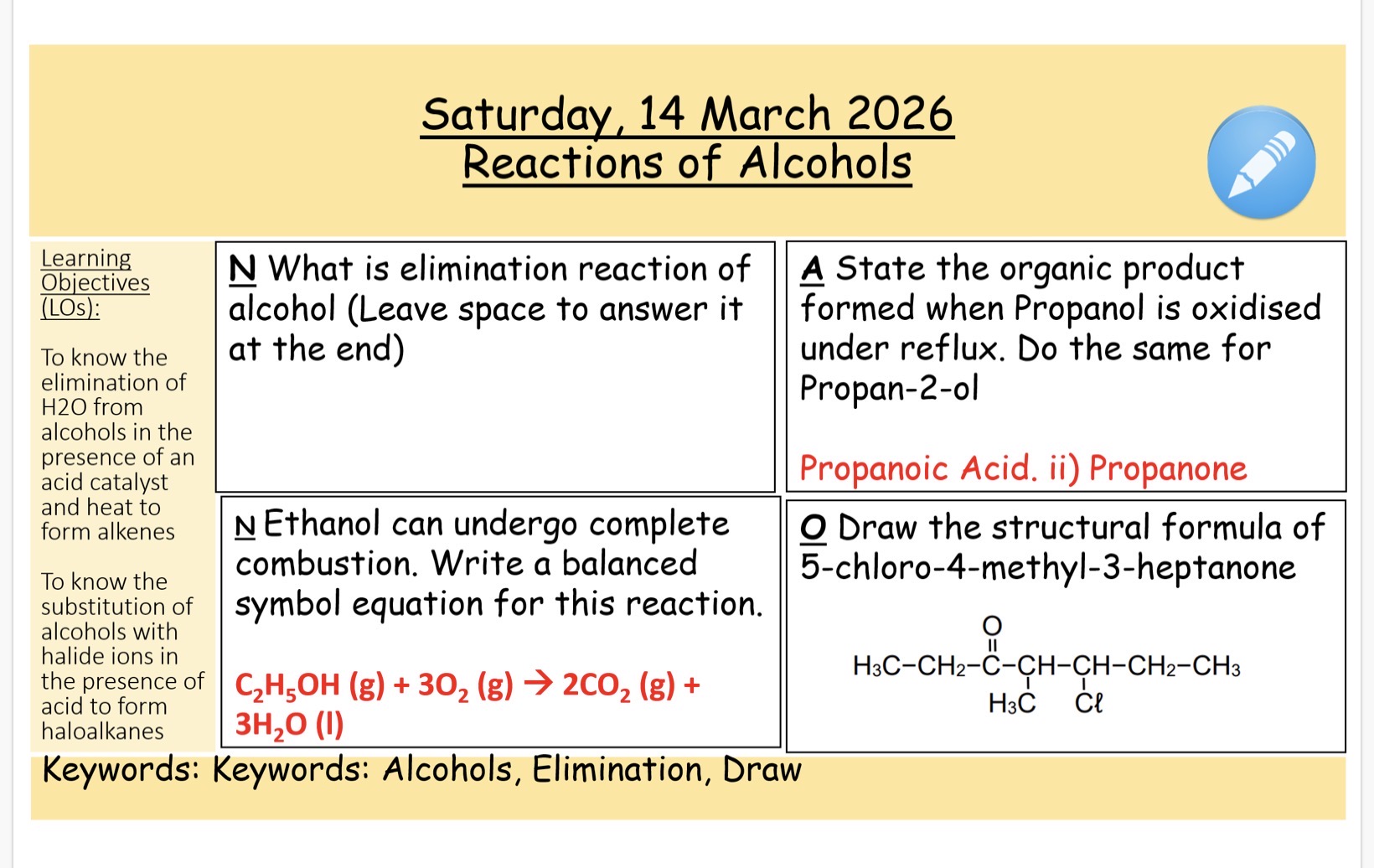

Reactions of alcohols:
Dehydration of alcohols is what type of reaction mechanism?
• Dehydration is a chemical reaction in which …2? Is lost from an organic compound. This is a type of …3? Reaction.
What catalyst do we use for this reaction mechanism?
What alternative catalysts can be used?
What other type of alcohols can dehydration take place in?
An elimination reaction mechanism
Water. 3. Elimination
Concentrated sulfuric acid (H2SO4)
Concentrated phosphoric acid(H3PO4) or.
Hot aluminium oxide (Al2O3)-Small scale lab reaction
Cyclic alcohols e.g. cyclohexanol
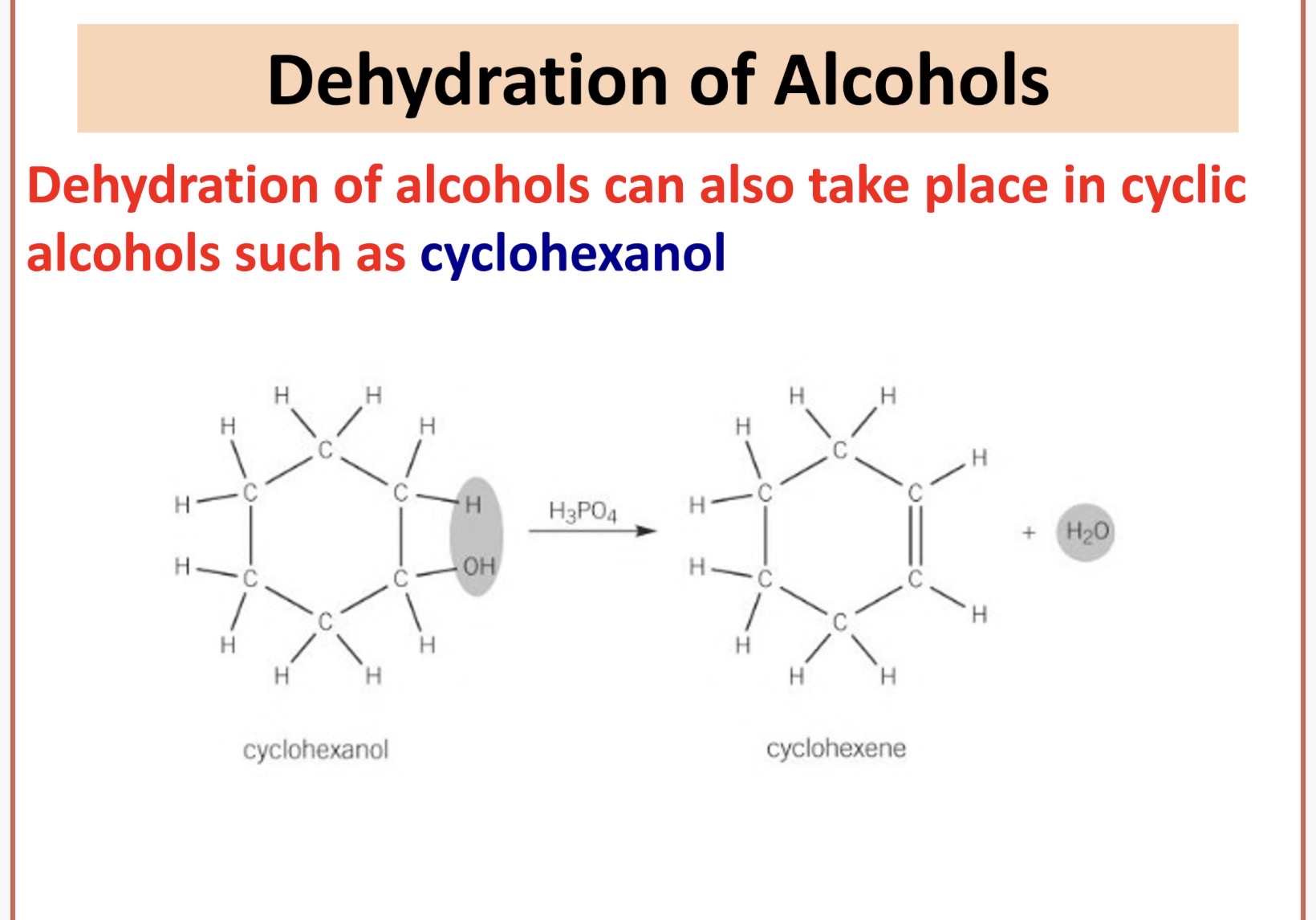
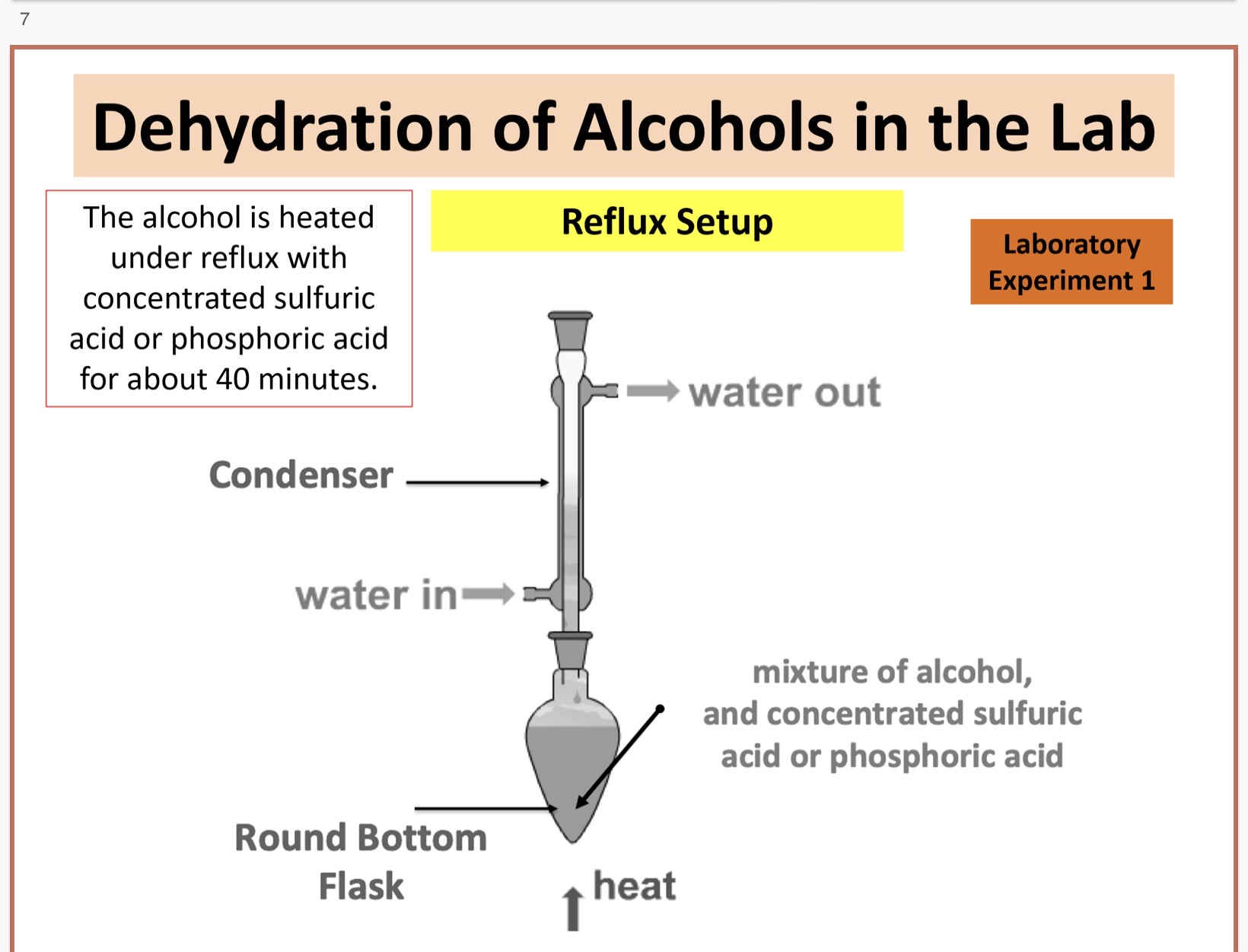
Info: the set up for dehydration of alcohols
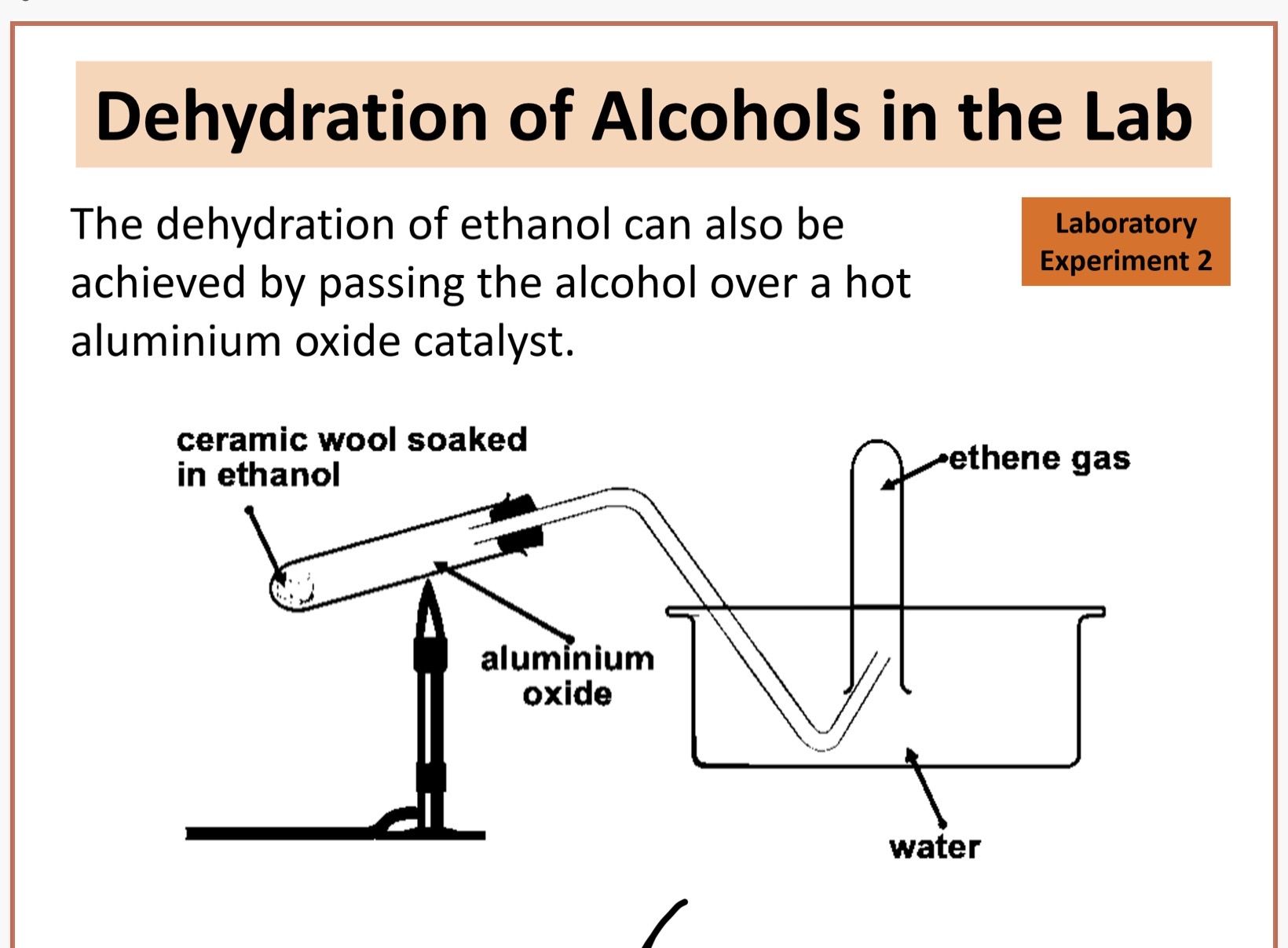

Example of the elimination reaction mechanism with propan-2-ol and aluminium oxide(note- These acid catalysts can be represented as H+)
Explanation:
The lone pair on the OH transfers its lone pair to the H+ from the acid and this forms a bond and creates water and the O becomes + whilst H+ becomes neutral.
The bond attaching the carbon and H2O breaks and the shared pair of electrons go the the O which eliminates water and the C becomes positive.
A bond between H and C is broken and the shared electrons move to the carbon carbon bond which has the C+. This forms a double bond between the carbon and causes the C+ to become neutral. The H is also removed.
This forms propene.
Draw the mechanism for the dehydration of propane-1-ol when it reacts with an acid.

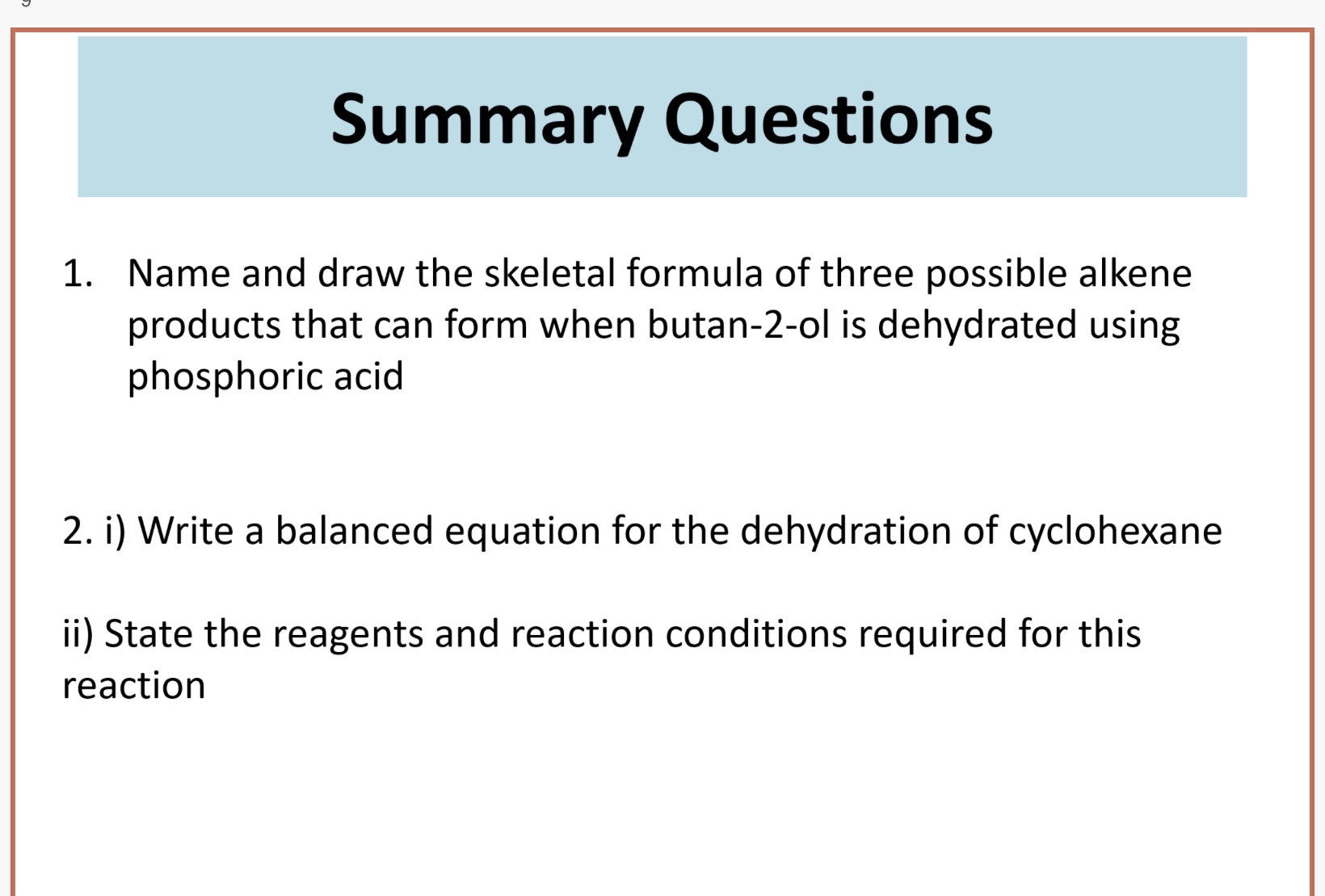
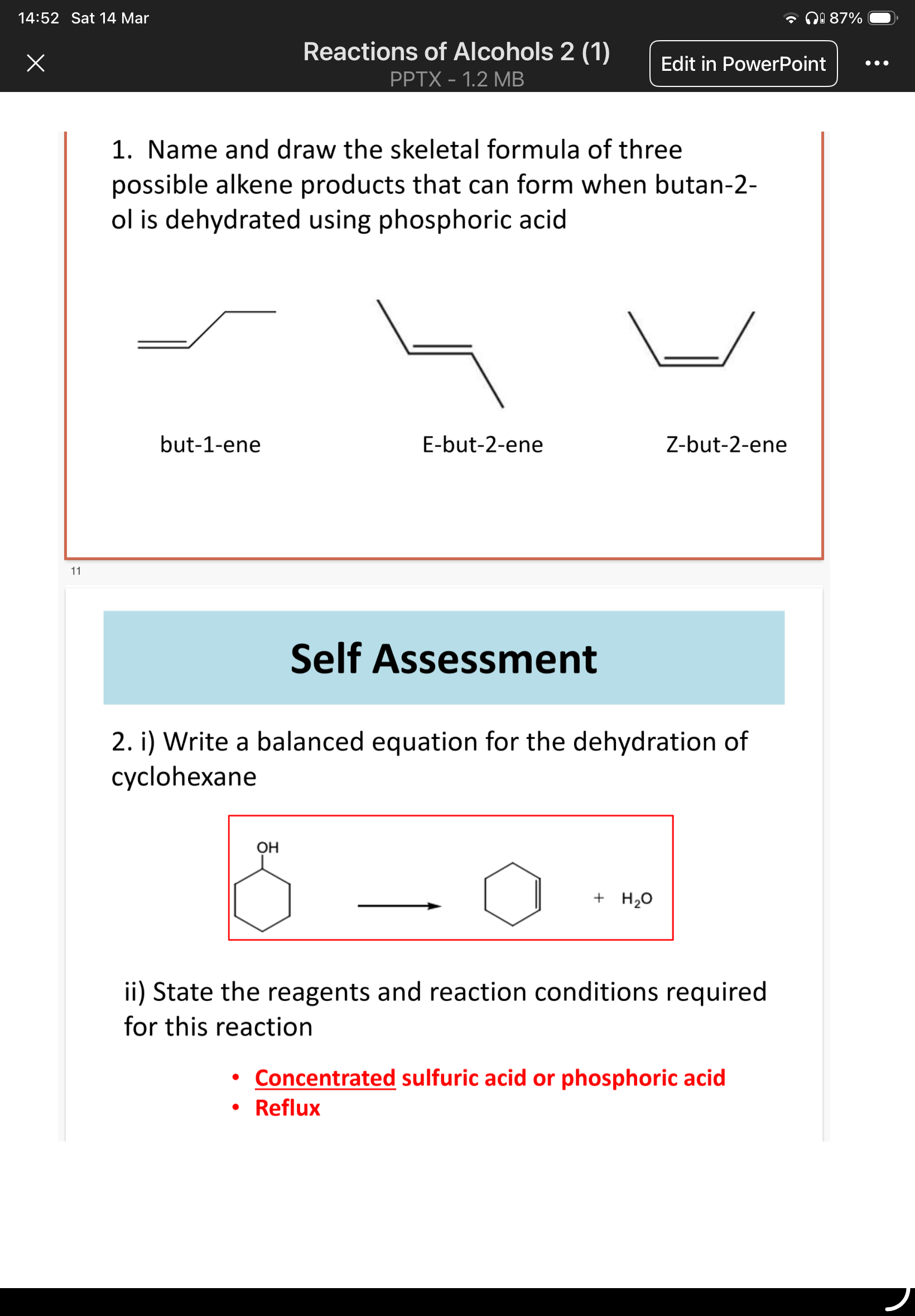
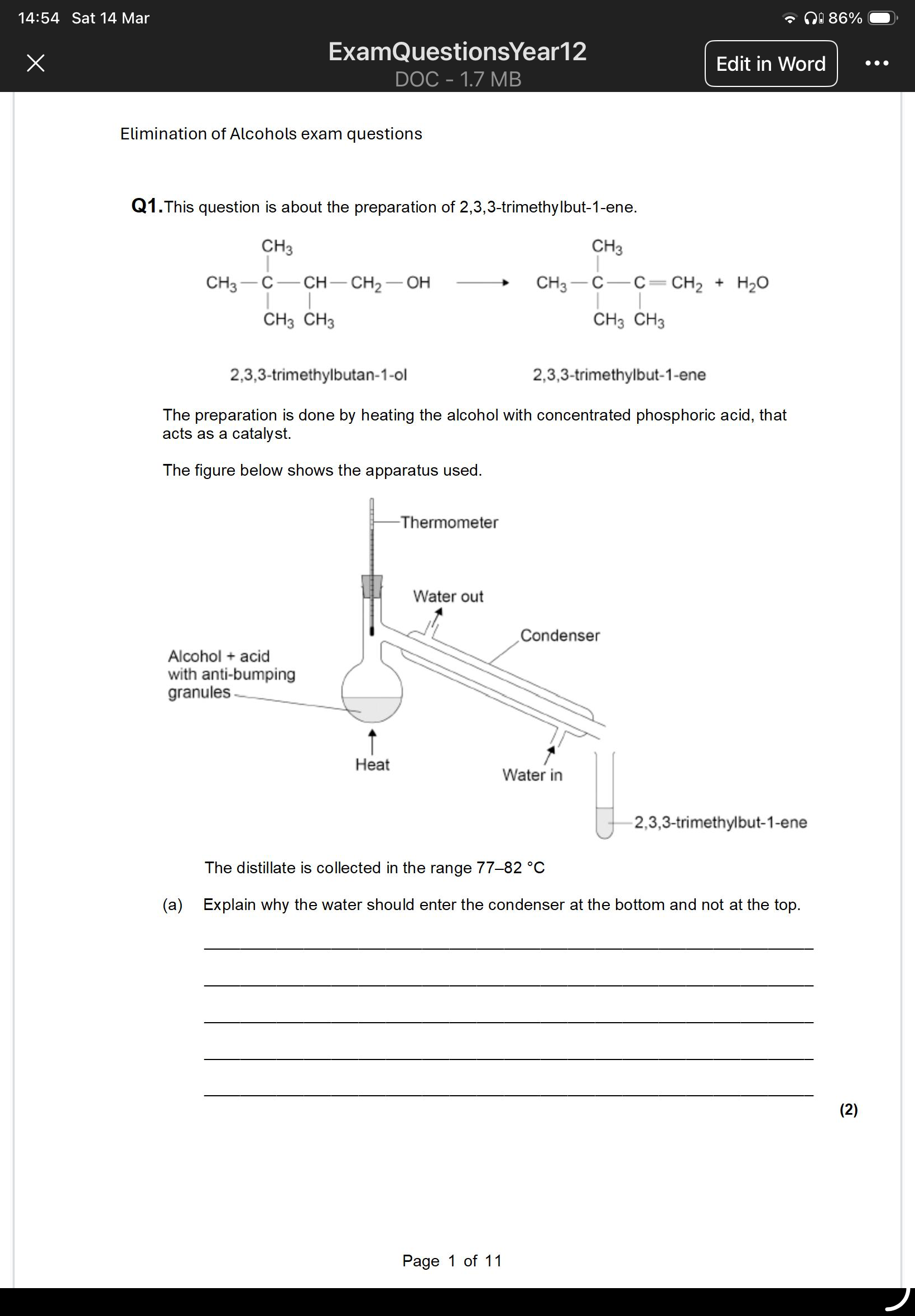
Answer image question.
2.What is a biofuel?
The water should enter the condenser at the bottom and exit at the top to ensure the condenser is completely filled with water, maximizing the cooling effect and allowing for efficient condensation.
2.A biofuel is a fuel that is produced from recently living organisms or their metabolic byproducts, rather than a fuel produced by geological processes such as those involved in the formation of fossil fuels. Biofuels can be produced from plants or algae, or from waste materials.
The answer is on the next flashcard