Electroweak Theory
 Call Kai
 Learn
Learn Practice Test
 Spaced Repetition
 Match
Match Flashcards
 Knowt Play
1/25

There's no tags or description
Looks like no tags are added yet.
Name | Mastery | Learn | Test | Matching | Spaced | Call with Kai |
|---|
No analytics yet
Send a link to your students to track their progress
26 Terms
Parity
Parity is a discrete conserved quantum number, and is equal to the eigenvalue of any wavefunction that is an eigenstate of the space-inversion transformation, P^.
Intrinsic parity of a particle
Either +1 = even parity, and −1 = odd parity.
Total parity of a system of particles
Parity is a multiplicative quantum number, so the total parity of a system of particles a,b,... with orbital angular momentum L is given by PaPb...(−1)L.
What does conservation of parity mean for interactions?
Conservation of parity in an interaction means that:
The interaction is invariant under a space-inversion transformation, i.e. under x→−x,y→−y,z→−z.
The total parity before the interaction is equal to that after the interaction.
Conservation of charge conjugation
The conservation of charge conjugation C is a symmetry under particle ↔ antiparticle exchange.
Eigenstates of C^
For a particle a, a transformation under the charge conjugation operator changes it to its antiparticle aˉ: C^ψa=Caψa, so ψa is only an eigenstate of C^ is a=aˉ, for example for photons.
The phase factor is Ca=±1.
If a particle is not its own antiparticle, eigenstates can only be formed from linear combinations of the involved particles.
with a=aˉ the phase factor Ca cannot be measured, and can therefore be set to 1.
Where is parity violated?
In the weak interaction, in the beta decay of Cobalt-60, for example.
Where is charge conjugation violated>
In the weak interaction, for example, in muon decay μ−→e−νˉeνμ or μ+→e+νeνˉμ (in which parity is also violated).
Weak interaction and C and P violations
The weak interaction violates C and P transformations, but is invariant under a combined CP transformation (to a good approximation).
Helicity
The projection of a particle’s spin on its direction of motion,
H=∣p∣s⋅p
where s is the particle spin and p is the particle momentum.
a negative helicity means that the particle is left-handed, and a positive helicity means it is right-handed.
The projection of a fermion’s spin on any chosen axis can take two possible values: ±21. Therefore, a fermion can have either H=±21.
Right and left-handed neutrinos
Only left-handed neutrinos and right-handed antineutrinos interact weakly, and as neutrinos only interact via the weak force: only left-handed neutrinos (νL) and right-handed antineutrinos (νˉR) are observed in nature.
Left-right-handedness and fermions
For any particle with non-negligible mass, (v < c), it is always possible for an observer to travel faster and overtake the particle. A left-handed particle would then appear right-handed.
A fermion (aside from neutrinos) cannot be said to be 100% left or right-handed,
Suppressed transitions for quark mixing
Mixing across generations is highly suppressed, whilst transitions within the same generation are favoured.
How is decay rate between different weak interactions determined?
By looking at CKM matrix for vertices which involve quarks. The largest decay rate of reaction is given by the largest ∣VijVkl…∣2 for vertices with quark flavours i→j, k→l, etc.
If two interactions have identical quark mixing, the largest rate will be that which has the smallest final product masses.
Bosons of the electroweak unified theory
Four massless bosons are predicted: W1,W2,W3 and B.
Electroweak spontaneous symmetry breaking (via the Higgs mechanism) occurs when going to lower energies, and the four bosons mix into the four physical states seen today:
the three massive
W+=21(W1+iW2),W−=21(W1−iW2),Z=W3sinθW+BcosθW
and the one massless
γ=W3cosθW−BsinθW
where θW is the weak mixing angle (or the Weinberg angle) and is defined by cosθW=MW/MZ.
Why is the weak force so much weaker than EM?
The intrinsic strengths of the weak and electromagnetic interactions are very similar, but the difference in the masses of the bosons leads to different interaction strengths.
Seen by the scattering amplitudes of an interaction with the W boson at:
q2≪MW: low energies M∽−MW2c2gW2ℏ2 giving a weaker interaction,
q2≫MW: high energies M∽−q2gW2ℏ2c2 where interaction is no longer dependent on MW, giving a stronger interaction.
Requirements of gauge theories
The equations of the theory must be invariant under local gauge transformations of the wavefunctions describing the particles.
A local gauge transformation acts on the wavefunction like: Ψ(x,t)→Ψ′(x,t)=e−if(x,t)Ψ(x,t), where local means that the function f depends on x and t.
If f were constant, it would be global gauge transformation.
Free particle equations under local gauge transformation
Free particle equations are not invariant under such a transformation, because they contain time and space derivatives that give rise to troublesome terms leading to differences in the equations before and after the transformation.
To solve this, additional terms were added to the equations, which gave rise to particle interactions via gauge bosons.
However, the gauge bosons must be massless to avoid destroying the gauge invariance.
Higgs mechanism
The expectation value of the Higgs field in the vacuum is non-zero, unlike all the other fields. Consider the potential of the field to have a shape that does not minimise at zero.
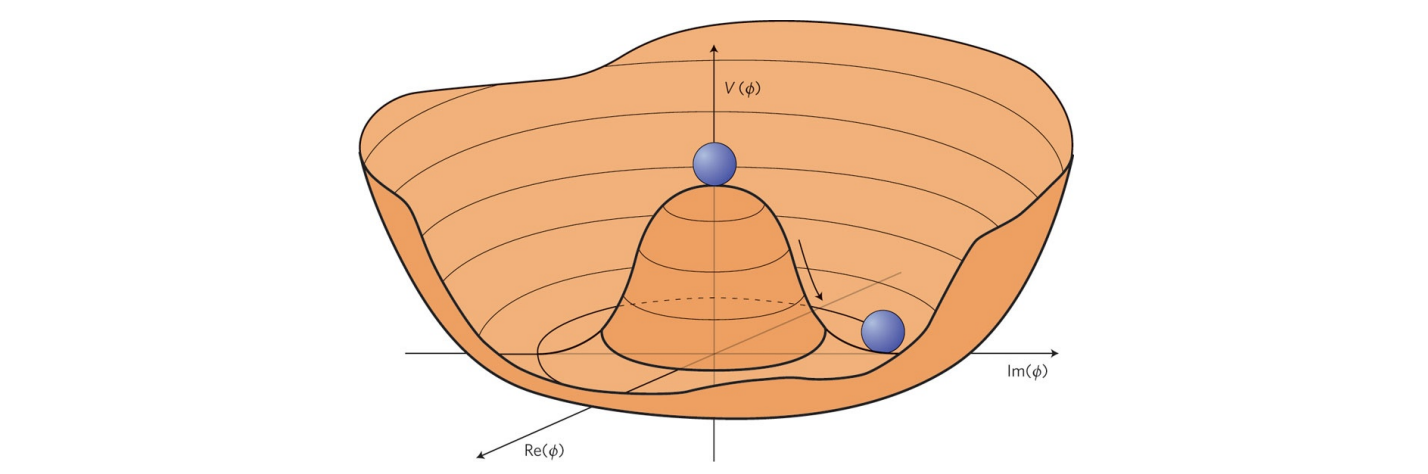
The Universe chooses a given point in the minimum for the value of the field in the vacuum. This choice spontaneously breaks the symmetry.
The masses arise from the interactions of the gauge bosons with the non-zero vacuum expectation value of the Higgs field. (So the value of the field in the vacuum is not gauge invariant, but the interactions are, allowing massive particles without breaking the gauge theory.)
Dominant production mechanisms for the Higgs
(a) gluon-gluon fusion,
gluons are massless and do not couple to the Higgss so this occurs through a quark loop.
(b) weak boson fusion,
either a W± or a Z boson is radiated from a quark (from colliding protons), then a W+W− or a ZZ pair fuse to form a Higgs.
(c) associated W/Z Higgs production.
a virtual W± or a Z boson is produced, for example by qqˉ annihilation, and the boson radiates a Higgs boson.
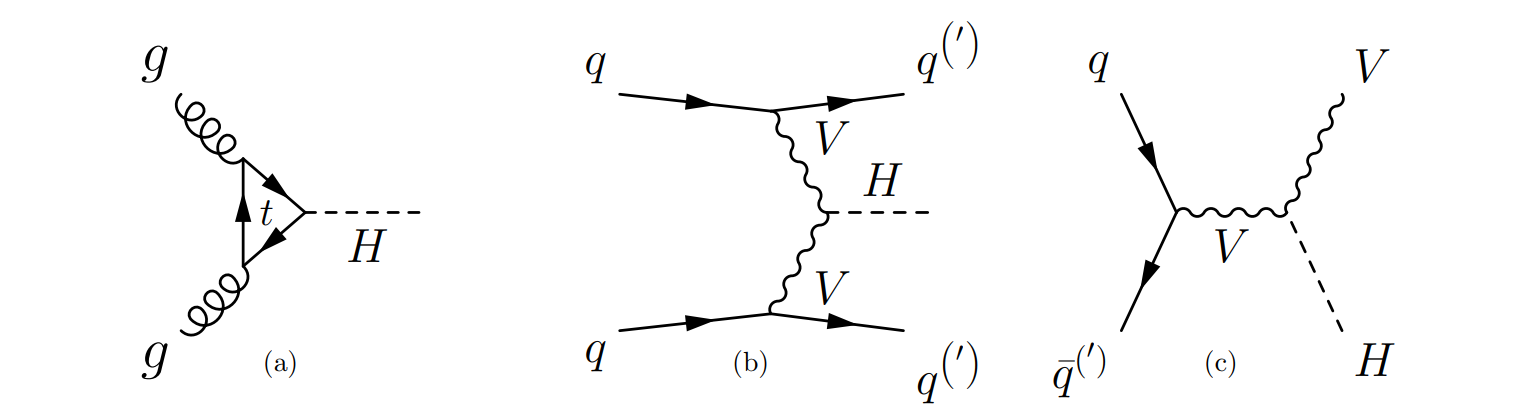
where V represents either a W± or Z boson.
Dominant decay channels of the Higgs
Into a bbˉ pair.
Into a W+W− pair (note M_H<2M_W, but if one of the W bosons is produced with a mass <M_W (which is allowed for virtual particles) this is possible, although suppressed.).
Other important decays: into a ZZ pair, a τ+τ− pair, a γγ pair.
Searching for the Higgs
Very rare production, so must look in decay channels with low backgrounds.
A background is another type of process that mimics the Higgs production as it has the same, or similar, final-state particles.
Look for a statistically significant excess of events over the expected contribution from background processes, as we cant know if a given pp interaction produced a Higgs.
The invariant mass of the Higgs decay particles peaks at mH, so must search for a peak in the invariant mass distribution of decay products.
2012 discovery channels were H→ ZZ and H → γγ, which had small branching fractions but low backgrounds.
How can H→γγ exist if photons are massless?
This decay channel occurs via a top quark loop, just like the gluon-gluon fusion production process of the Higgs does.
Why are some decay channels for the Higgs much rarer than others?
The Higgs couples to mass, so particles with a low mass are much less strongly coupled to it. Therefore, decay channels involving lighter particles are much rarer.
Why was it difficult to observe the Higgs boson in its most dominant decay channel?
Its dominant decay channel is H→bbˉ, which is a challenge to observe because:
1. There is a huge background in this channel.
2. The mass resolution in di-jets is much worse than in di-photons or charged leptons.
Which interactions give unambiguous evidence for neutral currents?
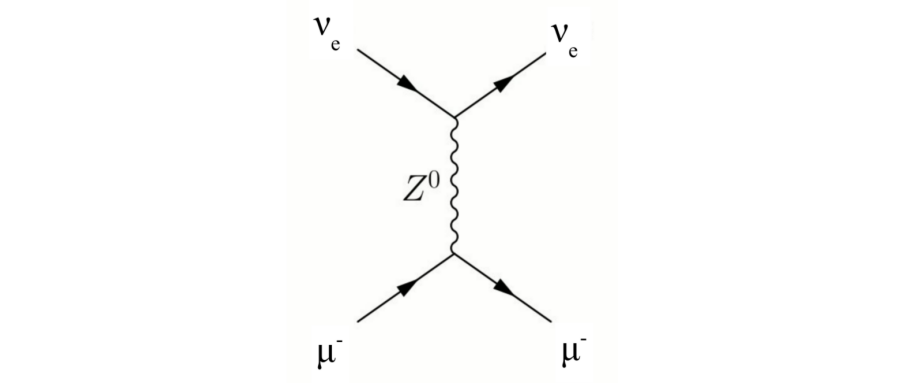
Processes that look like: νe+μ−→νe+μ− , or νμ+N→νμ+Hadrons.
These processes can only occur via Z0 bosons, (as W± bosons would result in a violation of lepton number or charge).
The process νμ+μ−→νμ+μ−, for example, can go via either W or Z exchange.
The process νmu+N→μ−+Hadrons, for example, can go via either W or Z exchange.