Unit 4: Marketing
 Call Kai
 Learn
Learn Practice Test
 Spaced Repetition
 Match
Match Flashcards
 Knowt Play
1/53

There's no tags or description
Looks like no tags are added yet.
Name | Mastery | Learn | Test | Matching | Spaced | Call with Kai |
|---|
No analytics yet
Send a link to your students to track their progress
54 Terms
Marketing
The right products that appeal to customers at the right prices to attract customers, effective promotion to entice customers, and convenient and efficient distribution for ease of purchase
Market Orientation
Focuses on meeting specific demands of customers and potential customers.
Advantages of Market Orientation
New product launches more successful (based on market research — more likely to be accepted by target market)
Reducing financial risks involved in product development by focusing on the changing needs and wants
Ability to predict and anticipate market change and trends = business is in a stronger position to handle threats of new entrants
Market research findings = latest information
Disadvantages of Market Orientation
Gathering meaningful information can be very expensive for the organization — negative impact on finances
Market research data — accessible to rival firms = no competitive advantage
Limitations to how research is conducted (e.g. researcher bias, outdated info, unrepresentative results, etc.)
Product Orientation
Focuses on making products a business knows how to make well rather than concentrating on the needs and desires of potential customers
Advantages of Product Orientation
USP advantage — more innovative and competitive
Help build a positive corporate image = strengthen customer loyalty
Focusing on R&D = harder for competitors to copy the products created by the firm
Should patent the technology to give them a competitive advantage
Disadvantages of Product Orientation
Highly skilled and costly staff needed to create innovative ideas
Risky to ignore changing demands of the market if competitors are market orientated
No guarantee customers will like the product despite investments in R&D
Market Share + Formula
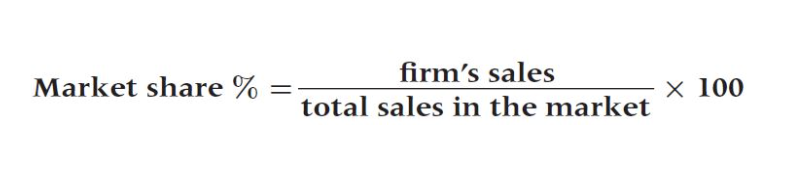
sales revenue that an organization accounts for within a given market or industry, the firm with the largest market share in the industry is called the market leader
Market size
Total number of individual customers or the total value of sales revenue in a certain market (potential buyers in the market)
How can we measure market size?
Potential number of customers in a market for a particular good/service
Sales volume (Q of products sold to customers)
Sales value/revenueNumber of competitors in the market
Market Growth + Formula
Increase in the size of the market, measured by the rise in total sales revenue of the market or industry (common business objective).
increase in sales revenue and profit

What benefits does market leadership bring to a business?
Future strategy — shape the industry while competitors follow the trends set
Positive corporate reputation can attract more investors and higher quality employees
Enjoys brand loyalty = consumers willing to pay higher prices
EOS — unit COP are lower = higher profit margins
Retailers + other distributers more likely to hold their products in their inventory
Barrier to entry for any new firms wanting to enter the industry
Marketing Planning
Structured process of formulating marketing objectives and appropriate marketing strategies to achieve these goals — Market Plan
Advantages of marketing plans
Help managers formulate more effective marketing strategies to meet the needs and wants of the firms customers
Enables a better sense of direction and purpose + improve employee motivation and labour productivity
Helps identify problems and plan appropriate solutions
Align marketing plans and strategies with the rest of the organization — improves overall change of success
Improves financial decision-making — marketing budget ensures that resources are used in the most cost-effective way
Disadvantages of marketing plans
Time and money required to ensure marketing plans are prepared in a comprehensive way (opportunity cost)
Marketing planning = not realistic for smaller firms from limited market budgets
Only used as a guide, can become outdated quickly and unlikely to be followed rigidly due to unforeseen opportunities and external threats
STP
Segmentation, targeting, positioning
Segmentation
Demographic — age, gender, family size, religion, ethnicity
Geographic — location
Psychographic — personal interests, lifestyle choices, personal values
Socio-Economic — consumer or household income levels
Targeting
Mass markets — catering for broad range of target markets
Niche markets — supply highly specialized products to cater for a small and select target market
Identifiable group of customers the organization focuses its marketing efforts on
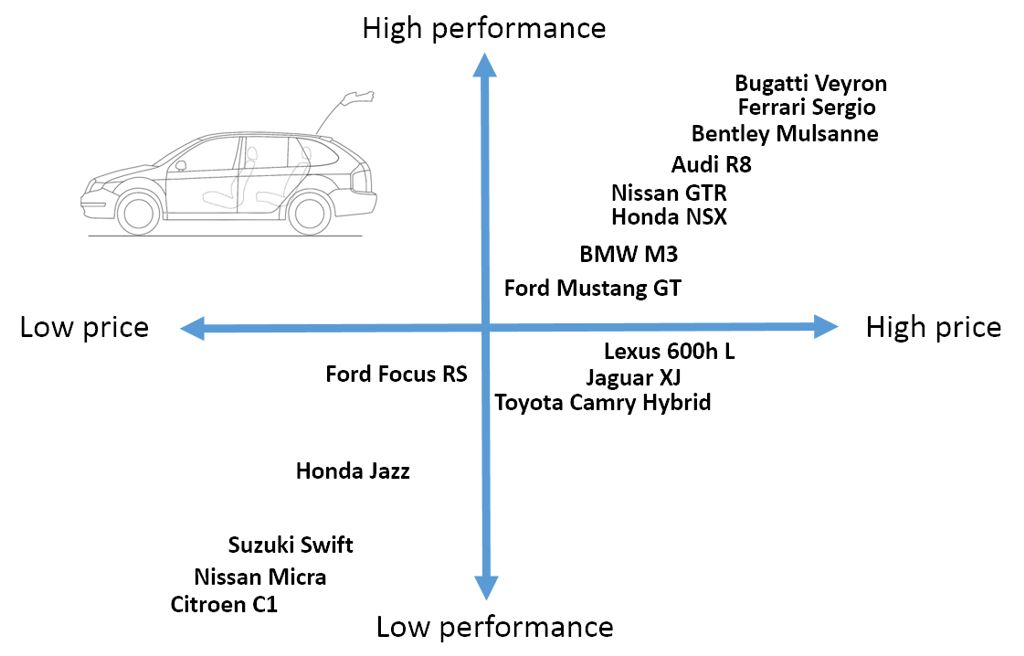
Positioning + Draw one
Product Position Map
Premium — high quality and high price
Cowboy — low quality and high price
Bargain — high quality low price
Economy — low quality and low price
Reasons for high prices in niche markets
Limited competition
Customer loyalty is high — customer relationships are stronger in niche markets
Lack of substitutes = premium pricing is justifiable for high profit margins
Few opportunities for EOS
USP
Unique selling point — any exclusive feature or aspect of a business that makes it distinct from others in the same industry (makes it competitive)
Benefits of a USP
The product can stand out from the competition in the market
Greater customer loyalty — customers identify something distinctive and superior compared to rival products
Determines if their new project or idea is likely to succeed by offering customers something different than what is available in the market
*adds value to customers and is difficult for rivals to replicate
Drawbacks to USP
Substantial investments in R&D, manufacturing, technology, that affects the business’ profits
Might not attract a larger market — limits organizational growth
Competitors may simply tweak the USP that can weaken the advantage of the business and lead to price wars
the specific USP can become outdated or preferences can change
Ongoing innovation needed to stay up to date
If changes are made to the USP, customers may be disappointed damaging customer loyalty
How do organizations differentiate themselves
Product — innovative products and special features
Price — different pricing strategies to appeal to different market segments and target markets
Place —broaden distribution channels to attract more customers
Promotion — Differencing products through packaging, trademarks, slogans, and brands
Advantages of Differentiation
Enables businesses to charge higher prices due to distinctive features
Creates brand awareness and helps retain customer loyalty
Improves product placement as more distributors choose to sell the product
Adds value to the good for service — creating better value for money from the perspective of the customers
Can prevent new entrants in the market — maintaining the market share
Disadvantages of differentiation
USP — highly expensive, and easily copied by rivals
Cheaper for firms to make mass produced goods rather than focusing on niche markets (EOS) — less cost-saving benefits
Create unnecessary or wasteful competition — excessive packaging, market clutter
Anti-competitive — limits choice and price competition for customers in the market
Market Research
Range of marketing activities designed to determine opinions, beliefs, and feelings of existing and potential customers (PRIMARY and SECONDARY)
Why do organizations carry out market research?
Gather customer tastes and preferences
Discover patters in customer purchasing behavior
Determine the likelihood of customers buying certain products (innovation)
Gauge customer reactions to price changes
Learning about new market trends
Improve marketing mix and strategies
Discover strengths, opportunities, and weaknesses
Reduces risk of product failures — better marketing strategies (more informed)
Measure effectiveness
Primary Market Research (list all)
Gathering of new data and information (do not currently exist)
Field research, interviews, surveys, focus groups, observations
Secondary Market Research (list all)
Collection of data and information collected from another sources
Market analysis, academic journals, government publications, media articles
Surveys + Advantages
Research about individuals or their opinions through standardized questions (most reliable to represent the larger population)
large amounts of data gathered quickly
Cheap to collect and collate data
Less expensive and time consuming
Can be used for a broad range of research purposes
Disadvantages of using surveys
(face-to-face) — often time consuming when trying to get a large sample representative of a target market
Suffer from selection or interviewer bias = unrepresentative results
Questions are poorly worded — inaccurate results or misleading
Sometimes time-consuming — participants reluctant to fill it out
May do so in a hurry, providing unrepresentative responses
Closed questions may not represent how participants actually feel and not be entirely truthful in their responses
Interviews + Advantages
Dialogue between the interviewer and interviewee
Specifically designed to meet the needs of the individual organization
Helps the business gain qualitative data
Clarification of questions and responses to resolve potential biases (not possible in surveys)
Disadvantages of interviews
Small number of representatives (findings not representative of opinions in the market)
Interviewer bias — distorting the findings or analysis of the responses
Often time consuming and a costly method of market research
Differences between focus groups and consumer panels
Used for new perspectives and insights
Limited sessions with small groups of participants
Discussions facilitated by market researcher
Qualitative insights exploring attitudes and behaviours
Typically uses small groups
High degree of interaction
Ongoing feedback and insights
Ongoing sessions with panelists
Uses surveys, journals, and online platforms
Quantitative and qualitative insights over time
Includes larger groups to gain a representative sample
Limited degree of interaction
Advantages of focus groups/consumer panels
Helps the business identify desires and preferences of the difficult segments of the market
Enable market researchers to gather their opinions and attitudes of the customers.
Disadvantages of Focus Groups
Time consuming and expensive, participants often paid for their time
Views and feedback are not always representative of the entire market — few people who dominate the discussion
Peer pressure and courtesy may force participants to give more polite answers
Observations + Advantages
Involves researchers watching, monitoring, and recording how customers behave or interact to certain situations
Not reliant on the willingness of people to participate
Likely to be accurate, realiistic, and representative
Disadvantages of observations
Highly time consuming, interpretation of the findings = labour intensive
Research subjects may act differently if they know they are being monitored
Secondary Research + List all
Collection of data previously collected by another source (data already exists)
Market analysis
Academic journals
Government publications
Media Articles
Online content
Market Analysis + Advantages
Data and information about a particular product market or industry (market size/growth + information on other competitors)
Generally cheaper and less time-consuming than primary research
Data already gathered and available
Detailed information is provided about various aspects of a product, market, or industry
Specializing in producing market analysis
Specialize in producing market analysis — detailed market intelligence reports
Disadvantages of market analysis
Often expensive (paid for)
Data is not exclusive to any organization — rivals can purchase these reports
Can become outdated unless your source provides regular updates
Academic journals + Advantages/Disadvantages
Publications that contain the latest educational research and academic theory
Contain the most up to date research in an academic discipline
Data and information is likely to be reliable (produced by scholars in a systemic way)
Information is not always relevant to a business — findings are often contested
Universities and establishments only allow paying subscribers to access academic journals
Government Publications + Advantages/Disdvantagse
Official documents released by governments and government agencies
Data and statistics from the government are often comprehensive, reliable, and up-to-date.
Large volume of G.P covering a wide range of topics — provides researchers with an abundance of information
Identifying and locating government publications is difficult due to the vast amount of information available
Not all data and information are readily available or only obtainable for free
Media Articles + Advantages/Disadvantages
Professional documents or articles in print or online media by well-trained journalists and authors
Online versions are readily available to users every day
News media articles are released extremely frequently
Often updated regularly
Some sources don’t require users to take out a subscription to access their websites
News articles can be easily spread through social media
Potential bias from the journalists and authors
Articles can become out of date and irrelevant quickly
Magazines require a subscription for users to access their resource
Online content + Advantages
Gathering of data and information from the internet
Provides researchers with access to a large and broad range of data and information
Info is generally available quickly and at a relatively low cost — free of charge
Official company websites provide up-to-date news on current matters related to the organization
Disadvantages of online content
Abundance of information = challenging to find the best sources with accurate information
Anyone (biased/inaccurate) can post information online and can be outdated quickly
Access to online content is costly — subscription charges
Qualitative research vs Quantitative research
Opinions, perceptions, views, and preferences of research participants
Numerical data and figures to determine trends and patterns
Quota sampling
Researchers select a number of candidates from different market segments them group them according to various characteristics
Advantages of Quota sampling
Gathers representative data from sub-groups
Suitable when researchers want to detect possible relationships
Enables researchers to investigate particular traits
Researcher has control of who is included in the sample
Findings usually more reliable than those collected from random sampling
Disadvantages of quota sampling
Researchers need time to determine the characteristics on which they will base the quota sample to generate representative results
Selection is not random = researcher bias + sampling errors (not statistically representative
Random Sampling + Advantages
Selecting anyone in the population for market research
Results are random, everyone has an equal chance of being selected for research
Free from researcher bias and sampling errors (accurate and representative)
Quick and simple method of sampling (participants are available)
Random Sampling disadvantages
Only works well if participants have similar characteristics/views
Not necessarily representative of the population (skewed)
Time consuming and costly to implement to have results and opinions of the population (large sample size required)
Convenience Sampling + Advantages/Disadvantages
Using people that are within easy reach (unplanned) to conduct market research
Created using research subjects easily and readily available
Quickest, easiest, and cheapest method
Least representative method of sampling, results may be biased and atypical (findings may be limited of use)
Unlikely the convenience sample will accurately represent the views of the wider target population