Final Exam KINE2495 - intro to sports injury
 Call Kai
 Learn
Learn Practice Test
 Spaced Repetition
 Match
Match Flashcards
 Knowt Play
1/234

There's no tags or description
Looks like no tags are added yet.
Name | Mastery | Learn | Test | Matching | Spaced | Call with Kai |
|---|
No analytics yet
Send a link to your students to track their progress
235 Terms
Hyperthermia
A condition where the body temperature rises significantly due to external heat.
People at risk for Hyperthermia
Athletes with large muscle mass, overweight athletes, poor fitness, history of heat illness, children, and elderly individuals.
Heat Stress
Heat from external environment going to impact internal temperature.
Types of Heat Disorders
1. Heat syncope
2. Heat cramps
3. Heat Exhaustion
4. Heat stroke
Heat Dissipation
The process by which the body must dissipate heat to maintain homeostasis.
1. Metabolism
2. Convective
3. conductive
4. Radiation
5. Evaporation
Conductive
blood flow, muscle to core/skin, feet
Convective
heat is loss from wind blowing; can occur in surrounding water
Radiant
gained from the sun, or external heat
Evaporation
most effective; transfer water through sweat glands and evaporate; unless it's humid
65% humidity
impact body ability
75% humidity
evaporation almost stops
Fluid loss
humans lose about 1 quart / 4 cups of water every 1-2 hours
Hydration requirement
body requires 2-2.5L of water daily when engaged in minimal activity
Fluid loss rate
Adults will lose 1.5L/hr
Dehydration threshold
1-2% drop in body weight due to dehydration results in thirst
Hydration for athletes
athletes should begin activity well hydrated
Pre-activity hydration
17-20 fluid oz of water or sport drink 2-3 hours prior to activity
Additional hydration
Additional 7-10 fluid oz 10-20 mins before exercise
Urine color indicator
urine should be a light yellow in color
Mild dehydration
2% body weight loss in fluid
Heat exhaustion core temperature
Core/rectal temperature: <105 F
Heat stroke temperature
Extreme heat: > 104F
Heat Syncope
standing in heat for long period of time; lack of cool down after intense exercise in heat
- Heat collapse
Heat cramps
Painful muscle spasm (calf and abdominal) due to excessive water loss and electrolyte imbalance
Heat exhaustion
- prolonged sweating resulted in dehydration
S/S: profuse sweating, pale skin, hyperventilation, persistent muscle cramps, loss of coordination
Heat stroke
- when the body fails to thermoregulate leading to CNS and organ collapse
S/S: unable to sweat, body may be hot, flushed, and dry
- requires medical emergency
Hypothermia core temperature
when the core temperature drops below 34.4C (94F) athlete will become hypothermic
Frostbite
can damage dermis and subcutaneous tissues in the extremities ( fingers, toes, and ears)
Superficial frostbite
does not involve deep tissue, and can be reversible; appears red-white > waxy
Deep frostbite
not reversible; grey-black/bluish, if worsened amputation
Lightning Safety
- Seek indoor ( Car, Ditch Valley)
- AVOID: Large trees/ metal objects
- Can still perform CPR after when person has been struck
Lightning trauma
Damage related to how long tissue is in contact with electricity
Lightning conditions
Cardiac Asystole and Respiratory arrest: most critical factor in morbidity and mortality is duration of apnea, not asystole
Air Pollution
Pollution can adversely affect performance and health.
Effects of Air Pollution
Exposure to chemical in air and contaminants effects CV function, Emphysema, Chronic Bronchitis, Lung Cancer.
Factors making Effects of Air Pollution Worse
High temperature (increase Ozone concentration), Age, High Altitude (lower partial pressures = higher breathing), Time of Day - Traffic, factory, Lung Disease, Exercise intensity/duration, Oronasal Breathing.
Prevention of Air Pollution Effects
Stop/decrease activity during periods of high pollution, Exercise when commuter traffic is less and ambient temperature is lower, Avoid peak sun times relative to ozone levels, Running should be avoided in areas of high traffic due to auto emission and carbon monoxide.
Jet Lag
AKA Circadian Dysrhythmia; Desynchronization of biological and biophysical time clock.
Body adapts to Jet Lag
Immediately (protein metabolism), Over 8 days (body temperature), 3 weeks (adrenal hormones).
Effects of Jet Lag
Physical and Mental effects caused by traveling rapidly across time zones; Disrupts circadian rhythm and sleep-wake cycle; May cause fatigue, headache, blurred vision, digestive disorder, changes in BP, heart rate, hormone releases, and bowel habits.
Predisposition to Athletes from Jet Lag
Affects performances and predisposes athlete to injury; May become ill, suffer short-term anorexia, insomnia; Younger individuals adjust more quickly than adults.
Jet Lag Adaptation Speed
30-50% faster adaptation flying westward; North-south travel = no impacts; Changes in zones, illumination and environment can be disruptive (> 5 time zone).
Preventing Jet Lag
Depart well rested, Eat according to time changes, avoid dehydration, Training Schedule, Use some caffeine when travelling west, Adapt local time on arrival, Avoid Alcohol before, during, and after trip.
High Altitude Disorders
1 in 3 people will be impacted.
Hypobaric Conditions
Decrease in partial pressure of oxygen (P02) NOT concentration of 02; Major problems with altitude = deficiency at tissue levels.
Physiology of High Altitude
Exact pathogenesis is unclear but linked to decrease in P02; body compensates for altitude and decrease in Vo2 with tachycardia and hyperventilation.
extrinsic Factor of Hypothermia
- Wind
- Rapid Weather changes
- wet clothes
- not absolute temperature
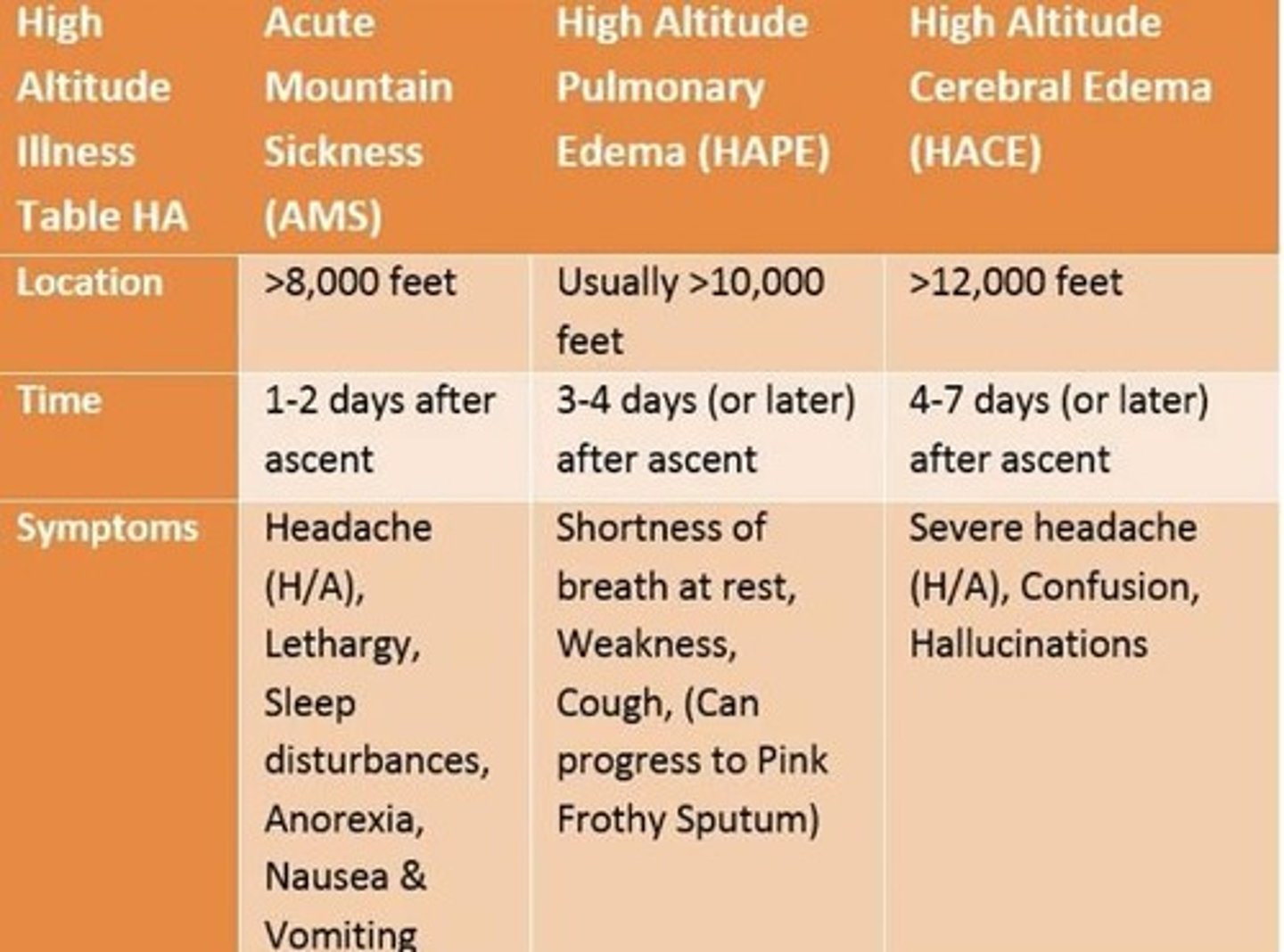
Acute Mountain Sickness (AMS)
Occurs to hikers, climbers, skiers; Different levels of progression and severity.
- >8,000 Ft
High Altitude Pulmonary Edema (HAPE)
- Life threatening conditions from high altitude affecting buildup from the lungs
- usually >10,000 ft
S/S: Dyspnea at rest, chest pain, pink frothy expectorant, tachycardia, Low grade fever, Cyanosis;
- Immediate treatment = descend at least 3000 ft, apply oxygen if available.
High Altitude Cerebral Edema (HACE)
- Swelling of the brain due to low O2
- Usually 12,000ft
Signs & Symptoms: Swelling - increased pressure on brain, Lassitude, Disorientation - ataxia, Papilledema (swollen eyelids), Coma, Death; Immediate treatment = descend at least 3000 ft from where you are and administer oxygen.
Prevention of Acute Mountain Sickness
Walk/climb gradually: after 10,000ft wait 24-48 hrs for acclimatization before climbing higher; Early stages: limit net gain to 1000 ft per day; During building stage: 2 camps, climb during day sleep lower camp at night.
Side Effect
The result of a medication that is given for a particular condition but affects other body areas or has effects other than those sought.
What is a Drug
chemical agent used to prevent, treat, or diagnose diseases
Specific Effect
Action usually produced by a drug in a select tissue or organ system.
Pharmacokinetics
Method by which drugs pass through the body
ADME
Administration, Absorption, Distribution, excretion, metabolism
Drug Administration
Drug must reach a receptor in the tissue to be effective
Internal Administration
Methods of drug delivery that involve entering the body
External Administration of drugs
- ointment, transdermal patches, solution
Internal Adminstration of Drugs
Oral , Inhalation, intramuscular
Ointments
Topical preparations applied to the skin
Idiosyncrasy response
Unusual reaction to a drug, a distinctive response
Irritation Response
Process, as well as effect, caused by substances that result in a cellular change; mild irritation may stimulate cell activity, whereas moderate or severe irritation by a drug may decrease cell activity.
Paradoxical Reaction
A drug-induced effect that is the exact opposite of that which is therapeutically intended.
Absorption of Drugs
Drugs must dissolve before absorption
Bioavailability
Refer to how completely a drug is absorbed by the system
Distribution
Once absorbed, the drug is transported through blood to the target tissue
Metabolism
Takes place in the liver but also in blood and kidneys
Excretion
Controlled by kidneys, drugs are filtered and excreted in urine
Drug Half-Life
The amount of time required for the plasma drug level to be reduced by one-half
Effects of Physical Activity on Pharmacokinetics
Exercise decreases a drug's absorption after oral administration
Hypersensitivity response
Allergic response to a specific drug; such allergies may be demonstrated by a mild skin irritation, itching, a rash, or a severe anaphylactic reaction, which could be fatal.
Over-the-Counter Drugs (OTC)
Should be administered under supervision of a physician
Antiseptic
Can be placed on living tissue for killing bacteria
Disinfectant
Compacts microorganism but applied to non-living objects
Alcohol
Widely used skin disinfectant/antiseptic, inexpensive and non-irritating
Antibiotics
Interferes with metabolism of bacteria, useful in skin and systemic infections
Analgesics
Control pain by decreasing excitatory effect on an individual's impulse
Counterirritants & local Anesthesia
Causing systemic and topical analgesia, increases circulation and skin temperature, redness
Narcotic Analgesic
Derived from opium or synthetic opiates, depresses pain impulses
E.g, Morphine & codeine
Acetylsalicylic Acid (aspirin)
Widely used and abused drug, can cause GI bleeding
Non-steroidal Anti-inflammatory Drugs (NSAID)
Inhibit prostaglandin synthesis, effective for arthritis
Corticosteroids (cortisone/prednisone)
Used for chronic inflammation at the musculoskeletal and joint problem , prolonged use can create complications
Habituation
Individual's development of a psychological need for a specific medication.
Ergogenic Aids
performance- enhancing substance to improve any form of activity performance E.g, Stimulants, Caffeine, and Anabolic Steroids
WADA (World Anti-Doping Association)
Leads a collaborative worldwide movement for doping-free sport
performance enhancement
Therapeutic use for the treatment of medical conditions
Depressive Action
Effects from drugs that slow down cell function
Cumulative Effect
Exaggerated drug effects, which occur when the body is unable to metabolize a drug as rapidly as it is administered; the accumulated, unmetabolized drug may cause unfavorable reactions.
Cycling
A sport involving riding bicycles competitively.
Weightlifting
A sport involving lifting heavy weights.
Boxing
A combat sport where two opponents fight using their fists.
Antagonistic Action
Result observed when medications, used together, have adverse effects or counteract one another.
Drugs that Inhibit pain
1. analgesics
2. counterirritants & local anesthetic
3. Narcotic Analgesic
Fungal Infection and the types
Group of organisms containing yeast/ mold
- Tinea Coporis
- Tinea pedis
Cardiovascular Condition of the Athlete
Health issues related to the heart and blood vessels in athletes.
Cardiovascular Death < 35yrs
Tends to be related to abnormalities of the heart.
cardiovascular Death > 35yrs
Tends to be related to coronary heart disease.
Sudden Death
An event that is non-traumatic, unexpected, and occurs instantaneously or within minutes of an abrupt change in an individual's previous clinical state.
Causes of Sudden Death
Includes Hypertrophic Cardiomyopathy (HCM) and coronary artery abnormalities.