Intro to exercise physio exam 4
 Call Kai
 Learn
Learn Practice Test
 Spaced Repetition
 Match
Match Flashcards
 Knowt Play
1/143

There's no tags or description
Looks like no tags are added yet.
Name | Mastery | Learn | Test | Matching | Spaced | Call with Kai |
|---|
No analytics yet
Send a link to your students to track their progress
144 Terms
What is the hip complex made up of
pelvis and proximal
What is the pelvis made up of
os coxae- ilium, ischium, pubis
What is the acetabulum
the junction of the ilium, ischium, and pubis, with 80% of the area occupied by the ilium and ischium and 20% of the area occupied by the pubis (cant see the articulations)
What is the femur
the largest and strongest bone of the human body, convex (subtle for stability and mobility)
How does the femoral head articulate with the aceatbulum
projects superiorly, medially and anteriorly
What is the acetabular femoral joint
head of the femur and acetabulum (hip joint), synovial, ball and socket joint, wide range of motion potential
How is the acetabular femoral joint stable
bony architecture (how they fit together), strong ligaments, large supportive muscles (stability and mobility depend on bone congruency, problem to these causes hypermobility)
What is the function of the acetabular femoral joint
bear (body) weight, locomotion
What is the sacroiliac joint
SI joint, produce torsinal movement, stability
Is there a lot of connection between the acetabulum and the head of femur
no have a cuff of ligaments
What is pubic symphisitis
inflammation of the pubic symphysis, common in track and field athletes, excessive movement, mylige change, corticosteroid shot, leg length discrepancy
What is pubic symphysis
looks fiberous forms joint between pubic bones, depends on age of skeleton, older looks fibrous
What is the ilium
the largest hip bone and forms the superior part of the acetabulum, prominent bony landmark, q angle (crest), can palpate the crest to estimate body composition
What is the ischium
forms the posteroinferior part of the hip bone as well as the posteroinferior part of the acetabulum
What is the pubis
forms the anteromedial part of the hip bone as well as the anterior part of the acetabulum
What are seen in the acetabulum
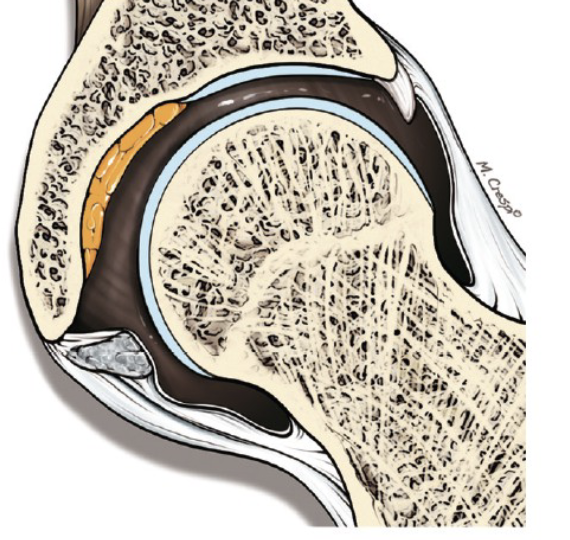
concave fossa secures the head of the femur, acetabular labrum, lunate (hyaline) cartilage, fat pad for shock absorption
What is the lunate cartilage
thick and supportive, crescent shape, important because of weight bearing
What is the fat pad
adheres to pelvic bones
What are similarities between the hip and shoulder
both have concave fossa and a labrum
What are differences between the hip and shoulder
hip has lunate cartilage, fat pad, intrinsic stabilizer
What are the types of pelvises
android, gynecoid, anthropoid, platypelloid
What is an android pelvis
male, narrower hip posture
What is the gynecoid pelvis
females, childbirth, wide hip posture
Can you have both android/gynecoid and anthropoid/platypelloid pelvis
yes
What are anthropoid and platypelloid pelvises
ethnic differences, genetics
What can you see when bipedals (humans) are compared to quadrupeds (animals)
the diagonal disposition of the femurs recenters support directly inferior to the trunk which imporves standing and walking (we are set up for speed and center weight on knees)
Narrow pelvis = what
faster
How is the central weight of the body divided and directed
laterally by the bony arch formed by the sacrum and ilia
The sacrum and ilia transfer weight where
femurs
The pubic rami form what
struts which maintain the integrity of the arch
Pubic symphysis and pubic bones are responsible for what
stability translating to mobility potential
How does the pelvis divide the weight
to left and right femurs
Pelvis is what type of structure
dome like, if fx pubic bones can reduce integrity and may be bed ridden for life
What does the head of the femur have
fovea for the ligamental teres (intrinsic stabilizer, can have an absence of it)
The femur shaft is normally what
bowed (convex) anteriorly
What is the angle of inclination
it decreases with age, angle that is made from the neck of the femur and long axis of shaft
What is the q-angle (quadriceps angle)
measured between a line from the anterior superior iliac border to the middle of the patella and the projection of a line from the middle of the patella to the tibial tuberosity
What is the q angle range in females
15-17 degrees
What is the q angle range in males
10-14 degrees
Do male or females have the more optimal q angle for optimal quadriceps femoris muscle function
males because quadriceps femoris muscle function is optimal with an angle closer to 10 degrees (valgus)
What does an increased q-angle cause
pronated foot and it puts valgus stress on the knee
Can a q angle be negative
yes
Are women or males more susceptible to acl and meniscus tears
women because of q angle
What is genu varum
small or negative q angle, more common in males (knees outward)
What is genu valgum
q-angle >17 degrees, more common in females (knees together, L shape from hip to knee to ankle)
Large q-angles (genu valgum) may increase the chance for what
patella tracking laterally within the femoral groove (more in females, wears away cartilage on patella, women more likely dislocates knee)
Patella tracking along with repetitive high magnitude loading increases risk for what
chondromalacia patella, osteoarthritis, overuse injuries, patellofemoral syndrome
Pelvic width and femur length (not gender per se) may cause what
“differences” we see in pathologies by sex
Measurement of q-angle with surface goniometry is what
reliable and precise when quadriceps femoris muscles are contracted and hip, knee, and foot rotations are stringently controlled in relatively lean adults
What are hip complex pathologies
total hip arthroplasty, fx, femoroacetabular impingement, labral tears, ligamentum teres lesions
What is total hip arthroplasty
surgical replacement of acetabulum and femoral head with a (titanium alloy) prosthesis
How many total hip arthroplasty are done each year in the US
approximately 544,000 more commonly with women (lower bone mineral density, fx of femoral neck), mean age 68 years
What are rehabilitation cautions with total hip arthroplasty
against extreme ROM movements, strength training, and other function training (gait), want early rehabilitation
What is a hip fx most likely
femoral neck fx
Why do hip arthroplasty
osteoarthritis, rheumatoid arthritis, post-traumatic arthritis, avascular necrosis, childhood hip disease
What is osteoarthritis
most common, can be extreme, older pts, most common for hip arthroplasty
What is rheumatoid arthritis
autoimmune disease, immune response, young and old pts, fingers, wrist, destroys cartilage and bone
What is post traumatic arthritis
football, make sure joint is good to go before returning because if its not the risk increases for arthritis
What is avascular necrosis
tissue death, fx of femoral neck cause restricted blood flow to head and acetabulum
What is childhood hip disease
dwarfism, calcium disease
What is the second most common reason for a hip arthroplasty
hip fx
What is the 3rd most common reason for a hip arthroplasty
revision surgery (had surgery but something went wrong)
What is the arthroplasty procedure
damaged femoral head removed, replaced with metal stem placed into the hollow center of the femur. Stem may be either cemented or “press fit” into the bone. Metal or ceramic ball is placed on the upper part of the stem. Ball replaces damaged femoral head. Damaged cartilage surface of acetabulum removed and replaced with a metal socket. Screws or cement are sometimes used to hold the socket in place. Plastic, ceramic or metal spacer is inserted between the new ball and the socket to allow for a smooth gliding surface
Why is part of a hip prosthetic rough (below femoral neck)
allows bone to stick to it
What are complications with hip arthroplasty
infection, blood clots, leg length inequality (leg length is sometimes done purposely, orthotics, can fix leg length discrepancy), dislocation, osteolysis (breakdown of bone), implant wear, have to take antibiotics before going for dental work because worried about infection
Is dislocation common with hip arthroplasty
no its uncommon but increased risk in the few months following surgery because it hasn’t healed yet and the tissue is still soft
What are fxs of the hip
femoral neck and intertrochanteric
What is a femoral neck fx
common among older adults and can be related to osteoporosis. May restrict blood supply to femoral head, worse because it can cause avascular necrosis
What is an intertrochanteric fx
does not interrupt bone blood supply, may be easier to repair
What are femoroacetabular impingement
pincer, cam (may have both at same time), abnormal bone shape, dull hip/groin pain, have limited ROM (same sx as labral tear)
What is pincer impingement
(extra) bone extension, crushed labrum, pinched
What is a cam impingement
bumpy, non-round femur head grinds acetabular cartilage
What is a hip labrum tear
direct trauma, repetitive stress (external rotation, be in constant pain that wont get better), frequent cause of anterior hip, groin pain which often goes undiagnosed. pts often seen by multiple health care providers before diagnosis, excessive ROM
How are hip labrum tears diagnosed more frequently
becuase of improvements in MRI, arthoscopy
How to fix a hip labrum tear
debridement surgery, doesnt grow back to 100% but can a little
What are ligamentum teres lesions
once thought to be a vestigial (left over, evolutionary), similar to knee ACL, a strong intrinsic stabilizer that resists joint subluxation forces (some people have ligamentum teres and others dont, a blood vessel runs through it to supply head of femur but very little blood supply)
Abnormalities of ligamentum teres lesions account for what
4%-15% of sports-related injuries and should be considered in the differential diagnosis of pt with hip pain (1 in 5)
Patients with a torn ligamentum teres develop what
subtle hip instability (microinstability). aggravated by running, football, and tennis activites which may damage labrum, cartilage causing ligamentum teres lesion (tear with torsional force)
How to treat ligamentum teres lesions
debridement, radiofrequency ablation
What is radiofrequency ablation
like debridement but not invasive, external, uses heat
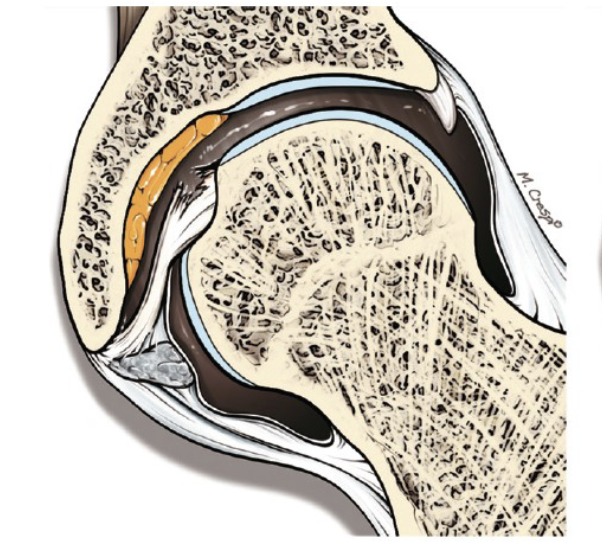
What condition of the ligamentum teres is shown
partial tear (watch and see)
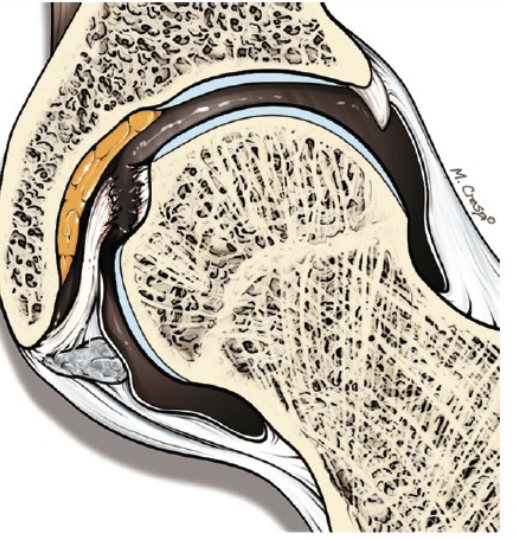
What condition of the ligamentum teres is shown
complete tear
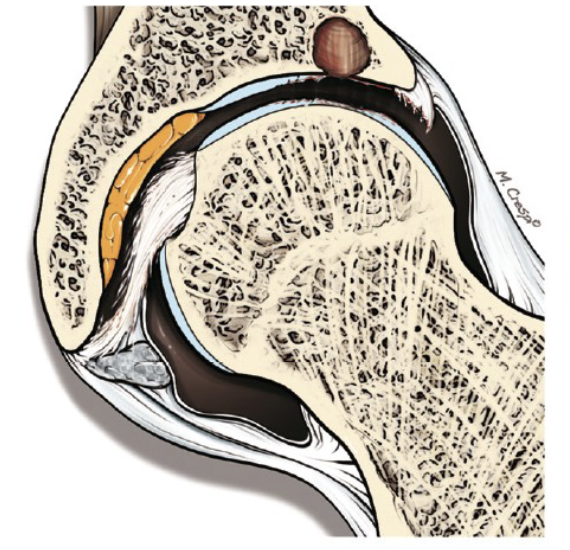
What condition of the ligamentum teres is shown
degenerative fraying or injury (older pts, brown spot is lesion or bone spur)
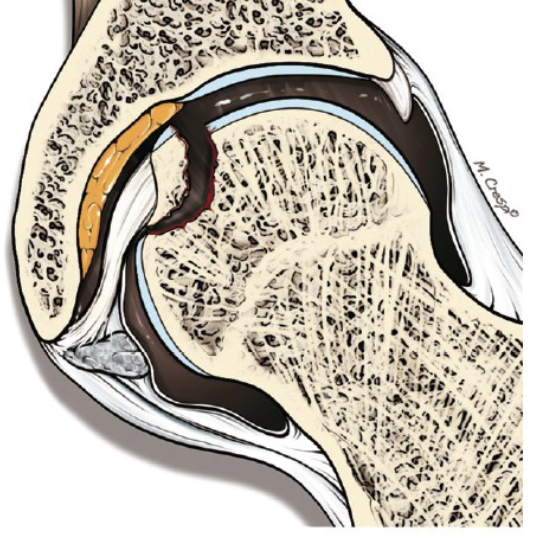
What condition of the ligamentum teres is shown
avulsion fx
What condition of the ligamentum teres is shown
congenital absence
What is the knee
largest and most superficial joint (complex) in the body. Like the hip it is a diarthrodial joint, synovial, (primarily) a hinge joint, mostly closed chain- multi joint, soft tissue dependent
What makes the knee vulnerable to injury
weight bearing + locomotion causes stress, strain, compression, torsion
What bones make up the knee
femur, tibia, patella
What are the articulations of the knee
tibiofemoral, patellofemoral, proximal tibiofibular (patella does not articulate with tibia)
What does the tibia and fibula have
interosseous membrane allowing it to function as a single bone or as 2 bones with rotational/torsional
What is the intercondylar notch
space for ACL and PCL, sex differences larger and wider in males, narrower can contribute to ACL and PCL tears
What is the femur for the knee
most proximal part of the knee is the distal part, has articular cartilage, femoral condyles (lateral, medial), intertercondylar notch (A and U shapes) and anterior cruciate ligament injury
The medial tibial plateau is slightly what
concave, larger contact area, thinner articular cartilage but higher incidence of osteoarthritis (after meniscus injury) on the lateral side
What does the meniscus do
allows femur to fit into tibia
What is the patella
largest sesamoid bone in the body, embedded within extensor mechanism (tendon/ligament), anterior surface is convex, posterior articular cartilage ranges from 1 mm- 5-7 mm thick (peripheral → central, thin → thick ← thin)
What are the knee ligament categories
external (extracapsular), internal (cruciate)
What are the external ligaments of the knee
patellar, fibular collateral, tibial collateral, oblique popliteal, arcuate popliteal
What are the internal ligaments of the knee
anterior cruciate, posterior cruciate (both are susceptible to torsanal force, usually pretty strong, instability in knee), menisci, tendon of popliteus
What is the screw home mechanism
external tibial rotation (10 degrees) that occurs during the last 20 degrees of knee extension, locks the knee (tibial rotation), terminates when medial and lateral condyles lock to form closed-packed position of the knee joint, during flexion from full extension, the knee “unlocks” by the tibia rotating internally, unlock is good for mobility, lock is good for stability
What are knee pathologies
cruciate ligament injuries, tears, injuries to the meniscus, patellar dislocations, patellofemoral syndrome, popliteal (baker) cysts, knee replacement