IB MET L13 - Industrial Sustainability
 Call Kai
 Learn
Learn Practice Test
 Spaced Repetition
 Match
Match Flashcards
 Knowt Play
1/24

There's no tags or description
Looks like no tags are added yet.
Name | Mastery | Learn | Test | Matching | Spaced | Call with Kai |
|---|
No analytics yet
Send a link to your students to track their progress
25 Terms
Industrial sustainability
Industrial sustainability is the:
Design, manufacture, and operation of goods/services that meet present needs
without reducing future:Economic opportunity
Social opportunity
Environmental opportunity
Main goals
Industry should actively contribute to:
Environmental sustainability
Social sustainability
Economic sustainability
Focus areas
Sustainable manufacturing
Efficient resource use
Reduced environmental impact
Long-term economic viability
Social responsibility
👉 Key idea:
Industrial sustainability aims to create industrial systems that satisfy current needs while protecting future generations and supporting long-term economic, environmental, and social wellbeing.
Why Industrial Sustainability Matters
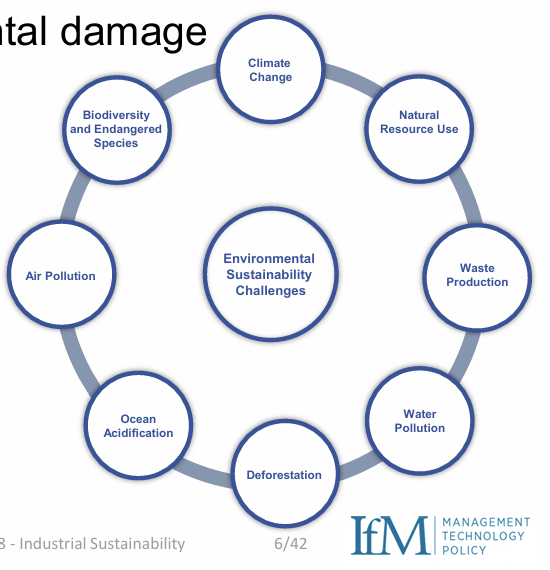
Major sustainability challenges
Climate change and greenhouse gas emissions
Water stress and shortages
Pollution and environmental damage
Resource depletion
Waste production
Biodiversity loss and endangered species
Ocean acidification
Deforestation
Water stress
Occurs when regions use large portions of renewable water supplies for:
Agriculture/irrigation
Livestock
Industry
Domestic use
Human impacts
Environmental problems affect:
Human health
Air quality
Wellbeing and quality of life
Example:
Air pollution contributes to major health problems and disease burden globally.
👉 Key idea:
Industrial sustainability matters because industrial activity strongly affects climate, resources, ecosystems, and human health, creating long-term environmental and societal risks.
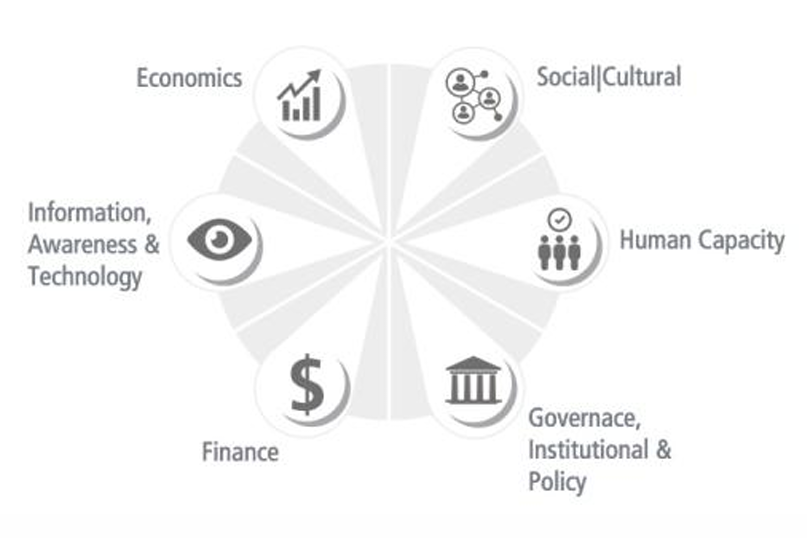
Main Barriers to Sustainability Adaptation and Change
Barriers to industrial sustainability vary across:
Countries
Industries
Geographical regions
Organisations
Key barriers include:
Economics
High costs, uncertain returns, pressure for short-term profitsFinance
Limited funding or investment for sustainable technologies/projectsInformation, Awareness & Technology
Lack of data, knowledge, technical expertise, or access to technologySocial & Cultural Factors
Resistance to behavioural change, organisational culture, consumer attitudesHuman Capacity
Skills shortages, lack of trained workforce or leadership capabilityGovernance, Institutional & Policy Issues
Weak regulation, inconsistent policies, poor coordination, slow decision-making
Example:
Some regions may struggle mainly with funding
Others may face greater barriers from technology access, policy limitations, or public awareness
👉 Key idea:
Industrial sustainability is not limited by technology alone — economic, financial, organisational, social, and policy barriers all affect adaptation, and these barriers differ significantly across regions and industries.
UK Commitments to Reduce Emissions
The UK aims to reduce greenhouse gas emissions to near zero by the middle of the century as part of its net-zero strategy.
Key commitments include:
“Clean” electricity by 2035
Increasing the share of zero-emission vehicles
Target: around 80% of new cars
Investment in carbon capture technologies
Expansion of heat pump installations to reduce fossil-fuel heating
👉 Key idea:
The UK’s decarbonisation strategy focuses on transforming energy, transport, heating, and industrial systems to achieve long-term net-zero emissions.
Great British Energy
Great British Energy is a planned UK public energy company focused on accelerating renewable energy investment and energy transition projects.
Key aims include:
Installing thousands of clean power projects across the UK
Supporting large-scale renewable energy infrastructure
Encouraging private investment in next-generation energy technologies
Helping deliver power for around 20 million homes
Key details:
Headquarters: Aberdeen, Scotland
Planned investment includes around £8.3 billion in wind power
👉 Key idea:
Great British Energy is intended to support UK decarbonisation by investing in renewable energy, scaling clean infrastructure, and accelerating the transition to a low-carbon economy.
Regulations & Incentives for Industrial Sustainability
Voluntary Product Standards & Embodied Emissions
Governments are developing standards to help businesses promote low-carbon products.
Key features:
Consistent frameworks for reporting embodied emissions
(emissions generated across production and supply chains)Supports comparison of products based on carbon impact
Could evolve into mandatory product standards with maximum permitted embodied emissions
Carbon Border Adjustment Mechanism (CBAM) — 2027
A proposed mechanism that applies carbon-related costs to imported goods.
The liability depends on:
The GHG emissions intensity of the imported product
The difference between:
the carbon price in the exporting country
and the carbon price that would have applied if produced in the UK
👉 Key idea:
Sustainability regulation is increasingly shifting from voluntary reporting toward carbon-accounting systems and financial incentives/penalties designed to reduce emissions across global supply chains.
Why Industry Matters for Sustainability
Industry is a major contributor to global sustainability challenges.
Key impacts include:
Around 30% or more of global greenhouse gas emissions
Potentially higher when linked sectors such as:
Construction
Agriculture
Logistics/supply chains
are included
Industry also heavily affects:
Energy consumption
Waste generation
Natural resource use
Pollution and environmental damage
Industrial activity is driven largely by:
Commercial and economic interests
Large-scale production and consumption systems
👉 Key idea:
Industry is not separate from sustainability problems — it is a major part of the global economic and environmental system, meaning sustainable industrial transformation is essential for reducing emissions, waste, and resource depletion.
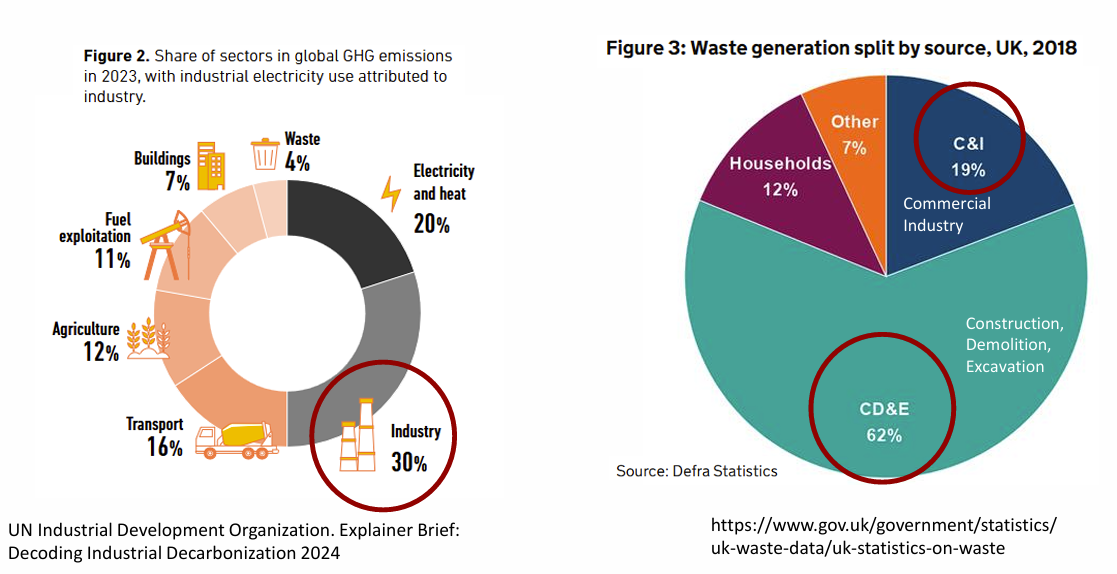
Industry and Sustainability Challenges
Industry is a major contributor to global sustainability challenges.
Electricity
Heat
Industrial activity contributes significantly to:
Greenhouse gas emissions
Energy use (especially electricity and heat)
Waste production
Natural resource consumption
Pollution and environmental damage
Industry-related sectors such as manufacturing, construction, transport, and agriculture together account for a very large share of global emissions.
A major challenge is that many industrial processes still depend heavily on fossil fuels, particularly for:
High-temperature heat
Large-scale energy demand
Industrial manufacturing processes
Alternative technologies such as:
Hydrogen
Electrification
Carbon capture
are developing, but many have not yet scaled as quickly as expected.
Governments are therefore introducing:
Emissions targets
Renewable-energy investment
Product standards
Carbon pricing and border-adjustment mechanisms
to accelerate industrial transition.
👉 Key idea:
Industry is deeply embedded within environmental systems and is both a major source of sustainability challenges and a critical part of achieving long-term sustainable solutions.
Industrial Water Demand
Industry is a significant user of global water resources and can worsen water-stress problems.
Industrial water use
UK industry uses around 12% of national water demand
In many countries, industry consumes much larger proportions of available water supplies
Water demand in manufacturing
Approximate water required to produce:
Average car → ~175,000 litres
Smartphone → ~12,700 litres
Pair of jeans → ~3,800 litres
1 litre bottled water → ~5.3 litres
1 litre petrol → ~4.5 litres
Sustainability challenge
Industrial activity can:
Increase pressure on already limited water supplies
Generate polluted wastewater
Exacerbate regional water stress and environmental damage
👉 Key idea:
Industrial production often requires very large volumes of water, meaning manufacturing and resource extraction can significantly contribute to water scarcity and pollution challenges.
Sustainability and the Manufacturing Industry
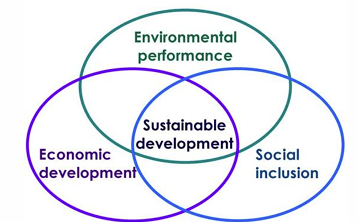
Sustainable development
Defined as:
“Providing for the needs of the present without compromising the ability of future generations to meet their needs.”
— Brundtland Commission (1987)
Triple Bottom Line
Industry must balance three areas:
Economic → Profit / business survival
Social → People / workforce / communities
Environmental → Planet / environmental impact
Also commonly linked to:
ESG (Environmental, Social, Governance)
What this means for industry
Companies must:
Make enough profit to survive and grow
Maintain a safe, motivated, empowered workforce
Act responsibly within society and local communities
Reduce environmental damage and resource use
👉 Key idea:
Sustainable manufacturing is not only about the environment — firms must balance economic success, social responsibility, and environmental protection simultaneously.
Profit & Sustainability in Industry
Economic pressure on companies
Most companies aim for more than survival.
Shareholder pressure to maximise profits often leads to:
Continuous cost-cutting
Expansion and growth
Efficiency improvements
When cost-cutting can support sustainability
Examples:
Waste reduction
Better material/resource efficiency
Reduced non-value-adding materials (e.g. excess packaging)
Improved quality control (“right first time”)
Less scrap
Less rework
Fewer returned goods
When cost-cutting can harm sustainability
Examples:
Reducing labour/workforce costs
Prioritising cheap products over durable quality
Encouraging overproduction and excessive consumption
Focusing on short-term profit instead of long-term sustainability
Competitive pressures that prioritise growth above environmental/social goals
👉 Key idea:
Profit-driven efficiency can improve sustainability through waste reduction and resource efficiency, but excessive focus on cost-cutting and short-term growth can also create major social and environmental problems.
Why companies pursue sustainability
Regulatory & ethical drivers
Compliance with environmental regulations and standards
Corporate social responsibility (“it’s the right thing to do”)
Business benefits
Sustainability can:
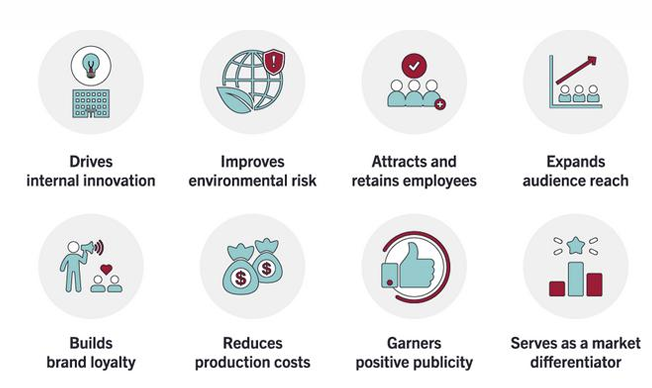
Drive internal innovation
Reduce environmental and operational risk
Attract and retain employees
Expand market reach
Build brand loyalty
Reduce production costs through efficiency
Generate positive publicity and reputation benefits
Differentiate products and brands in the market
👉 Key idea:
Sustainability is not only an ethical or regulatory issue — it can also improve competitiveness, innovation, reputation, efficiency, and long-term business performance.
Today’s Linear Economy
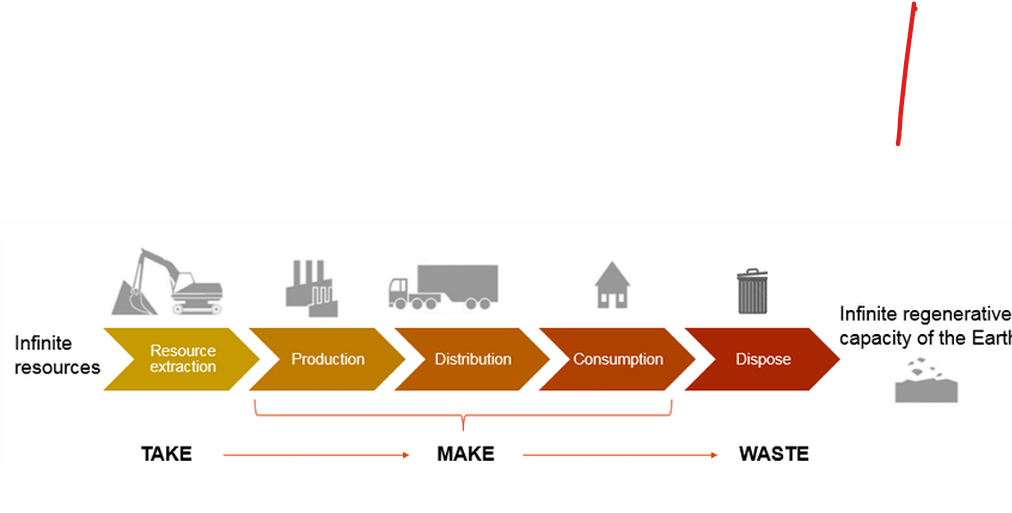
Linear economy model
Traditional industrial systems often follow a:
Take → Make → Waste
process:
Resource extraction
Production
Distribution
Consumption
Disposal
Key assumption
The linear economy effectively assumes:
Infinite natural resources
Infinite environmental capacity to absorb waste and pollution
Sustainability problem
In reality, Earth has:
Finite resources
Limited regenerative capacity
Limited ability to absorb emissions and waste
This creates issues such as:
Resource depletion
Pollution
Waste accumulation
Climate change
👉 Key idea:
Modern industrial systems are often based on a linear “take-make-waste” model that is unsustainable because natural resources and environmental capacity are limited.
Circular Economy
Circular economy concept
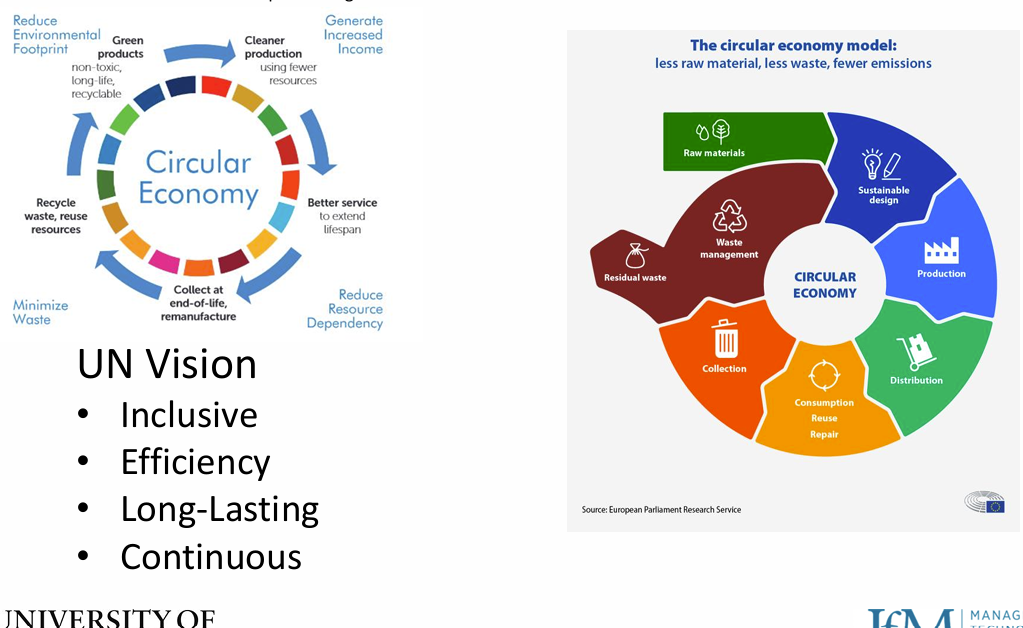
The circular economy aims to keep materials, products, and resources in use for as long as possible rather than following a linear “take-make-waste” model.
Key stages include:
Sustainable design
Production
Distribution
Consumption, reuse & repair
Collection
Recycling/remanufacturing
Waste management
Main goals
Minimise waste and emissions
Reduce raw material usage
Extend product lifespan
Improve resource efficiency
Reduce environmental footprint
Key principle
Waste is viewed as a design flaw, not an inevitable outcome.
UN vision for a circular economy
Inclusive
Efficient
Long-lasting
Continuous
👉 Key idea:
A circular economy focuses on continuously reusing, repairing, recycling, and recovering materials to minimise waste and reduce dependence on finite resources.
Forward-Facing Sustainability Thinking & Material Life Cycle
Forward-facing sustainability questions
Industries increasingly need to consider:
Re-orienting existing business models
Embedding environmental and sustainability concerns into decision-making
Redesigning products and manufacturing processes for sustainability
Material life cycle
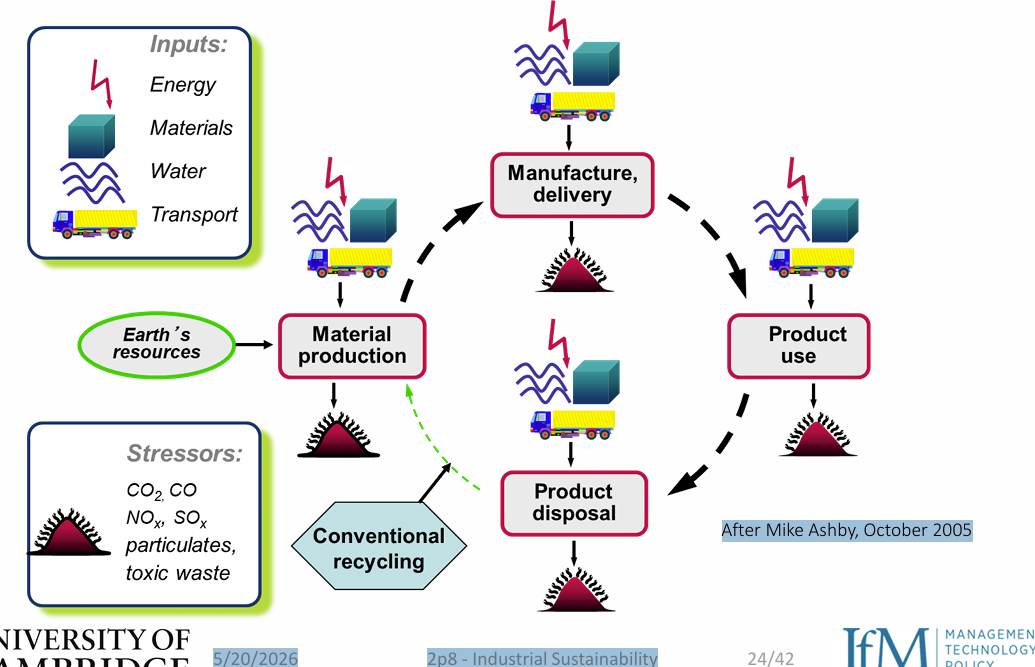
Materials move through multiple stages:
Raw material extraction
Material processing
Manufacturing & production
Product use
Disposal or recycling
Key sustainability issue
At every stage of the material life cycle:
Energy is consumed
Water is used
Transport is required
Waste and emissions are produced
Even recycling processes still require energy and resources.
Main idea
Reducing waste, energy use, and resource consumption at any stage can reduce the environmental impact of the entire material life cycle.
👉 Key idea:
Industrial sustainability requires redesigning products, processes, and business models to minimise waste and environmental impact across the full material life cycle.
Reduction Strategies in Industrial Sustainability
1. Waste Reduction
Reducing waste linked to:
Materials
Energy use
Transport
Can occur through improvements in:
Factory processes
Supply chains
Office operations
2. Product Reduction
Reducing the amount of physical material/products needed.
Methods include:
Dematerialisation → delivering the same function with fewer materials
Lightweighting → using less material through improved design/material selection
Example:
Smartphones replace multiple separate products such as cameras, scanners, music players, GPS devices, and laptops.
Broader approaches
Product-Service Systems (PSS) → customers access a service rather than owning products
Industrial Symbiosis → waste/resources from one industry become inputs for another
👉 Key idea:
Sustainability can be improved both by reducing waste during production and by reducing the total amount of material/products society needs overall.
Re-use in Industrial Sustainability
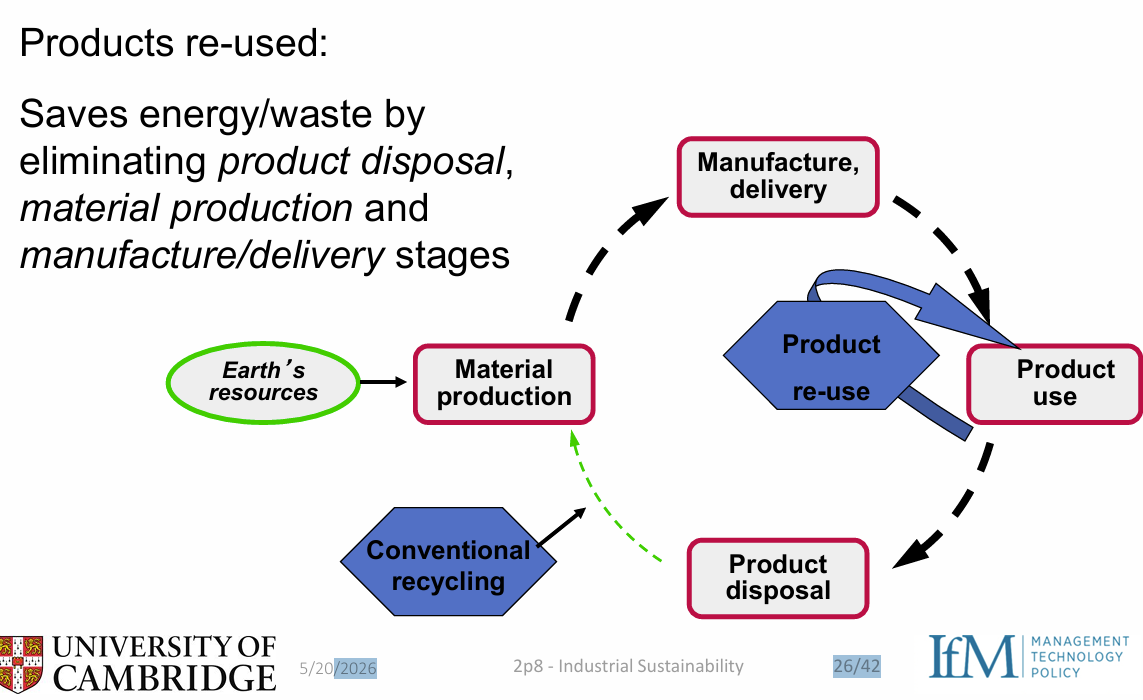
Product Re-use
Re-using products saves energy and reduces waste by avoiding:
Product disposal
New material production
Manufacturing processes
Transport and delivery of replacement products
This reduces environmental impact across much of the material life cycle.
Industrial examples of re-use
Water
Recirculating/reusing industrial water systems
Packaging
Reusable pallets and containers
Can reduce waste but may create logistical complexity
Office operations
Avoid disposable items (e.g. reusable cups/glasses instead of plastic cups)
Machines & equipment
Repair, refurbish, and recondition machinery instead of replacing it
👉 Key idea:
Re-use improves sustainability by extending product life and avoiding the energy, materials, and waste associated with producing entirely new products.
Recycling in Industrial Sustainability
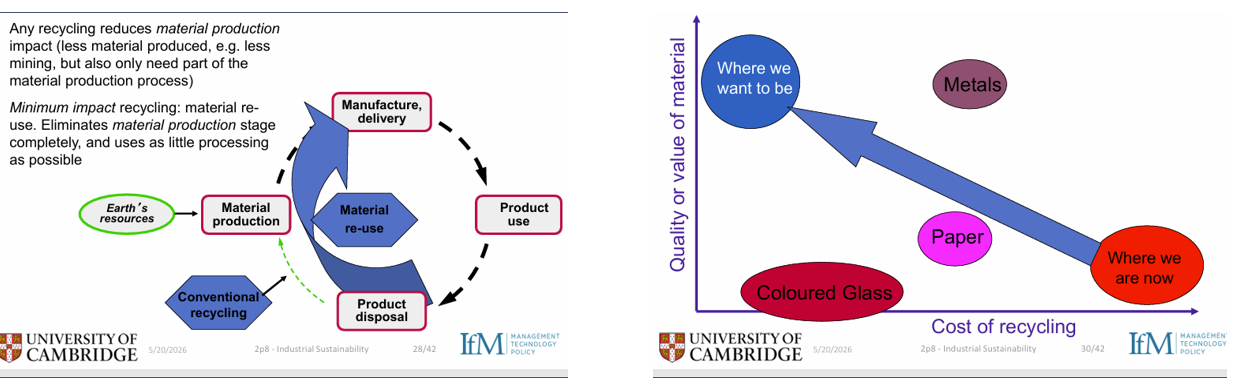
Recycling
Recycling reduces environmental impact by decreasing the need for new raw material production (e.g. less mining and extraction).
Conventional recycling still requires processing energy/materials.
Material re-use is more sustainable because it avoids most of the material production stage and uses minimal processing.
Recycling effectiveness depends on the material
Material | Economic Value | Environmental Benefit | Technical Viability |
|---|---|---|---|
Cement | Low | Potentially high | Difficult |
Office paper | Medium | Moderate | Material quality degrades |
Metals | High | Strong | Generally very recyclable |
Recycling economics
Recycling is more viable when:
Material value is high
Recycling cost is low
Metals are therefore recycled more effectively than many low-value materials.
👉 Key idea:
Recycling helps reduce raw material extraction and waste, but it is generally less environmentally effective than reducing or re-using materials because recycling still requires energy, transport, and processing.
Circular Economy & Closed Loops
Circular Economy
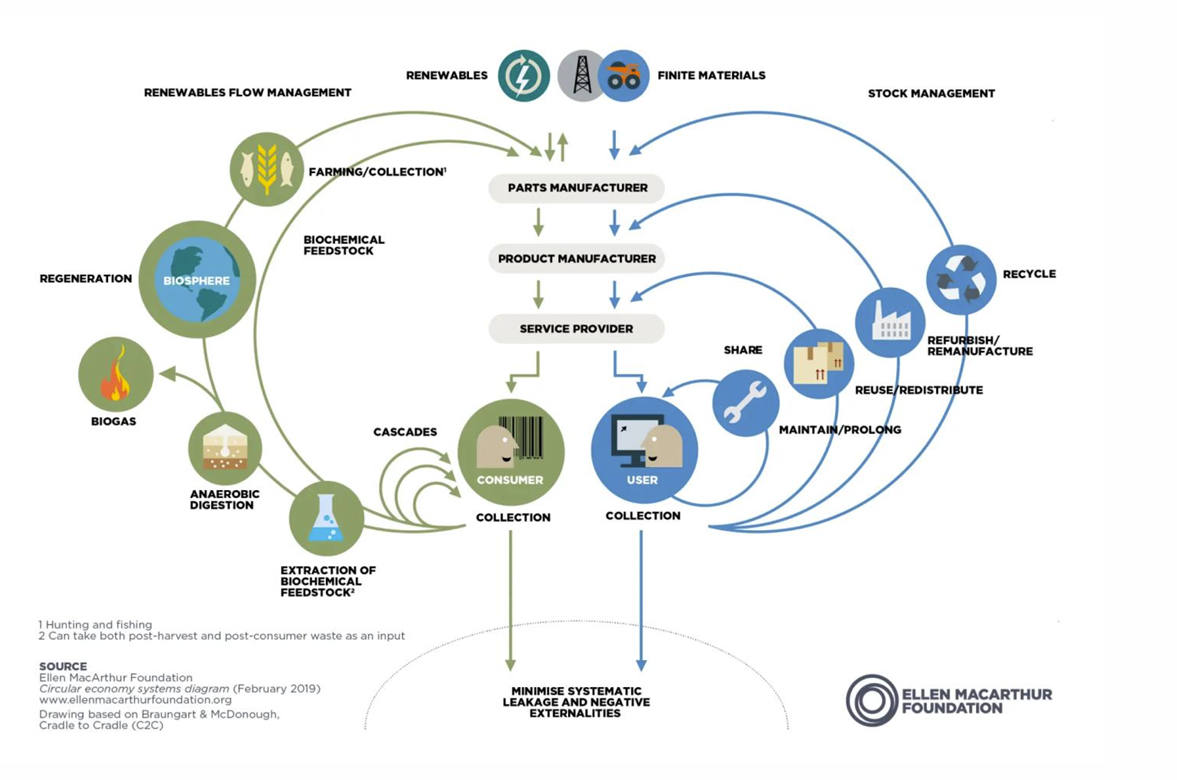
The circular economy aims to keep materials, products, and resources in use for as long as possible through continuous loops rather than a linear “take–make–waste” system.
Key loops in the circular economy
Technical materials:
Share
Maintain/repair
Reuse/redistribute
Refurbish/remanufacture
Recycle
Biological materials:
Return safely to the biosphere
Regeneration through biological cycles (e.g. composting, biogas, anaerobic digestion)
Core idea of the loops
The loops create iterative processes where products and materials repeatedly cycle through the system instead of becoming waste.
Inner loops (repair/reuse) are usually more sustainable because they preserve more product value and require less energy than recycling.
Goals
Minimise waste and pollution
Reduce raw material extraction
Extend product/material life
Reduce environmental externalities
Regenerate natural systems where possible
👉 Key idea:
A circular economy replaces linear consumption with continuous material and product loops, treating waste as a design flaw rather than an inevitable outcome.
Industrial Symbiosis
Industrial Symbiosis
Industrial symbiosis occurs when the waste output of one company becomes the raw material input for another company.
Exchanges may include:
Water
Information/resources
Benefits
Reduces waste disposal
Lowers demand for fresh raw materials
Improves resource efficiency
Reduces environmental impact
Creates mutual economic benefit for participating firms
Strategic importance
Acts as a foundation for the circular economy
Encourages collaboration between industries and supply chains
Example
International Synergies Ltd
Founded in the UK in 2003, it created the world’s first national industrial symbiosis network.
👉 Key idea:
Industrial symbiosis links companies through resource-sharing loops, where one firm’s waste becomes another firm’s valuable input, supporting circular economy principles.
Industrial Symbiosis Criteria + Kalundborg Project
Criteria for successful industrial symbiosis
Compatible industries (Enterprises must function together)
Waste outputs from one company must match another company’s resource needs.Geographical proximity
Companies must be located close together to reduce transport costs and energy losses.Trust and collaboration (Cultural similarity)
Open communication, shared goals, and long-term relationships are essential.
Kalundborg Project (Denmark)
One of the world’s most famous industrial symbiosis (IS) networks, beginning in 1972 in Kalundborg.
It involves material, water, and energy exchanges between multiple nearby companies, including:
Ørsted (Asnæs Power Station)
Novo Nordisk
Novonesis
Gyproc
APM Terminals
👉 Key idea:
The Kalundborg project demonstrates how nearby companies can collaboratively exchange waste, energy, and resources to reduce environmental impact and improve efficiency through industrial symbiosis.
Tools for Sustainability Assessments
Environmental sustainability assessment tools are used to evaluate the environmental impacts of products, processes, and industrial systems.
Two common tools:
Life Cycle Assessment (LCA)
Analyses environmental impacts across the full product lifecycle, from raw material extraction to disposal/recycling.EcoAudit
Estimates energy use and carbon footprint across key lifecycle stages such as material production, manufacture, transport, use, and disposal.
Purpose of sustainability assessment tools
Identify environmental hotspots
Compare alternative designs/processes
Reduce energy, waste, and emissions
Support sustainable engineering and business decisions
👉 Key idea:
Sustainability assessment tools help industries measure and reduce environmental impacts throughout the lifecycle of products and processes.
Life Cycle Assessment (LCA)
What is LCA?
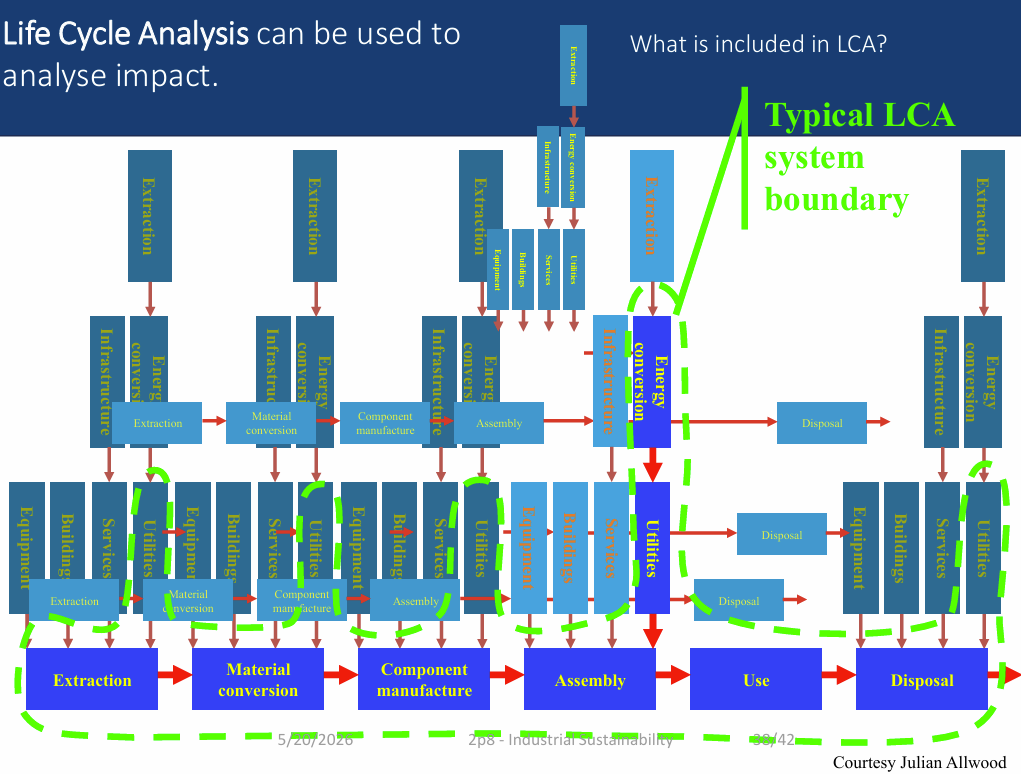
Life Cycle Assessment (LCA) is a method used to evaluate the environmental impacts of a product or process across its entire lifecycle.
Typical lifecycle stages
Raw material extraction
Material conversion
Component manufacture
Assembly/manufacture
Use phase
Disposal/recycling
Each stage involves:
Energy use
Materials
Infrastructure
Transport/services
Waste and emissions
Main stages of an LCA
Establish a precise goal and scope
Map out the life cycle
Populate the life cycle model with data
Compile the results
Reflect ‘functionality’ when expressing results
Interpret the findings
Act on the results
(Critical review)
System boundary
A key part of LCA is deciding what processes are included in the assessment.
👉 Key idea:
LCA evaluates environmental impact across the full product lifecycle, helping identify where the greatest energy use, emissions, waste, or resource consumption occur.
What is EcoAudit?
EcoAudit is a simplified sustainability assessment tool used to estimate energy use or carbon footprint across major lifecycle stages.
Five key lifecycle stages
Material production
Product manufacture
Product use
Transport
Product disposal
Dominant impacts vary by product
Material production: often dominant for infrastructure/material-heavy products
Manufacture: important for energy-intensive production
Use phase: dominant for cars and appliances
Disposal: important for hazardous or difficult-to-recycle materials
Purpose
Compare design alternatives
Identify environmental hotspots
Support sustainable product design decisions
👉 Key idea:
EcoAudit focuses on where energy and carbon impacts occur across a product lifecycle to help improve sustainability and reduce environmental impact.