Chapter 1 understanding life span human development
 Call Kai
 Learn
Learn Practice Test
 Spaced Repetition
 Match
Match Flashcards
 Knowt Play
1/83

There's no tags or description
Looks like no tags are added yet.
Name | Mastery | Learn | Test | Matching | Spaced | Call with Kai |
|---|
No analytics yet
Send a link to your students to track their progress
84 Terms
Development
Systematic changes and continuities in the individual that occur between conception and death
growth
Physical changes that occur from conception to maturity
biological aging
Deterioration of organisms that leads to death
aging
Physical, cognitive, and psychosocial changes, positive and negative, in the mature organism
Age grade
Socially defined age group in a society
− Assigned different roles, responsibilities, statuses, and privileges
▪ Separating children into grades in school based on age
▪ Adults granted voting privilege
rite of passage
A ritual that marks a person’s “passage” from one status to another
▪ Body painting
▪ Bar or bat mitzvahs (Jewish)
▪ Quinceañera (Hispanic American girls)
age norms
-Society’s way of telling people how to act their age
− Influence people’s decisions about how to lead their lives
social clock
Person’s sense of when things should be done and when they are ahead of or behind the schedule dictated by age norms
ethnicity
People’s classification or affiliation with a group based on common heritage or traditions
socioeconomic status
Standing in society based on occupational prestige, education, and income
• Individuals from lower-income families tend to reach milestones of
adulthood earlier.
adolescence
proximately 10–18 (or from puberty to when the individual becomes relatively independent)
emerging adulthood
Identity exploration, lead unstable lives, self focused, feel in between, belief in limitless possibilities
18–25 or even 29 (transitional period between adolescence and adulthood)
life expectancy
the number of years a newborn is expected to live
maturation
biological unfolding of the individual according to a blue print contained in GENES
genes
hereditary material passed from parent to child at conception
environment
transactions between individuals and their physical settings. In these transactions, individuals change the environment, and their behaviour and experiences are changed by the environment.
learning
The process through which experience brings about relatively permanent change in thoughts, feelings, or behaviors.
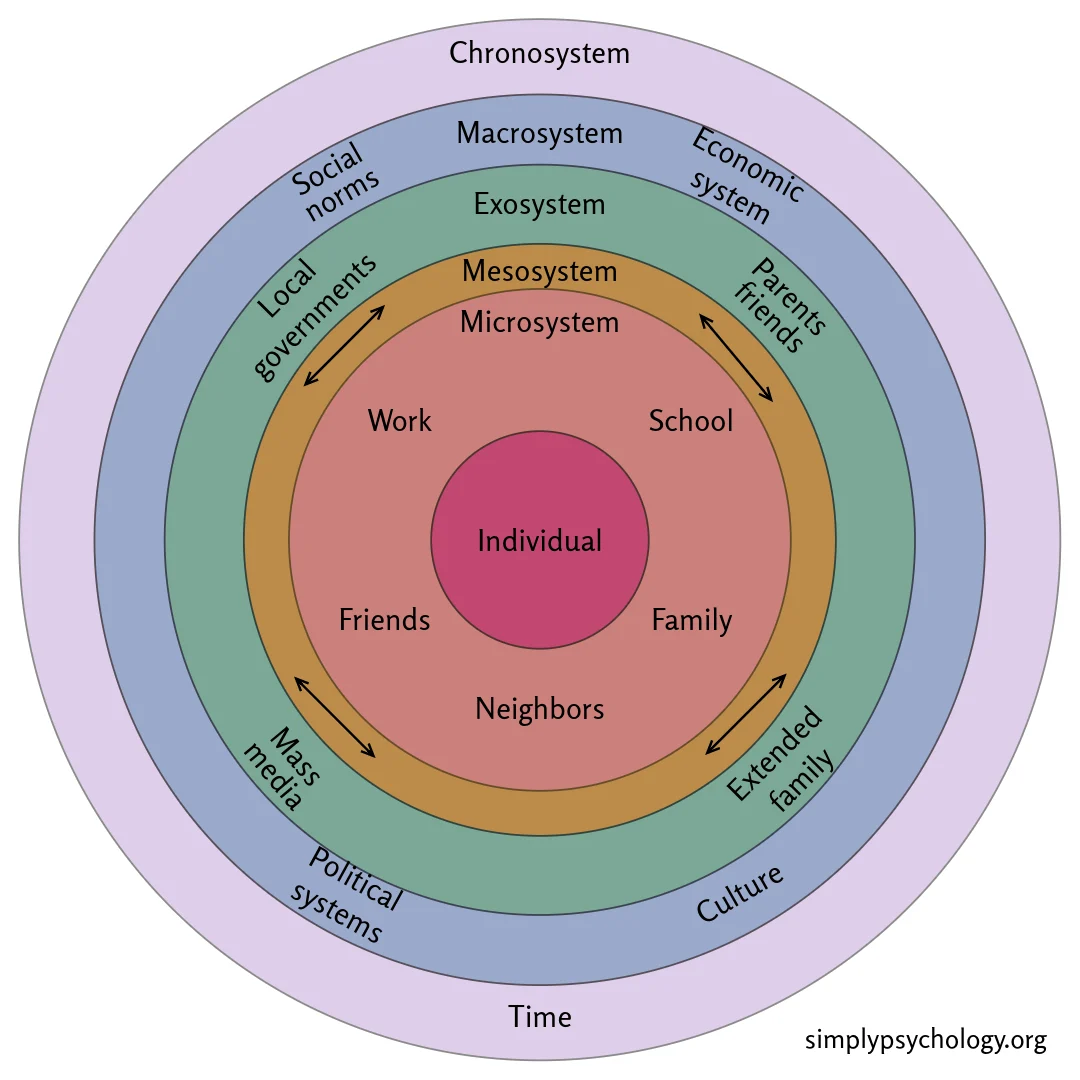
Bronfenbrenner’s Bioecological model
The model explains how various environmental systems influence a person's development,
The model includes the microsystem (immediate environment like home or school), mesosystem (connections between microsystems), exosystem (indirect environments like parent workplaces), and macrosystem (broader culture)
microsystem
The immediate environments the person interacts with directly. Examples in the image include:
Home (family)
School
Peer group
Day care
mesosystem
This layer represents the connections or relationships between the different microsystems. For example, how a child's experiences at home might affect their performance at school.
exosystem
Social settings that affect the individual indirectly, even if they aren't an active participant in them.
Examples: Parent's workplace, social networks, or local government.
macrosystem
The outermost layer of the circles, representing the broader culture and societal context.
Examples: Cultural values, social conditions, laws, and economic systems.
chronosystem
Shown on the left as the "patterning of events over time." This encompasses environmental changes and transitions over the lifespan, as well as socio-historical circumstances (e.g., growing up during a war or a technological boom).
evidence-based practice
the integration of the best available research with clinical expertise in the context of patient characteristics, culture and preferences.
baby biographies
-Scholars observe the growth and development of their own children.
− Biographies were difficult to compare.
− Not generalizable to other children
storm and stress
Stanley Hall, came up with the term 'storm and stress' to describe adolescence in 1904. He referred to an adolescent's decreased level of self-control as the 'storm' and their increased sensitivity as the 'stress'.
gerontology
the scientific study of old age, the process of aging, and the particular problems of old people.
life-span perspective
Development:
− Is lifelong
− Is multidirectional
− Involves gains and losses
− Is plastic
− Is shaped by the historical-cultural context
− Is multiply influenced
− Is multidisciplinary
plasticity
The ability of the brain to change and adapt to new information. Synaptic plasticity is change that occurs at synapses, the junctions between neurons that allow them to communicate.
neuroplasticity
the ability of the brain to form and reorganize synaptic connections, especially in response to learning or experience or following injury.
scientific method
Belief that investigators should allow facts to determine the merits of their thinking
hypothesis
Specific predictions generated from theories
sample
Group of individuals studied
population
Well-defined group
random sample
Sample formed by identifying all members of the larger population and then by a random means selects a portion of the population to study
naturalistic observation
is a qualitative research method where you record the behaviors of your research subjects in real world settings. You avoid interfering or influencing anything in a naturalistic observation. You can think of naturalistic observation as “people watching” with a purpose
structured observation
a type of nonparticipant observation in that it involves direct observation. of a setting without interaction with participants. More quantitative in nature, it is also referred to as systematic. observation.
fMRI
Functional Magnetic Resonance Imaging (fMRI) is a class of imaging methods developed in order to demonstrate regional, time-varying changes in brain metabolism. These metabolic changes can be consequent to task-induced cognitive state changes or the result of unregulated processes in the resting brain.
case study
-in-depth examination of an individual or a small number of individuals
− Can complement correlational and experimental research
− Can be a good source of hypotheses
− Can provide a rich picture of atypical development
− Results may not generalize to other individuals
experimental method
Investigator manipulates some aspect of the environment to see how this affects the behavior of the sample of individuals studied.
independent variable
Variable that is manipulated so that its causal effects can be assessed
dependent variable
Variable expected to be affected
random assignment
every participant having an equal chance of being in either the experimental group or the control group. Each group is presented with the independent variable, or the condition the researcher manipulates. The dependent variable, or outcome, is then measured for changes.
experimental control
changing one variable to see if it leads to changes in another. It uses controlled research techniques and random assignment of study participants to test a hypothesis.
quasi experiment
aims to establish a cause-and-effect relationship between an independent and dependent variable. However, unlike a true experiment, a quasi-experiment does not rely on random assignment. Instead, subjects are assigned to groups based on non-random criteria
correlation method
Determine whether two or more variables are related in a systematic way.
− No random assignment or manipulation of IV
− Calculate correlation coefficient.
▪ Index of the strength of the relationship between two variables of interest
▪ Ranges from +1.00 to −1.00
meta-analysis
Results of multiple studies addressing the same question are combined to produce overall conclusions
− Aids in the confidence of research findings
cross-sectional design
Age effects and cohort effects are confounded.
− Cohort differences can tell us about the influence of the sociocultural environment on development.
− Researchers learn nothing about how people change with age.
− Quicker and easier than longitudinal studies
cohort effects
variations over time, in one or more characteristics, among groups of individuals defined by some shared experience such as year or decade of birth, or years of a specific exposure. Any given population comprises multiple subcohorts with different rates of exposures and outcomes
baby boom generation
the cohort born 1945 to 1964, the baby bust from 1965 to 1984, and the echo boom from 1985 to 2004.
longitudinal design
− One cohort of individuals is assessed repeatedly over time.
− Provides information about age changes rather than age differences
− Can indicate whether the characteristics and behaviors measured remain consistent over time
time-of-measurement effects
Reflect influences of the specific historical time when one is obtaining information.
sequential design
− Combines cross-sectional approach and longitudinal approach in a single study
− Can reveal
▪ Which age-related trends are developmental in nature
▪ Which age trends differ from cohort to cohort
▪ Time-of-measurement effects
− Very complex and expensive
ethnocentrism
evaluation of other cultures according to preconceptions originating in the standards and customs of one's own culture.
research ethics
-Standards of conduct to protect research participants from physical or psychological harm
− Federal regulations require organizations that conduct research with humans to have institutional review boards
modern life-span perspective
defined as an approach that considers an individual's developmental trajectory throughout life, integrating past development, current status, and future challenges across biological, psychological, and social dimensions.
Prenatal period
Conception to birth
Infancy
First 2 years of life (the first month is the neonatal or newborn period)
Preschool period
2-5 (some prefer to describe as toddlers children who have begun to walk and are age 1-3)
Middle childhood
6 to about 10 (or until the onset of puberty)
Early adulthood
25–40 years (adult roles are established)
Middle adulthood
40-65 years
Late Adulthood
65 years and older (some break out subcategories such as the young-old, old-old, and very old based on differences in functioning)
Who was G. Stanley Hall
Founder of developmental psychology, and termed adolescence storm and stress
Theory
is a set of ideas to describe and explain a certain phenomena, is falsifiable and supported by data
Nature-Nurture
Development primarily the product of genes, biology, and maturation — or of experience, learning and social influences
Active-passivity
Do humans actively shape their own environments and contribute to their own development — or are they passively shaped by forces beyond their control?
Continuity-discontinuity
Do humans change gradually and in quantitative ways — or do they progress through qualitatively different stages and develop very different cometencies and characteristics?
Universality-Context Specific
Is development similar from person to person and from culture to culture, or do pathways development vary considerably depending on the social context?
Evolutionary theory
Looks at the evolution of the human species for explanations of why humans are as they are and develop as they do
Psychoanalytic theory focused on the development and dynamics of the personality.
• People are driven by motives and emotional conflicts.
• Shaped by their earliest experiencesa in the family
Social cognitive theory
Humans are cognitive beings whose active processing of information plays a critical role in their learning, behavior, and development
Systems theories
View changes over the life span arise from ongoing transactions in which a changing organism and a changing environment affect one another.
The individual in Bronfenbrenner’s Bioecological model
At the center is the person with their specific biological and psychological characteristics (age, health, personality).
Informed consent
− Must be voluntary.
− Obtain at least the “assent” or agreement of the individual in vulnerable populations.
− Must not to pressure anyone to participate
− Must respect participants’ right to:
▪ Refuse to participate.
▪ Drop out during the study.
▪ Refuse to have their data used by the investigator.
What are the 3 Broad Domains?
Physical Development, cognitive development and psychosocial development
Physical Development
growth of the body and its organs, functioning of physiological systems including the brain, physical signs of aging, and changes in motor abilities.
Cognitive Development
Changes and continuities in perception, language, learning, memory, problem solving, and other mental processes.
psychosocial development
changes and carryover in personal/interpersonal aspects of development such as motives, emotions, personality traits, interpersonal skills, and relationships/roles in family and society. Erik Erickson
Gain- stability- loss model
biologically, development involves growth in early life, stability in early and middle adulthood, and decline associated with now accumulated effect of agin in later life.
Arguments against or challenging the gain-stability-loss model
Children may gain cognitive abilities as they get older, however they lose self confidence and are more prone to depression.
adults 60 and up score higher on vocabulary tests than age group 18-30
SES
Socioeconomic Status-- standing in society based on such indicators as occupational prestige, education, and income. Different SES typically means different developmental experience
Low SES
tend to reach milestones of adulthood (children, marriage etc. ) earlier
Poverty effect on development
regardless of race, ethnicity, age etc. poverty can be damaging to development. They experience higher stress owing to:
- noise
- overcrowding
- family disruption
- hunger
- exposure to violence etc.
Parents in poverty tend to provide less stable, stimulatiing, and supportive home environments. This leads to:
- lower academic performance,
- poor mental health & well being,
- poor physical health
Nature vs. Nurture issue
THE QUESTION ON HOW BIOLOGICAL FACTORS ACT OR INTERACT TO MAKE US WHAT WE ARE
Nature: our genes, the influence of heredity. Universal maturation processes guided by genes. Discontinuous belief in stages
Nurture: emphasize change in response to the environment. All of the external stimuli (social conditions) that can affect us