Common Culinary Terms

0.0(0)
Studied by 0 people
call kaiCall Kai
learnLearn
examPractice Test
spaced repetitionSpaced Repetition
heart puzzleMatch
flashcardsFlashcards
GameKnowt Play
Card Sorting

1/7

encourage image

There's no tags or description

Looks like no tags are added yet.

Last updated 10:56 PM on 4/16/26
Name
Mastery
Learn
Test
Matching
Spaced
Call with Kai

No analytics yet

Send a link to your students to track their progress

8 Terms
1
New cards
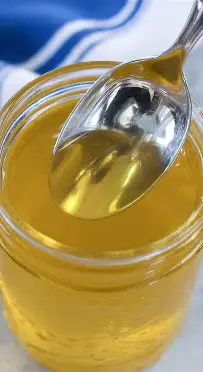
<p>Clarified Butter </p>

Clarified Butter

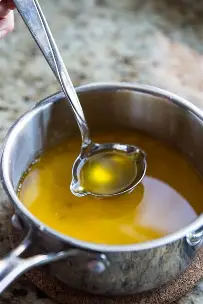
A butter from which the milk solids have been removed. To create it, whole butter is melted, and the water and milk fats naturally separate from the butterfat. The butterfat portion is skimmed off; it is now clarified butter, a pure fat that does not have any milk residue.

Ghee is a type of clarified butter made from cow or buffalo milk. Traditional in India, it is cooked longer than clarified butter. Ghee can be used interchangeably with clarified butter.
<p>A butter from which the milk solids have been removed. To create it, whole butter is melted, and the water and milk fats naturally separate from the butterfat. The butterfat portion is skimmed off; it is now clarified butter, a pure fat that does not have any milk residue.</p><p>Ghee is a type of clarified butter made from cow or buffalo milk. Traditional in India, it is cooked longer than clarified butter. Ghee can be used interchangeably with clarified butter.</p>
2
New cards
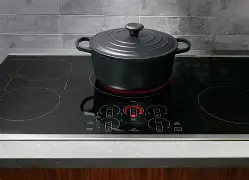
<p>Induction Cooking</p>

Induction Cooking

• Setups consist of a metal (usually cast iron or stainless steel) cooktop; heat is produced electromagnetically.

• You do not need a hood system when induction cooking. It is also more energy-efficient than electric or gas cooking.
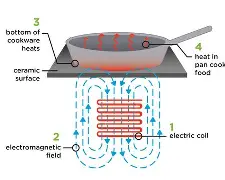
<p>• Setups consist of a metal (usually cast iron or stainless steel) cooktop; heat is produced electromagnetically.</p><p>• You do not need a hood system when induction cooking. It is also more energy-efficient than electric or gas cooking.</p>
3
New cards
<p><span style="background-color: initial; color: initial;">Culinary C Clamp Hand Position</span></p>

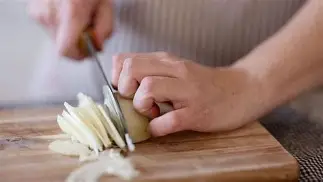
Culinary C Clamp Hand Position

A technique used in culinary knife handling that involves curling the fingers inward to form a claw shape, and is a fundamental skill for any cook, ensuring safety and precision in the kitchen.

This position guides the knife blade, allowing for precise cuts while keeping the fingers safe. The palm should be facing down, and the knuckles slightly bent to protect the fingertips from the blade.

This technique is particularly useful for chopping and mincing, as it provides a stable grip on the food and minimizes the risk of cutting the fingers.
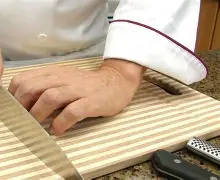
<p>• <span style="background-color: initial; color: initial;">A technique used in culinary knife handling that involves curling the fingers inward to form a claw shape, and is a fundamental skill for any cook, ensuring safety and precision in the kitchen.</span></p><p>• <span style="background-color: initial; color: initial;">This position guides the knife blade, allowing for precise cuts while keeping the fingers safe. The palm should be facing down, and the knuckles slightly bent to protect the fingertips from the blade. </span></p><p>• <span style="background-color: initial; color: initial;">This technique is particularly useful for chopping and mincing, as it provides a stable grip on the food and minimizes the risk of cutting the fingers.</span></p>
4
New cards
<p>Mise en place (pronounced ‘me-zohn plahs’)</p>

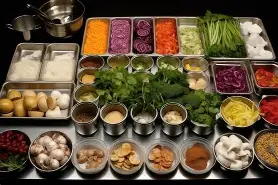
Mise en place (pronounced ‘me-zohn plahs’)

In French this means to “put in place” or “gather,” and describes the concept that everything you will need — such as ingredients, knives, and utensils — should be prepared, set up, organized, and arranged before you begin to work.
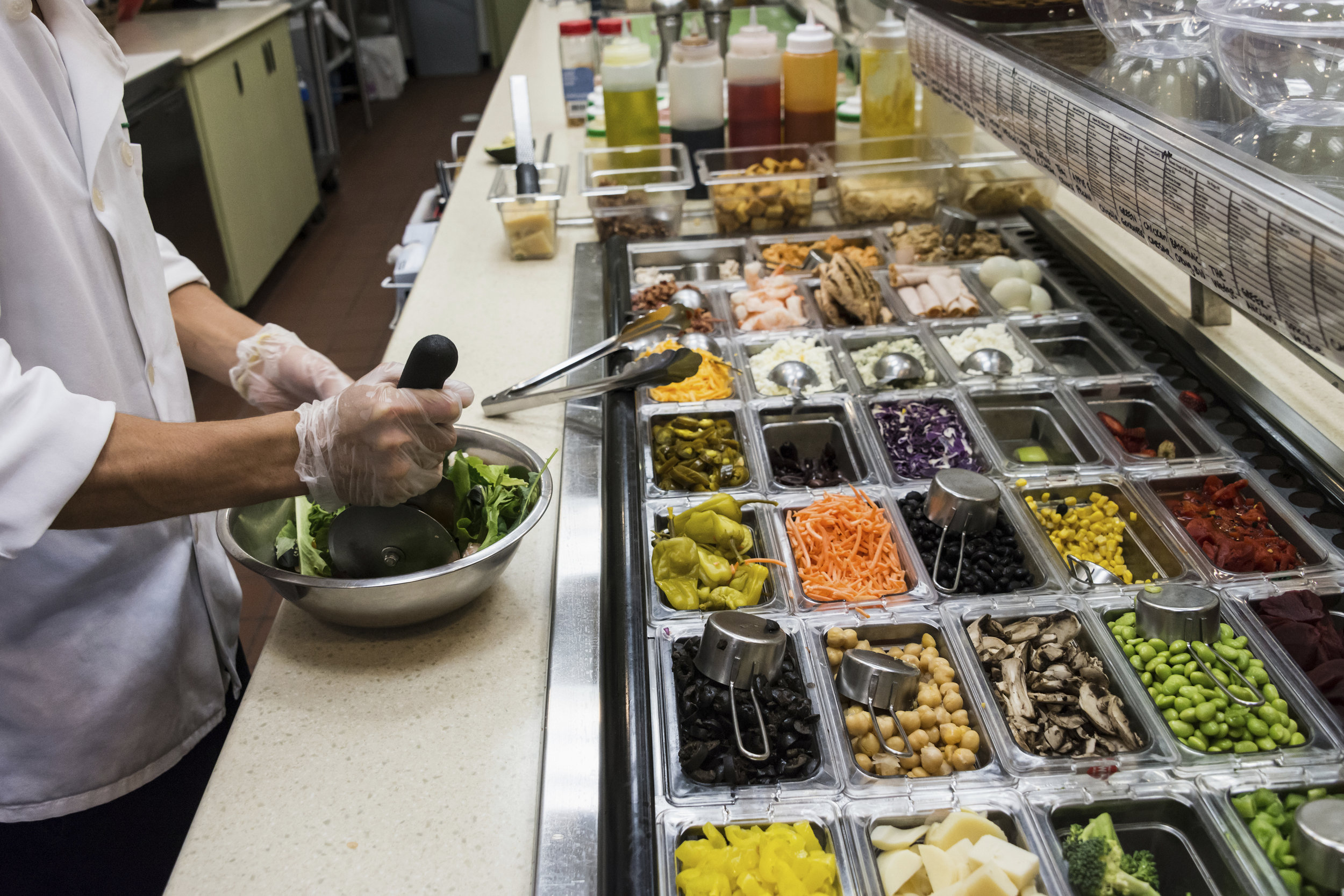
<p>In French this means to “put in place” or “gather,” and describes the concept that everything you will need — such as ingredients, knives, and utensils — should be prepared, set up, organized, and arranged before you begin to work.</p>
5
New cards
<p>Dicing</p>

Dicing

• The procedure used when cutting something into a cube shape

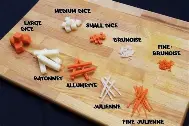
• To properly dice foods to an even dimension, first cut it into even slices. The cut each slice into uniform julienne or bâtonnet shapes.

You would then cut those into uniform cubes. Cut julienne cuts into cubes to form a brunoise cut, and cut bâtonnet shapes into cubes to form a small dice.
<p>• The procedure used when cutting something into a cube shape</p><p>• To properly dice foods to an even dimension, first cut it into even slices. The cut each slice into uniform julienne or <span>bâtonnet shapes.</span></p><p>You would then cut those into uniform cubes. Cut julienne cuts into cubes to form a brunoise cut, and cut bâtonnet shapes into cubes to form a small dice.</p>
6
New cards
<p>Cooking Oil</p>

Cooking Oil

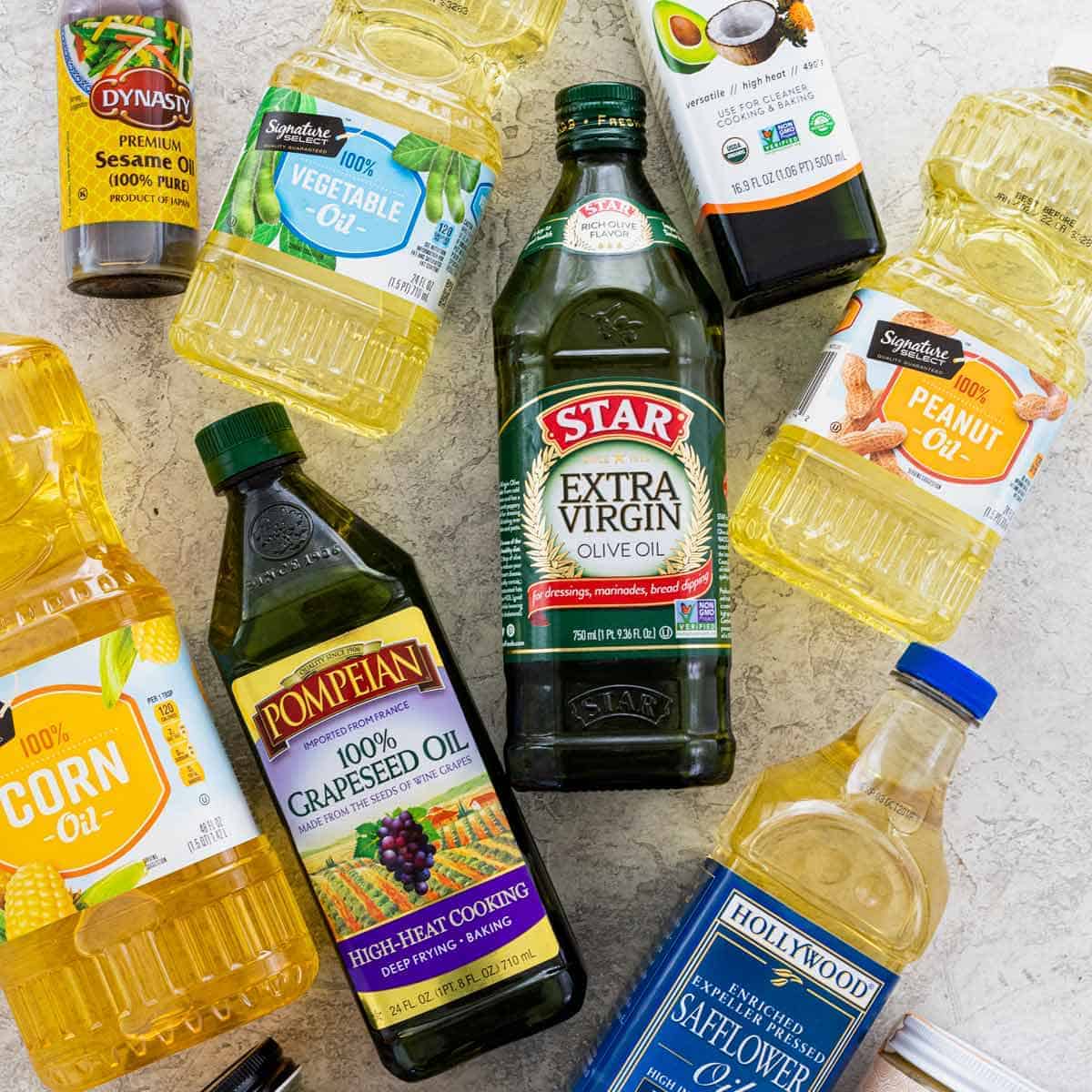
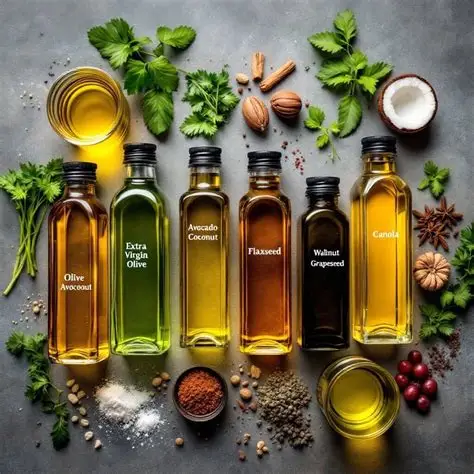
• Is an animal fat, plant, or synthetic origin that is used for cooking.

• Oil can be safely heated to higher temperature than water, which evaporates when it boils over 212°F. Therefore, oil is better able to transfer the heat to the surfaces of ingredients.

• When choosing, consider the cooking method and the temperature to which you must heat the food you are cooking.

• Certain oils can also add color and flavor to the finished dish.

Caring for Cooking Oils When Frying: Make sure to change pans of oil when necessary and ensure that the fryer is kept clean

Be sure to change the fryer oil when it starts to produce off flavors in the food, smells foul, or the color becomes dark and murky.

Foods with high moisture content should be deep fried carefully. Moisture can cause the oil to splatter and splash the cook. Water itself should never be introduced into hot cooking fat.

Serve fried foods immediately after cooking because salt and time soften the crispy finish for which frying is known.
<p>• Is an animal fat, plant, or synthetic origin that is used for cooking.</p><p>• Oil can be safely heated to higher temperature than water, which evaporates when it boils over 212°F. Therefore, oil is better able to transfer the heat to the surfaces of ingredients.</p><p>• When choosing, consider the cooking method and the temperature to which you must heat the food you are cooking.</p><p>• Certain oils can also add color and flavor to the finished dish.</p><p><strong>Caring for Cooking Oils When Frying</strong>: Make sure to change pans of oil when necessary and ensure that the fryer is kept clean</p><p>Be sure to change the fryer oil when it starts to produce off flavors in the food, smells foul, or the color becomes dark and murky.</p><p>Foods with high moisture content should be deep fried carefully. Moisture can cause the oil to splatter and splash the cook. Water itself should never be introduced into hot cooking fat.</p><p>Serve fried foods immediately after cooking because salt and time soften the crispy finish for which frying is known.</p>
7
New cards
<p>Volume</p>

Volume

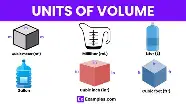
• A unit of measurement used when describing the space something occupies.

• Volume is used to measure liquids.
<p>• A unit of measurement used when describing the space something occupies.</p><p>• Volume is used to measure liquids.</p>
8
New cards
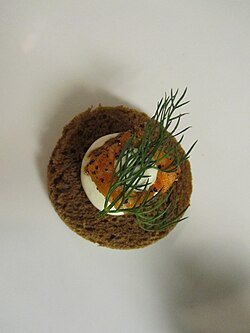
<p><strong>Canapé </strong>— A French word that means “sofa” and is pronounced ‘<span>ka-NA-pay</span>‘</p>

Canapé — A French word that means “sofa” and is pronounced ‘ka-NA-pay

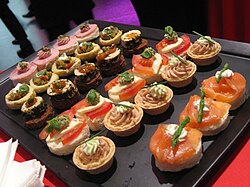
• Named “sofa” because the garnish sits on top of the bread as people do on a sofa.

• A canapé is a type of starter/appetizer, a small, decorative appetizer served on a piece of bread (sometimes toasted) or cracker, wrapped or topped with some savory food.

• Often eaten in 1-2 bites, and may also be referred to as finger food, although not all finger foods are canapés.
<p>• Named “sofa” because the garnish sits on top of the bread as people do on a sofa.</p><p>• A canapé is a type of starter/appetizer, <span>a small, decorative appetizer served on a </span>piece of bread (sometimes toasted) or cracker, wrapped or topped with some savory food.</p><p>• Often eaten in 1-2 bites, and may also be referred to as finger food, although not all finger foods are canapés.</p>