virus classification
 Call Kai
 Learn
Learn Practice Test
 Spaced Repetition
 Match
Match Flashcards
 Knowt Play
1/11

There's no tags or description
Looks like no tags are added yet.
Name | Mastery | Learn | Test | Matching | Spaced | Call with Kai |
|---|
No analytics yet
Send a link to your students to track their progress
12 Terms
baltimore classification
what does it divide according to
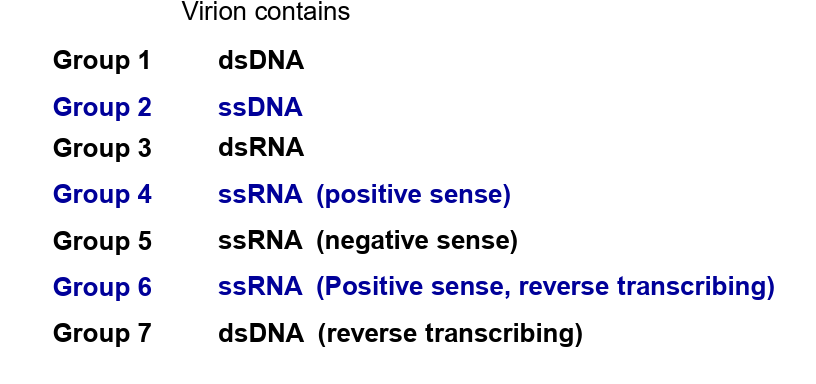
divides all viruses into seven groups according to their mechanism of replication and the type of nucleic acid present in the virion
what is described as the positive sense
the RNA strand (messenger sense)
what must occur before the translation of virus proteins
the genome of negative sense RNA viruses must be copied to make positive sense RNA
what do all RNA viruses replicate via
a double stranded RNA intermediate
but retroviruses are an exception. they use an rna:dna intermediate in their replicaiton instead f dsRNA.
what is the difference in group 3-5 in baltimore
which rna replicative intermediate is present in the virus particle
group 1 replication
the host DNA dependent RNA polymerase can directly bind to the viral dsDNA template to transcribe mRNA
virus uses host DNA dependendent DNA polymerase to make exact copies
group 2 replication
host enzyme converts ss to a dsDNA intermediate
then replication as 1
replication in group 3
virus has RdRp inside which transcribes each genome segment separately
these are used to to synthesise viral proteins and serve as templates for new dsRNA
replication in group 4
acts directly as mRNA
used by host ribosomes to translate viral proteins including rdrp
the newly made rdrp copies the original positive strand to create a complementary negative strand creating a dsDNA intermediate
the negative strand serves as a template to synthesise more positive
replication in group 5
viral RdRp transcribes the negative sense genomic RNA into positive sense mRNA
group 6 replication
virus carries reverse transcriptase whcih synthesises single strand of DNA complementary to the viral RNA
the enzymes ribonuclease activity breaks down the original RNA strand
reverse transcriptase synthesises a second complemenary DNA strand forming dsDNA
replication in group 7 viruses
initial dna genome has a gap in one strand
host enzymes repair te gap to form ciruclar dna
this is transcribed into mRNA