Lecture 8 - Peer interactions and moral reasoning
 Call Kai
 Learn
Learn Practice Test
 Spaced Repetition
 Match
Match Flashcards
 Knowt Play
1/54

There's no tags or description
Looks like no tags are added yet.
Name | Mastery | Learn | Test | Matching | Spaced | Call with Kai |
|---|
No analytics yet
Send a link to your students to track their progress
55 Terms
1-2 years (timeline of peer interactions)
-interact with other babies in friendly, inquisitive way
-watch each other play, engage in pretend play
-play develops from being done in parallel to more co-ordinated
3 years (timeline of peer interactions)
-more co-ordinated play
-role taking
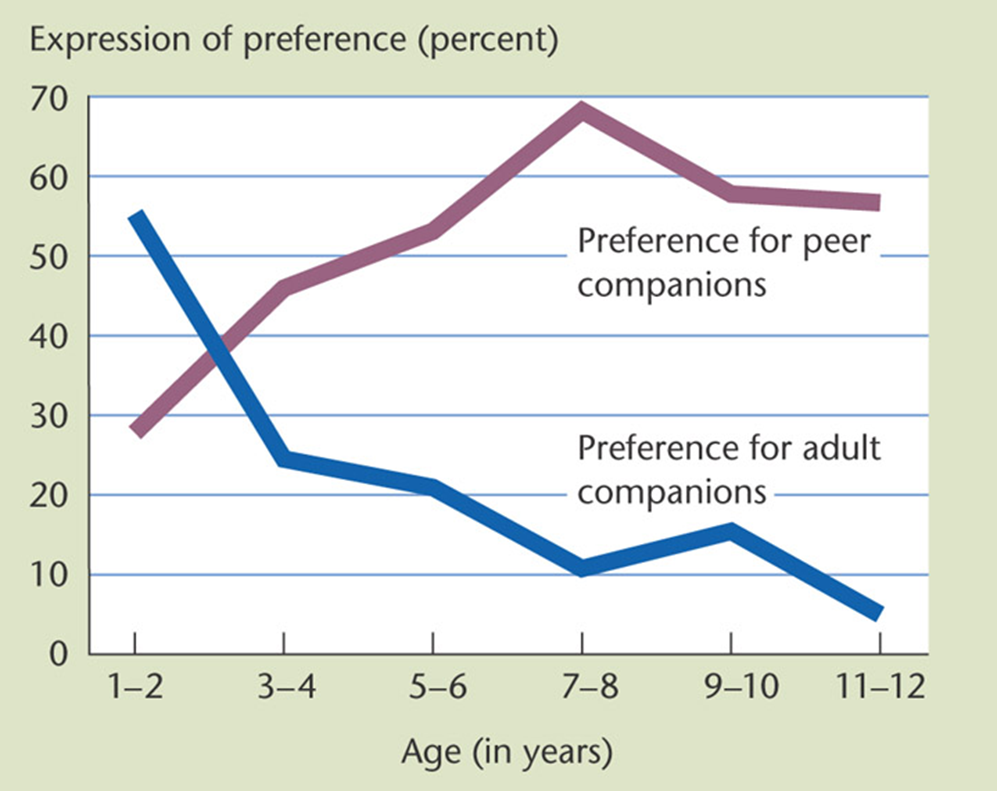
-prefer peer to adult company
6 years (timeline of peer interactions)
-peak in imaginative play
-long play sequences
7 years (timeline of peer interactions)
-stable same gender preference
-expectations of friends develop
11 years (timeline of peer interactions)
-expect deeper foundations to friendship
-emotional support, someone to confide in and not just a play mate
13 years (timeline of peer interactions)
-emergence of cross gender relationships
-further development of conception of friendship
cooperation
-having a joint goal
-different but flexible roles
-commitments to the joint goal
development of cooperation
-1-2 years children become increasingly attuned to cooperative activities and social games
-species-specific to humans
-partner ceases to play child attempts to reengage communicatively
-ability to take a bird’s eye view of interactional scenarios
tube with handles (cooperation tasks)
-child holds handles on tube
-attempts to get adult to holds the handle on the other end
-when this is done tube opens to reach prize inside
double tube (cooperation tasks)
-two tubes
-hold cup at end of tube
-child has to drop ball in correct tube and communicate and work with the adult holding the cup to do this
cooperation as specific to humans
-chimpanzees sometimes perform one or other role in trapdoor task but don’t reengage
-no evidence of shared goals
development of peer preference
-cooperation emerges early and sets the stage for later interactions when infants start to prefer peer interaction
socialising role of peers
-peers have more in common with a child than adults
-influence behaviour by:
modelling behaviours that a child can imitate
reinforcing behaviour
setting benchmarks for a child to compare themselves to → affects self-esteem
peers and ecological systems theory
-interacting with peers affords very different types of learning opportunities compared to caregiver interactions
peer acceptance
-popularity is important to children
-peer status can affect children’s happiness, social development, school attendance and future behaviour and life outcomes
-effect of peer acceptance on a child can be mitigated by close friendships
-peer status tends to be stable over time, even in new groups
sociometric techniques
-categorises children according to their popularity in the classroom
-each child is presented with pictures of all class members and asked to nominate 3 people they like a lot and 3 people they don’t like very much
-each child then scored according to how many people did or didn’t like them
sociometric categories
popular → many positive votes, few negative votes
controversial → many equally positive and negative votes
average → some positive and some negative, roughly equal
neglected → few of either kind of votes
rejected → few positive votes, many negative votes
rejected children
-subcategorised into:
aggressive rejected → poor self-control, behavioural problems, disruptive
nonaggressive rejected → anxious, withdrawn,socially unskilled
factors affecting peer status
-temperament
-personality
-past experiences
-physical appearance
-social skills
social information processing
-largely automatic
-database:
memory store
acquired rules
social schemas
social knowledge
social information processing - steps
encode cues → own thoughts and other’s behaviours
interpret cues → attribute causes, intent, evaluate goal and past performance, evaluate self and others
clarify goals
review possible actions
decide on action → review possible outcomes, evaluate likely response and self-efficacy, select action
act on decision
social information processing - method
-task 1 child watched videos of social interactions involving (1a) peer group entry and (1b) peer provocation
-asked questions relating to each step in a social information processing model
-task2a child assessed on a peer group entry task -> had to join two children who were already playing together
-task 2b child provoked by peer
social information processing - results
-children’s ability on task 1a but not task 1b predicted their ability on task 2a
social information processing - average
-in peer entry task, asked questions, didn’t hover, no conflict, rated a 4 by 2 peers in task
-responded to provocation by crying but did not retaliate aggressively or blame peers
-spent 97% time in solitary appropriate activity, compared to mean of 62% → remainder in positive peer interaction
social information processing - rejected aggressive
-didn’t use presented cues, generated an incompetent response, low enactment skills score
-in peer entry task, hovered, changed physical orientation a lot, displayed numerous disconnected behaviours, incoherent verbalisations, rated 1.5/4
-responded to provocation with insults
-spent 48% time in solitary appropriate activity and 16% of time in antisocial interaction compared to mean of 4%
overcoming rejection
-to want to interact with others
-feel confident in having something to contribute to the group
-to be interested in what others in the group are like
parents’ promotion of peer acceptance
-being first partners with whom their children learn to interact
-creating opportunities for their children to interact with others
-being a role model in social interaction
-talk about social interactions and thereby developing a child’s understanding
-explicitly providing suggestions as to how to behave or advice on a way forward in a specific situation
-building up children’s confidence about their own likeability
examples of parent talk
“if i can sense she wants to get out of a situation but wants to be polite i suggest a way out she could use”
“show her how to make friends rather than fall out all the time, ask to play rather than forcing it , don’t try to be the boss all the time”
“walk out of a situation if feeling of cross before he blows, shouldn’t frighten or hit other children”
teachers’ promotion of peer acceptance
-adult coach can help children to be more accepted by teaching them 3 methods of communication:
asking peers positively toned questions
offering useful suggestions and directions to peers
making supportive statements to peers
-children who did this showed improvements on sociometric measures compared to controls → experimenter not blind to conditions
friends’ protection from peer acceptance
-many children who are unpopular but do have a friend and are contented within that friendship
-this relationship appears to have some protective effect against low peer group acceptance
-others find themselves bullied by supposed friend
morality reasoning
-prescriptive judgements of justice, rights and welfare pertaining to how people ought to relate to each other
moral systems
-interlocking sets of values, norms, practices, identities, institutions and evolved psychological mechanisms that work together to suppress or regulate selfishness and make social life possible
morality
-pluralism → no unifying principle but many values - care, loyalty, purity
-relativism → no one right moral code but many viable alternatives
-morality is product of physical, psychological, cultural and institutional mechanisms
sociobiology (morality and emotions)
-morality is defined by emotive centres of hypothalamic-limbic system
-true for developmentalists like kohlberg and piaget
-only by interpreting the activity of the emotive centres as a biological adaptation can the meaning of the canons can be deciphered
trolley dilema
-trolley headed for 5 people who will be kliled if it proceeds on present course
-only way to save them is to hit a switch that will turn the trolley into an alternate set of tracks to kill 1 person instead
footbridge dilemma
-trolley threatens to kill 5 people
-standing next to fat stranger on footbridge that spans the track in between the trolley and 5 people → only way to save them is to push the stranger off the bridge and kill him
emotion meets reason
-fMRI study suggests effect of emotional engagement on moral reasoning
emotional contagion
-tendency to catch other people’s emotions
-babies cry when they hear other babies crying
-pupillary contagion in adults
mimicry
-tendency to automatically synchronise affective expressions, vocalisations, postures and movements with those of another person
-argued to lead to a causal chain whereby one adopts another’s affective facial expressions and feels the corresponding affective expression oneself
-neonates mimic facial expressions
meltzoff (like me hypothesis)
-human acts are represented within a common code that applies to the self as well as others
-newborns do this in their first interactions with people
-provides an interpretive framework for understanding the behaviour they see
happe
-our empathy for someone is critically affected by how much we identify with them
development of concern for others - method
-1-2 years old
-mothers trained to record children’s responses to the emotions of others over the year long period
-once a week mothers also simulated different emotions and recorded how their children reacted
-at 2 years children attended the research lab and their reactions to simulated emotions were again video recorded
development of concern for others - results
-children made the transition from generally being upset themselves when they saw someone in distress to increasingly attempting to comfort the person by engaging in prosocial behaviours
-by 15 months over 50% has spontaneously responded to another’s distress by engaging in prosocial behaviour
-by 25 months all but one child had done so
-with age children’s repertoire of comforting behaviours expanded to included verbal and physical comforting behaviours
-children sometimes responded to others’ distress with amusement, aggression or indifference
perspective taking and sympathy
-2 year olds can respond to those distressed
-but can they understand how other people are feeling even when their emotions are not visible
-can children infer or imagine what another person must feel given the circumstances and act appropriately
vaish - method (perspective taking and sympathy)
-18-25 month olds played with E1 and E2
-E1 engaged in an activity
-then E2 came along and E1 showed no emotion while E2 either:
harm condition → tore up E1’s picture
control condition → tore up a blank paper
-DV 1 → number of concerned looks made to E1
-later E1 and child played with some balloons, child had 2 balloons and E1 had 1
-DV 2 → number of children who comforted or helped E1
vaish - results (perspective taking and sympathy)
-children in harm condition:
more likely to look at E1 with concern
quicker to look to E1, looked at more and for longer
more likely to help E1 when she lost her balloon
-18 months children show concern for a stranger who is in a hurtful situation but shows no emotion
piaget - stages of moral development
premoral → 0-5, no understanding of moral rules
moral realism → 5-10, rules come from higher authorities, actions are evaluated by their outcomes
moral subjectivism → 10+, rules can be change by mutual consent, intentions are important
kohlberg - stages of moral development
preconventional → 0-9, what is right is what authority figures determine to be right
conventional → 9+, what is right is what is generally accepted by people as right
postconventional → some adults, universal moral principles that can transcend the law/majority view
criticisms of kohlberg
-gender bias
-culture bias → emphasis on western values
-validity of the clinical method of the interview
-idea that can only move upwards from one stage to another and cannot be at two stages simultaneously
-didn’t acknowledge children appreciate distinction between social conventions from moral ones early on
tomasello - stages of moral development
second-personal morality → moral decisions revolve around specific others
agent-neutral morality → moral decisions involve following and enforcing group-wide social norms
-there are numerous cultural influences on the expression of agent-neutral morality e.g., collectivist cultures typically defer to the majority more
tomasello - moral development
-evolutionary and developmental approach
-social interaction drives the development of moral reasoning
-joint then collective intentionality
joint intentionality (tomasello - moral development)
-two agents having a joint goal
-goal is shared and engage in joint attention to coordinate with each other while knowing their own role
collective intentionality (tomasello - moral development)
-moving things to the group level
-taking a more objective, normative, perspective on how things are done and should be done in one’s culture
the role of peers (moral reasoning)
-developmental and evolutionary origins of reasoning are argued to be social
-reasoning skills primarily developed to persuade others with arguments
-children often first get to do this with peers → key context for early moral reasoning
facilitating moral reasoning
-interactions with peers is critical for development
-assessed 7-10 year olds moral reasoning using dilemmas
-then children talked over the situations, engaging in consensus seeking discussion with either a peer or with their mother
-children post-tested for moral reasoning
-peer condition showed greater gains in moral reasoning at post-test
-degree to which the child engaged in reflective discourse correlated positively with moral reasoning