BDS 2 Network approaches
 Call Kai
 Learn
Learn Practice Test
 Spaced Repetition
 Match
Match Flashcards
 Knowt Play
1/12

There's no tags or description
Looks like no tags are added yet.
Name | Mastery | Learn | Test | Matching | Spaced | Call with Kai |
|---|
No analytics yet
Send a link to your students to track their progress
13 Terms
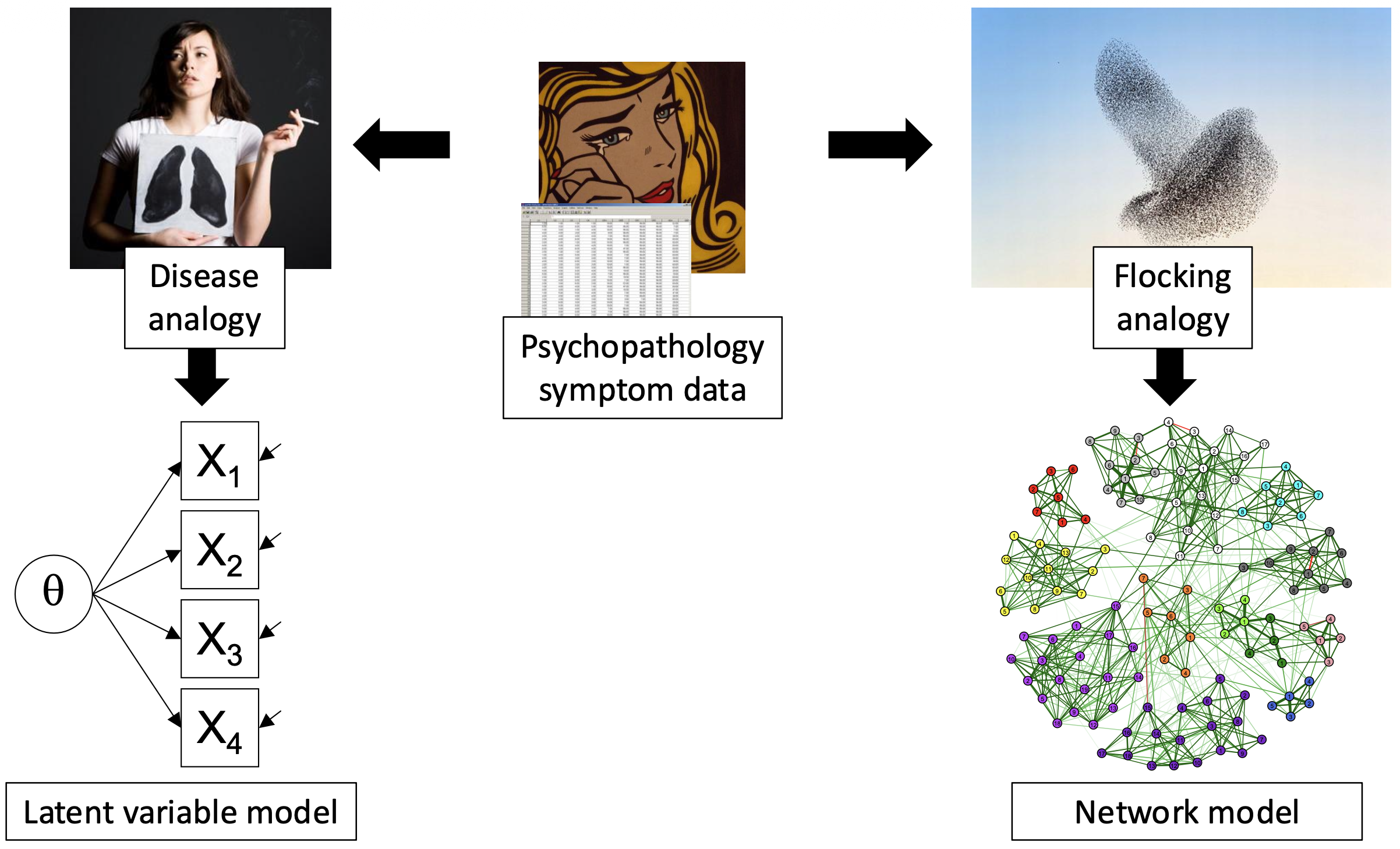
What is the fundamental difference between the latent variable model and the network model of mental disorders?
In the latent variable model, symptoms are passive indicators caused by an underlying disorder (like a disease). In the network model, symptoms are active elements that causally interact with each other — the disorder IS the network of interacting symptoms, not something hidden beneath them.
What is hysteresis, and why is it important for understanding mental disorders?
Hysteresis is when a system requires more force to enter a state than to exit it (or vice versa). In psychopathology, it means the stress needed to push someone INTO a disorder is higher than the stress needed to KEEP them there. This explains why mental disorders persist even after the original stressor is removed.
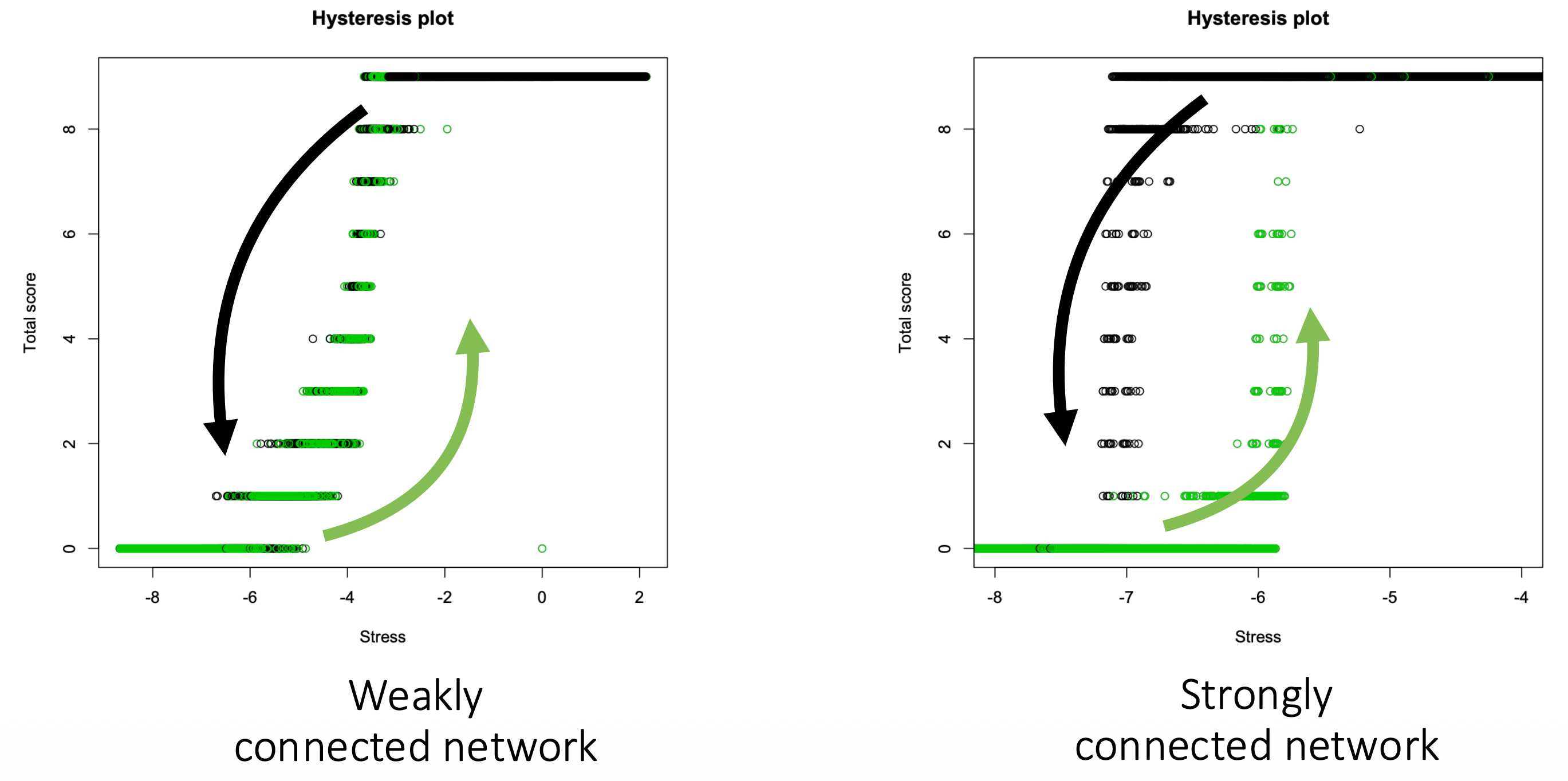
How does network connectivity lead to hysteresis in strongly connected symptom networks?
In a strongly connected network, each activated symptom activates its neighbours (e.g. insomnia → fatigue → low mood → loss of interest → insomnia). Once enough symptoms activate, they mutually sustain each other even without external stress. The network settles into an alternative stable state (the disordered state), making spontaneous recovery hard.
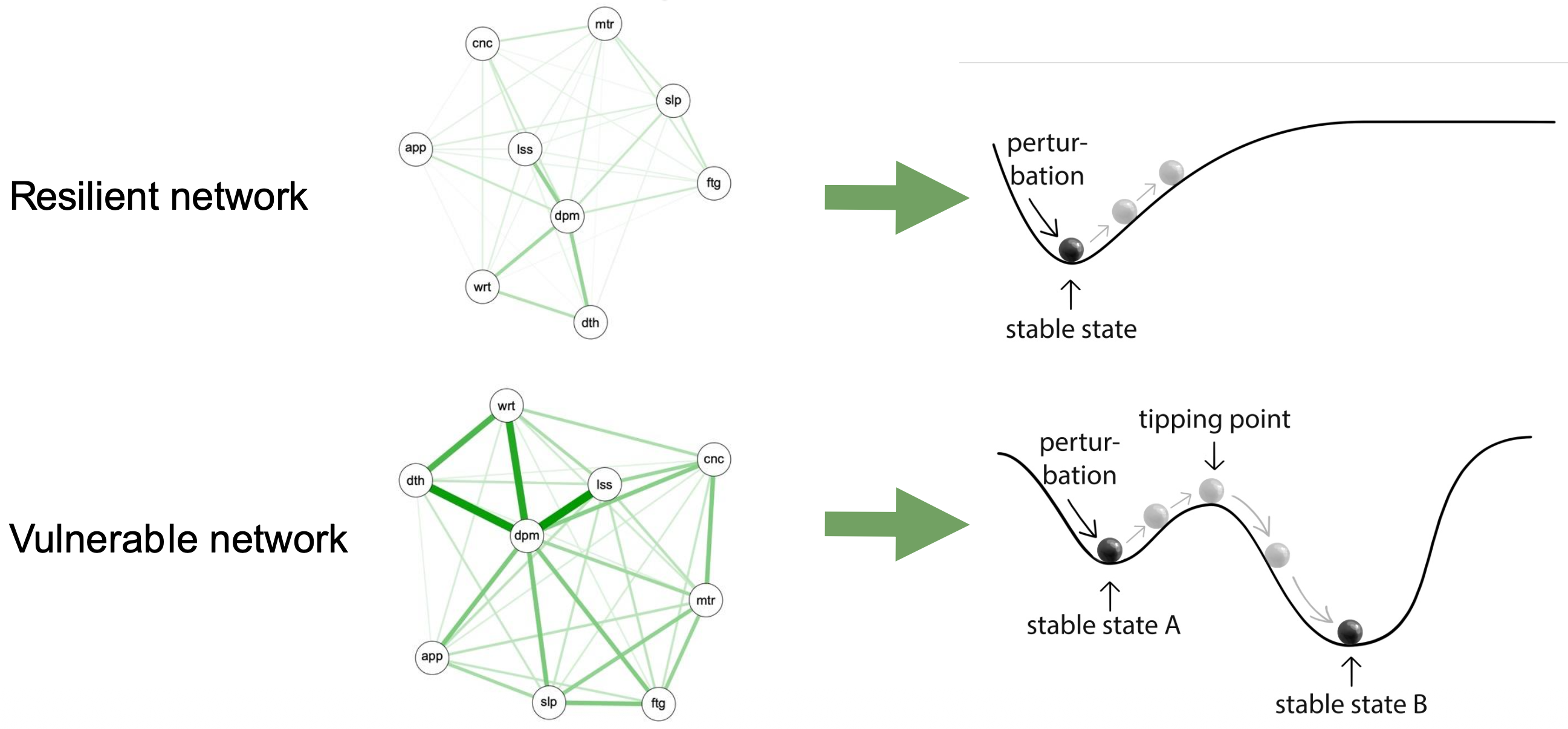
What is a dynamical landscape, and what do the two valleys represent in the context of mental health?
A dynamical landscape (potential landscape) is a metaphor showing stable states as valleys and unstable states as hilltops. For mental health: one valley = healthy state, the other valley = disorder state. The hill between them is the tipping point. A strongly connected (vulnerable) network has two deep valleys; a weakly connected (resilient) network has only one.
What is critical slowing down, and when does it occur relative to a mental health transition?
Critical slowing down occurs BEFORE a transition to an alternative stable state. As the system approaches a tipping point, it recovers more slowly from small perturbations. Mathematically, the state at time t becomes a stronger predictor of state at t+1 (increased autoregression). It is a potential early warning signal for an oncoming depressive episode.
What distinguishes a resilient network from a vulnerable network in Borsboom's framework?
A resilient (weakly connected) network has weak inter-symptom connections: perturbations fade and the system returns to the healthy state spontaneously. A vulnerable (strongly connected) network has strong connections: the system can tip over a threshold and get stuck in the disorder state even after the stressor is removed — this is hysteresis.
What is the eLasso algorithm and what does it estimate?
eLasso (van Borkulo et al., 2014) estimates a psychometric network from data using regularised logistic regressions. Each variable is regressed on all others; a LASSO penalty shrinks weak connections to zero. When two variables predict each other (are in each other's neighbourhood), an edge is drawn. It was the first method designed to fit symptom networks for binary data.
In a psychometric network, what do nodes and edges represent?
Nodes are observed variables (symptoms, e.g. depressed mood, fatigue, insomnia). Edges are conditional associations — the relationship between two symptoms after controlling for all other symptoms in the network. A thicker edge means a stronger unique relationship between two symptoms.
What is Network Intervention Analysis (NIA) and how does it use network models clinically?
NIA uses estimated symptom networks to identify treatment targets. The most central (strongly connected) nodes are targeted first, because intervening on them propagates change through the network. For example, in co-occurring insomnia and depression, treating insomnia (a bridge symptom) can cascade positive effects to depressive symptoms (Blanken et al., 2019).
What is experience sampling methodology (ESM) and what kind of network does it allow researchers to build?
ESM involves asking participants to report their symptoms multiple times per day via phone. This yields time-series data for an individual. Using VAR (vector autoregressive) models on these data, researchers can build a within-person temporal network showing which symptoms predict which other symptoms over time for that specific person (Bringmann et al., 2013).
Name three open criticisms or methodological challenges to the psychometric network approach.
1. Centrality metrics may lack clear psychological interpretation (Bringmann et al., 2016).
2. Reproducibility: networks estimated from different samples can look very different (Forbes et al., 2017).
3. Ergodicity problem: between-person networks may not reflect within-person dynamics (Bos et al., 2017). Other issues include boundary specification and distinguishing absent edges from undetected ones.
Give a real-world analogy for hysteresis outside of psychopathology.
(1) Deforestation — removing trees tips an ecosystem into dry savanna; restoring rainfall alone won't bring the forest back.
(2) Smoking addiction — far more sustained effort is needed to quit than was needed to start the habit.
(3) Supercooled water — stays liquid below 0°C until disturbed, then freezes rapidly and won't melt until temperatures rise again. The key pattern: asymmetric force needed to enter vs. exit a state.
What is the difference between a Weakly and stronly connected network?
Weakly connected networks are resilient and show spontaneous recovery
Strongly connected networks are vulnerable and display hysteresis
This suggests that mental disorders could arise as alternative stable states of networks