Ionisation energy
 Call Kai
 Learn
Learn Practice Test
 Spaced Repetition
 Match
Match Flashcards
 Knowt Play
1/8

There's no tags or description
Looks like no tags are added yet.
Name | Mastery | Learn | Test | Matching | Spaced | Call with Kai |
|---|
No analytics yet
Send a link to your students to track their progress
9 Terms
What is first ionisation energy and write an equation
Energy required to remove one electron from each atom of one mole of gaseous atoms of an element to form one mole of gaseous 1+ ions
He(g)→He(g)1+ + e-
What is second ionisation energy and write an equation
Energy required to remove one electron from each ion of one mole of gaseous 1+ ions of an element to form one mole of 2+ ion
He(g)1+→ He(g)2+ + e-
What factors affect ionisation energy
Nuclear charge
Atomic radius
Electron shielding
Why does ionisation energy increase for successive electrons
After each electron is removed, the atom becomes a positive ion or more positive, the remaining electrons are pulled closer due to the same nuclear charge, reduced shielding and radius, so more energy is required to remove the next electron.
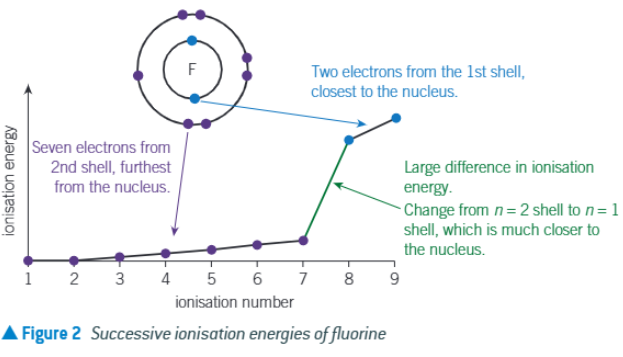
How can you use a graph such as this to predict group of an element and no. shells
There is a large increase in ionisation energy from seventh and eighth ionisation energy so we know that fluorine has 7 outer electrons and number of electrons left is 2 so we also know fluorine only has 2 shells. Therefore it is group 2.
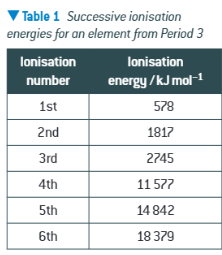
How can you use an ionisation table such as this one to find unknown element
We know element is in period 3, and there is a large increase in ionisation energy between 3 and 4 so we can conclude it is in group 3 so is aluminium
What is the general trend in first ionisation energy across a period
Ionisation energy increases, this is because number of protons increase so higher nuclear charge and electron shielding stays around the same as electrons added to same shell, so outer electrons pulled is stronger so more energy needed to remove electrons so ionisation energy increases
Why is there a drop in first ionisation in period 2 from beryllium to boron and from nitrogen to oxygen
Fall in ionisation from Be to B marks the the start of the filling of the 2p sub-shell. The 2p sub-shell has a higher energy than the 2s sub-shell so is held further away from nucleus so less electrostatic attraction between electron in 2p sub shell so is easier to remove so first ionisation energy of B is lower than Be
Falls in ionisation from N to O marks the start of electron pairing in p-orbitals of p sub-shell. In N and O the highest energy electrons are in the p sub-shell but in O there is a paired electron in one orbital and repulsion between paired electrons makes it easier to remove an electron so first ionisation energy of O is lower than N
note:
These drops occur n the same spot in period 3 so between magnesium and aluminium also between phosphorus and sulphur
What is the general trend in first ionisation energy down a group
Ionisation energy decreases, this is because electron shielding increases as there are more electron shells so more inner electrons which cause shielding, atomic radius also increases so outer electrons pulled is weak so less energy needed to remove outer electrons so ionisation energy decreases